
Items related to Shadow and Light: A Novel
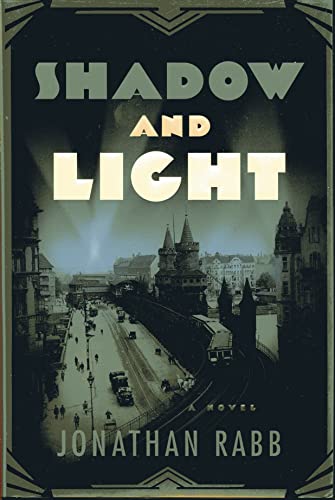
Synopsis
Berlin, between the two world wars. When an executive at the renowned Ufa film studios is found dead floating in his office bathtub, it falls to Nikolai Hoffner, a chief inspector in the Kriminalpolizei, to investigate. With the help of Fritz Lang (the German director) and Alby Pimm (leader of the most powerful crime syndicate in Berlin), Hoffner finds his case taking him beyond the world of film and into the far more treacherous landscape of Berlin’s sex and drug trade, the rise of Hitler’s Brownshirts (the SA), and the even more astonishing attempts by onetime monarchists to rearm a post-Versailles Germany. Being swept up in the case are Hoffner’s new lover, an American talent agent for Metro-Goldwyn-Mayer, and his two sons: Georg, who has dropped out of school to work at Ufa, and Sascha, his angry, older son, who, unknown to his father, has become fully entrenched in the new German Workers Party as the aide to its Berlin leader, Joseph Goebbels. What a spellbinding novel Shadow and Light is, and what a novelist Jonathan Rabb has become! When we last met Hoffner, it was 1919, and he had taken on the disappearance and death of Rosa Luxembourg in Rosa, a novel the critic John Leonard hailed as “a ghostly noir that could have been conspired at by Raymond Chandler and André Malraux.” Shadow and Light is equally brilliant and atmospheric, and even harder to put down or shake off. Like Joseph Kanon or Alan Furst, Rabb magically fuses a smart, energetic narrative with layers of fascinating, vividly documented history. The result is a stunning historical thriller, created by a writer to celebrate—and contend with.
"synopsis" may belong to another edition of this title.
About the Author
Jonathan Rabb is the author of three previous novels: Rosa, The Overseer, and The Book of Q. He lives in New York with his wife and two children.
Reviews
From The Washington Post's Book World/washingtonpost.com Reviewed by Wendy Smith Atmosphere is all in Jonathan Rabb's brooding new mystery, the second in his Berlin trilogy that began in 2005 with "Rosa." When Inspector Nikolai Hoffner arrives at the Ufa film studios in February 1927 to probe the suicide of producer Gerhard Thyssen, readers can be sure of three things: (1) The suicide will turn out to be murder. (2) The inspector will track the killers into Berlin's seamiest quarters. (3) The clouds of political and sexual corruption hanging over Weimar Germany will darken. Hoffner has heard of the National Socialists making trouble "somewhere in the south," but their appearance on the national stage in Berlin proves to be a central thread in the web of sex, drugs and dirty corporate deals that he slowly picks apart in the wake of the producer's death. Thyssen was sleeping with an Ufa starlet named Ingrid Volker, who has vanished, but in her apartment Hoffner meets Helen Coyle, an American talent agent who claims Metro-Goldwyn-Mayer sent her to Berlin to sign Volker to an American contract. The pair follow the starlet's trail to a sex club containing a secret chamber where people have been filming some very ugly porn. Hoffner flicks the switch on a projector and sees a vicious rape scene, but the most shocking element isn't the visuals; it's the victim's scream echoing around the room. Eight months before the release of "The Jazz Singer," someone has figured out how to record sound on film -- not on a separate disc that can get out of sync with the movie, but on the film itself. Thyssen was in charge of that top-secret development, but now he's dead, the device marrying pictures to sound has disappeared, and everyone is looking for it, including the real-life star director of the Ufa studio, Fritz Lang. Meanwhile, Hoffner is such a neglectful father that he doesn't even know 16-year-old Georg has dropped out of school until he stumbles across his son working at the Ufa studio. And it's been eight years since Hoffner has seen Georg's older brother, but soon enough Sascha too turns up -- at a right-wing rally led by Joseph Goebbels. Rabb's brilliantly plotted narrative leads his detective past dead ends and red herrings to the discovery that much more is at stake than just control of the latest movie technology. Both Coyle and Sascha are deeply embroiled in the conspiracies Hoffner uncovers; only Georg's inexplicable decency and intelligence offer a faint glimmer of comfort for his father, awash in Weltschmerz and self-loathing. Rabb never strays far from the conventions of hardboiled fiction in his depiction of a sordid society whose worst criminals go unpunished, but he relocates the genre from the mean streets of urban America to the shady byways of a European metropolis soon to be engulfed by evil well beyond the aspirations of crooked cops and venal politicians. A grim early scene in "Shadow and Light" -- when Hoffner visits his dying, unforgiving mother in an old-age home for Russian Jews -- foretells that things can only get worse in the final volume of this projected trilogy. Rabb writes so well and the mood he creates is so haunting that occasional lapses into noir cliches -- a femme fatale whose betrayals grow steadily more predictable, the inevitable confrontation with an untouchable bigwig -- are more jarring than they would be in a less accomplished novel. Given the psychological and political landmines he's skillfully planted for Hoffner all over Berlin, however, we can expect some spectacular explosions when next we meet Rabb's wounded detective in his beloved, battered city.
Copyright 2009, The Washington Post. All Rights Reserved.
Starred Review. Set in 1927 Germany, Rabb's superb sequel to Rosa correlates the advent of talking movies with the rise of Nazism. When Kriminal-Oberkommisar Nikolai Hoffner investigates the apparent suicide of an Ufa film studio executive, the trail leads the Berlin policeman to the sex and drug trade as well as to the National Socialist German Workers Party's local leader, Joseph Goebbels. Working with Helen Coyle, an attractive American talent agent for MGM, Hoffner learns how cutthroat the picture business is. Rumors of films with sound threaten to change the industry. Without sound, all you have is shadow and light, an inventor tells Hoffner. With sound, movies can do a lot more than entertain, as soon to be shown by Nazi propaganda films and newsreels. Rabb's meticulous research brings to life a corrupt society vulnerable to extremism. Well-conceived cameos by director Fritz Lang and actor Peter Lorre add to the intrigue. Author tour. (Apr.)
Copyright © Reed Business Information, a division of Reed Elsevier Inc. All rights reserved.
*Starred Review* Nazi noir is hot, what with Philip Kerr’s A Quiet Flame, Rebecca Cantrell’s A Trace of Smoke, and Rabb’s second Chief Inspector Nikolai Hoffner novel all appearing between March and May. Technically, these three novels should be called Weimar noir, as they all focus either entirely or partially on the years between the wars, when the Weimar Republic was hanging by a thread and Hitler’s brownshirts were gathering steam. In 1927, Hoffner is called to the movie studio Ufa to rubber-stamp the suicide of an executive. Except that it’s clearly murder, and Hoffner can’t help poking around. What he finds is a plot of Chandlerian complexity. It starts with a new invention to synchronize sound and action on film, but that’s really a McGuffin of sorts, leading Hoffner to the brownshirts and a plan to rearm Germany. Rabb keeps both balls in the air effectively, introducing a host of real-life figures (Josef Goebbels and legendary director Fritz Lang among them) and dallying with subplots involving Hoffner’s sons (one a brownshirt) and the inspector’s romance with an MGM talent scout, also in search of the sound device. There’s plenty of Weimar decadence on view here, but it’s the fascinating slice of film history overlaid with a sense of the gathering storm that gives the novel its punch. That and Hoffner himself, a noir hero in every way, from his unquenchable thirst for potables to the inevitability with which he finds himself caught in the riptide of history. --Bill Ott
Excerpt. © Reprinted by permission. All rights reserved.
Chapter One
1927
They say it is rare to have good reason to leave Berlin. In the summer you have Wannsee, where the beaches are powdered and cool, and where for a few pfennigs even a clerk and his girl can manage a cabana for the day. The cold months bring the Ice Palast up near the Oranienburger Gate, or a quick trip out to Luna Park for the rides and amusements, where a bit of cocoa and schnapps can keep a family warm for the duration. And always there is that thickness of life in the east, where whiskey (if you're lucky) and flesh (if not too old) play back and forth in a careless game of half-conscious decay. No reason, then, to leave the city with so much to keep a hand occupied.
And yet she was empty—not truly empty, of course, but thin to the point of concern. A phenomenon had descended on Berlin in early February, something no one could control or predict. Naturally they could explain it, but only in the language of high science and complexity. For the rest, it was simply Weisserhimmel—white sky—days on end of a too-bright sun without the sense to generate a trace of heat. Every forty years or so, it ca as a faint reminder of the city's Nordic past, but history was not what Berliners chose to see. They were unnerved, their world made too clear, and so they left: businesses took unexpected holidays, schools indefinite recesses. It would all pass in a few days' time, but in the meanwhile, only the stalwarts were keeping the city alive.
Still, a few hours on the outskirts of town could do wonders. The sun might have been no less forgiving, but at least the surroundings were unfamiliar for a reason. Nonetheless, Nikolai Hoffner continued to glance into his rearview mirror as he drove. The Berlin he saw seemed compressed, small, her reflection strangely misleading. Even distance was doing little to help. He knew it best not to stare.
Instead, he opened his mouth wide and chanced a look at his teeth; they seemed to shake with the car's motion. The tooth, he had been told, would have to come out. Funny, but it didn't look all that different from the others, a bit thick, crooked, yellowed by tobacco. Hoffner had little faith in doctors, but he believed in pain, and that was enough. He was meant to rub some sort of ointment on his gums every few hours, at least until he could make time for an appointment. He was finding a brandy worked just as well.
The road to Neubabelsberg—the new road to Neubabelsberg—was straight and smooth, and for the price of a few pfennigs had you out to the film studios in less than half an hour. Someone had had the brilliant idea that Berlin needed a racing circuit, an asphalt totem to Mercedes and Daimler and Cadillac—although no one spoke of Cadillac—that ripped through the satiny pine needles and heavenly green leaves of the Grunwald. There had always been something of an escape when it came to the woods and lakes and beaches of the great, untamed forest. Now even that was gone, or going, eighteen kilometers uninterrupted. It seemed to dull everything.
With a quick press of the accelerator, Hoffner decided to test the old car. The exhaust roared and a hum rose as the rubber tires heated on the road. That was always the trick: to smell when they had reached their limit. These had the tang of disarmament surplus, the good military stuff that appeared now and then from some unknown warehouse. Everyone knew not to ask.
A big Buick hooted angrily from behind, and Hoffner checked his mirror again: the car had come from nowhere. He waved the driver on and watched as first the radiator, then the cabin, raced by. The Kriminalpolizei had yet to invest in speed. It would take something else to catch the criminals.
There was a sudden thud to his undercarriage—a parting gift from the Buick—and Hoffner waited for the agonizing scrape of metal on asphalt, but none came. Still, there might have been a puncture, or something wedged in where it wasn't meant to be. Not that Hoffner knew anything about a car's tending-to, but he reckoned he should take a look. After all, he would need a bit of grease on his face and hands to show at least some effort to the boy they would be sending out to tow him.
He brought the car down onto the grass and reached over for the two yellow flags he kept in the glove compartment. It was a pointless exercise—six meters in front, six meters behind—but someone had taken great pains to devise die Verkehrsnotverfahren (emergency traffic procedures), the totality of which filled a full eight pages in the bureau's slender handbook on automobile operation: Who was he to question their essentialness? The flags blew aimless warning to the deserted road as Hoffner lay on his back and pulled himself under.
Surprisingly, everything looked to be in working order. Various metal shafts stretched across at odd angles. Metal boxes to hold other metal things were bolted to iron casings, and while there were two or three wires hanging down from their protective covers—each wrapped in some sort of black adhesive—nothing appeared to be torn or strained or even mildly put out. The wood above was worn but whole, and the tires looked somehow thicker from this vantage point. Hoffner imagined much the same might have been said of his own fifty-three-year-old frame: shoulders still wide even if the barrel chest was relocating south with ever-increasing speed. He caught sight of a line of blurred handwriting on one of the tires and slowly inched his way over. Closer in, the scrawl became Frankreich, Süd, 26117-7-6, Vichy.
Hoffner smiled. These had been slated for reparations, not surplus, and yet somehow—just somehow—they had failed to make it across the border. In fact, very little these days was making it to the French or English or Belgians or Italians—how the Italians had managed to get in on the spoils, having sided with the Kaiser up through 1915, still puzzled him—except, of course, for the great waves of money. There, things were decidedly different. The French might have been willing to turn a blind eye to a few tires ending up in the service of Berlin's police corps, but if so much as a single pfennig of repayments, or interest on repayments, or interest on the loans taken out to pay for the interest on those repayments went missing, then came the cries from Paris for the occupation of the Rhine and beyond. It was a constant plea in the papers from the ever-teetering Social Democrats to keep our new allies happy, keep the payments flowing out, no matter how many times the mark had to be revalued or devalued or carted around like so many reams of waste tissue just to pay for a bit of bread. Luckily, the worst of it was behind them now, or so said those same papers: who cared if Versailles and its treaty were beginning to prompt some rather unpleasant responses from points far right? Odd, but Hoffner had always thought Vichy in the north.
He slid out, planted himself on the running board, and flipped open his flask. The Hungarians, thank God, had remained loyal to the Kaiser up to the bitter end: little chance, then, of a shortage on slivovitz anytime soon. He took a swig of the brandy and stared out into the green wood as a familiar burning settled in at the back of his throat. A trio of wild boar was digging up the ground no more than twenty meters off. They were a dark brown, and their haunches looked fat and muscular. These had done well to keep the meat on during the winter. The smallest turned and cocked its head as it stared back. No hint of fear, it stood unwavering. Clearly, it knew it was notits place to cede ground. Hoffner marveled at the misguided certainty.
He tossed back a second drink just as a goose-squawk horn rang out from the road. Hoffner turned to see a prewar delivery truck pulling up, its open back packed with small glass canisters, each filled with some sort of blue liquid. Hoffner wondered if perhaps he might have failed to hear about an imminent hair tonic shortage, but the man who stepped from the cab quickly put all such concerns to rest. He was perfectly bald, with a few stray wisps of black matted down above the ears. Hoffner stood as he approached.
" 'Twenty-two Opel?" The man spoke with an easy authority. "They'll give you a bit of trouble on a road like this."
Hoffner nodded, although he couldn't remember whether the car was a '21 or a '22. "I thought I'd caught something underneath," he said. "Didn't see anything."
"High frame," said the man. "Not meant for these speeds."
"You know your cars, then?"
"I take an interest. So nothing up in the housing?"
Hoffner motioned to the car. "You're welcome to take a look."
The man stepped over, released the catch on the metal bonnet, and raised it. "You keep it well." He leaned in and jiggled a few bits and pieces.
"Yes," said Hoffner, never having once opened the thing up himself. He noticed the baby boar still watching them. "Cigarette?"
The man stood upright and refastened the bonnet. "Very kind."
"I'm the one who should be thanking you."
...
"About this title" may belong to another edition of this title.
Search results for Shadow and Light: A Novel

Stock Image
Shadow and Light: A Novel
Published by
Farrar, Straus and Giroux, 2009
ISBN 10: 0374261946
ISBN 13: 9780374261948
Used
Hardcover
Seller: World of Books (was SecondSale), Montgomery, IL, U.S.A.
Seller rating 5 out of 5 stars

Condition: Good. Good condition ex-library book with usual library markings and stickers. Seller Inventory # 00100197808
Stock Image
Shadow and Light: A Novel
Published by
Farrar, Straus and Giroux, 2009
ISBN 10: 0374261946
ISBN 13: 9780374261948
Used
Hardcover
Seller: World of Books (was SecondSale), Montgomery, IL, U.S.A.
Seller rating 5 out of 5 stars
Condition: Very Good. Item in very good condition! Textbooks may not include supplemental items i.e. CDs, access codes etc. Seller Inventory # 00101621960
Stock Image
Shadow and Light: A Novel
Published by
Farrar, Straus and Giroux, 2009
ISBN 10: 0374261946
ISBN 13: 9780374261948
Used
Hardcover
Seller: Once Upon A Time Books, Siloam Springs, AR, U.S.A.
Seller rating 4 out of 5 stars

hardcover. Condition: Acceptable. This is a used book. It may contain highlighting/underlining and/or the book may show heavier signs of wear . It may also be ex-library or without dustjacket. This is a used book. It may contain highlighting/underlining and/or the book may show heavier signs of wear . It may also be ex-library or without dustjacket. Seller Inventory # mon0001158004
Stock Image
Shadow and Light: A Novel
Published by
Farrar, Straus and Giroux, 2009
ISBN 10: 0374261946
ISBN 13: 9780374261948
Used
Hardcover
Seller: ThriftBooks-Atlanta, AUSTELL, GA, U.S.A.
Seller rating 5 out of 5 stars
Hardcover. Condition: Good. No Jacket. Missing dust jacket; Pages can have notes/highlighting. Spine may show signs of wear. ~ ThriftBooks: Read More, Spend Less. Seller Inventory # G0374261946I3N01
Stock Image
Shadow and Light: A Novel
Published by
Farrar, Straus and Giroux, 2009
ISBN 10: 0374261946
ISBN 13: 9780374261948
Used
Hardcover
Seller: ThriftBooks-Atlanta, AUSTELL, GA, U.S.A.
Seller rating 5 out of 5 stars
Hardcover. Condition: Very Good. No Jacket. Former library book; May have limited writing in cover pages. Pages are unmarked. ~ ThriftBooks: Read More, Spend Less. Seller Inventory # G0374261946I4N10
Stock Image
Shadow and Light: A Novel
Published by
Farrar, Straus and Giroux, 2009
ISBN 10: 0374261946
ISBN 13: 9780374261948
Used
Hardcover
Seller: ThriftBooks-Dallas, Dallas, TX, U.S.A.
Seller rating 5 out of 5 stars
Hardcover. Condition: Good. No Jacket. Pages can have notes/highlighting. Spine may show signs of wear. ~ ThriftBooks: Read More, Spend Less. Seller Inventory # G0374261946I3N00
Stock Image
Shadow and Light: A Novel
Published by
Farrar, Straus and Giroux, 2009
ISBN 10: 0374261946
ISBN 13: 9780374261948
Used
Hardcover
Seller: ThriftBooks-Atlanta, AUSTELL, GA, U.S.A.
Seller rating 5 out of 5 stars
Hardcover. Condition: Good. No Jacket. Former library book; Pages can have notes/highlighting. Spine may show signs of wear. ~ ThriftBooks: Read More, Spend Less. Seller Inventory # G0374261946I3N10
Stock Image
Shadow and Light: A Novel
Published by
Farrar, Straus and Giroux (edition First Edition), 2009
ISBN 10: 0374261946
ISBN 13: 9780374261948
Used
Hardcover
First Edition
Seller: BooksRun, Philadelphia, PA, U.S.A.
Seller rating 5 out of 5 stars
Hardcover. Condition: Fair. First Edition. With dust jacket. The item might be beaten up but readable. May contain markings or highlighting, as well as stains, bent corners, or any other major defect, but the text is not obscured in any way. Seller Inventory # 0374261946-7-1-29
Stock Image
Shadow and Light
Published by
Farrar, Straus & Giroux, 2009
ISBN 10: 0374261946
ISBN 13: 9780374261948
Used
Hardcover
First Edition
Seller: Better World Books: West, Reno, NV, U.S.A.
Seller rating 5 out of 5 stars
Condition: Very Good. First Edition. Former library copy. Pages intact with possible writing/highlighting. Binding strong with minor wear. Dust jackets/supplements may not be included. Includes library markings. Stock photo provided. Product includes identifying sticker. Better World Books: Buy Books. Do Good. Seller Inventory # 468312-6
Stock Image
Shadow and Light
Published by
Farrar, Straus & Giroux, 2009
ISBN 10: 0374261946
ISBN 13: 9780374261948
Used
Hardcover
First Edition
Seller: Better World Books, Mishawaka, IN, U.S.A.
Seller rating 5 out of 5 stars
Condition: Good. First Edition. Former library copy. Pages intact with minimal writing/highlighting. The binding may be loose and creased. Dust jackets/supplements are not included. Includes library markings. Stock photo provided. Product includes identifying sticker. Better World Books: Buy Books. Do Good. Seller Inventory # 6374465-6