
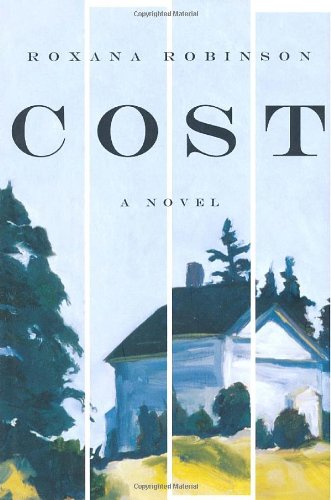
Items related to Cost: A Novel
Synopsis
THE LUMINOUS AND GRIPPING NEW NOVEL FROM “ONE OF OUR BEST WRITERS” (JONATHAN YARDLEY, THE WASHINGTON POST)
"synopsis" may belong to another edition of this title.
About the Author
Roxana Robinson is the author of three earlier novels and three short-story collections, as well as a biography of Georgia O’Keeffe. Four of these were named Notable Books of the Year by The New York Times. Her work has appeared in The New Yorker, The Atlantic, Harper’s Magazine, The New York Times, Best American Short Stories, and Vogue, among other publications. She has received fellowships from the Guggenheim Foundation, the National Endowment for the Arts, and the MacDowell Colony. She teaches at the New School in New York.
Reviews
Ambitious and wholly mesmerizing, Cost explores all angles of a family’s raw, messy tragedy. With profound analysis into each member’s different fears, anxieties, and relationships with each other, Robinson probes deeply into their souls and exposes heroin addiction’s devastating effects. Reviewers agreed that while the plot is strong and authentic, the author’s exceptionally well-drawn charactersâ€"particularly Julia, her gentle mother, and the rehab counselorâ€"carry the novel. The only point of contention seemed to be the omniscient narration. While most critics praised this device, others felt the changes in perspective were too abrupt and the characters’ voices too repetitive. Still, this is a minor flaw; Cost is a sensitive, compassionate, and beautifully written portrayal of a dysfunctional family.
Copyright © 2004 Phillips & Nelson Media, Inc.
Julia Lambert is a New York art professor spending the summer in Maine with her elderly father, a domineering neurosurgeon, and mother, a gentle soul succumbing to Alzheimer's. Julia's oldest son, Steven, joins the clan as tragic news surfaces: her second son, Jack, is addicted to heroin. Ex-husband Wendell, Julia's distant sister Harriet and Jack himself soon arrive, and intervention is on the agenda. Jack refuses to go quietly, and Robinson, who has worked in multiple genres (including penning a biography of Georgia O'Keeffe), engulfs the clan in a sea of resentment and repressed hostility, spiked with the intermittent need to feel close. Her unrelenting look at the deep physical and mental distress involved in heroin abuse is not for the faint of heart, with key portions of the drama unfolding through descriptions of Jack's perpetually itching skin, twitching muscles, heaving stomach, needle-tracked arms and addled brain. While the omniscient narration sometimes loses focus, Robinson offers adept closeups of family trauma. (June)
Copyright © Reed Business Information, a division of Reed Elsevier Inc. All rights reserved.
Robinson’s fourth novel is an engrossing tale of a patrician family’s unravelling during a summer in Maine. Julia Lambert is a divorced artist, trying to entertain her oppressive, former neurosurgeon father (he points out everything that’s wrong with his daughter’s run-down cabin) and her self-effacing mother, who is in the early stages of Alzheimer’s. Julia’s elder son suspects that his younger brother, Jack, is a heroin addict, and when this turns out to be true an intervention is staged. The family’s ugly, dysfunctional history pours out in the process, in sharp contrast with the halcyon setting. Robinson moves nimbly among the numerous characters’ mind-sets, and although Julia’s meditations on "the long tradition of luminist painting" can drag, Jack’s story maintains its tension until the final, affecting pages.
Copyright ©2008Click here to subscribe to The New Yorker
Excerpt. © Reprinted by permission. All rights reserved.
Her memory was gone.
It came to Katharine like a soft shock, like a blow inside the head. She was in the yellow bedroom at her daughter’s house in Maine, standing at the bureau, getting ready for lunch. She’d just finished doing her hair, smoothing it back to her modest bun, tucking in the small combs to hold it in place. The combs were hardly necessary now, her long, fine hair—still mostly black—had turned wispy and weightless, and no longer needed restraint. But vanity, like beauty, is partly habit, and Katharine still put the combs carefully into her thinning hair, though now they slipped easily out, then vanished, beneath the furniture, against the patterns of the rugs.
Hair done, combs briefly and precariously in place, Katharine looked around for her scarf. It was an old soft cotton one, a blue paisley square. She’d worn it once at a birthday party, and now, for a moment, in her daughter’s guest room with its faded yellow walls, the sunlight slanting onto the worn wooden floors, the idea of the scarf and the party seemed confusingly to merge. She had a sudden sense of the party blooming around her—a blur of voices, laughter, a fireplace—a sense of pleasure at being with these people, whoever they were. Green demitasse cups, those tiny tinkling spoons, a tall brass lamp by the fireplace—or was that somewhere else?
She tried to remember herself further into it, but could not. She could not mentally arrive at the event. She stood at the bureau, her mind groping. Everything else about the party—whom it was for, when it had happened, where—had vanished. The small, hard, bright facts, like nails that should connect it to the rest of her life, were missing. The place where her memory had been was gone, blurrily erased, like a window grayed by mist. Beyond it was unknown space.
Other things, besides that party, were vanishing—the names and places she depended on, the familiar links that made up her past. This was happening gradually, as though pieces of her mind were breaking off and floating away, like ice in a river. She couldn’t stop it, she didn’t want to think about it.
But now, standing at the bureau, this realization rose up around her, closing in on her like a high breaking wave. She felt as though she were being held helpless and still, while the rest of her awareness slid past her, increasingly fast. Who were you if you had no past? If you existed nowhere but in this room, right now? If your life were being swept away from you?
Katharine stood still, disoriented by the thought. She held on to the bureau with both hands, bracing herself, as though this were a fast current she might be able to resist. She looked down at the hands be-fore her: they did not seem to be hers. They were mottled and swollen, slow with arthritis, the knuckles thick. She’d always had graceful hands, pale, with long narrow fingers. Hadn’t she?
She stood without moving in her daughter’s yellow guest room, grip-ping the bureau and looking down at her things as though they might keep her steady: the blue cotton scarf, which was right in front of her; the spray bottle of lavender cologne—the scent reminding her of her mother—missing its cap; a round silver pin etched with leaves—a birthday present, years ago, but from whom? One of the children, she thought: it still held a strong charge of affection. She saw all these things in front of her, whole, present, while that thought ranged greedily through her mind—radical, bewildering, calamitous—her memory was gone.
Julia, in the kitchen, was making lunch, moving quickly, her movements hurried, slightly inept: having her parents in the house put her on high alert, her pulse thrumming. When they were here, there was not enough of her. She should be everywhere, all the time—in the bed-room, helping her mother find a lost comb; in the cellar, looking for a tool for her father; out on the porch, quickly sweeping it before lunch; in the kitchen, fixing meals.
Julia wanted her parents here—she loved them—but their presence altered her gravity. She had to struggle to stay upright. As she swung open the door of the refrigerator, leaning into its chilly radiance, taking out the wrapped packet of ham, the mayonnaise, she could feel the beat of anxiety, the hurrying of her pulse. Down the hall, in the yellow room, were her parents, breathing, speaking, about to need something.
What she felt when her parents were here was something large and unsayable, confusing, nearly unbearable. Affection, anxiety, resentment— although she was an adult, with her own children, nearly grown, and she should long ago have moved beyond this confusion. But her parents’ presence still unsettled her. When they were here, the house seemed small and ill equipped, the doors put on backward, the light switches unconnected, a troubling dreamscape where nothing was right.
Deliberately, Julia slowed herself down. She drew a long breath. Relax. Deliberately she took down the blue-and-white-striped plates, set them down on the counter. You can’t do everything, she told herself sensibly. (Why did good advice come in platitudes?) Her parents enjoyed it here. The visit itself, that was what she was giving them. Julia liked having them here, liked offering them all this, the summer day, the house, with its faintly spicy, cedary smell. The early-morning twittering of finches in the lilacs. The sun on the tall ferns that crowded the back porch. The long pink grass of the meadow, rippling down to the cove. These
were the things her parents were here for. And herself. Her parents were here to see her. They loved her.
She drew another long, calming breath, releasing the clutch of anx-iety. She picked up the jar of mayonnaise. Twisting the top, she felt its hidden threads turn smoothly beneath her hands, unlocking the grip of metal on glass, and felt sudden pleasure at the way things worked, at the way one neat circular motion did exactly what it should. A ripple of admiration for the whole mechanized world of gears, cogs, ratchets, levers, pulleys—the physical systems that made things work. It was bril-liant, the way people—men, really, engineers were mostly men, despite feminism—had established such ingenious control over the world of objects.
What she wanted was to make her parents happy. It didn’t matter when they had lunch, or if the porch had been swept. She unwrapped the damp translucent packet of meat. (There was something indecent about sliced ham, about the look of it, that pink succulence, its clinging moistness.)
Julia sliced a tomato, opening its juicy scarlet core, then lapping the slices in a neat circle on a plate. She opened the jar of mustard, for her mother and herself. Her father’s sandwich would not have mustard or lettuce. The list of things her father did not like was legion: Edward viewed the world as a student project offered up to him for correction.
Edward’s presence flooded through the house, powerful, demand-ing, judgmental. At any moment he might appear in the doorway, offer-ing criticism, finding fault. The day before, while Julia was fixing dinner, Edward had arrived in the kitchen with a peremptory request for a flashlight to check beneath the sink in his bathroom.
“Water’s dripping onto the floor,” he announced. “I want to see what’s going on.”
“It’s probably only condensation on the pipes,” said Julia, her heart sinking. “Not a leak.” Surely she’d know if there were a leak? Surely this wasn’t a leak?
“I’d like to have a look at it,” he told her, as though she hadn’t spoken. “Could I have a flashlight?”
He’d stood in the doorway, waiting, while Julia stopped chopping carrots to root through the kitchen drawer. She found a flashlight, but it was dead, and there seemed to be only one new battery—a mystery, since they came in pairs.“Sorry,” she said, irritated at herself. Her father turned without a word and went back down the hall.
It was a fact that the house was shabby, and that many aspects of it were primitive or provisional. Julia and her ex-husband Wendell—both underpaid university professors—had always had less money than her parents, and now that she was single again, Julia had even less than be-fore. Her father, who’d been a brilliant and successful neurosurgeon, had offered her no financial help during the divorce, believing that beds should be made and then lain in. He’d always seemed to take a stern relish in reminding her of her impecuniousness, pointing out the flaws in her house, her life, and the way she ran them. Now that she was poorer it seemed to Julia that he did this more often, as though being poor were merely an oversight on her part, and, if offered enough con-vincing evidence from him, she would change her mind and decide to be rich.
It was the constant threat of her father’s appearance, his criticisms and demands, that made Julia feel harried. (“Rattled,” her mother would say. “Nettled.” She used those old-fashioned expressions. No one nowa-days would know what a nettle felt like, the faint silvery irritation made by the leaves against your bare leg.)
She must relax, Julia told herself. Though why was he so rude about her house? And so casually rude, as though finding fault were his right. As though he had some special entitlement to criticism.
She drew another deep breath and laid out the slices of bread on the counter in rows, like bread solitaire. She spread the mayonnaise, smooth-ing it creamily out to the edges. The tangible world: she admired the rich surface of the mayonnaise. Opaque, succulent. How would you paint it, she wonde...
"About this title" may belong to another edition of this title.
Search results for Cost: A Novel

Seller Image
Cost: A Novel
Published by
Farrar, Straus and Giroux, 2008
ISBN 10: 0374271879
ISBN 13: 9780374271879
Used
Hardcover
Seller: Zoom Books Company, Lynden, WA, U.S.A.
Seller rating 5 out of 5 stars

Condition: very_good. Book is in very good condition and may include minimal underlining highlighting. The book can also include "From the library of" labels. May not contain miscellaneous items toys, dvds, etc. . We offer 100% money back guarantee and 24 7 customer service. Seller Inventory # ZBV.0374271879.VG
Seller Image
Cost: A Novel
Published by
Farrar, Straus and Giroux, 2008
ISBN 10: 0374271879
ISBN 13: 9780374271879
Used
Hardcover
Seller: Zoom Books East, Glendale Heights, IL, U.S.A.
Seller rating 5 out of 5 stars
Condition: good. Book is in good condition and may include underlining highlighting and minimal wear. The book can also include "From the library of" labels. May not contain miscellaneous items toys, dvds, etc. . We offer 100% money back guarantee and 24 7 customer service. Seller Inventory # ZEV.0374271879.G
Stock Image
Cost: A Novel
Published by
Farrar, Straus and Giroux, 2008
ISBN 10: 0374271879
ISBN 13: 9780374271879
Used
Hardcover
Seller: Orion Tech, Kingwood, TX, U.S.A.
Seller rating 5 out of 5 stars
hardcover. Condition: Good. Seller Inventory # 0374271879-3-37278043
Stock Image
Cost
Seller: World of Books (was SecondSale), Montgomery, IL, U.S.A.
Seller rating 5 out of 5 stars
Hardback. Condition: Good. Julia Lambert, an artist, is spending the summer in her old Maine farmhouse. During a visit from her elderly parents, she hopes to mend complicated relationships with her domineering father, a retired neurosurgeon, and her gentle mother, who is descending into the fog of Alzheimer's. But a shattering revelation intrudes: Julia's son, Jack, has spiraled into heroin addiction. In her attempts to save him, Julia marshals help from her loosely knit clan, but Jack's addiction courses through the family with a devastating energy, sweeping them all into a world of confusion, fear, and obsession. In Cost, Roxana Robinson applies her trademark gifts as an intelligent, sensitive analyst of family life and creates a warmly human and deeply satisfying book, marking a new level of ambition and achievement for this talented author (Chicago Tribune). Seller Inventory # 00100427444
Stock Image
Cost: A Novel
Published by
Farrar, Straus and Giroux, 2008
ISBN 10: 0374271879
ISBN 13: 9780374271879
Used
Hardcover
Seller: New Legacy Books, Annandale, NJ, U.S.A.
Seller rating 5 out of 5 stars
hardcover. Condition: Good. Fast shipping and order satisfaction guaranteed. A portion of your purchase benefits Non-Profit Organizations, First Aid and Fire Stations! Seller Inventory # mon0000158077
Stock Image
Cost: A Novel
Published by
Farrar, Straus and Giroux (edition First Edition), 2008
ISBN 10: 0374271879
ISBN 13: 9780374271879
Used
Hardcover
First Edition
Seller: BooksRun, Philadelphia, PA, U.S.A.
Seller rating 5 out of 5 stars
Hardcover. Condition: Very Good. First Edition. It's a well-cared-for item that has seen limited use. The item may show minor signs of wear. All the text is legible, with all pages included. It may have slight markings and/or highlighting. Seller Inventory # 0374271879-11-1
Stock Image
Cost: A Novel
Published by
Farrar, Straus and Giroux, 2008
ISBN 10: 0374271879
ISBN 13: 9780374271879
Used
Hardcover
Seller: HPB-Emerald, Dallas, TX, U.S.A.
Seller rating 5 out of 5 stars
hardcover. Condition: Very Good. Connecting readers with great books since 1972! Used books may not include companion materials, and may have some shelf wear or limited writing. We ship orders daily and Customer Service is our top priority! Seller Inventory # S_448346071
Stock Image
Cost: A Novel
Published by
Farrar, Straus and Giroux, 2008
ISBN 10: 0374271879
ISBN 13: 9780374271879
Used
Hardcover
Seller: ThriftBooks-Atlanta, AUSTELL, GA, U.S.A.
Seller rating 5 out of 5 stars
Hardcover. Condition: Very Good. No Jacket. May have limited writing in cover pages. Pages are unmarked. ~ ThriftBooks: Read More, Spend Less. Seller Inventory # G0374271879I4N00
Stock Image
Cost: A Novel
Published by
Farrar, Straus and Giroux, 2008
ISBN 10: 0374271879
ISBN 13: 9780374271879
Used
Hardcover
Seller: ThriftBooks-Dallas, Dallas, TX, U.S.A.
Seller rating 5 out of 5 stars
Hardcover. Condition: Very Good. No Jacket. Missing dust jacket; May have limited writing in cover pages. Pages are unmarked. ~ ThriftBooks: Read More, Spend Less. Seller Inventory # G0374271879I4N01
Stock Image
Cost: A Novel
Published by
Farrar, Straus and Giroux, 2008
ISBN 10: 0374271879
ISBN 13: 9780374271879
Used
Hardcover
Seller: ThriftBooks-Atlanta, AUSTELL, GA, U.S.A.
Seller rating 5 out of 5 stars
Hardcover. Condition: Very Good. No Jacket. Missing dust jacket; May have limited writing in cover pages. Pages are unmarked. ~ ThriftBooks: Read More, Spend Less. Seller Inventory # G0374271879I4N01