
Items related to Why the West Rules--for Now: The Patterns of History,...
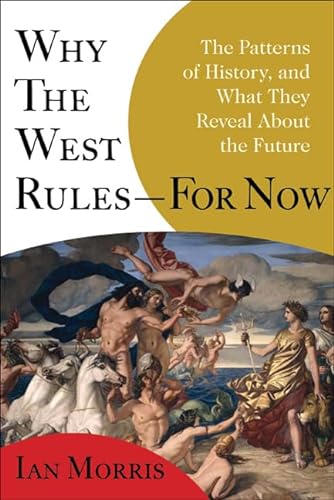
Why the West Rules--for Now: The Patterns of History, and What They Reveal About the Future - Hardcover
Synopsis
A New York Times Notable Book for 2011
Sometime around 1750, English entrepreneurs unleashed the astounding energies of steam and coal, and the world was forever changed. The emergence of factories, railroads, and gunboats propelled the West's rise to power in the nineteenth century, and the development of computers and nuclear weapons in the twentieth century secured its global supremacy. Now, at the beginning of the twenty-first century, many worry that the emerging economic power of China and India spells the end of the West as a superpower. In order to understand this possibility, we need to look back in time. Why has the West dominated the globe for the past two hundred years, and will its power last?
Describing the patterns of human history, the archaeologist and historian Ian Morris offers surprising new answers to both questions. It is not, he reveals, differences of race or culture, or even the strivings of great individuals, that explain Western dominance. It is the effects of geography on the everyday efforts of ordinary people as they deal with crises of resources, disease, migration, and climate. As geography and human ingenuity continue to interact, the world will change in astonishing ways, transforming Western rule in the process.
Deeply researched and brilliantly argued, Why the West Rules―for Now spans fifty thousand years of history and offers fresh insights on nearly every page. The book brings together the latest findings across disciplines―from ancient history to neuroscience―not only to explain why the West came to rule the world but also to predict what the future will bring in the next hundred years.
"synopsis" may belong to another edition of this title.
About the Author
IAN MORRIS is Willard Professor of Classics and History at Stanford University. He has published ten scholarly books, including, most recently, The Dynamics of Ancient Empires, and has directed excavations in Greece and Italy. He lives in the Santa Cruz Mountains in California.
Reviews
Only the supremely self-confident put forth all-encompassing theories of world history, and Morris is one such daredevil. An archaeologist by academic specialty, he advances a quasi-deterministic construct that is suitable for nonacademics. From a repeatedly enunciated premise that humans by nature are indolent, avaricious, and fearful, Morris holds that such traits, when combined with sociology and geography, explain history right from the beginning, when humanity trudged out of Africa, through the contemporary rivalry between China and America. Such temporal range leaves scant room for individual human agency: Morris names the names of world history, but in his narrative, leaders and tyrants, at best, muddle through patterns of history that are beyond their power to shape. And those patterns, he claims, can be numerically measured by a “social development index” that he applies to every epochal change from agriculture to the industrial revolution. However, the reading is not as heavy as it may sound. His breezy style and what-if imagination for alternative scenarios should maintain audience interest; whether his sweeping perspective convinces is another matter altogether. --Gilbert Taylor
"About this title" may belong to another edition of this title.
Search results for Why the West Rules--for Now: The Patterns of History,...

Stock Image
Why the West Rules--For Now: The Patterns of History, and What They Reveal about the Future
Seller: World of Books (was SecondSale), Montgomery, IL, U.S.A.
Seller rating 5 out of 5 stars

Hardback. Condition: Very Good. A New York Times Notable Book for 2011 Sometime around 1750, English entrepreneurs unleashed the astounding energies of steam and coal, and the world was forever changed. The emergence of factories, railroads, and gunboats propelled the West's rise to power in the nineteenth century, and the development of computers and nuclear weapons in the twentieth century secured its global supremacy. Now, at the beginning of the twenty-first century, many worry that the emerging economic power of China and India spells the end of the West as a superpower. In order to understand this possibility, we need to look back in time. Why has the West dominated the globe for the past two hundred years, and will its power last? Describing the patterns of human history, the archaeologist and historian Ian Morris offers surprising new answers to both questions. It is not, he reveals, differences of race or culture, or even the strivings of great individuals, that explain Western dominance. It is the effects of geography on the everyday efforts of ordinary people as they deal with crises of resources, disease, migration, and climate. As geography and human ingenuity continue to interact, the world will change in astonishing ways, transforming Western rule in the process. Deeply researched and brilliantly argued, Why the West Rules--for Now spans fifty thousand years of history and offers fresh insights on nearly every page. The book brings together the latest findings across disciplines--from ancient history to neuroscience--not only to explain why the West came to rule the world but also to predict what the future will bring in the next hundred years. Seller Inventory # CIN0374290024VG
Stock Image
Why the West Rules--for Now: The Patterns of History, and What They Reveal About the Future
Published by
Farrar, Straus and Giroux, 2010
ISBN 10: 0374290024
ISBN 13: 9780374290023
Used
Hardcover
Seller: More Than Words, Waltham, MA, U.S.A.
Seller rating 5 out of 5 stars
Condition: Good. A sound copy with only light wear. Overall a solid copy at a great price! Seller Inventory # BOS-K-14e-01510
Stock Image
Why the West Rules--for Now: The Patterns of History, and What They Reveal About the Future
Published by
Farrar, Straus and Giroux, 2010
ISBN 10: 0374290024
ISBN 13: 9780374290023
Used
Hardcover
Seller: ThriftBooks-Reno, Reno, NV, U.S.A.
Seller rating 5 out of 5 stars
Hardcover. Condition: Very Good. No Jacket. Missing dust jacket; May have limited writing in cover pages. Pages are unmarked. ~ ThriftBooks: Read More, Spend Less. Seller Inventory # G0374290024I4N01
Stock Image
Why the West Rules--for Now: The Patterns of History, and What They Reveal About the Future
Published by
Farrar, Straus and Giroux, 2010
ISBN 10: 0374290024
ISBN 13: 9780374290023
Used
Hardcover
Seller: ThriftBooks-Phoenix, Phoenix, AZ, U.S.A.
Seller rating 5 out of 5 stars
Hardcover. Condition: As New. No Jacket. Pages are clean and are not marred by notes or folds of any kind. ~ ThriftBooks: Read More, Spend Less. Seller Inventory # G0374290024I2N00
Stock Image
Why the West Rules--for Now: The Patterns of History, and What They Reveal About the Future
Published by
Farrar, Straus and Giroux, 2010
ISBN 10: 0374290024
ISBN 13: 9780374290023
Used
Hardcover
Seller: ThriftBooks-Reno, Reno, NV, U.S.A.
Seller rating 5 out of 5 stars
Hardcover. Condition: Very Good. No Jacket. May have limited writing in cover pages. Pages are unmarked. ~ ThriftBooks: Read More, Spend Less. Seller Inventory # G0374290024I4N00
Stock Image
Why the West Rules--for Now: The Patterns of History, and What They Reveal About the Future
Published by
Farrar, Straus and Giroux, 2010
ISBN 10: 0374290024
ISBN 13: 9780374290023
Used
Hardcover
Seller: ThriftBooks-Reno, Reno, NV, U.S.A.
Seller rating 5 out of 5 stars
Hardcover. Condition: Good. No Jacket. Former library book; Pages can have notes/highlighting. Spine may show signs of wear. ~ ThriftBooks: Read More, Spend Less. Seller Inventory # G0374290024I3N10
Stock Image
Why the West Rules--for Now: The Patterns of History, and What They Reveal About the Future
Published by
Farrar, Straus and Giroux, 2010
ISBN 10: 0374290024
ISBN 13: 9780374290023
Used
Hardcover
Seller: ThriftBooks-Phoenix, Phoenix, AZ, U.S.A.
Seller rating 5 out of 5 stars
Hardcover. Condition: Very Good. No Jacket. May have limited writing in cover pages. Pages are unmarked. ~ ThriftBooks: Read More, Spend Less. Seller Inventory # G0374290024I4N00
Stock Image
Why the West Rules--for Now: The Patterns of History, and What They Reveal About the Future
Published by
Farrar, Straus and Giroux, 2010
ISBN 10: 0374290024
ISBN 13: 9780374290023
Used
Hardcover
Seller: ThriftBooks-Atlanta, AUSTELL, GA, U.S.A.
Seller rating 5 out of 5 stars
Hardcover. Condition: Good. No Jacket. Missing dust jacket; Pages can have notes/highlighting. Spine may show signs of wear. ~ ThriftBooks: Read More, Spend Less. Seller Inventory # G0374290024I3N01
Stock Image
Why the West Rules--for Now: The Patterns of History, and What They Reveal About the Future
Published by
Farrar, Straus and Giroux, 2010
ISBN 10: 0374290024
ISBN 13: 9780374290023
Used
Hardcover
Seller: ThriftBooks-Atlanta, AUSTELL, GA, U.S.A.
Seller rating 5 out of 5 stars
Hardcover. Condition: Very Good. No Jacket. Former library book; May have limited writing in cover pages. Pages are unmarked. ~ ThriftBooks: Read More, Spend Less. Seller Inventory # G0374290024I4N10