
Items related to Raisel's Riddle
Synopsis
A Jewish Cinderella
What's more precious than rubies, more lasting than gold?
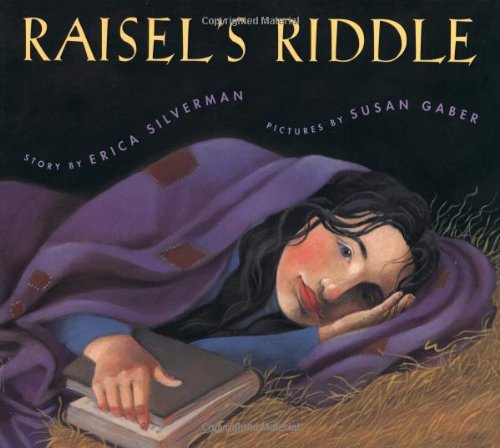
Raisel knows. She learned it from her grandfather, a poor scholar who taught her. When he dies, Raisel finds work in the home of a rabbi. His jealous cook makes Raisel toil from sunup to sundown. And as the Jewish holiday of Purim approaches, Raisel works even harder. The rabbi's son presides over the Purim dinner, and Raisel listens closely when he responds to riddles posed by his guests. Is it possible that this young man can answer Raisel's riddle? Erica Silverman's lively retelling of the Cinderella story features a heroine for whom knowledge is as essential to happiness as love. In striking paintings, Susan Gaber captures all her beauty, external and internal.
"synopsis" may belong to another edition of this title.
About the Author
Erica Silverman is the author of The Halloween House and other books for children. She lives in Los Angeles, California. Susan Gaber has illustrated many children's books. She lives in Huntington, New York.
Reviews
Kindergarten-Grade 3-In this Jewish holiday variant of the Cinderella story, Raisel, the granddaughter of a learned scholar, uses her wits to win the rabbi's son. After Raisel's grandfather dies, the orphaned girl moves from her Polish village to a large city and goes to work in the kitchen of a rabbi. On the night of the Purim ball, she feeds an old woman who gives her three wishes for her kindness, thus allowing Raisel to attend the ball and tell the rabbi's son a riddle that wins his heart. Using elements from the classic tale and ideas from the Talmud, Silverman crafts a story that teaches the importance of learning while retaining the romance of the fairy tale. The quotes from the Talmud blend in well with the rest of the narration and the themes reappear in the art. Gaber's pictures are uneven, with Raisel looking different from page to page, but at their best, the composition is lovely and the realistic paintings with their smears of bright colors beautifully reflect the emotions of the text. The artist plays with point of view, setting her illustrations at all different angles and distances, some of which are more effective than others. However, as a whole, the book works, and while not a necessary purchase, it will be a welcome addition where more folklore with a Jewish focus is needed.
Amy Lilien, Ferguson Library, Stamford, CT
Copyright 1999 Reed Business Information, Inc.
Starring a Jewish orphan in a long-ago Polish village, this colorful, expertly structured variation on Cinderella offers many things: an independent-minded heroine plus a hero attracted by wisdom and virtue; a fairy-tale patina plus old-world ambiance; and a tie-in to Purim that grounds the story without limiting its appeal. Raisel is not immediately recognizable as a Cinderella type. Raised by her grandfather, a poor but devout scholar, she has studied right alongside him. When he dies, she finds work in a faraway village as the helper to a rabbi's cook, a jealous and harsh woman who could rival any evil stepmother. Silverman (Don't Fidget a Feather) maintains impeccable pacing, characterization and once-upon-a-time diction as Raisel catches the eye of the rabbi's learned son, and, through an act of kindness, earns three wishes on Purim. Enter a costume and magical transportation, and the Cinderella parallel pops out, to surprise and delight young readers. Raisel uses her wishes wisely and wins the love of the rabbi's son; unlike Cinderella, this maiden sets a test for her beloved, and it brings the story full-circle to its flavorful beginnings. Gaber (Bit by Bit) underscores the text's emphasis on the characters' inner resources. Her paintings find the warmth in Raisel's companionship with her grandfather, despite the modest surroundings, and they pay more attention to Raisel as a scullery maid than to her appearance in the magical costume. A splendid story, intelligently served. Ages 5-8.
Copyright 1999 Reed Business Information, Inc.
Silverman (The Halloween House, 1997, etc.) tells of Raisel, an orphan girl who is raised by her scholarly grandfather until his death; three wishes from an old beggar woman allow Raisel to attend the Purim play dressed as Queen Esther, where she captures the attention of the rabbi's son. It is her clever riddle about the precious nature of learning, however, that eventually wins his heart. Carefully crafted, this story not only entertains, but it teaches readers about the Jewish holiday, Purim, Queen Esther, and the tradition of costumed re-enactment. Unlike a majority of the other versions of the Cinderella story, this one does not include a self-absorbed prince who combs the countryside looking for a bride of a particular shoe size; refreshingly, Silverman's hero is as intelligent as he is handsome, and seeks a bride who is his equal. Graber's illustrations are the perfectly complement, embodying Raisel's transformation from a life of servitude to one of riches ``more precious than rubies.'' (Picture book. 5-8) -- Copyright ©1999, Kirkus Associates, LP. All rights reserved.
A lovely re-imagining of the Cinderella story, with a fine twist. Raisel lives in a tiny village in Poland with her grandfather, a poor scholar. When Zaydeh dies, Raisel goes to town to seek work and finds it in the kitchen of a famed rabbi. But the cook mistreats her and keeps her from the Purim party. That night, when Raisel gives her supper to an old woman, the beggar grants her three wishes. Raisel, who then goes to the Purim party costumed as Queen Esther and enchants the rabbi's son with her riddle, is wise enough to keep one wish back and uses it for cleaning the kitchen when she returns at midnight. The next day the rabbi's son searches for her, and Raisel, locked in the pantry, calls out her riddle: "What's more precious than rubies, more lasting than gold? / What can never be traded, stolen, or sold? / What comes with great effort and takes time, but then--/ Once yours, will serve you again and again?" The rabbi's son knows the answer, which is "learning," and so they "lived and learned happily ever after." The illustrations in velvety, muted colors make use of strong geometric shapes and varying perspectives: we see Raisel and her Zaydeh through a window studying together; the nasty cook looming over Raisel in the rabbi's kitchen; and dramatic close-ups of Raisel and the beggar woman and a gorgeous one of Raisel dressed as Queen Esther with the rabbi's son. This universal story fits into its Jewish milieu as neatly as a key in a lock. GraceAnne A. DeCandido
"About this title" may belong to another edition of this title.
Search results for Raisel's Riddle

Stock Image
Raisel's Riddle
Published by
Farrar, Straus and Giroux (BYR), 1999
ISBN 10: 0374361681
ISBN 13: 9780374361686
Used
Hardcover
Seller: World of Books (was SecondSale), Montgomery, IL, U.S.A.
Seller rating 5 out of 5 stars

Hardback. Condition: Good. Gaber, Susan (illustrator). The story of how Chico the dog experienced the loss of his family and how he got the courage to decide to adopt a new human. Seller Inventory # 00093057019
Seller Image
Raisel's Riddle
Published by
Farrar, Straus and Giroux (BYR), 1999
ISBN 10: 0374361681
ISBN 13: 9780374361686
Used
Hardcover
Seller: Reliant Bookstore, El Dorado, KS, U.S.A.
Seller rating 5 out of 5 stars
Condition: acceptable. Gaber, Susan (illustrator). This book is a well used but readable copy. This is an ex-library book with stickers and markings. Integrity of the book is still intact with no missing pages. May have notes or highlighting. Cover image on the book may vary from photo. Ships out quickly in a secure plastic mailer. Seller Inventory # RDV.0374361681.A
Stock Image
Raisel's Riddle
Published by
Farrar, Straus and Giroux (BYR) (edition First Edition), 1999
ISBN 10: 0374361681
ISBN 13: 9780374361686
Used
Hardcover
First Edition
Seller: BooksRun, Philadelphia, PA, U.S.A.
Seller rating 5 out of 5 stars
Hardcover. Condition: Very Good. Gaber, Susan (illustrator). First Edition. With dust jacket. It's a well-cared-for item that has seen limited use. The item may show minor signs of wear. All the text is legible, with all pages included. It may have slight markings and/or highlighting. Seller Inventory # 0374361681-11-1-29
Stock Image
Raisel's Riddle
Published by
Farrar, Straus and Giroux (BYR), 1999
ISBN 10: 0374361681
ISBN 13: 9780374361686
Used
Hardcover
Seller: PlumCircle, West Mifflin, PA, U.S.A.
Seller rating 5 out of 5 stars
hardcover. Condition: Good. Gaber, Susan (illustrator). Somewhat damaged. May have bumped corner, torn dust cover, folded pages, light dust soil, remainder mark, price sticker, other damage, or be bent. 99% of orders arrive in 4-10 days. Discounted shipping on multiple books. Seller Inventory # mon0001327367
Stock Image
Raisel's Riddle
Published by
Farrar, Straus and Giroux (BYR), 1999
ISBN 10: 0374361681
ISBN 13: 9780374361686
Used
Hardcover
Seller: ThriftBooks-Atlanta, AUSTELL, GA, U.S.A.
Seller rating 5 out of 5 stars
Hardcover. Condition: Very Good. No Jacket. Gaber, Susan (illustrator). May have limited writing in cover pages. Pages are unmarked. ~ ThriftBooks: Read More, Spend Less. Seller Inventory # G0374361681I4N00
Stock Image
Raisel's Riddle
Published by
Farrar, Straus and Giroux (BYR), 1999
ISBN 10: 0374361681
ISBN 13: 9780374361686
Used
Hardcover
Seller: ThriftBooks-Dallas, Dallas, TX, U.S.A.
Seller rating 5 out of 5 stars
Hardcover. Condition: As New. No Jacket. Gaber, Susan (illustrator). Pages are clean and are not marred by notes or folds of any kind. ~ ThriftBooks: Read More, Spend Less. Seller Inventory # G0374361681I2N00
Stock Image
Raisel's Riddle
Published by
Farrar, Straus and Giroux (BYR), 1999
ISBN 10: 0374361681
ISBN 13: 9780374361686
Used
Hardcover
Seller: ThriftBooks-Dallas, Dallas, TX, U.S.A.
Seller rating 5 out of 5 stars
Hardcover. Condition: Very Good. No Jacket. Gaber, Susan (illustrator). May have limited writing in cover pages. Pages are unmarked. ~ ThriftBooks: Read More, Spend Less. Seller Inventory # G0374361681I4N00
Seller Image
Raisel's Riddle
Published by
Farrar, Straus and Giroux (BYR), 1999
ISBN 10: 0374361681
ISBN 13: 9780374361686
Used
Hardcover
Seller: Blue Vase Books, Interlochen, MI, U.S.A.
Seller rating 5 out of 5 stars
Condition: acceptable. Gaber, Susan (illustrator). The item is very worn but is perfectly usable. Signs of wear can include aesthetic issues such as scratches, dents, worn and creased covers, folded page corners and minor liquid stains. All pages and the cover are intact, but the dust cover may be missing. Pages may include moderate to heavy amount of notes and highlighting, but the text is not obscured or unreadable. Page edges may have foxing age related spots and browning . May NOT include discs, access code or other supplemental materials. Seller Inventory # BVV.0374361681.A
Stock Image
Raisel's Riddle
Published by
Farrar, Straus and Giroux (BYR), 1999
ISBN 10: 0374361681
ISBN 13: 9780374361686
Used
Hardcover
Seller: Half Price Books Inc., Dallas, TX, U.S.A.
Seller rating 5 out of 5 stars
Hardcover. Condition: Very Good. Gaber, Susan (illustrator). Connecting readers with great books since 1972! Used books may not include companion materials, and may have some shelf wear or limited writing. We ship orders daily and Customer Service is our top priority! Seller Inventory # S_269399915
Stock Image
Raisel's Riddle
Published by
Farrar, Straus and Giroux (BYR), 1999
ISBN 10: 0374361681
ISBN 13: 9780374361686
Used
Hardcover
Seller: World of Books Inc, Montgomery, IL, U.S.A.
Seller rating 4 out of 5 stars

Hardback. Condition: Good. Gaber, Susan (illustrator). The story of how Chico the dog experienced the loss of his family and how he got the courage to decide to adopt a new human. Seller Inventory # CIN0374361681G