
Items related to Somewhere for Me: A Biography of Richard Rodgers
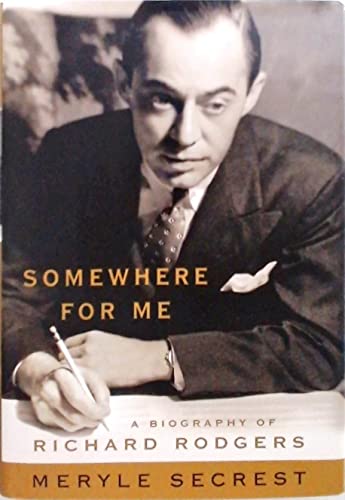
Synopsis
Everywhere regarded as one of our most brilliant composers–more than nine hundred published songs, forty Broadway musicals, numerous films, every award conceivable–Richard Rodgers, the man, has nonetheless been consistently misunderstood –seen as the almost stolid opposite of what he really was.
Now Meryle Secrest–biographer of Frank Lloyd Wright, Stephen Sondheim, and Leonard Bernstein–brings her extraordinary skills to this full-scale life of Rodgers. She shows us for the first time the complexities of his nature, his emotional fault lines, and, most important, the wellsprings of his art.
She writes of his childhood and how he learned at an early age to mask his feelings, escaping into the world of operetta—of Franz Lehar and Jerome Kern. She follows his close and wonderfully productive working relationship with Lorenz Hart–a collaboration that resulted in more than thirty Broadway and West End musicals, including Babes in Arms and Pal Joey, but was ultimately undone by Hart’s drinking. She evokes Rodgers’s triumphant second collaboration, with the gifted–and happily stable–Oscar Hammerstein, which gave us Oklahoma!, Carousel, South Pacific, The King and I, and more. She explores Rodgers’s own problems with alcohol as well as his periodic breakdowns; and she illuminates the deep-rooted tensions that underlay his forty-nine-year marriage to Dorothy Feiner.
Somewhere for Me is both a lively portrait of the American musical theatre and a revelation of the brilliant, passionate, moody, and mercurial artist who was one of its greatest figures.
"synopsis" may belong to another edition of this title.
About the Author
Meryle Secrest was born and educated in Bath, England, and now lives in Washington, D.C. She has written biographies of Romaine Brooks, Bernard Berenson, Kenneth Clark, and Salvador Dalí, among others.
From the Back Cover
"Somewhere for Me is a thorough and scrupulously researched biography that is both welcome and necessary. . . . It is our most detailed portrait of a man whose compositions may have substantially changed the world for the better. . . . As in her biographies of Leonard Bernstein and Stephen Sondheim, Secrest delves into both the personal history of her subject and his underlying psychology. The result is a copiously documented, generous portrait of a Richard Rodgers unknown until this account."
- Gerard Alessandrini, New York Times Book Review
"How you managed to capture so contradictory a man so well, I don't know, but it's a feat you have brought off and should be proud of."
-Arthur Laurents, author of Original Story
From the Inside Flap
Everywhere regarded as one of our most brilliant composers–more than nine hundred published songs, forty Broadway musicals, numerous films, every award conceivable–Richard Rodgers, the man, has nonetheless been consistently misunderstood –seen as the almost stolid opposite of what he really was.<br><br>Now Meryle Secrest–biographer of Frank Lloyd Wright, Stephen Sondheim, and Leonard Bernstein–brings her extraordinary skills to this full-scale life of Rodgers. She shows us for the first time the complexities of his nature, his emotional fault lines, and, most important, the wellsprings of his art.<br><br>She writes of his childhood and how he learned at an early age to mask his feelings, escaping into the world of operetta―of Franz Lehar and Jerome Kern. She follows his close and wonderfully productive working relationship with Lorenz Hart–a collaboration that resulted in more than thirty Broadway and West End musicals, including Babes in Arms and Pal Joey, but was ultimately undone by Hart’s drinking. She evokes Rodgers’s triumphant second collaboration, with the gifted–and happily stable–Oscar Hammerstein, which gave us Oklahoma!, Carousel, South Pacific, The King and I, and more. She explores Rodgers’s own problems with alcohol as well as his periodic breakdowns; and she illuminates the deep-rooted tensions that underlay his forty-nine-year marriage to Dorothy Feiner.<br><br><i>Somewhere for Me</i> is both a lively portrait of the American musical theatre and a revelation of the brilliant, passionate, moody, and mercurial artist who was one of its greatest figures.
Reviews
"Whiskers on kittens and warm woolen mittens," sings Maria to a lighthearted melody in Rodgers and Hammerstein's The Sound of Music, but this sentimental, carefree imagery was hardly the stuff of which composer Rodgers's life was made. This deeply researched and moving critical biography covers the composer's long life and career (he died in 1979), with astute analysis of his work and sympathetic, but not hagiographic, insights into the man. Born in 1902 to an upper-middle-class Jewish family in New York City, Rodgers copyrighted his first song, "Auto Show Girl" when he was 15. After he teamed up with Lorenz Hart in 1919, they turned out a series of shows and songs that made them world famous and well-off (by the mid-1930s, at the height of the depression, they were each making more than $100,000 a year). When Hart died in 1943, Rodgers partnered with Oscar Hammerstein and went on to produce some of the most popular and important musicals in the second half of the 20th century, including The King and I and No Strings. Secrest, who has penned critically acclaimed biographies of Leonard Bernstein and Stephen Sondheim, has a good eye for detail and neatly integrates important personal details such as the impact of Dorothy's homophobia concerning her husband's relationship with the gay Hart or the increasingly debilitating effect that Rodgers's alcoholism had on his work. Based on extensive interviews (and the help of Rodgers's children) as well as comprehensive research in the sociology of the music and theater industry, this is a wonderful addition to the literature on American popular culture. (Nov.)Forecast: Bookstores with music sections would be wise to stock this title. Expect strong sales from both theatergoers and lovers of song standards.
Copyright 2001 Cahners Business Information, Inc.
Secrest, the author of previous works on Bernstein, Sondheim, and Frank Lloyd Wright, has perfected the tell-all biography, and so we are not shocked to learn that beneath his controlled persona Rodgers was an alcoholic, a philanderer, a cold and distant parent—the composer's elder daughter, Mary Rodgers Guettel, describes their family life with exceptional sourness and zest—and, of course, a highly sensitive artist. Fortunately, Secrest's attention to detail has produced a remarkably balanced portrait. Rodgers's marriage to the beautiful and demanding Dorothy Feiner may have been an unhappy one, but its stability made his career possible; and in his dealings with his deeply troubled lyricist, Lorenz Hart, he displayed as much patience as anyone could possibly expect. Rodgers himself was always the consummate theatre professional, one who believed that he owed his success not to genius but to solid craftsmanship and disciplined hard work: as Secrest takes us through one brilliant Broadway show after another, you never doubt that it was all worthwhile.
Copyright © 2005 The New Yorker
Richard Rodgers (1902-79) is arguably the most popular composer that America has produced, with credits that include Oklahoma!, South Pacific, The King and I, and The Sound of Music. He was also a partner in two of the most famous collaborations in musical theater history (Rodgers and Hart, Rodgers and Hammerstein). Though Rodgers's daughters, Mary Rodgers Guettel and Linda Rodgers Emory, commissioned this book, Secrest (Leonard Bernstein: A Life) does not hide Rodgers's failings as a father and man. Indeed, her book differs from William Hyland's Richard Rodgers (Yale Univ., 1998) and Rodgers's own Musical Stages (LJ 9/1/75) in its fuller treatment of the sometimes sordid and difficult aspects of Rodgers's life, especially his family relationships and his collaboration with the brilliant but difficult Lorenz Hart, whom Rodgers tried to bar from the theater at the end of their association. Rodgers's famous musicals may have contained a bright core of wish fulfillment, but this romanticism masked an inner (and usually well-hidden) darkness and angst. Secrest also includes perceptive comments on the "adult fairy stories" concocted by Rodgers and his collaborators as well as their place in American popular culture. Published on the eve of the centenary of the composer's birth, this book is recommended for all libraries interested in musical theater or American popular culture. [Stage and Screen Book Club dual main selection.] Bruce R. Schueneman, Texas A&M Univ., Kingsvill.
- Bruce R. Schueneman, Texas A&M Univ., Kingsville
Copyright 2001 Reed Business Information, Inc.
*Starred Review* Without composer Richard Rodgers, the American musical might never have grown up. In the '20s and '30s with Lorenz Hart and the '40s and '50s with Oscar Hammerstein, he created noteworthy musicals such as The Boys from Syracuse, Pal Joey, Oklahoma! and South Pacific, supplying elegant, intelligent music for his partners' increasingly sophisticated lyrics. Secrest chronicles Rodgers' growth as an artist, from his first forays as an adolescent to the years of increasing triumph, just before and after World War II, when he helped create such standards as "Blue Moon," "Bewitched, Bothered, and Bewildered," and "Oh What a Beautiful Morning"--all in the service of the theater. But what makes this book remarkable is how well Secrest gets under Rodgers' skin and the skins of everyone associated with him. Here are fascinating, warts-and-all portraits of the sad, self-destructive Hart; the shy workhorse Hammerstein; Rodgers' long-suffering, Demerol-addicted wife; and Rodgers himself. Secrest surprises those who thought Rodgers was as wholesome as his collaborations with Hammerstein, especially the last, The Sound of Music. He was immensely talented--but for a childhood bone infection in a finger, he might have been a concert pianist--but also an ill-tempered perfectionist, a compulsive philanderer, and a secret alcoholic. Secrest's detailed, well-researched accounts of the creation and rehearsal of his important shows make it clear: Rodgers was a cad and a gifted composer, a bad husband and father and a major artist. Jack Helbig
Copyright © American Library Association. All rights reserved
Excerpt. © Reprinted by permission. All rights reserved.
Chapter One
BLUE ROOM
Here comes Jacob Levy trotting along the street, a tiny little man in a neat black suit and fussy bow tie, carrying a cane and sporting a white panama with a surprisingly rakish brim. It is 1926, and Richard Rodgers's grandfather on his mother's side is spending the summer in Long Beach, New York, walking down an expanse of sidewalk bordered by identical lawns, a single Model T Ford parked behind him on that ramrod-straight, deserted street. Now here is Will, Dick's physician father, in the home movies Richard Rodgers began to take with his fancy new film camera, the one you wound up by hand. Will, too, is spending his summer in Long Beach, and stands on the steps of their cottage, red-haired, handsome, and blue-eyed, a smudge of moustache on his upper lip, in his starched-collar shirt and his suit with matching waistcoat, laughing uproariously at some forgotten joke. And here is Mamie, Dick's mother, with her flat, blunt nose, close-set eyes, pince-nez, and distinct gap between her front teeth. Even in those days of blurry and faded film one somehow knows it is a dusty afternoon in high summer, and only city folk get dressed up in hats and gloves to have their pictures taken.
Now the golden boy himself appears, towering (even though of modest height) over his tiny mother, his hair glistening in the sunlight, his lips parted in a curving smile, with his beautifully modeled forehead and the slight cleft in his chin, the kind of face to be found in magazine illustrations of the period advertising cigars, cognacs, Cadillacs, and crossings on the Cunard Line. His suit is something formal and dark and the shirt collar is fashionably stiff and confining, but his tie tells another story: it is daringly patterned with dots and can only be bright red. He leans solicitously over his mother and the tree under which they are posing throws a pattern of light on his cheekbones and the edge of his lapel.
Soon they are on the boardwalk in Atlantic City, whither they have come for the tryout of a new show. Here is Dick, the brim of his hat pulled down snappily over one eye, with his mother on his arm. She is in mourning for her father, lately dead, and looks, in her mountainous black hat, as solemn as an owl. Next to them, in a line advancing toward the camera, are Lew Fields, the famous comedian-turned-producer who backed so many of Rodgers's first shows, and Lew's son Herbert, Rodgers's collaborator on the books. At the far right is the impeccably dressed Lorenz Hart, Rodgers's brilliant lyricist, whose Homburg hat and perfectly tailored double-breasted coat only serve to underline the contrast between his manly head and stunted body. Now we are at the tennis courts, where the agile form of Richard Rodgers, in faultless white flannels, can be seen serving and volleying with the rapidity of a dragonfly. Next we are on a lake and he is lounging in a canoe, wearing a fashionable two-piece swimsuit (striped, sleeveless top, white belt, dark trunks), with his half-smile, his widow's peak of immaculate dark hair parted just off-center, the ever-present cigarette between his fingers. Or he is standing on the dock beside Bobbie Perkins, who sang "Mountain Greenery" in the Garrick Gaieties of 1926, his arm around her waist, a charming scene disrupted by his handsome older brother Mortimer. Morty interposes himself between them and triumphantly carries off the girl.
Next he is on a picnic in Canada, wearing a beret, eating sandwiches and drinking from a thermos flask, then proudly displaying the fish he has just caught. Or he is in Cannes, coming around the corner with a beauty on each arm. On one side is Corinne Griffith and on the other, Kendall Lee, then married to Jules Glaenzer, vice-president of Cartier's. Rodgers is on the Riviera to attend some kind of lavish party at the invitation of Glaenzer, youngish and handsome and wearing what looks like a silk kimono. For Richard Rodgers, ambitious young composer-about-town, has been taken up by café society and invited everywhere. And no wonder, since although he is only in his mid-twenties, he has had several hit musicals and has taken bachelor's quarters, three rooms on the nineteenth floor with a wrap-around terrace, in a deluxe apartment hotel called the Lombardy at 11 East Fifty-sixth Street, with its two-story-high Spanish Renaissance lobby and hand-modeled stucco walls with travertine quoins and jambs. There he has decorated his study as befits his status: light red draperies, cork walls (a daring touch), Moderne furniture, and the latest in Art Deco built-in bookcases. Writing to his future wife, Dorothy Feiner, he said that a divan and bookcase had just arrived and he was biting his nails with anxiety. "I suspect it's rather successful, but you'll know!" he wrote. Charles, his valet, who insisted on the French pronunciation of his name, did everything without being told. One night Rodgers brought home a congenial group after a prizefight, and they sat around singing songs and strolled about on his spacious terrace. Charles made sandwiches, scrambled eggs, and sausages and served champagne. He left the gathering at 4:30 a.m. and "showed up again at nine-thirty to give me breakfast, with the same smile," Rodgers wrote. "Dot, what a way to live! Expensive, but so nice."
The year was 1929, and a decade had gone by since that hot summer day when he and Larry Hart had traveled out to Rockaway to play some of their first tunes for Lew Fields. That same summer the two of them stood in the back of the Casino Theatre at Broadway and Thirty-ninth Street to hear Eve Lynn and Alan Hale sing "Any Old Place with You." It was 1919, the musical was A Lonely Romeo, and Rodgers's first song had been heard on Broadway; he was just seventeen. Years of struggle followed until the big chance came with The Garrick Gaieties of 1925, and the writing team of Rodgers and Hart was launched. By the late 1920s newspapers were publishing drawings of Rodgers, the composer of such musicals as Peggy-Ann and A Connecticut Yankee and such songs as "My Heart Stood Still," "Manhattan," "Here in My Arms," "The Girl Friend," "Thou Swell," and "This Funny World." The headline was "The Young Master of Melody." A short film had even been made, with Rodgers and Hart as the stars, celebrating their rapid rise. And everyone was singing their songs.
We'll have a blue room,
A new room,
For two room,
Where ev'ry day's a holiday
Because you're married to me.
("The Blue Room")
Spring of 1929 began, appropriately enough, with a February tryout for Spring Is Here at the Shubert Theatre, Philadelphia; it moved to the Alvin Theatre, New York, the following month. The musical was based on a book by Owen Davis, which he had adapted from his play Shotgun Wedding, and, like most confections of the period, told a forgettable story about a boy in love with a girl in love with somebody else until the last act. It ran for 104 performances, not a very prepossessing number, although the reviewers had been kind, and was notable for at least one wonderful melody, "With a Song in My Heart." It was also notable for its bevy of pretty girls, called "Ladies of the Ensemble" in the program, every one vivacious and charming and with perfect thighs. Rodgers lovingly photographed them all in their silk negligées or their garden outfits of white cloche hats and polka-dot dresses, or their Pierrette costumes-it was the moment for puffed sleeves and tiers of frills on skirts-in which they pouted, pirouetted, and drooped charmingly against doorways. The early home movies are full of such pretty girls, and Dorothy Rodgers, who later provided the commentary, was forbearing. "This is Bobbie Perkins," she announced as that particularly trim and lively girl appeared to take her bow. "Dick used to take her out a lot, and she and I became great friends."
Dorothy herself appeared in the films, her long brown hair loose around her face, swimming in the pool of the house in Tarrytown, New York, that her parents had rented for a year, or riding horseback with Herbert Fields, her ponytail bouncing along behind her, or posing against the doorway of the house in something clinging and low-cut, a dress one would have thought too sultry for a girl of seventeen. Or she is getting into Dick's chauffeur-driven Stutz Bearcat convertible, in an amazingly chic outfit, a belted two-piece with contrasting trim, and, in those days of the universal cloche hat, wearing what looks like a very becoming turban. There is an air of maturity about this young and pretty admirer, whose youthfulness is betrayed occasionally by a tremulous uncertainty in her smile. And, indeed, she was something of a sophisticate, the much-indulged daughter of wealthy parents, who had made the yearly pilgrimage to Europe since childhood. She knew, for instance, that one went to Egypt for perfume, to Turkey for star sapphires, to Naples for coral and tortoiseshell, to Rome for antiques, and to Florence for leather goods.
In Paris, she and her mother spent countless hours being fitted for clothes. It was, she wrote later, "an era of almost unimaginable luxury . . . French underwear, for example, was made of the sheerest pure silk ninon and trimmed with hand-run Alençon lace. Combinations called 'teddies,' slips, petticoats and nightgowns were designed to be knife-pleated-a process that had to be repeated by hand each time they were washed." Since American laundries would not perform this time-consuming work, Dorothy Feiner would take her dirty underwear to France on each transatlantic trip to be painstakingly repleated. Such close knowledge of the fine points of haute couture would stand her in good stead when she came to buy her trousseau, a year's worth of hats, coats, dresses, evening clothes, furs, shoes, and underwear-everything, right down to the hand-pleated silk chiffon han...
"About this title" may belong to another edition of this title.
Search results for Somewhere for Me: A Biography of Richard Rodgers

Stock Image
Somewhere for Me: A Biography
Seller: World of Books (was SecondSale), Montgomery, IL, U.S.A.
Seller rating 5 out of 5 stars

Condition: Acceptable. Item in acceptable condition! Textbooks may not include supplemental items i.e. CDs, access codes etc. Seller Inventory # 00108791902
Stock Image
Somewhere for Me: A Biography
Seller: World of Books (was SecondSale), Montgomery, IL, U.S.A.
Seller rating 5 out of 5 stars
Condition: Good. Item in good condition. Textbooks may not include supplemental items i.e. CDs, access codes etc. Seller Inventory # 00107085204
Stock Image
Somewhere for Me: A Biography of Richard Rodgers
Seller: Gulf Coast Books, Cypress, TX, U.S.A.
Seller rating 5 out of 5 stars
hardcover. Condition: Good. Seller Inventory # 0375401644-3-28009825
Stock Image
Somewhere for Me: A Biography of Richard Rogers
Seller: World of Books Inc, Montgomery, IL, U.S.A.
Seller rating 4 out of 5 stars

Hardback. Condition: Good. No American composer has been more widely celebrated, nor so consistently misunderstood as Richard Rodgers. Although he was one of America's most brilliant and prolific composers, whose credits include more than 900 published songs, 40 Broadway musicals and numerous films, Rodgers is widely believed to be the almost stolid opposite of who he really was. Meryle Secrest shows us for the first time his complex nature and the inspiration for his art. Looking intensely at Rodger's unparalleled career, Secrest follows his close and fruitful working relationship with Lorenz Hart, a collaboration that resulted in more than thirty musicals but was ultimately undone by Hart's alcoholism. Moving on to Rodger's second collaborator, Secrest records the triumphs with the gifted and more stable Oscar Hammerstein, including Carousel, South Pacific and The King and I, along with many more. Rodgers' personal life is explored, as well. Secrest writes about the composer's childhood, and how, from an early age, he used music to escape. And she explores Rodgers' own battle with alcohol, as well as the deep tensions in his 49-year marriage to Dorothy Feiner. Somewhere for Me is both a vivid portrait of American musical theatre, and an illuminating examination of one of its greatest artists. Seller Inventory # CIN0375401644G
Stock Image
Somewhere for Me: A Biography of Richard Rodgers
Seller: ThriftBooks-Phoenix, Phoenix, AZ, U.S.A.
Seller rating 5 out of 5 stars
Hardcover. Condition: Good. No Jacket. Pages can have notes/highlighting. Spine may show signs of wear. ~ ThriftBooks: Read More, Spend Less. Seller Inventory # G0375401644I3N00
Stock Image
Somewhere for Me: A Biography of Richard Rodgers
Seller: ThriftBooks-Dallas, Dallas, TX, U.S.A.
Seller rating 5 out of 5 stars
Hardcover. Condition: Good. No Jacket. Pages can have notes/highlighting. Spine may show signs of wear. ~ ThriftBooks: Read More, Spend Less. Seller Inventory # G0375401644I3N00
Stock Image
Somewhere for Me : A Biography of Richard Rogers
Published by
Knopf Doubleday Publishing Group, 2001
ISBN 10: 0375401644
ISBN 13: 9780375401640
Used
Hardcover
First Edition
Seller: Better World Books: West, Reno, NV, U.S.A.
Seller rating 5 out of 5 stars
Condition: Very Good. First Edition. Pages intact with possible writing/highlighting. Binding strong with minor wear. Dust jackets/supplements may not be included. Stock photo provided. Product includes identifying sticker. Better World Books: Buy Books. Do Good. Seller Inventory # 8743500-6
Stock Image
Somewhere for Me : A Biography of Richard Rogers
Published by
Knopf Doubleday Publishing Group, 2001
ISBN 10: 0375401644
ISBN 13: 9780375401640
Used
Hardcover
First Edition
Seller: Better World Books, Mishawaka, IN, U.S.A.
Seller rating 5 out of 5 stars
Condition: Good. First Edition. Pages intact with minimal writing/highlighting. The binding may be loose and creased. Dust jackets/supplements are not included. Stock photo provided. Product includes identifying sticker. Better World Books: Buy Books. Do Good. Seller Inventory # 469636-6
Stock Image
Somewhere for Me: A Biography of Richard Rodgers
Published by
Knopf (edition First Edition), 2001
ISBN 10: 0375401644
ISBN 13: 9780375401640
Used
Hardcover
First Edition
Seller: BooksRun, Philadelphia, PA, U.S.A.
Seller rating 5 out of 5 stars
Hardcover. Condition: Very Good. First Edition. With dust jacket. It's a well-cared-for item that has seen limited use. The item may show minor signs of wear. All the text is legible, with all pages included. It may have slight markings and/or highlighting. Seller Inventory # 0375401644-11-1-29
Stock Image
Somewhere for Me; A Biography of Richard Rodgers
Seller: Jeff Stark, Barstow, CA, U.S.A.
Seller rating 4 out of 5 stars
Hardcover. Condition: Near Fine. 1st. First edition stated on copyright page. Near fine in a near fine jacket. Looks about new. Seller Inventory # 041153