
Items related to Thunder from the East: Portrait of a Rising Asia
Synopsis
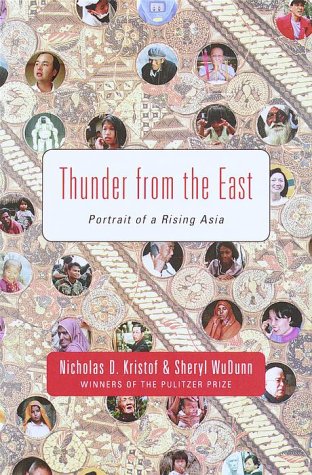
From two Pulitzer Prize-winning New York Times correspondents, a cutting-edge report on Asia and how its people are reshaping the world.
Nicholas D. Kristof and Sheryl WuDunn bring to their revelatory book all the authority and insight of the fourteen years they spent covering Asia. They depict a continent poised to reassume the role it ceded five hundred years ago as the "center of the world." They muster convincing evidence that China may soon overtake the United States as the world's largest economy, that India is awakening from its long hibernation, that Japan is developing future consumer technologies that will benefit millions of people.
Kristof and WuDunn tell their story through vivid descriptions of the unforgettable characters they have encountered: the Cambodian girl sold by her parents to a brothel; the bankrupted Thai entrepreneur who starts life anew with a street-vending business; the Japanese veteran haunted by the mother and child he killed in war. Through lives such as these, the authors underscore the pragmatism and perseverance that drive Koreans, Filipinos, Japanese, and their fellow Asians to greater success, to the point that many workers embrace the same sweatshops that horrify Westerners.
Thunder from the East shows that the rise of Asia paradoxically has been accelerated by the financial crisis that began to tear through the lives of multitudes in the East in 1997. The authors make clear that, by radically undermining the cronyism and the suffocating regulations that had long fettered Asian economies, the crisis liberated energies and creativity that had until then been immobilized.
Kristof and WuDunn avoid a Panglossian focus on Asia's strengths, for they also emphasize such shortcomings as discrimination against women, horrendous pollution, and the rise of nationalism. They warn that the rise of Asia will be a risky and tumultuous process, and that the emergence of powers like China and India will be in many ways destabilizing. New missile technologies and the rise of new nuclear powers in Asia pose a greater threat to American cities as well. Asia is, the authors warn, not only the most vibrant part of the world today, but also the most dangerous.
Thunder from the East is a brilliant guide to a region that is now in a position to wrest economic, diplomatic, and military power from the West in the coming decades. It offers a riveting account of a continent that is fast becoming the focus of the world's attention.
"synopsis" may belong to another edition of this title.
About the Author
Nicholas D. Kristof and Sheryl WuDunn, husband and wife, shared a Pulitzer Prize in 1990 for their coverage for the New York Times of the Tiananmen democracy movement in China and its suppression. They are the authors of China Wakes: The Struggle for the Soul of a Rising Power. Kristof has served as Times bureau chief in Hong Kong, Beijing, and Tokyo; WuDunn was a Times correspondent in Beijing and Tokyo, and has specialized in business journalism. Both now work for the Times in New York City and live nearby with their three children.
From the Inside Flap
itzer Prize-winning <i>New York Times</i> correspondents, a cutting-edge report on Asia and how its people are reshaping the world.<br><br>Nicholas D. Kristof and Sheryl WuDunn bring to their revelatory book all the authority and insight of the fourteen years they spent covering Asia. They depict a continent poised to reassume the role it ceded five hundred years ago as the "center of the world." They muster convincing evidence that China may soon overtake the United States as the world's largest economy, that India is awakening from its long hibernation, that Japan is developing future consumer technologies that will benefit millions of people. <br><br>Kristof and WuDunn tell their story through vivid descriptions of the unforgettable characters they have encountered: the Cambodian girl sold by her parents to a brothel; the bankrupted Thai entrepreneur who starts life anew with a street-vending business; the Japanese veteran haunted by the mother and child he killed in war
Reviews
HAbout a third of the way through this eye-opening book, a 13-year-old Cambodian girl describes her mixed feelings about her parents, who sold her into prostitution to raise money for her now-deceased mother. "Mom was sick and needed money. I don't hate her," the girl says. This simple description of the awful choices faced by many of the participants in Asia's economic revolution is just one of the many devastating portrayals in this deftly woven and gracefully written book by a Pulitzer Prize-winning husband-and-wife team (authors of China Wakes) who were longtime Asia correspondents for the New York Times. Using individual lives to examine countries ranging from Japan to Singapore, Kristof and WuDunn convincingly argue that Asia's current economic crisis is just a blip in the continent's more-than-half-century ascent toward economic power. The crisis is "an imposed breather, a forced opportunity to recuperate and regroup." And instead of viewing this growth with fear and hostility, as many authors have previously, Kristof and WuDunn approach it with curiosity. Part history, part anthropology and part journalism, the book describes the factorsDmainly isolationism and bloated bureaucracyDthat held Asia back and helped Europe in the 19th and 20th centuries and how these factors continue to prevent some countries, whether Malaysia or India, from reaching their full economic potential. Nor do they shy away from the difficult questions posed by globalization and expansion. They describe an Indonesian woman who speaks glowingly about the possibility of her son working some day in a local sweatshop: it would be a step up from her employmentD trawling through a local dump. Despite these obstacles, the authors believe that the entrepreneurial spirit of Asians like Sirivat Voravetvuthikun, who launched his own sandwich stand in Bangkok, provide evidence of their optimism: "[T]he center of the world may be shifting... and eventually it will settle in Asia." Whether the reader agrees with them or not, images of Sirivat and the others will remain with the reader long after this gem of a book is placed back on the shelf. 66 b&w photos. (Sept.)
Copyright 2000 Reed Business Information, Inc.
An entertaining and occasionally thought-provoking tour of Asia as it prepares for the 21st century.Husband and wife Kristof and WuDunn (China Wakes, 1994) provide a panoramic view of Asia on the verge of dramatic social and economic change. The impetus for the book is the Asian economic crisis, which, the authors argue, was actually a blessing in disguise, in that it cleared out a lot of the dead wood-totalitarianism, cronyism, and corruption-that threatened to stall Asia's continued "rise." In trying to explain the crisis, Kristof and WuDunn come around to the view that the past 500 years of Western dominance represent a historical anomaly, and they assert that in the near future Asian nations will regain a dominant role in world affairs. This thesis is not particularly original, of course, nor does the book break any scholarly ground (or even survey the existing literature in any great depth). But Kristof and WuDunn are excellent journalists, and they are at their best when presenting anecdotes and images that convey larger truths in compelling and often touching ways. Thus, their analysis of Japan and China (countries where they have lived and where they speak the language) is especially thoughtful and nuanced; their accounts of life in Indonesia and Thailand are also written with confidence. The book's major flaw, however, is its treatment of India. It is unclear why India should be analyzed with East Asia at all-Iran, Central Asia, and Nepal are not touched upon-and the portions of the book devoted to it have a sketchy, added-on quality that is exacerbated by a condescension that verges on distaste (the country is described several times as "neurotic").An intelligent, wonderfully written account of life in millennial Asia that, despite its almost quaint goal of painting a portrait of a continent, works best when it simply tells the stories of people whom the authors have come to know. -- Copyright © 2000 Kirkus Associates, LP. All rights reserved.
The authors, husband and wife, won a Pulitzer Prize for their New York Times coverage of Tiananmen and coauthored China Wakes (1994). Kristof, raised on an Oregon farm, has headed Times bureaus in Hong Kong, Beijing, and Tokyo over the past 15 years; WuDunn, a third-generation Chinese-American from New York City, worked in banking and earned an M.B.A. before joining the Times in Beijing in 1988. In Thunder from the East, they examine the complex reality of Asia at the millennium. The Asian financial crisis caused enormous upheaval but may have positive consequences, they suggest, because it pushed many nations to reduce or eliminate cronyism and excessive regulation. Kristof and WuDunn (separately in all but the last chapter) take on demographic trends and economic statistics, nationalism and the changing role of women. The heart of their book, however, is vivid portraits of ordinary people, from Indonesian vigilantes to Japanese Internet entrepreneurs to sex workers in Bangkok. Their discussion of Japanese education is particularly insightful,^B because the authors' children attended schools there. Fascinating analysis of a vital subject. Mary Carroll
Copyright © American Library Association. All rights reserved
New York Times correspondents Kristof and WuDunn shared a Pulitzer for their in-depth coverage of China in 1990 and in 1994 wrote a dazzling book, China Wakes: The Struggle for the Soul of a Rising Power. Unfortunately, their new book lacks many of the qualities that have made their work on China truly outstanding. One problem is how the authors depict the Asian economic crisis, which started in Thailand in 1997 and devastated all of Asia. Using the crisis as a center point, they present various human-interest stories about how people currently live (i.e., not very well) and posit that Asia will undergo much more strife before it becomes an economic giant. Although the authors say that they do not believe in cultural stereotyping, they promote a silly stereotype that all of Asia has "brutal drive and fantastic flexibility." The authors describe nationalism as an extreme negative in Asia, equating the term with fanatical bloodshed, and state that if the "best and brightest" were to go into business instead of government, Asia's problems of nepotism, corruption, and rigged elections would be mediated. In sum, the human-interest stories are interesting, but the analysis is weak. Moderately recommended for a general audience.DPeggy Spitzer Christoff, Oak Park, IL
Copyright 2000 Reed Business Information, Inc.
Excerpt. © Reprinted by permission. All rights reserved.
Chapter One
He must have been a raffishly handsome young man, with his bushy eyebrows, large coal-black eyes, high-cheekboned face, and thick mop of black hair dangling over his ears. He looked pale but improbably serene, showing no sign of the torture he had endured, and those eyes were still wide open and frozen in a final instant of surprise. He had a strong, projecting chin, but his head ended a few inches below that chin in a jagged eruption of blood, tissue, and bone. His head had been hacked off with a machete and was impaled on a bamboo stake, and he seemed to be staring at me.
I stared back. That abrupt transition from human flesh to bamboo stake wrenched my gut and paralyzed my legs. I was scared stiff. The mob that had killed him was in front of me now, the killers waving machetes and screaming Allahu akbar, God is great. There were about two dozen of them, mostly men in their twenties and thirties, all riding motorcycles slowly down the main street of the little farmtown of Turen, Indonesia.
It was a typical warm afternoon in what seemed a bucolic, prospering community. A tropical drizzle had created a shine on the beautifully paved blacktop road, but there were plenty of trees to shield people from the rain. Comfortable one- and two-story homes lined the road, their walls neatly whitewashed, their roofs made up of pleasant red tile. A few repair shops and small restaurants competed for business, and a billboard advertised "Sun Silk Shampoo" with an image of a young woman with thick, beautiful, black hair. A few bicycle rickshaws were waiting for rides and several pushcart vendors were selling fried rice and noodles. Townspeople were emerging by the side of the road to see what was causing the racket.
It seemed like any of Indonesia's tens of thousands of little villages, except that it had abruptly tumbled into savagery. Some motorcyclists were waving S-shaped machetes, two feet long and bloody, while others wielded sickles that were equally grisly. A few were clenching their fists in power salutes of victory, and they were all grinning happily, cheering and shouting, while the fast-forming crowd on the sidewalk waved back and roared its approval. In the middle of the cluster of motorcycles was a glossy black one, and its driver smiled proudly at the responsibility he had been given. Behind him on the same motorcycle was a long-haired younger man, perhaps twenty years old, his black shirt unbuttoned to the waist, his face gleaming with excitement. Black Shirt was standing up on the footrests, holding on to the driver's shoulder with his left hand, and with his right he was holding up the bamboo stake. Exultantly, he waved it all around, as if he were exhibiting a doll's head on a handle, so that everyone could admire it. Black Shirt was small and skinny, shining with his eagerness to please, and he looked less like a killer than like a proud high-school kid in the center of a homecoming parade.
I was standing under a tree to keep out of the drizzle, and the motorcyclists did not see me at first. But now the cries faded as the mob became aware of the presence of a foreigner. Black Shirt frowned, switched hands and thrust the severed head toward me, he too shouting Allahu akbar. The head was raised high, and my eyes locked on the bloody tissue, jagged and ragged, where the neck ended.
Instinctively, I transferred my notebook to my left hand and reached up with my right to feel my own neck. I massaged it absentmindedly with trembling fingers, appreciating its continuity and imagining a motorcyclist's machete arcing down on it and parting the skin.
. . .
I had come to Java not in search of a beheading but to understand the upheavals in rural Indonesia caused by the economic crisis in Asia. The crisis had begun in Thailand in July 1997 and then had devastated once-booming economies throughout the region, leaving Indonesia worst hit of all. I was staying in a town in East Java called Mojokerto, where I met Salamet, a twenty-seven-year-old rickshaw driver. Salamet was a gentle man with a round face, a drooping moustache, and a pleasing smile. Years of work as a rickshaw driver, rock-crusher, and gravel-hauler had left him as strong as an ox, and with roughly the same build. He was of only average height, but he had a barrel chest and a boxer's neck, and he might have looked intimidating if he hadn't spent so much time gently cradling his youngest daughter. He would sit back in his rickshaw, his bare feet dangling out over the footrest, rocking the girl on his knee and griping about the rising price of food.
The neighborhood seemed as placid as the nearby river running through the town, but Salamet had been telling me that tensions were mounting. One day when he was eating a bowl of noodles, he told me between loud slurps that one bad sign was the rise of sorcery. "Sorcerers are taking advantage of the confusion these days," he warned. Slurp. "There didn't used to be much black magic around, but now it's beginning again." Slurp.
Salamet referred to a series of two hundred gruesome murders in East Java, mostly of Muslim leaders whose bodies were chopped into pieces that were left hanging in the trees. I believed that some army unit was behind the killings, trying to create political instability or even conditions for a coup d'état, but to Salamet and most people in Mojokerto the obvious suspects were sorcerers. Javanese have always believed in black magic and sorcery, and rumors were spreading that the killers wore black and could vanish into thin air. "Those killings -- that's the work of sorcerers," Salamet told me confidently. Slurp.
In nearby towns angry mobs began to kill suspected witches and sorcerers. And even in Mojokerto vigilante groups were organized to fight against the sorcerers, whom people called "ninja" after the Japanese warriors. Salamet joined one of these vigilante groups, and the men in it spent their days sharpening their knives and their nights roaming around looking for sorcerers to kill. They were good family men, and I went with some of them to a meeting at the local mosque where a charismatic man named Ahmed Banu was urging the crowd to butcher the sorcerers. Banu and the others greeted me warmly, made sure I was seated comfortably, and then got down to business.
"If we Muslims are being treated like animals, will we stand for it?" Banu asked, his voice rising to a crescendo.
"No!" his followers yelled back.
"If we catch the ninja, what should we do? Give them to the police or kill them?"
"Kill them!"
"So send this message to your families," Banu added grimly: "When we catch the attackers, we must kill them."
That night, I tossed and turned. Would these villagers, who had been so hospitable to me, actually attack people they suspected to be sorcerers? I wondered whether I had lent credibility to Banu by attending the meeting, increasing the chance that he and his friends would butcher strangers. Finally, I decided that it was all talk and fell into a comfortable slumber. But in the morning, my interpreter brought a local newspaper and I learned that at roughly the same time that Banu was holding his meeting, mobs a bit farther to the south had been tearing apart five men who lacked identification and were consequently suspected of being sorcerers. Two were burned alive and three were beheaded, their heads impaled on pikes and paraded through the nearby towns.
"Where did that happen?" I asked.
"In a little town called Turen," replied my interpreter, a local journalist. As I looked at the articles, I felt revulsion and fear, but in the mix there was also a large dose of curiosity. What kind of people could commit such grotesque acts? How could citizens behead their neighbors? The killings struck me as a modern version of the seventeenth-century Salem witch trials. If there were any sorcery in Indonesia, I mused, it was the economic and social alchemy that left people running around in mobs carrying human heads on pikes. The despair and social disintegration that accompanied the crisis seemed to leave Indonesians particularly inclined to supernatural explanations, particularly vulnerable to manipulation by secret army units, and particularly likely to respond with mob violence to each new threat that appeared to disrupt their lives.
"Let's go," I suggested. "Let's try to find some of the people who did it and talk to them."
It was an odd drive. In journalism you occasionally find yourself careering the wrong way on a one-way street, heading in precisely the direction that you know quite confidently you should be fleeing from. I was tense with apprehension but also soothed by the vivid green countryside we were driving through. It seemed impossible to reconcile the macabre news accounts with a landscape that was tranquil and lovely that morning: paddies sprouting rich green rice plants, dark green forested hills in the distance, occasional coconut plantations with endless rows of palms.
This was the first time in ten years that I had been in this part of East Java, and the economic development over the intervening decade was dazzling. The previous time I had bounced over rutted gravel roads in creaky old buses filled with exhaust smoke. Once a bus had simply let me off on a remote hillside where the road had washed out, and I had been forced to spend the night in a peasant's house, cadging bananas for dinner. Now, just ten years later, I was hurtling along a road that was sleek, paved, and straight, and modern cars and trucks were gliding by clean restaurants and stores. I was traveling on a modern highway to meet mobs that paraded heads on pikes.
When Dante set forth into the Inferno, he was battered by the "sighs, lamentations, and loud wailings resounding through the starless air." I was encountering my own netherworld, with its own wails an...
"About this title" may belong to another edition of this title.
Search results for Thunder from the East: Portrait of a Rising Asia

Stock Image
Thunder from the East: Portrait of a Rising Asia
Seller: World of Books (was SecondSale), Montgomery, IL, U.S.A.
Seller rating 5 out of 5 stars

Hardback. Condition: Very Good. From the Pulitzer Prize-winning journalists and authors of China Wakes comes this insightful and comprehensive look at Asia on the rise. The recent economic crisis in Asia heaped devastation upon millions. Yet Nicholas Kristof and Sheryl WuDunn argue that it was the best thing that could have happened to Asia. It destroyed the cronyism, protectionism, and government regulation that had been crippling Asian business for decades, and it left in its wake a vast region of resilient and determined millions poised to wrest economic, diplomatic and military power from the West. Thunder from the East is a riveting look at a complex region, a fascinating panoply of compelling characters, and a prophetic analysis from arguably the West's most informed and intelligent writers on Asia. Seller Inventory # 00095884486
Stock Image
Thunder from the East: Portrait of a Rising Asia
Seller: World of Books (was SecondSale), Montgomery, IL, U.S.A.
Seller rating 5 out of 5 stars
Hardback. Condition: Good. From the Pulitzer Prize-winning journalists and authors of China Wakes comes this insightful and comprehensive look at Asia on the rise. The recent economic crisis in Asia heaped devastation upon millions. Yet Nicholas Kristof and Sheryl WuDunn argue that it was the best thing that could have happened to Asia. It destroyed the cronyism, protectionism, and government regulation that had been crippling Asian business for decades, and it left in its wake a vast region of resilient and determined millions poised to wrest economic, diplomatic and military power from the West. Thunder from the East is a riveting look at a complex region, a fascinating panoply of compelling characters, and a prophetic analysis from arguably the West's most informed and intelligent writers on Asia. Seller Inventory # 00096985835
Seller Image
Thunder from the East: Portrait of a Rising Asia
Seller: Bay State Book Company, North Smithfield, RI, U.S.A.
Seller rating 5 out of 5 stars
Condition: good. The book is in good condition with all pages and cover intact, including the dust jacket if originally issued. The spine may show light wear. Pages may contain some notes or highlighting, and there might be a "From the library of" label. Boxed set packaging, shrink wrap, or included media like CDs may be missing. Seller Inventory # BSM.1AIQL
Stock Image
Thunder from the East: Portrait of a Rising Asia
Seller: ThriftBooks-Atlanta, AUSTELL, GA, U.S.A.
Seller rating 5 out of 5 stars
Hardcover. Condition: Good. No Jacket. Pages can have notes/highlighting. Spine may show signs of wear. ~ ThriftBooks: Read More, Spend Less. Seller Inventory # G0375403256I3N00
Stock Image
Thunder from the East : Portrait of a Rising Asia
Published by
Knopf Doubleday Publishing Group, 2000
ISBN 10: 0375403256
ISBN 13: 9780375403255
Used
Hardcover
Seller: Better World Books, Mishawaka, IN, U.S.A.
Seller rating 5 out of 5 stars
Condition: Good. Former library copy. Pages intact with minimal writing/highlighting. The binding may be loose and creased. Dust jackets/supplements are not included. Includes library markings. Stock photo provided. Product includes identifying sticker. Better World Books: Buy Books. Do Good. Seller Inventory # GRP17042920
Stock Image
Thunder from the East : Portrait of a Rising Asia
Published by
Knopf Doubleday Publishing Group, 2000
ISBN 10: 0375403256
ISBN 13: 9780375403255
Used
Hardcover
Seller: Better World Books: West, Reno, NV, U.S.A.
Seller rating 5 out of 5 stars
Condition: Good. Former library copy. Pages intact with minimal writing/highlighting. The binding may be loose and creased. Dust jackets/supplements are not included. Includes library markings. Stock photo provided. Product includes identifying sticker. Better World Books: Buy Books. Do Good. Seller Inventory # GRP17042920
Stock Image
Thunder from the East: Portrait of a Rising Asia
Seller: Wonder Book, Frederick, MD, U.S.A.
Seller rating 5 out of 5 stars
Condition: Very Good. Very Good condition. Good dust jacket. A copy that may have a few cosmetic defects. May also contain light spine creasing or a few markings such as an owner's name, short gifter's inscription or light stamp. Seller Inventory # N03N-00871
Stock Image
Thunder from the East: Portrait of a Rising Asia
Seller: Wonder Book, Frederick, MD, U.S.A.
Seller rating 5 out of 5 stars
Condition: Good. Good condition. Good dust jacket. A copy that has been read but remains intact. May contain markings such as bookplates, stamps, limited notes and highlighting, or a few light stains. Seller Inventory # S07D-02609
Stock Image
Thunder from the East: Portrait of a Rising Asia
Seller: World of Books Inc, Montgomery, IL, U.S.A.
Seller rating 4 out of 5 stars

Hardback. Condition: Good. From the Pulitzer Prize-winning journalists and authors of China Wakes comes this insightful and comprehensive look at Asia on the rise. The recent economic crisis in Asia heaped devastation upon millions. Yet Nicholas Kristof and Sheryl WuDunn argue that it was the best thing that could have happened to Asia. It destroyed the cronyism, protectionism, and government regulation that had been crippling Asian business for decades, and it left in its wake a vast region of resilient and determined millions poised to wrest economic, diplomatic and military power from the West. Thunder from the East is a riveting look at a complex region, a fascinating panoply of compelling characters, and a prophetic analysis from arguably the West's most informed and intelligent writers on Asia. Seller Inventory # CIN0375403256G
Stock Image
Thunder from the East: Portrait of a Rising Asia
Seller: World of Books Inc, Montgomery, IL, U.S.A.
Seller rating 4 out of 5 stars
Hardback. Condition: Very Good. From the Pulitzer Prize-winning journalists and authors of China Wakes comes this insightful and comprehensive look at Asia on the rise. The recent economic crisis in Asia heaped devastation upon millions. Yet Nicholas Kristof and Sheryl WuDunn argue that it was the best thing that could have happened to Asia. It destroyed the cronyism, protectionism, and government regulation that had been crippling Asian business for decades, and it left in its wake a vast region of resilient and determined millions poised to wrest economic, diplomatic and military power from the West. Thunder from the East is a riveting look at a complex region, a fascinating panoply of compelling characters, and a prophetic analysis from arguably the West's most informed and intelligent writers on Asia. Seller Inventory # CIN0375403256VG