
Synopsis
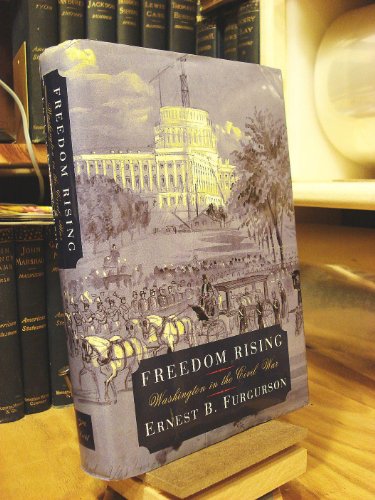
Freedom Rising is a fresh, intensely human account of how the Civil War transformed the nation’s capital from the debating forum for a loose union of states into the seat of a forceful central government.
Before 1861, Washington was a dusty, muddy city of 60,000, joked about by urban sophisticates from New York and Boston. But at the onset of war, thousands of soldiers, job seekers, nurses, good-time girls, gamblers, newly freed slaves–all kinds of Americans–poured in. For days, Washington was cut off from the North, and no one was sure whether it would become the capital of the Union or the Confederacy.
Ernest Furgurson–author of the widely acclaimed Chancellorsville 1863, Ashes of Glory, and Not War but Murder–tells the story through the men and women who brought the city to rambunctious life. He re-creates historic figures such as William Seward, who fancied himself Abraham Lincoln’s prime minister; poet Walt Whitman, who nursed the wounded; and detective Allan Pinkerton, who tracked down Southern sympathizers; and he introduces intriguing others, such as Mayor James Berret, arrested for disloyalty; architect Thomas Walter, striving to finish the Capitol dome in the middle of war; and accused Confederate spy Antonia Ford, romancing her captor, Union Major Joseph Willard, operator of the capital’s premier hotel. Here is Mary Lincoln, mourning the death of her son Willie, seeking solace from fakers who conducted séances in the White House. And here is the president–in all his compassion, determination, and complexity–inspiring the nation, wrangling with generals, pardoning deserters, and barely escaping death on the ramparts of Fort Stevens as Jubal Early’s Southern army invades the outskirts of Washington and fights the Union Army within five miles of the White House. For four years, the city was awash in drama and sometimes comedy, until the assassination of Lincoln by John Wilkes Booth became the tragedy of the century.
By the time the grand two-day victory parade of 150,000 troops surged along Pennsylvania Avenue, the men and women who had arrived in such great numbers at the start of the war had made Washington a capital to be reckoned with throughout the world. Freedom Rising is an invaluable aid to understanding the making of America.
"synopsis" may belong to another edition of this title.
About the Author
Ernest B. “Pat” Furgurson, formerly a correspondent and columnist for the Baltimore Sun, has spent most of his life in the nation’s capital. A native of Virginia, he is also the author of Chancellorsville 1863, Ashes of Glory, and Not War but Murder. He lives in Washington, D.C.
From the Inside Flap
Freedom Rising is a fresh, intensely human account of how the Civil War transformed the nation s capital from the debating forum for a loose union of states into the seat of a forceful central government.
Before 1861, Washington was a dusty, muddy city of 60,000, joked about by urban sophisticates from New York and Boston. But at the onset of war, thousands of soldiers, job seekers, nurses, good-time girls, gamblers, newly freed slaves all kinds of Americans poured in. For days, Washington was cut off from the North, and no one was sure whether it would become the capital of the Union or the Confederacy.
Ernest Furgurson author of the widely acclaimed Chancellorsville 1863, Ashes of Glory, and Not War but Murder tells the story through the men and women who brought the city to rambunctious life. He re-creates historic figures such as William Seward, who fancied himself Abraham Lincoln s prime minister; poet Walt Whitman, who nursed the wounded; and detective Allan Pinkerton, who tracked down Southern sympathizers; and he introduces intriguing others, such as Mayor James Berret, arrested for disloyalty; architect Thomas Walter, striving to finish the Capitol dome in the middle of war; and accused Confederate spy Antonia Ford, romancing her captor, Union Major Joseph Willard, operator of the capital s premier hotel. Here is Mary Lincoln, mourning the death of her son Willie, seeking solace from fakers who conducted séances in the White House. And here is the president in all his compassion, determination, and complexity inspiring the nation, wrangling with generals, pardoning deserters, and barely escaping death on the ramparts of Fort Stevens as Jubal Early s Southern army invades the outskirts of Washington and fights the Union Army within five miles of the White House. For four years, the city was awash in drama and sometimes comedy, until the assassination of Lincoln by John Wilkes Booth became the tragedy of the century.
By the time the grand two-day victory parade of 150,000 troops surged along Pennsylvania Avenue, the men and women who had arrived in such great numbers at the start of the war had made Washington a capital to be reckoned with throughout the world. Freedom Rising is an invaluable aid to understanding the making of America.
Reviews
Adult/High School–Two images bracket this stirring history. The prologue recalls the arrival in 1859 of an 18-foot sculpture called Freedom, intended for the unfinished Capitol building in Washington, DC. At the book's conclusion, Freedom stands atop the magnificent dome in May 1865, while victorious Union forces parade proudly below and citizens mourn a president murdered barely five weeks earlier. Between these events, equally dramatic scenes played out in Washington, where political struggles could be as vicious in their own way as anything transpiring on wartime battlefields. Furgurson brings everything to vigorous life: Lincoln's indomitable character and his skill at manipulating friends and foes in his efforts to preserve the country; the partisan, sometimes corrupt news reporters driven by self-interest; idealists and healers seeking to do good; spies ferreting out secrets; complex and odd characters from all social strata who populated the city during the war years. The attention given to the experiences of mid-19th-century women and African Americans is notable, and as a whole the author's scholarship updates and complements Margaret Leech's Reveille in Washington (Simon, 2001), a Pulitzer Prize-winner long considered the standard work on this topic. Freedomis as readable as it is well documented.–Starr E. Smith, Fairfax County Public Library, VA
For over six decades, a single book has dominated the subject of Abraham Lincoln's Washington. Published in 1941, winner of a Pulitzer Prize, Margaret Leech's Reveille in Washington, 1860-1865 is a classic account of life in the capital during the Civil War. It remains a formidable achievement.
Now a challenger has appeared to contest Leech's preeminence. The unavoidable question is whether Ernest B. Furgurson's Freedom Rising: Washington in the Civil War surpasses Leech's work, rivals it or falls short.
Blessedly, the new book complements the old. A career journalist and the author of three solid warm-up works on Civil War subjects, Furgurson maneuvers around Leech's strengths to take advantage of her (few) weaknesses. He is Grant to her Lee. Reveille in Washington is timeless; Freedom Rising is the ideal portrait of Civil War Washington for our times, an account of the political cat fights behind the dogs of war. Furgurson reported for the Baltimore Sun for more than three decades; as his newspaper's Washington bureau chief, he watched political generations pass in review along Pennsylvania Avenue. He knew the men, the women and the ghosts. That long contact with late-20th-century Washington prepared him as nothing else could to write about the city in the mid-19th century. He understands the political animal as an individual and as a species.
If you want the atmosphere of Lincoln's Washington, turn to Leech, whose 1893 birth placed her in the twilight of formal society, a world that no tarted-up charity gala can recall from the darkness. The manner and manners that separated America's social classes before the triumph of mass capitalism were second-nature to Leech. You can smell her Washington, from the layered scents of gowns worn through a season to the stench of slum lanes. She understood both the viciousness and virtues of gradations.
But if you seek political Washington -- the city of democratic fervor, necessary compromises and exemplary crassness, the inbred town of great character and gleeful character assassination -- Furgurson is your author. He is superb at rendering the terrible machinery of government at work when too many hands grasp too few levers. His Lincoln is no less admirable for being a sharp politician whose strengths included an uncanny ability to size up other men, a sure sense of the moment's possibilities -- and impossibilities -- and a stalwart will.
Furgurson's book is especially instructive at the close of a mean election season. Freedom Rising reminds us that the invective of America's political past was even more vicious than it has been in 2004.
A comprehensive work, Freedom Rising also reaches well beyond party politics. As the reader expects, Furgurson takes more note than Leech of the roles of blacks in the city and the war, from Sojourner Truth's rehearsal on a horse-drawn streetcar of the ordeal of Rosa Parks nine decades later, to regiments of U.S. Colored Troops passing in review before Lincoln. (Walt Whitman felt "it looked funny to see the President standing with his hat off to them just the same as the rest.") He also expands the cast of female characters on the capital stage, from Antonia Ford, the spunky Confederate spy who married into the Willard hotel dynasty, to Jane Grey Swisshelm, a crusader of mighty spleen and erratic judgment.
Furgurson is slyly relevant when describing the moral lapses of the journalists who infected our capital as hopelessly in 1864 as they do in 2004. It was commonplace then for reporters to supplement their incomes between congressional sessions by holding government positions -- provided by patrons who, in return, were viewed favorably by the correspondents. Openly corrupt, the system was, at least, forthright. Nor did the journals of the day make a pretense of objectivity. They were papers of party, and they gloried in the role. The journalists of Lincoln's day chose partisanship over hypocrisy. Given recent tendencies for media outlets to prefer one political party over another, while claiming impartiality, one suspects we are reviving an American tradition of favoring outright those whom we favor in secret.
Always, Freedom Rising returns to Lincoln. Reviled, taunted, insulted, he led the country through an "unwinnable" war and made it a nation. Many another figure struts past in Furgurson's pages, but not one consumes the imagination as does the Great Emancipator. Gen. George McClellan marches by, undone by his own unmanageable brilliance. Cabinet members scheme. Ulysses S. Grant fights. Secretary of State William Seward, the most underappreciated figure in U.S. political history, shares the fate of Ben Jonson, overshadowed by a colossus.
Furgurson's background attunes him to history's tendency to repeat itself not as tragedy, nor as farce, but as a series of ineradicable human patterns. Describing the crucial election of 1864, when the Democrats fielded a former military man as their "peace candidate," the author notes that the students of Columbian College (later George Washington University) "took a straw vote among themselves, and McClellan defeated Lincoln 46 to 12."
Furgurson captures the bite and bile but also the wondrous glory of the Civil War era. Freedom Rising serves as a refreshing tonic at the end of this sorry year, reminding us not only that things might be worse, but that they once were far more dangerous and troubling. Leech drew us inside Washington's past. Furgurson reveals the Washington that endures. Read them both.
Reviewed by Ralph Peters
Copyright 2004, The Washington Post Co. All Rights Reserved.
The journalistic parentage of this book is apparent. Anecdotes, interesting characters—some well known, others obscure—and facts abound, all presented with obvious zeal by an author who spent 30 years with the Baltimore Sun and has written three other books on the Civil War. What's missing is a structure to help Furgurson's exhaustive research, doled out in brief vignettes, cohere into a compelling narrative. The book is neither the promised urban history nor a history of the Civil War, which has certainly been abundantly documented elsewhere, including in Furgurson's other works (Chancellorsville; Not War but Murder). Instead, the reader gets confusing snatches of both. One chapter, for example, begins with a sequence of anecdotes about three young women who arrive in Washington by different routes; devotes a page to Mary Todd Lincoln's spendthrift ways; veers out to St. Louis and John Frémont's unauthorized freeing of Missouri's slaves; proceeds to a discussion of the imposition of martial law and the political discord it causes; and ends with Julia Ward Howe's penning of "The Battle Hymn of the Republic." Civil War buffs and Washingtonians well may find in all this more grist for their enthusiasms, but the general reader may grow impatient as the author ricochets from battlefield to ballroom. 16 pages of b&w photos, 3 maps.
Copyright © Reed Business Information, a division of Reed Elsevier Inc. All rights reserved.
Before the Civil War, Washington, D.C., was a city clearly tied to the South, and it was often viewed as a provincial, cultural backwater by elites in the populous Northeast. By the end of the war, it had been transformed into a great urban center, crowded with troops, bureaucrats, and escaped slaves, and it was the seat of a dramatically expanded federal government. And as a wartime necessity, it was also the most heavily fortified city on Earth. Furgurson paints a compelling portrait of a dynamic, rapidly evolving city on edge. Although the primary focus is on prominent figures, including Lincoln, Seward, and Walt Whitman, the author also captures the hurly-burly of ordinary lives. Citizens try to go about their business under the constant threat (perhaps overblown) of Confederate attack as casualties pour into the city, and news of the progress of the war seems to change daily. This is a well-written and informative account of a city and its citizens passing through a traumatic national ordeal. Jay Freeman
Copyright © American Library Association. All rights reserved
Excerpt. © Reprinted by permission. All rights reserved.
Chapter One
God Alone Can Avert the Storm
Burn the building! Burn it down!"
Hiding on the roof of the ransacked Tremont House, three blocks from the United States Capitol, a handful of scared young Lincolnites peeked down at the shouting mob in the street, sure that they were in mortal danger.
All that fall of 1860, boisterous Republicans who called themselves "Wide-Awakes" had marched along the avenues of other northern cities in black oilcloth capes and caps, waving torches and carrying fence rails to show their enthusiasm for their candidate, the Great Rail-Splitter. But in Washington, surrounded by Southern partisans, they had kept quiet until the last weeks of the presidential campaign, when Abraham Lincoln's victory seemed more and more likely. Then, sure that history was with them, some 500 paraded openly, with a few blacks tagging along behind. As they strode along Pennsylvania Avenue, they defied showers of rocks and taunts from proslavery ruffians shouting "Damn niggers! They oughtn't to be allowed on the streets." Late on November 6, the Wide-Awakes gathered to greet the election returns at the Tremont House, at Second Street and Indiana Avenue, the former office of the National Era, which had serialized Harriet Beecher Stowe's Uncle Tom's Cabin eight years earlier. Now the building was headquarters for local Republicans, who called it their "wigwam," after the Chicago hall where Lincoln had been nominated the previous May.
Loud as some Washingtonians were, they had no legal voice in what was coming; they could not vote for president, so all their excitement was focused on the returns from elsewhere. Pennsylvania Avenue, Seventh Street and C Street were alive that night with people streaming from one hotel to another, one political club to another, looking for news and free whiskey. An anxious crowd surrounded the telegraph office on Fourteenth Street, awaiting the figures from crucial New York, and another watched results posted on the bulletin board outside the National Hotel. At the theater on E Street, in the city where he had made his stage debut at the age of four with a blackface comedian called Jim Crow, the wildly popular Joe Jefferson was playing to a full house. He repeatedly interrupted his performance to announce the latest election returns; the audience cheered each Democratic upswing and hissed at Republican successes. At the Democratic Jackson Association (derided by opponents as the "Dem. Jack. Ass."), misleading early bulletins encouraged officers to send for a brass band to lead a triumphant parade. But after tuning up, the musicians slumped away when the hard truth set in. Disappointed losers then milled around Brown's Hotel, the traditional base of Southern legislators, where one young gladiator dared anybody to admit being "a damned black Republican," thus setting off a mass scrimmage that left noses bloody. When police broke up the melee, the crowd surged toward the Republican wigwam.
By that time, half an hour after midnight, the news that Pennsylvania had gone Republican spread up and down the Avenue: Abe Lincoln would become the sixteenth president of the United States. The jubilant Wide-Awakes were celebrating with songs and speeches when one of their members rushed in shouting that the gang of frustrated Democratic toughs, many of them from the secessionist National Volunteers militia company, were on their way to tear down the Republican clubhouse. The Lincoln boosters quickly scattered, leaving behind only a handful of their officers, who turned out the gaslights and locked the doors.
When the fighting-drunk mob arrived, it let go three loud cheers, then started firing pistols and throwing rocks, smashing windows and breaking in doors. The few remaining Republicans retreated to the second floor, then the third, then the roof, where they armed themselves with bricks from the chimney to hold off the intruders. But the mob was busy wrecking the building's interior, pitching furniture out the windows, ripping up banners, ransacking club records, smashing statuettes of Lincoln and his vice presidential running mate, Hannibal Hamlin of Maine. When police arrived, rioters leaped down stairwells and out windows to escape, but once outside they re-formed and began chanting "Burn the building! Burn it down!" The Wide-Awakes trapped on the roof were finally saved when the police arrested a batch of the wreckers and drove the rest away. Even then the mob marched off defiantly, filling the street from curb to curb, shouting allegiance to the National Volunteers, until at last its energy flickered out in the approaching dawn.
In the most momentous election in the nation's history, Lincoln had won only 39.9 percent of the popular ballots but 59.4 percent of the electoral vote, against a divided field: the Northern Democrat, Senator Stephen A. Douglas of Illinois; the Southern Democrat, Vice President John C. Breckinridge of Kentucky; and the Constitutional Unionist, former Senator John Bell of Tennessee. The result inspired more political turbulence than celebration in a capital dominated by Marylanders, Virginians and the Southern Democrats who had held power for most of the previous decade. The day after the vote was confirmed, a North Carolinian in the capital wrote to friends back home that the election of the "Black Republican" Lincoln was "the greatest calamity that has ever befallen the United States. The sun that rose on Tuesday morning cast its bright rays upon a powerful & noble Republic, in the evening it went down on a ruined, tattered Union, for such I believe will be the result."
Both Virginia and Maryland, the two states that enclose the capital on the Potomac, had rejected Lincoln by overwhelming margins. Hotheaded politicians farther south immediately started moves toward secession; some of the ultras among them had spoken secretly of mounting a coup to prevent the president-elect from taking office. The National Volunteers, whose rioting members had tried to burn down Republican headquarters, would be heard from again and again. Extremists on both sides took spirit from the emergency; the roar from Southern militants antagonized radical abolitionists up north. But Washingtonians, most of them, epitomized the millions of conservative Americans in between, who were more alarmed than exhilarated by the clamor.
At the Capitol, surrounded by construction sheds, scaffolding, iron girders and scattered columns of marble, Thomas Ustick Walter was near despair. "Our country is in the midst of a terrible partisan conflict," he told his son-in-law, "and we are in the vortex of it."
Walter was a tall, imposing Philadelphian, his German-American roots deep in the North. But he was torn. He had been appointed architect of the Capitol by a Whig president and kept in his prestigious job by two Democrats. As tension rose, he wrote that "the North looks to me to be insane. [It is] mere stinking pride of opinion that is this moment moving on to allow the country to be deluged in blood."
"I have no idea that there will be any appropriation this winter for public works," he wrote-and so the climactic mission of his distinguished career, building the new dome that he had just redesigned, might stop before it was well started. Vendors could still hawk fruit, beer and souvenirs within the hallways of the Capitol, and members of Congress could still trade votes in their hideaway watering holes. But Walter feared that work on the new House and Senate wings would halt and the Capitol would stand as it was, seeming decapitated, leaking around the edges of new construction, some of its brick walls without their marble facings, its niches without their statues.
If war came, Walter wrote, he might even leave the country, to "try how it goes to live under an autocrat; Russia is the place." Perhaps he was remembering how the Italian architect Francesco Bartolomeo Rastrelli had conceived so many of the masterpieces of Peter the Great's capital. "If I knew the language, I believe I would make straight for St. Petersburg the moment our politicians 'break the machine.' . . .
"God alone can avert the storm," Walter wrote. "We must trust in Him."
But on the Senate floor, Benjamin Franklin Wade, an irrepressible antislavery senator from Ohio, backed up his confidence in the Almighty. Remembering how his abolitionist colleague Charles Sumner of Massachusetts was caned near to death a few desks away by the South Carolina Congressman Preston Brooks, he made known that any Southern fire-eater who threatened or insulted him would be invited to duel-with rifles, at twenty paces, with paper targets the size of silver dollars over each man's heart.
For four weeks after the election, Southern voices in the capital were even more dominant than usual, because Congress was in recess. Until the legislature returned, most of the politicians on hand were Democratic bureaucrats and supplicants, whose party had controlled the White House and thus patronage through the Franklin Pierce and James Buchanan administrations. Between the election and Congress's return, Buchanan called two meetings of his ideologically split cabinet, and reached no consensus at all on how to deal with the situation. But in the cabinet, in the saloons and in Congress when it returned, the focus of debate had shifted from expansion of slavery to the right of secession, and the use of Federal force to prevent it.
The legalistic Buchanan, whom one fellow Democrat had called "that damned old wry-necked, squinty-eyed, white-livered scoundrel who disgraces the White House with his presence," was squeezed from both sides. He had come to the job with what seemed eminent qualifications: after service in the War of 1812, he had been elected to the Pennsylvania legislature in 1814, spent ten years as a congressman and ten years as a senator, then become minister to Russia, secretary of state, and minister to G...
"About this title" may belong to another edition of this title.
Other Popular Editions of the Same Title

Search results for Freedom Rising: Washington in the Civil War

Stock Image
Freedom Rising Washington in t
Seller: World of Books (was SecondSale), Montgomery, IL, U.S.A.
Seller rating 5 out of 5 stars

Condition: Very Good. Item in very good condition! Textbooks may not include supplemental items i.e. CDs, access codes etc. Seller Inventory # 00101209112
Stock Image
Freedom Rising: Washington in the Civil War
Seller: HPB Inc., Dallas, TX, U.S.A.
Seller rating 5 out of 5 stars
Hardcover. Condition: Very Good. Connecting readers with great books since 1972! Used books may not include companion materials, and may have some shelf wear or limited writing. We ship orders daily and Customer Service is our top priority! Seller Inventory # S_468724899
Stock Image
Freedom Rising: Washington in the Civil War
Seller: ThriftBooks-Dallas, Dallas, TX, U.S.A.
Seller rating 5 out of 5 stars
Hardcover. Condition: Very Good. No Jacket. May have limited writing in cover pages. Pages are unmarked. ~ ThriftBooks: Read More, Spend Less. Seller Inventory # G0375404546I4N00
Stock Image
Freedom Rising: Washington in the Civil War
Seller: ThriftBooks-Dallas, Dallas, TX, U.S.A.
Seller rating 5 out of 5 stars
Hardcover. Condition: Very Good. No Jacket. Missing dust jacket; May have limited writing in cover pages. Pages are unmarked. ~ ThriftBooks: Read More, Spend Less. Seller Inventory # G0375404546I4N01
Stock Image
Freedom Rising : Washington in the Civil War
Published by
Knopf Doubleday Publishing Group, 2004
ISBN 10: 0375404546
ISBN 13: 9780375404542
Used
Hardcover
Seller: Better World Books, Mishawaka, IN, U.S.A.
Seller rating 5 out of 5 stars
Condition: Good. Former library copy. Pages intact with minimal writing/highlighting. The binding may be loose and creased. Dust jackets/supplements are not included. Includes library markings. Stock photo provided. Product includes identifying sticker. Better World Books: Buy Books. Do Good. Seller Inventory # 2014365-6
Stock Image
Freedom Rising : Washington in the Civil War
Published by
Knopf Doubleday Publishing Group, 2004
ISBN 10: 0375404546
ISBN 13: 9780375404542
Used
Hardcover
Seller: Better World Books: West, Reno, NV, U.S.A.
Seller rating 5 out of 5 stars
Condition: Good. Pages intact with minimal writing/highlighting. The binding may be loose and creased. Dust jackets/supplements are not included. Stock photo provided. Product includes identifying sticker. Better World Books: Buy Books. Do Good. Seller Inventory # 4043592-6
Stock Image
Freedom Rising : Washington in the Civil War
Published by
Knopf Doubleday Publishing Group, 2004
ISBN 10: 0375404546
ISBN 13: 9780375404542
Used
Hardcover
Seller: Better World Books: West, Reno, NV, U.S.A.
Seller rating 5 out of 5 stars
Condition: Good. Former library copy. Pages intact with minimal writing/highlighting. The binding may be loose and creased. Dust jackets/supplements are not included. Includes library markings. Stock photo provided. Product includes identifying sticker. Better World Books: Buy Books. Do Good. Seller Inventory # 2014365-6
Stock Image
Freedom Rising: Washington in the Civil War
Seller: Wonder Book, Frederick, MD, U.S.A.
Seller rating 5 out of 5 stars
Condition: Very Good. Very Good condition. Very Good dust jacket. A copy that may have a few cosmetic defects. May also contain light spine creasing or a few markings such as an owner's name, short gifter's inscription or light stamp. Seller Inventory # Y06L-00007
Stock Image
Freedom Rising: Washington in the Civil War
Seller: Wonder Book, Frederick, MD, U.S.A.
Seller rating 5 out of 5 stars
Condition: As New. Like New condition. Very Good dust jacket. A near perfect copy that may have very minor cosmetic defects. Seller Inventory # T00B-02815
Stock Image
Freedom Rising: Washington in the Civil War
Seller: Wonder Book, Frederick, MD, U.S.A.
Seller rating 5 out of 5 stars
Condition: Good. Good condition. Good dust jacket. A copy that has been read but remains intact. May contain markings such as bookplates, stamps, limited notes and highlighting, or a few light stains. Bundled media such as CDs, DVDs, floppy disks or access codes may not be included. Seller Inventory # Y01A-02077