
Items related to The Right Hand of Sleep
Synopsis
Oskar Voxlauer is in flight from his past—from his bourgeois Austrian upbringing; from horrific memories of fighting on the Italian front in 1917 as a teenage recruit; and from the twenty years he has spent in the Ukraine watching his socialist ideals crumble and the life of the woman he loved slowly waste away. Alone, he finally decides to return to the Austrian village of his birth, where his mother is waiting to greet a son she hasn’t seen since he was a boy.
But the year is 1938, and despite Oskar’s attempt to live a reclusive existence as a gamekeeper in the hills, he cannot escape the tensions that are threatening the once tranquil village of Niessen. Hitler marches into Austria and the Black Shirts come to the valley. Voxlauer watches as his Jewish friend and benefactor is driven to ruin. The only things saving him—a “Red,” a deserter and a “Yid lover”—from the attentions of the SS seem to be the respect the community has for his parents and his growing love for the mysterious Else Bauer, cousin of the new SS Führer.
In his extraordinary first novel, John Wray has given both a poetic evocation of the Austrian landscape and an acute portrait of the dark side of its past. His subtle and human understanding of the ambiguities of history, the complexities of his characters and the stunning richness of his prose mark him as one of America’s most gifted new writers.
"synopsis" may belong to another edition of this title.
About the Author
John Wray was born in Washington, D.C., in 1971. A citizen of the United States and Austria, he lives in Brooklyn. This is his first novel.
Reviews
The ghost hovering over this assured and astonishingly mature first novel is that of Joseph Roth, the great interwar Austrian novelist. Perhaps this reflects Wray's own double origin, as the son of an Austrian father and an American mother. Oskar Voxlauer, Wray's Austrian protagonist, was a teenage deserter from the Austro-Hungarian army in WWI. As the novel begins, he is returning to his native village, Niessen bei Villach, in 1938, after a 19-year stay in the Ukraine. His Russian lover's death has released him, and he is coming back in the middle of Hitler's Anschluss to see his lonely mother. To escape the tensions in Niessen, Oskar goes to work as a gamekeeper on a stretch of forest his Jewish tavernkeeper friend Ryslavy owns outside town. There he meets the old gamekeeper's daughter, Else Bauer, who lives under a vague cloud, having borne a daughter out of wedlock. The two are briefly happy together, but then Else's cousin, Kurt, returns to Austria from exile in Germany, as the head of the Nazis in Niessen. Kurt is also, Oskar quickly discovers, more to Else than a cousin. Oskar publicly opposes the Nazis; Kurt ambiguously patronizes him. Soon the triangle between Else, Oskar and Kurt becomes fraught with menace. The gloom of the dark days of late '30s Austria is heightened by Oskar's recollections of personal trauma: his wartime experiences; the suicide of his father, a famous opera composer; and the brutal collectivization of the Ukrainian countryside. Wray's first novel displays psychological acuity, a mastery of dialogue and an unfailing historical empathy, and should garner deserved raves.
Copyright 2001 Cahners Business Information, Inc.
A disillusioned Austrian soldier returns home from World War I after 20 years only to face a new moral and social dilemma. Oskar Voxlauer, son of a well-regarded family in his town, deserts his unit soon after arriving at the Italian front in 1917. He makes his way to the Ukraine in the days following the Russian Revolution, taking up with Anna, a Ukrainian widow. After her death, he returns home, finding work as a gamekeeper. History, in the form of the German annexation of Austria in 1938, soon intrudes on his solitude, however. Complicating matters, he becomes involved with Else, whose cousin is the local Nazi commander. The delicate d tente among the threesome disintegrates after hooligans vandalize a bar owned by Paul, a Jewish friend of Oskar, forcing him, in his own way, to take a stand. More a character study than a moral tale, this is a quietly memorable first novel. For most libraries.DLawrence Rungren, Merrimack Valley Lib. Consortium, Andover, MA
Copyright 2001 Reed Business Information, Inc.
Excerpt. © Reprinted by permission. All rights reserved.
Niessen
October 12, 1917
A boy came out of the house first, the crumbling, sun-yellowed house with the dark tiles and ivied sides, the peaked roof and sandstone steps down which he went stiffly, nervously, adjusting the plaid schoolboy’s backpack on his shoulders. A tall stooping boy in his middle teens, smiling to himself as he waited by the gate, breathing quickly. It was a bright fall day and he closed his eyes for a moment, feeling the sunlight through his eyelids there at the garden’s edge.
Soon the others came, a man and a woman, the parents of the boy. The man moved slowly, his cream-colored suit well ironed but billowy, as though cut for someone larger. His features like his clothes seemed oversized or borrowed, a loose cluster of tics behind which his eyes hung uncertainly, moving from the boy to the trellises to the old house behind them. The woman walked half a pace behind the man, guiding him by the elbow down the steps. She was still young. She carried herself proudly and severely. Hearing them the boy opened his eyes. He was still smiling slightly, and looking at them as he smiled, but the smile was not meant for them and when he realized this he drew his lips together. He stood at the gate for what seemed a very long time, watching them coming. Finally they reached him and the three of them went out onto the street.
Linking arms they walked toward the mortared gray wall of the canal and the brightly colored rooftops behind it. A smell of woodsmoke was in the air. At the canal they left the road and turned onto a narrow lane. The woman was watching the boy silently, her left arm braced against her husband. He and the boy were talking to each other in low, even tones, but she was not listening to them. The man’s eyes as he spoke were not on the boy or on the ground ahead of them but instead on some far-off thing, as they always were. The boy talked on, not listening to the talk itself but talking only to fill the minutes, eyes rarely leaving his father’s face. From time to time he let out an embarrassed laugh.
After some minutes they came to a wide gravel avenue curling out from town over a mortared bridge. They stayed there awhile looking down into the water. Before long a young, doughy-faced man came up the avenue on a bicycle. The woman waved to him and he pulled up in front of them.
—Well, Oskar, said the man, grinning down at the boy.
—Your number’s come up at last, has it?
—Yes, Uncle.
—Yes. Well, we’re damn proud, all of us. Hopping proud.
—We’re not proud at all, Gustl, said the woman.
The man on the bicycle grinned again.
—Mothers take these things hard, old man, he said, tapping the boy’s shoulder.
—“We have all of us our burthens,” as the ditty goes.
—Why aren’t you in Italy yet, Uncle? said the boy.
—Palpitations, Oskar. You know very well. Palpitations, damn them. He sighed.
—Still. There’s need of good men on the home front as well, as the Kaiser says. Eh, Karl?
The boy’s father made a low sound, possibly of assent, looking down the avenue through the lines of whitewashed willow trunks toward the station.
—We’d best be going on, Gustl, said the woman quietly.
—You’ll be round tonight for supper?
—Yes, yes, Dora. He drew in a breath, looked down at the boy and gave a wink.
—Well, Oskar: do your duty by those greasy olive-pickers. Stack ‘em straight for your nearest and dearest.
—That’s enough, now, Gustl, said the woman.
—God in heaven.
—Good-bye, Uncle. I’ll do my best.
—Damn right you will.
—The train, Dora, said his father, stepping forward.
Walking down the Bahnhofstrasse with his parents on either side of him, hurrying to the station, the boy was struck for the first time by the significance of what was happening to him and looked back often over his shoulder. Framed by the cut-back willow rows, encircled and held toward the sun by the mountain behind it, the town looked like nothing so much as an antique jeweler’s miniature, sliding away with a clicking of wheels and cogs into the pines. He realized that it was beautiful and at the same time that it was vanishing from his life. His mother was talking to him now, rapidly, urgently; his father was walking as quickly as he was able, wheezing and opening his eyes wide with every breath. It occurred to the boy that he hadn’t looked at his mother since they’d left the house and he knew this must hurt her but still he could not do it. I know what she looks like, he thought. I know what she looks like right now. I don’t need to see her.
—Have you taken enough warm things, Oskar? she was saying.
—Have you taken enough winter clothes?
—Maman, he said, laughing a little.
—I can’t wear just whatever I like, you know. They’ll be wanting me in a uniform. He looked over at his father, who nodded gravely.
His mother’s voice resumed immediately, tight with worry, humorless.
—Do you find this so very funny, Karl?
—A little funny, Dora. Not so much.
—I was thinking more about your underclothes, Oskar, his mother said, pulling him forward. His father let out a quiet laugh behind them.
At the station the boy presented his conscription card and was issued a ticket. There were a number of other families on the platform but he stood with his parents a small distance away, look- ing in the direction from which the train would come. One of the women was sobbing noisily and clutching at her two sons, twins with thick shoulders and flattened reddish hair who muttered and made faces at each other.
—Who are these people? the boy’s mother said.
—Who is that woman, Karl, with those two boys? She frowned.
—I swear I don’t know one single person here at all.
—You do know them, Maman, the boy said, looking at his father and rolling his eyes.
—Franz and Christian Rindt. Their brother, Willi, runs the new gasthaus across the square from Ryslavy’s. And you know the Hoffenreichs behind them. Erich, Maria and Peter.
—Well, his mother said, straightening herself.
—For me there will always be one gasthaus in Niessen: the Niessener Hof. She looked over at her husband, who stared resolutely up the tracks. Her lips were tightly drawn and she looked prim and comical. As though she’s just eaten a piece of wax-dipped fruit, the boy said to himself. Everything she is is joyless, and not just because of Père. She was like that before, too, when he was better. Your finest country lady. He thought again that if the war hadn’t called him he’d have found another way to leave, with or without their blessing, before very long.
—We’re all cut from the same cloth in times of war, Maman, said the boy.
—Our Kaiser tells us so.
His father raised a hand to cover his mouth.
—Go on, his mother said.
—Go on, Karl. Laugh at that. But she was smiling now as well.
At that moment someone pointed and the three of them turned to see the first jet of steam coiling over the trees.
—Well, Oskar, said his mother calmly. She had taken hold of him by his shoulders and was looking him over exactingly and slowly, studying him, her eyes wide and determined. In case I don’t come back, the boy thought, turning the thought back and forth in his mind to get the feeling of it. He looked past her at his father who was watching the train approaching, motionless and enraptured, as if this were the inescapable thing he’d been awaiting. It isn’t this, all the same, the boy thought. It isn’t this. But this reminds him of it.
For the space of a minute none of them said a word. Behind them Frau Rindt was still weeping and shouting in her heavy hill-town drawl against the war.
—Keep a journal, Oskar, his father said when the train was almost to the station.
—Will you do that for me? All the inane details, les temps absurdités . . . yes? I’m sure there’ll be plenty. Send it to me in installments, with your letters. I did that for my own Père, when I had my time in Dalmazien. He was smiling now.
—Will you? His voice was very mild, almost beseeching.
The boy glanced at his mother.
—Would that help you, Père? he said slowly.
His father nodded.
—I’d consider it a kindness. It saved your old grandfather, in his day, from expiring of boredom. He raised his shoulders slowly, doggedly, as though resisting a pull upward.
—You’ll spare me that, won’t you, Oskar? Wasting slowly away in this pretty backwater, decaying into dust?
—Now, Karl, said the boy’s mother, suddenly severe again.
—I’m sorry, Dora. A little joke.
—We can’t have this, Karl. Not now. Are you listening?
—It’s all right, Maman, for Christ’s sake, said the boy.
—Let it alone, he said, already hearing the noise of the train behind him.
—I’m sorry, Dora, said his father.
—A little joke with the boy, that’s all. We’ll never see him again, you know.
—Karl! she said now, beginning to tremble.
—Please, Maman. Let him be. Please.
—Oskar, she said, laying hold of his arm. Then the train was beside them.
"About this title" may belong to another edition of this title.
Search results for The Right Hand of Sleep

Stock Image
The Right Hand Of Sleep
Seller: BookHolders, Towson, MD, U.S.A.
Seller rating 5 out of 5 stars

Condition: Very Good. [ No Hassle 30 Day Returns ][ Ships Daily ] [ Underlining/Highlighting: NONE ] [ Writing: NONE ] [ Edition: Reprint ] Publisher: Knopf Pub Date: 2/1/2000 Binding: Hardcover Pages: 325 Reprint edition. Seller Inventory # 6649522
Stock Image
The Right Hand of Sleep
Published by
Knopf Doubleday Publishing Group, 2001
ISBN 10: 0375406514
ISBN 13: 9780375406515
Used
Hardcover
First Edition
Seller: Better World Books: West, Reno, NV, U.S.A.
Seller rating 5 out of 5 stars
Condition: Very Good. 1st. Pages intact with possible writing/highlighting. Binding strong with minor wear. Dust jackets/supplements may not be included. Stock photo provided. Product includes identifying sticker. Better World Books: Buy Books. Do Good. Seller Inventory # 38559503-75
Stock Image
The Right Hand of Sleep
Seller: HPB-Emerald, Dallas, TX, U.S.A.
Seller rating 5 out of 5 stars
hardcover. Condition: Very Good. Connecting readers with great books since 1972! Used books may not include companion materials, and may have some shelf wear or limited writing. We ship orders daily and Customer Service is our top priority! Seller Inventory # S_461045674
Stock Image
The Right Hand of Sleep
Seller: HPB Inc., Dallas, TX, U.S.A.
Seller rating 5 out of 5 stars
hardcover. Condition: Very Good. Connecting readers with great books since 1972! Used books may not include companion materials, and may have some shelf wear or limited writing. We ship orders daily and Customer Service is our top priority! Seller Inventory # S_480867673
Stock Image
The Right Hand of Sleep
Published by
Knopf Doubleday Publishing Group, 2001
ISBN 10: 0375406514
ISBN 13: 9780375406515
Used
Hardcover
First Edition
Seller: Better World Books, Mishawaka, IN, U.S.A.
Seller rating 5 out of 5 stars
Condition: Very Good. 1st. Former library copy. Pages intact with possible writing/highlighting. Binding strong with minor wear. Dust jackets/supplements may not be included. Includes library markings. Stock photo provided. Product includes identifying sticker. Better World Books: Buy Books. Do Good. Seller Inventory # 50826886-6
Stock Image
The Right Hand of Sleep: A Novel
Published by
Alfred A. Knopf, 2001
ISBN 10: 0375406514
ISBN 13: 9780375406515
Used
Hardcover
First Edition
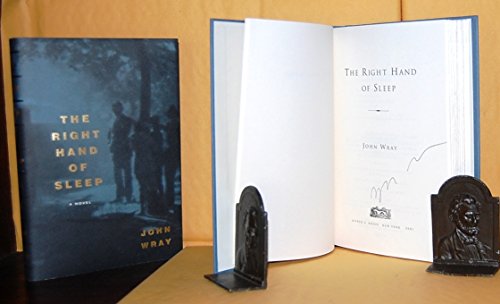
Signed
Seller: Garys Books-Log Cabin Books, Apache Junction, AZ, U.S.A.
Seller rating 5 out of 5 stars
Hardcover. Condition: Fine. Dust Jacket Condition: Fine. 1st Edition. First Printing. Included in the price is a SIGNED Uncorrected Proof. Tiny bit of exposure to one corner of the unlaminated jacket. Author of GODSEND and LOWBOY. Signed by Author(s). Seller Inventory # 017099
Stock Image
The Right Hand Of Sleep
Seller: Library House Internet Sales, Grand Rapids, OH, U.S.A.
Seller rating 5 out of 5 stars
Hardcover. Condition: Good. Dust Jacket Condition: Good. A teenage deserter from the army during the First World War, Oskar Voxlauer returns to his home in Austria after nearly twenty years of exile, only to find himself caught up in the growing political tensions and rising fascism in the area. Former library book. Mylar protector included. Solid binding. Binding is so loose that the book will stay open to any given page. Please note the image in this listing is a stock photo and may not match the covers of the actual item. Ex-Library. Seller Inventory # 123569739
Stock Image
The Right Hand of Sleep
Published by
Knopf, New York, 2001
ISBN 10: 0375406514
ISBN 13: 9780375406515
Used
Hardcover
First Edition
Seller: A Boy Named Crow, Van Nuys, CA, U.S.A.
Seller rating 5 out of 5 stars
Hardcover. Condition: Near Fine. Dust Jacket Condition: Near Fine. 1st Edition. A NF+ book in a NF dust jacket. First Edition (stated)/ First Printing of author's first book. Book has bumping to base of spine else clean, unmarked, tight and square. Jacket has light edge wear, chipping to corners and an very small (1/8th-1/16th of an inch) tear at base of spine else fully intact, bright and clean with no markings or further tears. A solid, unread copy over all. Seller Inventory # 001082
Stock Image
The Right Hand of Sleep
Seller: POQUETTE'S BOOKS, DEWITT, MI, U.S.A.
Seller rating 5 out of 5 stars
Hardcover. Condition: Good. Seller Inventory # mon0000114199
Stock Image
The Right Hand of Sleep
Published by
Knopf April 2001, 2001
ISBN 10: 0375406514
ISBN 13: 9780375406515
Used
Hardcover
First Edition
Seller: Dunaway Books, St. Louis, MO, U.S.A.
Seller rating 4 out of 5 stars

Hardcover. Condition: Very Good. Dust Jacket Condition: Poor. First Edition. Dust jacket covered in protective mylar sleeve. Seller Inventory # 225096