
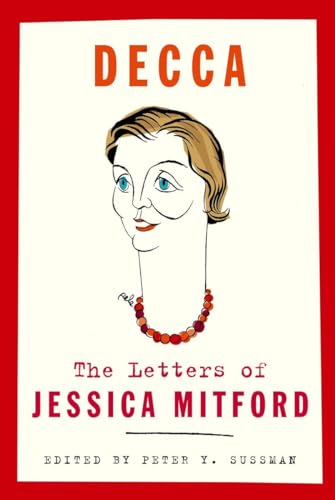
Items related to Decca: The Letters of Jessica Mitford
Synopsis
“Decca” Mitford lived a larger-than-life life: born into the British aristocracy—one of the famous (and sometimes infamous) Mitford sisters—she ran away to Spain during the Spanish Civil War with her cousin Esmond Romilly, Winston Churchill’s nephew, then came to America, became a tireless political activist and a member of the Communist Party, and embarked on a brilliant career as a memoirist and muckraking journalist (her funeral-industry exposé, The American Way of Death, became an instant classic). She was a celebrated wit, a charmer, and throughout her life a prolific and passionate writer of letters—now gathered here.
Decca’s correspondence crackles with irreverent humor and mischief, and with acute insight into human behavior (and misbehavior) that attests to her generous experience of the worlds of politics, the arts, journalism, publishing, and high and low society. Here is correspondence with everyone from Katharine Graham and George Jackson, Betty Friedan, Miss Manners, Julie Andrews, Maya Angelou, Harry Truman, and Hillary Rodham Clinton to Decca’s sisters the Duchess of Devonshire and the novelist Nancy Mitford, her parents, her husbands, her children, and her grandchildren.
In a profile of J.K. Rowling, The Daily Telegraph (UK), said, “Her favorite drink is gin and tonic, her least favorite food, trip. Her heroine is Jessica Mitford.”
"synopsis" may belong to another edition of this title.
About the Author
Jessica Mitford is also the author of Hons and Rebels (previously published as Daughters and Rebels), The American Way of Death, The Trial of Dr. Spock, Kind and Usual Punishment, A Fine Old Conflict, Poison Penmanship, Faces of Philip: A Memoir of Philip Toynbee, Grace Had an English Heart, and The American Way of Birth. Until her death in 1996, she lived in Oakland, California, with her husband, labor lawyer Robert Treuhaft.
Peter Y. Sussman was an award-winning editor at the San Francisco Chronicle from 1964 to 1993 and has written, edited, taught, and lectured widely since then. He is the coauthor of Committing Journalism and was a coauthor of the Society of Professional Journalists’ Code of Ethics. He lives in Berkeley, California.
Reviews
Mitford? Now where have we heard that name before? Let me count the ways, or at least a few of them.
Once upon a time, in England, Lord and Lady Redesdale had six daughters and one son. All the girls were good-looking but a little out of the ordinary, especially after they grew up. Nancy resided in Paris, lived "in sin" and wrote delicious comic novels, including The Pursuit of Love and Love in a Cold Climate. Deborah married very, very well, becoming the duchess of Devonshire and chatelaine of the great English country house Chatsworth. Unity, alas, got to be an intimate friend of Adolf Hitler, whom she just adored, and shot herself in the head on the day Britain declared war on Germany. The particularly beautiful Diana divorced her first husband to wed her lover, the infamous British fascist leader, Sir Oswald Mosley. Brother Tom was killed during World War II, and sister Pam somehow led a quiet, fairly conventional life, probably just to be different.
And then there was Jessica (1917-96). If you don't know about Decca, as everyone called her, just start reading this terrific collection of letters and hang on for the ride.
During the 1930s, Decca took off to fight on the Republican side in the Spanish Civil War with her boyfriend and eventual husband, Esmond Romilly. Later, the adventurous lovebirds moved to Washington, where they became close chums with the young Katharine and Philip Graham, as well as the crusading civil libertarians Virginia and Clifford Durr. After World War II broke out, Esmond enlisted, returned to Britain, and one day never came back from a flying mission. Esmond's uncle, Winston Churchill, told Decca that there was no hope of her 23-year-old husband being found alive.
By this time, Decca was working for the Office of Price Administration and was happy to leave Washington, with its painful memories, for a position in San Francisco. There, she married a crusading young attorney named Robert Treuhaft. The two almost immediately joined the American Communist Party, tirelessly focusing their efforts on the cause of civil rights. This never changed, even after they quit the party in the late 1950s. Throughout his career, Treuhaft took on myriad cases of perceived injustice, defending the wrongfully accused, agitating for retrials, fighting for prisoners' rights. He even became lawyer to the legendary Free Speech Movement at Berkeley and something of a hero of the times. In the late 1960s, a young Yale law student named Hillary Rodham spent a summer clerking for Treuhaft's law firm.
Meanwhile, Decca, the subversive housewife, reared three children, agitated, protested, and wrote magazine articles, a memoir of the Mitford family (Hons and Rebels) and, as this book shows, lots of letters. Wonderful letters. On every page of this enormous volume, she is right there -- funny, smart, swinging hard, fiercely uncompromising. In 1943, she complained to Churchill ("Dear Cousin Winston") about the Mosleys' release from prison on health grounds: "My personal feeling is that the release of the Mosleys is a slap in the face to antifascists in every country, and that it is a direct betrayal of those who have died for the cause of anti-fascism. The fact that Diana is my sister doesn't alter my opinion on this subject." For the rest of her life, she remained "off-speakers" with Diana, and the two sisters never saw each other again.
But Decca corresponded regularly with Lady Redesdale, Nancy and Deborah (or "Debo"). On June 25, 1950, she wrote to her very proper and conservative mother, in an example of what she sometimes called the "Mitford tease": "Could you possibly ring up the Daily Worker next time you're in London & ask them whether they know of any interesting mass meetings or demonstrations in Paris scheduled for late Sept. or early October; if so, we could arrange accordingly about when to go to Paris." She ends another note to Lady Redesdale with this P.S.: "On re-reading this letter I see it is full of references to jails, sorry, but that is where most of our friends are."
Throughout her life, Decca laughs -- "roars" is her favorite verb -- at the quirks and prejudices of the rich or racist. Here are two anecdotes from a single letter (June 19, 1957), describing a wedding in Montgomery, Ala.:
"The wedding was preceded by innumerable lunches, evening parties with Ladies Home Journal type food (croquettes, creamed asparagus, ice cream in shape of bridal shoes, jellied salads, etc. etc.) where the conversation tended to run in similar channels: 'My, you look lovely.' 'I deaclare [sic] I never did see a prettier bride than Lucy.' 'Well Tilla will be the next one now,' and similar gems of wisdom and erudition. . . . I had an interesting conversation with Lucy's father-in-law. He is a leading light from Birmingham, on the school board etc. We were deploring the state of education all over, lack of provision for bright kids, etc. He asked me what was being done for them in Calif, so I told him about the special group at Washington Grammar School for children with IQ of over 150, and let drop the information that in the group are 1 white child, two orientals, 1 Negro. He said, in genuine amazement, 'It don't seem possible that no Nigra would have no IQ of no 150, do it now?' I answered politely, 'Well, I think it do seem possible, I don't think no race has nothing to do with no IQ.' "
A few years later, Decca found herself back in Montgomery -- locked in a church with Martin Luther King Jr. and other supporters of the Freedom Rides while a mob outside set fire to her borrowed car.
In the early 1960s, Decca started to investigate the gruesome subject of funeral arrangements, which she found bizarre, exorbitantly expensive and emotionally exploitative. The result was her 1963 bestseller The American Way of Death. When the book appeared in England, Evelyn Waugh -- whose novels included The Loved One, about Forest Lawn Cemetery -- reviewed it positively, but, as Decca wrote to Debo, he "said I don't have a 'plainly, stated attitude to death.' So if you see him, tell him of course I'm against it."
For the rest of her life, Decca was widely known as the "Queen of the Muckrakers," publishing a subsequent book about prisons (Cruel and Usual Punishment), a retrospective account of her years as a communist (A Fine Old Conflict) and much else, even a magazine exposé of the Famous Writers School. She wrote to Betty Friedan about women's issues and to Merle Miller about "coming out," to the Black Panther George Jackson in Soledad Prison and to Carl Bernstein about being a "red diaper" baby. Her American "sisters" included both Maya Angelou and the novelist Kay Boyle, but she had friends everywhere. When a restaurant refused her check, she phoned New York Times food critic Craig Claiborne. Vanessa Redgrave inquired into the possibility of a movie about her life. Julie Andrews became a pen-pal, as did her now celebrated editor Robert Gottlieb, and she gradually renewed contact with Katharine Graham. In one note to the San Francisco columnist Herb Caen, she even mentioned doing a piece for Nina King, "the v. nice book editor at Newsday." (Mitford later wrote for King again after the latter became editor of Book World.)
Decca's activism naturally passed on to her daughter Constancia (by Romilly), who joined the Student Nonviolent Coordinating Committee and became the partner of its leader, James Forman, by whom she eventually had two sons. Decca adored the boys, though the couple seemed uninterested in actually getting married. Still, as Decca explained to Nancy, now when a racist asks if she'd want her daughter to marry a Negro, she can answer, "Rather."
Jessica Mitford was once pressed about what kind of funeral she would like, and the author of The American Way of Death replied, with tongue firmly in cheek, "six black horses with plumes and one of those marvelous jobs of embalming that take 20 years off," adding that she also wanted "streets to be blocked off, dignitaries to declaim sobbingly over the flower-smothered bier, proclamations to be issued -- that sort of thing." As it happens, after her cremation, Decca's good friends in San Francisco obliged with just that sort of thing, including the horses, an antique hearse and the 12-piece Green Street Mortuary Band playing "When the Saints Come Marching In."
This is a superb collection of letters, and editor Peter Y. Sussman deserves the greatest possible praise and gratitude. His introduction, connecting essays and extensive notes supply all the biographical and historical information a reader needs. Being witty as well as scholarly, he is precisely the right guide through this life in letters of the most astonishing of the astonishing Mitford girls.
Copyright 2006, The Washington Post. All Rights Reserved.
Starred Review. Best known for her classic funeral-industry exposé, The American Way of Death, Jessica Mitford (1917– 1996) was fifth of the famous Mitford sisters, but rebelled against her privileged English roots to become a member of the American Communist Party and union organizer, a civil rights activist and a celebrated investigative journalist. Sussman, a former longtime editor at the San Francisco Chronicle, has gathered an array of letters that capture Mitford's legendary wit, warmth and self-deprecating humor: decades of exuberant—and sometimes sparring—correspondence with friends, including civil rights activists Virginia and Clifford Durr, publisher Katharine Graham, journalist Shana Alexander, writers Kay Boyle and Maya Angelou. Mitford's prickly relations with her aristocratic clan are much in evidence, as is her estrangement from its fascist members; writing to Winston Churchill in 1943, she unswervingly protests the release from prison of her sister Diana Mosley and Diana's husband, the British fascist leader Oswald Mosley. Relating her bold emigration to the United States with her cousin and first husband, Communist journalist Esmond Romilly; her resilience as a war widow in a foreign country with an infant daughter; and the evident happiness of her 50-year marriage to her second husband, radical labor attorney Robert Treuhaft, Mitford's letters crackle with wit and mordant observations. 59 illus. (Oct. 21)
Copyright © Reed Business Information, a division of Reed Elsevier Inc. All rights reserved.
*Starred Review* Fifth of the noted Mitford sisters, Jessica (called Decca since childhood) eschewed family politics but kept her mother's practice of prodigious letter writing, leaving reams of lively correspondence to family and friends, including some of the intelligentsia of her time. Her letters are forthright, warm, and witty to the point of being laugh-out-loud funny, sometimes serving as epistolary notes for her investigative journalism. Dubbed "Queen of the Muckrakers" for her landmark book The American Way of Death, she took strong stands against injustice and exploitation, becoming estranged from family members, particularly sisters Unity and Diana, early friends of Hitler. (In 1943 she wrote Winston Churchill, uncle of her first husband, who died in action in the war, protesting his release from prison of Diana and her Fascist leader husband.) Each of nine chronological chapters begins with photographs and brief biographical summaries, providing social history from Decca's days as a Communist Party member and civil-rights activist to acclaimed author. From childhood notes to her parents to a letter to her husband of 53 years, labor lawyer Bob Treuhaft, days before her death in 1996, this is a treasure. Michele Leber
Copyright © American Library Association. All rights reserved
Excerpt. © Reprinted by permission. All rights reserved.
I
BABY BLUEBLOOD AND HOBOHEMIAN
Just enough letters survive from Decca's childhood to give a feel for the peculiar nature of the close-knit, even ingrown, world in which she was raised, mostly in a succession of country mansions and the family's London house. Even without biographical background—available in innumerable memoirs, biographies, and autobiographies of the Mitford sisters and their friends—Decca's earliest surviving letters convey the self-confidence and freedom that come with a pedigree of privilege, as well as the bantering, chattering, brash playfulness, and the sometimes stinging wit and candor that characterized this particular family.
As devotees of the family's legend are all too aware, in addition to the secret languages and rituals the children and their parents had numerous nicknames that sometimes showed the daughters' cult of inventive nonsense and sometimes carried political or ironic undertones. In Decca's early letters, Baron Redesdale was "the Old Subhuman" and "the Feudal Remnant," among other names, and both parents were "the Revereds" or the Female (Fem) and Male, although they were most commonly and endearingly simply Muv and Farve.
Decca's parents, she once wrote, were "Edwardian by chronology but Victorian in ideology." Her father, she said, "acquired [an] extra degree of British jingoism, remarkable even for his class and generation," and she noted that her two Nazi sisters used to refer to him, "approvingly and accurately," as "one of Nature's Fascists."
Most of the sisters have published their sometimes contradictory recollections, and it is pointless to rehash all their childhood motivations and influences, much less the long-running disputes over the degree of, say, Lady Redesdale's vague detachment or her husband's fiery temper, unwavering habits, or atavistic views. Decca's letters, as well as her memoirs, convey her own reactions, both at the time and in retrospect. Her perceptions of her childhood changed somewhat over time, and more than most writers, she returned to the subject frequently throughout her life, as if she could never quite make sense of it or, indeed, define herself except in terms of the family she left abruptly at the age of nineteen.
Decca once summed up her sisterly relationships before global and family politics shattered their confined world:
Boud [Unity] was the one I really adored. Family relationships at that age changed in a kaleidoscope: first one, then 'tother was foremost Loved One amongst the sisters. Nancy was a remote star. Pam, a cypher, a perennial butt of teasing by the rest of us (led by Nancy), & I barely saw her at all; she went off to do farming or something for Diana & [her first husband] Bryan [Guinness] when I was about 12. The Diana relationship (from loving to loathing). . . . Debo & I, closest in age, veered a lot. That is, I think we always had a certain HONNISH* ADORATION of each other, but hardly any common interests, even when v. young.
Although the Mitfords' financial resources were in decline during her childhood, partly because of Baron Redesdale's fascination with buying and building houses, "we were sort of cosseted, lapped in luxury & comfort," Decca has written. There were always household retainers to attend to their needs and whims. The six daughters were tutored by their mother and then placed, in turn, "under the jurisdiction of a series of inept governesses, from whom we learned next to nothing," she said. The sisters tormented the governesses mercilessly. As but one small example of their habitual defiance, Decca recalled how, when forbidden to say the word "damn," they delighted in infuriating the governess by routinely referring to the cities Rotter and Amster.
Decca's parents were Conservatives to the core, comforted by the motto on the Redesdale coat of arms: "God careth for us." Decca dated her earliest awareness of the inequities of the English class system to walks she used to take with her mother near their rural Swinbrook home, bearing small charitable gifts for the "village people." Disturbed by their poverty, she recalled asking her mother one day why all the English people's money wasn't divided among everyone, so that no one would be so desperately poor. Her mother, she said, replied, "But that's what Socialists want," explaining that "Socialists want everyone to be poor, but we Conservatives want everyone to be rich." Although she never forgot the anecdote, it was years later before she rebelled against the family's politics. At the time of the general strike in England, when she was nearly nine, she recalled being "a confirmed Tory" and harboring fears of being shot by the "Bolshies." She volunteered in the strikebreakers' canteens—a fact that she probably refrained from mentioning when she later joined the Communist Party.
Her early rebellions were apolitical in nature, like the time when she was forbidden from visiting the estates of shocked neighboring families because she had passed along to her dancing-class friends some information she'd picked up about "conception and [the] birth of babies."
In her early and midteens, Decca followed her oldest sister and role model Nancy to the left, becoming an "avid reader" of, first, pacifist literature. "By age 12, influenced by Nancy," she wrote in one letter, "I was a crashing intellectual snob." Decca then developed a broader interest in Communist and other left-wing periodicals, pamphlets, and books. As she became more earnest and excited about her newfound socialist insights—"suddenly confronted for the first time with a rational explanation of society"—she grew disenchanted with Nancy and her fashionably witty friends, who "didn't take anything very seriously."
Decca once wrote to her grandson James Forman that at about the age of fifteen, "the clarity, the brilliance, the total solution to horrors of war & mass poverty contained in the Communist Manifesto & other writings . . . burst on me like fireworks."
Thus began her growing estrangement from her parents and class, which continued as she sulked through weekend house parties and fulfilled the coming-of-age rituals demanded of her. "You've no idea of the boredom (to me, anyway) of the company," Decca once wrote to the writer Alex Haley. "Try to visualize twittering debutantes and what we (or I, at least) used to call Chinless Wonders, i.e. the deb escorts—goodness they were DULL fellows. What did we talk about? The latest dance, the next ball, who was going." The rituals culminated with her formal presentation at court before "what appear to be two large stuffed figures, nodding and smiling down from their thrones like wound-up toys."
Decca started confronting her parents on their political views, which her mother evidently took as a generalized sign of her unhappiness. She recalled at one point accusing her mother of being "an Enemy of the Working Class." The "genuinely stung" and angry Lady Redesdale is said to have replied, "I'm not an enemy of the working class! I think some of them are perfectly sweet!"
Nancy Mitford, thirteen years Decca's elder, was a distant model at best by her teenage years. The only brother, Tom, eight years older, had been sent away to school, as boys were, and was also a less immediate influence. And Pam, born between Nancy and Tom, was so different in temperament and interests, as well as age, that she was hardly an influence at all.
As young women, the two sisters to whom Decca felt most attached—the beautiful and supportive Diana, her elder by seven years, and the ungainly, outrageously quirky Unity, three years older, who was Decca's contemporary in the governesses' schoolroom—followed their parents to the right . . . about as far right as they could go. Diana, after three years of marriage to beer heir Bryan Guinness, scandalized her family and her country by divorcing him and beginning an ill-disguised affair with the then-married Oswald Mosley, founder of the British Union of Fascists, whom she later married at the Berlin home of powerful Nazi propagandist Joseph Goebbels, with Hitler in attendance at the wedding dinner. Still later, during the Second World War, Diana was confined with Mosley in prison. With the exception of their joint appearance at ailing Nancy Mitford's bedside in 1969, Decca was "off speakers" with Diana for the rest of her life.
At the age of eighteen, Unity, Decca's teenage comrade-in-rebellion against their parents, was a debutante in London and frequently visited Diana and her paramour. Decca believed Unity was fascinated by Mosley and his uniform and "fascinated with the idea of belonging to something." At about the time Unity joined Mosley's British Union of Fascists—the Blackshirts—Decca, fifteen, resolved to become a Communist, leading to almost comical competing household displays of posters, swastikas, and hammer and sickles. They threw books and records at each other in their common sitting room "until Nanny would come and stop the noise." Decca sang the "Internationale" with Communist sympathizers she encountered on Sunday walks through London's Hyde Park with her governess, she later reported. Unity gave the stiff-armed Nazi salute to townsfolk and flaunted her BUF membership and increasingly right-wing views on a far larger stage.
In 1933, Unity traveled to Germany with Diana and attended the Nazi Party congress in Nuremberg. It was, Diana later wrote, a trip that "changed Unity's life." While Decca and her cousin Ann Farrer were in Paris for their traditional predebutante "year abroad," Unity took up residence in Munich, which their mother called "her spiritual home." She soon became an obsessed Hitler "groupie," plotting to catch the Führer's eye, and basked in his company by special invitation, in Munich and elsewhere. Published photographs showed Unity in Hitler's company, attending Nazi events and giving the "sieg heil" salute. Among her most treasured possessions was the Nazi Party badge given her by Hitler.
Later, Diana and Unity introduced their parents into Hitler's circle, and both were impressed. Lady Redesdale was especially taken with the Führer and fascism and maintained her allegiance long after her husband publicly repudiated his. After a 1937 tea party with Hitler, who incidentally "asked after" Decca, Lady Redesdale gushed in a letter, "He is very 'easy' to be with & no feeling of shyness would be possible, & such very good manners." Decca's reaction: "I was through with the whole lot of them." (Many years later, speaking of her family during this period, Decca commented to a friend, "Do admit they were a rum bunch, & that I'm the only ordinary one of the lot.") Her parents' growing rift on fascism was an important factor in their eventual separation during the war.
At the age of seventeen, as Decca endured the predebutante social rounds and brooded about a way to realize her fervent commitment to leftist causes, the activities of her second cousins, Esmond and Giles Romilly, captured her attention. The pacifist brothers were in open rebellion against the Officers Training Corps at Wellington College, their fashionable military prep school, where they disrupted Armistice Day observances by distributing pacifist leaflets in the prayerbooks. They edited a magazine called Out of Bounds, billed as "an exposé of the English public school system." Decca wrote in Daughters and Rebels* that "Esmond's abrupt conversion to Communist ideas had come about in a way very similar to my own. He wrote: 'I had a violent antipathy to Conservatism, as I saw it in my relations. I hated militarism . . . and I had read a good deal of pacifist literature. Like many people, I mixed up pacifism with Communism.' " And like Decca, he chanced upon the Communists' Daily Worker and began subscribing.
Esmond Romilly ran away from the school at the age of fifteen, trailing headlines about "Winston's 'Red' Nephew." He entered London's leftist/bohemian demimonde, editing his magazine and making a living as best he could, for one stretch as a door-to-door salesman. Decca took careful note from afar when Esmond Romilly was detained by police after showing up drunk at his parents' house with another public school runaway, his chum Philip Toynbee. Romilly was declared uncontrollable, sentenced to six weeks in a facility for delinquent boys, and released as a ward of his wealthy elderly cousin Dorothy Allhusen, a widow who was very close to Esmond and whose own son had died in childhood. In her country house Romilly completed the book Out of Bounds, coauthored with his brother and chronicling their controversial radical activities. Decca read it with admiration when it was published in 1935.
Decca's world continued to splinter as her beloved sister Unity became an ever more flagrant fascist. Unity thrust herself farther into the limelight in mid-1935 when Der Stürmer published her fawning letter of praise for the publication and its virulent anti-Semitism. In a P.S. she wrote, "If you should happen to find room in your paper for this letter, please print my name in full. I do not want my letter initialled U.M. for everyone should know that I am a Jew-hater." And everyone soon did know as the English papers reported on the letter. The headline in the Daily Mirror read "Peer's Daughter as Jew-Hater."
Decca, overcoming increasing bitterness and friction over her favorite sister's politics—at one point they nearly came to blows—wrote Unity that she hated what she had written in Der Stürmer but loved her nevertheless. Unity returned the sentiment, in a fashion, two years later, after Decca's elopement, by writing her that she hated Communists as much as Esmond Romilly hated Nazis and "My attitude to Esmond is as follows—and I rather expect his to me to be the same. I naturally wouldn't hesitate to shoot him if it was necessary for my cause, and I should expect him to do the same to me. But in the meanwhile, as that isn't necessary, I don't see why we shouldn't be friends, do you." She also told Decca that Hitler had asked about her and as a favor had suppressed news of Decca's elopement to Spain in the German press.
While Unity was in Munich in the summer and fall of 1936, often in Diana's company, hobnobbing with Hitler, his inner circle, and his storm troopers, Esmond Romilly headed off to Spain to fight with the Republican forces defending Madrid as part of the International Brigade. He was one of the few English survivors of a bloody battle near the village of Boadilla del Monte and returned to England after six weeks, suffering from dysentery.
Isolated at home with her leftist ideology, yearning to put it to some use, Decca at one point phoned the Communist Party headquarters in London to ask if they needed any women guerrilla volunteers. She also talked with Esmond Romilly's brother, Giles, about the possibility of running away to "where the action was," Spain, which she later said was "a sort of lodestar for people of my generation," in roughly the same way that the black liberation struggle in the South was for her daughter's generation several decades later. She was also trying to find a way to meet Esmond, the cousin she'd never met in childhood because of her mother's dislike for his family. Decca succeeded unexpectedly in January 1937 when she accepted an invitation to spend a weekend at the Marlborough home of Dorothy Allhusen, her own distant relative as well as the cousin and guardian of Esmond Romilly, who Decca subsequently learned was also to be a guest there. (Some accounts suggest that Esmond had casually suggested to his guardian that Decca be invited.)
"About this title" may belong to another edition of this title.
Search results for Decca: The Letters of Jessica Mitford

Seller Image
Decca: The Letters of Jessica Mitford
Seller: Greenworld Books, Arlington, TX, U.S.A.
Seller rating 5 out of 5 stars

Condition: good. Fast Free Shipping â" Good condition. It may show normal signs of use, such as light writing, highlighting, or library markings, but all pages are intact and the book is fully readable. A solid, complete copy that's ready to enjoy. Seller Inventory # GWV.0375410325.G
Stock Image
Decca: The Letters of Jessica Mitford
Seller: SustainableBooks.com, Amherst, NY, U.S.A.
Seller rating 5 out of 5 stars
Condition: Poor. Book is Poor condition. Good for reading, not pretty to look at! The pages and cover are soiled and/or yellowed, worn throughout. Seller Inventory # 0375410325-2-6
Stock Image
Decca: The Letters of Jessica Mitford
Seller: ThriftBooks-Dallas, Dallas, TX, U.S.A.
Seller rating 5 out of 5 stars
Hardcover. Condition: Very Good. No Jacket. May have limited writing in cover pages. Pages are unmarked. ~ ThriftBooks: Read More, Spend Less. Seller Inventory # G0375410325I4N00
Stock Image
Decca: The Letters of Jessica Mitford
Seller: ThriftBooks-Atlanta, AUSTELL, GA, U.S.A.
Seller rating 5 out of 5 stars
Hardcover. Condition: Fair. No Jacket. Readable copy. Pages may have considerable notes/highlighting. ~ ThriftBooks: Read More, Spend Less. Seller Inventory # G0375410325I5N00
Stock Image
Decca: The Letters of Jessica Mitford
Seller: ThriftBooks-Dallas, Dallas, TX, U.S.A.
Seller rating 5 out of 5 stars
Hardcover. Condition: Very Good. No Jacket. Missing dust jacket; May have limited writing in cover pages. Pages are unmarked. ~ ThriftBooks: Read More, Spend Less. Seller Inventory # G0375410325I4N01
Stock Image
Decca: The Letters of Jessica Mitford
Seller: ThriftBooks-Reno, Reno, NV, U.S.A.
Seller rating 5 out of 5 stars
Hardcover. Condition: Very Good. No Jacket. May have limited writing in cover pages. Pages are unmarked. ~ ThriftBooks: Read More, Spend Less. Seller Inventory # G0375410325I4N00
Stock Image
Decca: The Letters of Jessica Mitford
Seller: ThriftBooks-Dallas, Dallas, TX, U.S.A.
Seller rating 5 out of 5 stars
Hardcover. Condition: Good. No Jacket. Pages can have notes/highlighting. Spine may show signs of wear. ~ ThriftBooks: Read More, Spend Less. Seller Inventory # G0375410325I3N00
Stock Image
Decca: The Letters of Jessica Mitford
Seller: ThriftBooks-Atlanta, AUSTELL, GA, U.S.A.
Seller rating 5 out of 5 stars
Hardcover. Condition: Very Good. No Jacket. May have limited writing in cover pages. Pages are unmarked. ~ ThriftBooks: Read More, Spend Less. Seller Inventory # G0375410325I4N00
Stock Image
Decca: The Letters of Jessica Mitford
Seller: ThriftBooks-Atlanta, AUSTELL, GA, U.S.A.
Seller rating 5 out of 5 stars
Hardcover. Condition: Very Good. No Jacket. Former library book; May have limited writing in cover pages. Pages are unmarked. ~ ThriftBooks: Read More, Spend Less. Seller Inventory # G0375410325I4N10
Stock Image
Decca : The Letters of Jessica Mitford
Published by
Knopf Doubleday Publishing Group, 2006
ISBN 10: 0375410325
ISBN 13: 9780375410321
Used
Hardcover
First Edition
Seller: Better World Books, Mishawaka, IN, U.S.A.
Seller rating 5 out of 5 stars
Condition: Good. First Edition. Pages intact with minimal writing/highlighting. The binding may be loose and creased. Dust jackets/supplements are not included. Stock photo provided. Product includes identifying sticker. Better World Books: Buy Books. Do Good. Seller Inventory # 7488404-6