
Items related to The PowerBook
Synopsis
Winterson enfolds her seventh novel within the world of computers, and transforms the signal development of our time into a wholly human medium. The story is simple: an e-mail writer called Ali will compose anything you like, on order, provided you're prepared to enter the story as yourself and risk leaving it as someone else. You can be the hero of your own life. You can have freedom just for one night. But there is a price, and Ali discovers that she, too, will have to pay it.
The PowerBook reinvents itself as it travels from London to Paris, Capri, and Cyberspace, using fairy tales, contemporary myths, and popular culture to weave a story of failed but requited love.
"synopsis" may belong to another edition of this title.
About the Author
A novelist whose honours include England's Whitbread Award and the American Academy's E.M. Forster Award, Jeanette Winterson burst into the literary community as a very young woman in the eighties with Oranges Are Not the Only Fruit and soon won the praise of such masters as Gore Vidal ("the most interesting young writer I have read in twenty years") and Muriel Spark ("just what we need now in the literature of the English language"). She lives in London and the Cotswolds.
From the Inside Flap
folds her seventh novel within the world of computers, and transforms the signal development of our time into a wholly human medium. The story is simple: an e-mail writer called Ali will compose anything you like, on order, provided you're prepared to enter the story as yourself and risk leaving it as someone else. You can be the hero of your own life. You can have freedom just for one night. But there is a price, and Ali discovers that she, too, will have to pay it.<br><br>The PowerBook reinvents itself as it travels from London to Paris, Capri, and Cyberspace, using fairy tales, contemporary myths, and popular culture to weave a story of failed but requited love.
Reviews
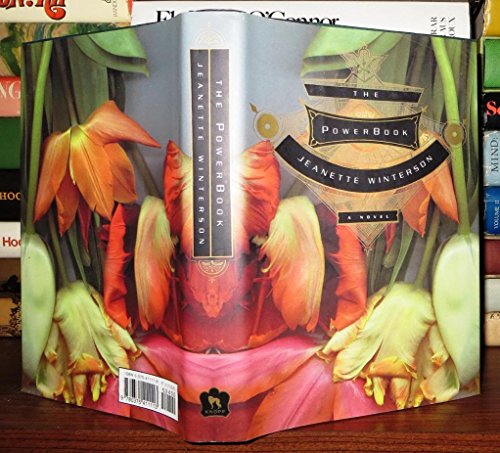
Composed in tight, spare prose echoing Web communications, Winterson's seventh novel takes its cues from the Internet, where reality is implied but never inherent. Like the protagonist of her previous novel, Written on the Body, narrator Ali is not defined by sex. An Internet writer, she/he creates stories for people, offering "Freedom, just for one night," allowing her e-mail clients to be whoever they want to be. In return, they are required to understand that, like customers at Verde, the famous old costume shop in London where Ali lives, they may enter as themselves and leave as someone else. Such is the transformation Ali undergoes after a brief liaison in Paris with a married woman. Falling desperately in love, Ali follows the unnamed woman to Capri and attempts to convince her to leave her husband. Entwining this love story with accounts of Turkish tulip bulbs disguised as testicles, and tales of Lancelot and Guinevere, Winterson treads a slippery slope between linear storytelling and multidimensional cyberfiction. Most conventional, but also most egregious, is a digression recounting Ali's childhood as the adopted daughter of scrap-yard owners who are terrified of straying out into the Wilderness (the real world), but still hope that one day their daughter will find the Promised Land that exists in the heart. Winterson's dashing, sensually stylish writing is marred by heavy-handed symbolism, but the concept of transformation is adeptly juggled throughout. The brightly colored jacket, featuring two suggestively limp tulips, plays directly to the sensibility of Winterson's many fans. (Nov. 3)
Copyright 2000 Reed Business Information, Inc.
Winterson adroitly combines the sensual with the metaphysical in her seventh novel, which, like her earlier works, is a love story but a love story that conflates notions of time, identity, and gender and explores the poetics of cyberspace. Ali, her narrator, sits at a computer and spins enchanting variations on the theme of forbidden love, stories offered to her restless online reader as means to escape the tyranny of the self. Ali opens windows on many intriguing realms, retelling the amorous tragedies of such mythic lovers as Lancelot and Guinevere and reaching a surprising climax in a story about a sixteenth-century Turkish girl who smuggles tulip bulbs to Holland disguised as a boy. Such fantasies alternate with suspenseful chapters set in contemporary Paris, London, and Capri in which a married woman and her lover, gradually revealed as female, make love and argue over the impossibility of their situation. Winterson's supple and radiant writing is itself a form of lovemaking, and as she renders cosmic her characters' predicament, she considers the thin line between the real and the invented. Donna Seaman
Copyright © American Library Association. All rights reserved
Winterson (The Passion; Art & Lies) here employs the vast protean realm of cyberspace, once again weaving a metaphorical flight of words and images, of love and longing. The plot that lines this slim but profoundly textured novel involves Ali, an e-mail writer who will compose anything you likeDin the case that launches this tale, an aborted love story of tulipsDwhereas you may be any figure in your invented life. But, be warned, how you enter will not be how you leave, and Ali learns that not even the writer is immune to this caveat. Winterson captivates and engages, submerging the reader in her sure and golden prose and interspersing classical and contemporary myths and fairytales between love and loss in Paris and CapriDexperiences that become flesh while the Internet is just an instrument analogous to pen and paper. Stirring and passionate, this volume is nevertheless light in bulk, belying the sensual body of the text and the intense power of its flow. The unconventional, though wholly Winterson, narration addresses the reader and proclaims the certainty of tides; it dares, "You can change the story. You are the story . Open it. Read it. This is the true history of the world."DAnn Kim, "Library Journal"
Copyright 2000 Reed Business Information, Inc.
Excerpt. © Reprinted by permission. All rights reserved.
language
costumier
To avoid discovery I stay on the run. To discover things for myself I stay on the run.
It's night. I'm sitting at my screen. There's an e-mail for me. I unwrap it. It says--Freedom, just for one night.
Years ago you would have come to my shop at the end of the afternoon, telling your mother you had an errand for the poor.
At the tinkle of the bell you would have found yourself alone for a moment in the empty shop, looking at the suits of armour, the wimples, the field boots, and the wigs on spikes, like severed heads.
The sign on the shop says verde, nothing more, but everyone knows that something strange goes on inside. People arrive as themselves and leave as someone else. They say that Jack the Ripper used to come here.
You stand alone in the empty shop. I come out from the back. What is it you want?
Freedom for a night, you say. Just for one night the freedom to be somebody else.
Did anyone see you arrive?
No.
Then I can pull the blinds and light the lamp. The clock ticks, but only in time. From outside, looking in, there will be only a movement of shadows--the looming of a bear's head, a knife.
You say you want to be transformed.
This is where the story starts. Here, in these long lines of laptop DNA.
Here we take your chromosomes, twenty-three pairs, and alter your height, eyes, teeth, sex. This is an invented world. You can be free just for one night.
Undress.
Take off your clothes. Take off your body. Hang them up behind the door. Tonight we can go deeper than disguise.
It's only a story, you say. So it is, and the rest of life with it--creation story, love story, horror, crime, the strange story of you and I.
The alphabet of my DNA shapes certain words, but the story is not told. I have to tell it myself.
What is it that I have to tell myself again and again?
That there is always a new beginning, a different end.
I can change the story. I am the story.
Begin.
OPEN
HARD
DRIVE
I want to start with a tulip.
In the sixteenth century the first tulip was imported to Holland from Turkey. I know--I carried it myself.
By 1634 the Dutch were so crazy for this fish-mouthed flower that one collector exchanged a thousand pounds of cheese, four oxen, eight pigs, twelve sheep, a bed and a suit of clothes for a single bulb.
What's so special about a tulip?
Put it this way . . . When is a tulip not a tulip?
When it's a Parrot or a Bizarre. When it's variegated or dwarf. When it comes called Beauty's Reward or Heart's Reviver. When it comes called Key of Pleasure or Lover's Dream . . .
Tulips, every one--and hundreds more--each distinctively different, all the same. The attribute of variation that humans and tulips share.
It was Key of Pleasure and Lover's Dream that I carried from Sulyman the Magnificent to Leiden in 1591. To be exact, I strapped them under my trousers . . .
. . .
'Put it this way.'
'No. I'll crush them when I rest.'
'Put it this way . . .'
'No. I'll crush them when I pray.'
'Put one here and one here . . .'
'No! It will look as though I have an evil swelling.'
Well, where would you store a priceless pair of bulbs?
That gave me the idea.
In the same place as a priceless pair of balls.
Yes! Yes! Yes!
When I was born, my mother dressed me as a boy because she could not
afford to feed any more daughters. By the mystic laws of gender and economics, it ruins a peasant to place half a bowl of figs in front of his daughter, while his son may gorge on the whole tree, burn it for firewood and piss on the stump, and still be reckoned a blessing to his father.
When I was born, my father wanted to drown me, but my mother persuaded him to let me live in disguise, to see if I could bring any wealth to the household.
I did.
So slender am I, and so slight, that I can slip under the door of a palace, or between the dirt and the floor of a hovel, and never be seen.
A golden thread, a moment's talk, a spill of coffee, a pepper seed, is all the distance I am between one side and the other.
I became a spy.
Sulyman himself appointed me and his instruction now is that I should get into a boat and bear a gift to his friends, the Dutch. A gift that every scurvy captain and leprous merchant will try to steal.
How to conceal it?
Put it this way . . .
My mother got some stout thread and belted it through the natural die-back of the bulb tops. Then she sewed the lot on to a narrow leather strap and fastened it round my hips.
'Should they hang dead centre like that?'
(My mother went to inspect my father.)
'Dress them on the left.'
'That's good, but there's something missing.'
'What?'
'The bit in the middle.'
I went up into the hills, for tulips grow as thick as thieves here. I found
myself a well-formed fat stem supporting a good-sized red head with rounded tips. I nicked it at the base with my knife and the juice covered my fingers.
At home my mother embalmed the tulip, and in a few days it was ready to wear.
This was my centrepiece. About eight inches long, plump, with a nice weight to it. We secured it to my person and inspected the results. There are many legends of men being turned into beasts and women into trees, but none I think, till now, of a woman who becomes a man by means of a little horticultural grafting.
My mother knelt down and put her nose close.
'You smell like a garden,' she said.
. . .
The sun rose. The ship hoisted sail. I lifted my arms and waved and waved. Then, adjusting my tulip, I went below.
I seemed to dream of buffalo muddying the banks of clear streams that spilled down into the watercress beds. There were crystallised oranges on a table in the sun, and small cups of sweet coffee, and the little workshops and weaving sheds of our town.
There were women at the roadside selling hard-boiled eggs and homemade dolma, while their children wove simple mats and their men unloaded charcoal or packed tobacco, or went in and out of Nikolaus the pawnbroker's.
I dreamed I was ploughing a field and the stork was following behind me and inspecting the turned earth and waiting by the marshy edges for a frog.
At the bazaar, the copper pots were coming in stacked on the ox-carts. Eager hands carried them to shaded rugs, to burnish up the spatterings with a cloth. All the pots were sealed--it keeps the genie in, and no Turk would want a pot without a genie.
Humble or grand, what is made must keep with it the memory of what cannot be made. In the spun cloth, the thrown earthenware, the beaten pot and the silver box, is Allah--the spirit of God in the things of the world.
Atom and dream.
I awoke to a rattle. The only light in my cabin was a wick in a cruse of oil. I took it from the shelf over my hammock and looked down. I had filled a wooden bucket with water for washing and drinking, and left my metal cup on its chain inside the bucket. Knocking the cup from side to side as it drank was a long-haired rat.
In the morning, as the only paying passenger on the spice ship, I was invited to breakfast with the Captain. He offered me roast chicken and his wife's hard-baked bread covered in pumpkin seeds.
He was a man of the world and a worldly man, who profited from trade with the English, regularly cargoing the tin, coarse cloth and shot the Sultan needed for his armies, in return for the jewels and luxury stuffs the English loved.
If tin for gold and sh...
"About this title" may belong to another edition of this title.
Search results for The PowerBook

Stock Image
The PowerBook
Seller: World of Books (was SecondSale), Montgomery, IL, U.S.A.
Seller rating 5 out of 5 stars

Condition: Good. Item in good condition. Textbooks may not include supplemental items i.e. CDs, access codes etc. Seller Inventory # 00106941301
Stock Image
The PowerBook
Seller: World of Books (was SecondSale), Montgomery, IL, U.S.A.
Seller rating 5 out of 5 stars
Condition: Very Good. Item in very good condition! Textbooks may not include supplemental items i.e. CDs, access codes etc. Seller Inventory # 00107792635
Seller Image
The PowerBook
Seller: Greenworld Books, Arlington, TX, U.S.A.
Seller rating 5 out of 5 stars
Condition: very_good. Fast Free Shipping â" Very Good condition book with a firm cover and clean pages. Shows normal use and some light wear or limited notes markings. A solid, nice copy to enjoy. Seller Inventory # GWV.0375411119.VG
Stock Image
The PowerBook
Seller: Evergreen Goodwill, Seattle, WA, U.S.A.
Seller rating 5 out of 5 stars
hardcover. Condition: Good. Seller Inventory # mon0000124256
Stock Image
The PowerBook
Seller: Half Price Books Inc., Dallas, TX, U.S.A.
Seller rating 5 out of 5 stars
hardcover. Condition: Very Good. Connecting readers with great books since 1972! Used books may not include companion materials, and may have some shelf wear or limited writing. We ship orders daily and Customer Service is our top priority! Seller Inventory # S_465257908
Stock Image
The PowerBook
Seller: HPB Inc., Dallas, TX, U.S.A.
Seller rating 5 out of 5 stars
hardcover. Condition: Very Good. Connecting readers with great books since 1972! Used books may not include companion materials, and may have some shelf wear or limited writing. We ship orders daily and Customer Service is our top priority! Seller Inventory # S_452298120
Stock Image
The PowerBook
Seller: HPB-Ruby, Dallas, TX, U.S.A.
Seller rating 5 out of 5 stars
hardcover. Condition: Very Good. Connecting readers with great books since 1972! Used books may not include companion materials, and may have some shelf wear or limited writing. We ship orders daily and Customer Service is our top priority! Seller Inventory # S_434051757
Stock Image
The PowerBook
Seller: ThriftBooks-Dallas, Dallas, TX, U.S.A.
Seller rating 5 out of 5 stars
Hardcover. Condition: As New. No Jacket. Pages are clean and are not marred by notes or folds of any kind. ~ ThriftBooks: Read More, Spend Less. Seller Inventory # G0375411119I2N00
Stock Image
The PowerBook
Seller: ThriftBooks-Dallas, Dallas, TX, U.S.A.
Seller rating 5 out of 5 stars
Hardcover. Condition: Good. No Jacket. Missing dust jacket; Pages can have notes/highlighting. Spine may show signs of wear. ~ ThriftBooks: Read More, Spend Less. Seller Inventory # G0375411119I3N01
Stock Image
The PowerBook
Seller: ThriftBooks-Atlanta, AUSTELL, GA, U.S.A.
Seller rating 5 out of 5 stars
Hardcover. Condition: Very Good. No Jacket. May have limited writing in cover pages. Pages are unmarked. ~ ThriftBooks: Read More, Spend Less. Seller Inventory # G0375411119I4N00