
Items related to Christ the Lord: Out of Egypt
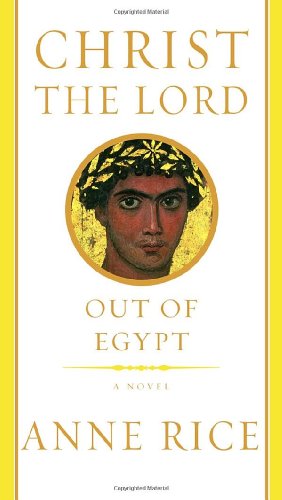
Synopsis
Having completed the two cycles of legend to which she has devoted her career so far, Anne Rice gives us now her most ambitious and courageous book, a novel about the early years of CHRIST THE LORD, based on the Gospels and on the most respected New Testament scholarship.
The book’s power derives from the passion its author brings to the writing and the way in which she summons up the voice, the presence, the words of Jesus who tells the story.
"synopsis" may belong to another edition of this title.
About the Author
Anne Rice is the author of twenty-six books. She lives in La Jolla, California.
www.annerice.com
Reviews
Drawing on the Gospels and New-Testament scholarship, Rice responds to the skeptics with Christ the Lord. Critics agree that Rice’s studious research into subjects as diverse as Jewish groups and daily life has produced visceral, historically convincing scenes, though she writes in a leaner style that Vampire readers may find unfamiliar. She generally succeeds in transforming Jesus, a first-person narrator, from an icon into a flesh-and-blood person. However, Jesus, whom Rice approaches with blind veneration, struck some critics as too innocent and simplistic. Christ may not appeal to readers with other religious beliefs; some scholars will debate her theology. It’s important to read the afterword, for there Rice discusses her return to the Catholic Church—and reveals her brave agenda.
Copyright © 2004 Phillips & Nelson Media, Inc.
Adult/High School–In crisp, straightforward prose, Rice leaves the gothic behind and explores the mysteries beneath the childhood of Jesus. At age seven, the boy and his family leave Egypt to return to their home. They find themselves caught in a revolution after the death of the first King Herod, ruler of the portion of the Roman Empire that includes Israel. Although the historical and cultural details are authentic and well done, it is the character of Jesus that drives this novel. He feels like a typical seven-year-old, but he's also suddenly discovering abilities that no one else possesses. He brings clay birds to life, makes snow fall, and even resurrects a dead playmate. Stunned by these odd happenings, he turns to Joseph and Mary for answers. When they are not forthcoming, he's forced to hunt out clues through local legends, rumors, and a strange spirit that taunts him in his dreams. The story is told from Jesus's point of view, and the strength of the book weighs heavily on Rice's ability to make him believable both as a child and as the son of God; she does a winning job. The wisdom of all things religious fills Jesus completely, but he's naive about day-to-day events: he can't understand why a young girl he used to play with prefers at age 12 to learn about weaving and rearing children. This new direction for Rice is both bold and reverent, and is bound to please fans and newcomers alike.–Matthew L. Moffett, Northern Virginia Community College, Annandale
Copyright © Reed Business Information, a division of Reed Elsevier Inc. All rights reserved.
God -- in the singular or plural, as deity or idea -- has always been a great subject. From the Bible onward, a host of serious writers including Dante, Milton and Dostoyevsky has wrestled with divinity. More recently, there are so many examples that, in the words of St. John, "I suppose that even the world itself could not contain them." God has figured in a modern version of midrash (a Jewish term for tale-spinning extrapolated from biblical text) by Jenny Diski, who retold the story of Abraham and Sarah in Only Human, and by David Maine, who retold the story of Noah last year in The Preservationist and that of Adam and Eve in this season's Fallen. Among the renderings of Jesus have been Jim Crace's sensuous isolate in Quarantine and Norman Mailer's ecstatic bombaster in The Gospel According to the Son.
Now, say you had to guess the living writer least likely to feel compelled to enter this quest. How about Anne Rice? Known for multi-volume sagas of vampire lore and quasi-literary erotica, Rice has found religion in her new novel, Christ the Lord. On the surface ridiculous, this odd pairing actually makes sense if you consider the vampire Lestat and Jesus as flip sides of the same coin. Both are suffering young men who exist eternally, one by taking life, the other by giving it. And blood figures prominently in their stories.
The notion of Jesus à la Rice has a lot of appeal, especially after reading the first page of her previous book, Blood Canticle, which promises the lures she has reliably provided throughout her career: "a full-dress story . . . with a beginning, middle and end . . . plot, character, suspense, the works." Well, she may deliver elsewhere but not here; these niceties of narrative are uniformly missing from Christ the Lord.
As for the plot, it's a year in the life of a rather plodding 7-year-old boy. As for suspense, he discovers that several mysterious events attended his birth, but we already know that, and so do all the other characters, who are made entirely of cardboard. Mary is innocent; Joseph steadfast; Mary's brother Cleopas laughs so continuously that he might as well be at a vaudeville show; and James, the savior's older brother, glowers throughout the book with big-time sibling rivalry.
Perhaps we could tolerate a one-dimensional cast as long as the narrator/protagonist came alive on the page, but Rice's childhood Jesus is a cipher at the center of the book. Of course, he's also a cipher in Scripture. Interpretations of his nature differ among the four canonical Gospels -- priest, prophet, king or God -- and his early years are virtually a blank slate except for a few tantalizing legends that tell how the young Jesus breathed life into clay birds and, more shocking, killed a local bully. Rice aims to explore this apocryphal domain, but her Jesus is like no other child, not merely because he's begotten by the Creator of the universe but because he shows hardly an ounce of spunk or curiosity. He never burns as either a child or an incipient deity.
Nor do the surroundings of this fabulous tale provide any greater reward. At the beginning of the book, Jesus's family leaves a sojourn in Egypt to enter into a tumultuous Judea. King Herod the elder has just died, and the population is stuck between contending Roman soldiers, rebels and pillaging bandits. But this potentially dynamic setting remains inert. Aiming for scrupulousness based on her self-described extensive research, Rice takes no imaginative leaps and refuses to offer any but the scantest of detail. For example, she describes Jerusalem's Holy Temple as "a building so big and so grand and so solid . . . a building stretching to the right and to the left" so that the reader sees effectively nothing. In fact, real research would have provided abundant imagery, from the billowing purple curtains that veiled the Holy of Holies to the zodiac symbols embroidered upon them.
Worse still, clumsy and outright ungrammatical prose infects every page. For instance, we're told, "Joseph and Mary were cousins themselves of each other, that meant happiness for both of them." Presumably aiming for the resounding echoes of biblical syntax, Rice is merely redundant, so much so that the 300-plus pages of this book feel infinitely longer. Here's a sample of dialogue. Mary says, "Think of all the signs. . . . Think of the night when the men from the East came." Then Joseph says, "Do you think anybody there has forgotten that? Do you think they've forgotten anything. . . . They'll remember the star. . . . They'll remember the men from the East," to which Mary replies, "Don't say it, please. . . . Please don't say those words."
Likewise, the consciousness of the Jesus who narrates is repetitive as well as uninformative. Meeting cousin Elizabeth for the first time, Jesus notes, "I thought her face pleasing in a way I couldn't put into words to myself." Then he describes himself as having "the mind of a child who had grown up sleeping in a room with men and women in that same room and in other rooms open to it, and sleeping in the open courtyard with the men and women in the heat of summer, and living always close with them, and hearing and seeing many things," none of which he shares with us.
Stunned into earnestness by a personal tragedy that she refers to in an afterword, Rice cannot summon any of the literary blood that throbbed through her multiple neck-biters. She strives diligently, but she's so respectful that no messy humanity whatsoever comes from her deity. Christ the Lord is more of an act of personal devotion than the fulfillment of an acknowledgedly audacious fictional concept. It will neither offend believers the way author Nikos Kazantzakis and director Martin Scorsese did in "The Last Temptation of Christ" nor satisfy evangelicals as did Mel Gibson's "The Passion of the Christ." Instead, both audiences are likely to be bored.
Whether Jesus was the soul of mercy or, as some historians have claimed, a political rabble-rouser, the one quality he must have had in order to live through the millennia was spirit. It's the one great quality the Bible has in abundance, as revealed by either the chiseled spareness of Everett Fox's translation of Genesis or the luscious oratory of King James. Rice has sucked the life out of the greatest story ever told.
Reviewed by Melvin Jules Bukiet
Copyright 2005, The Washington Post. All Rights Reserved.
Rice departs from her usual subject matter to pen this curious portrait of a seven-year-old Jesus, who departs Egypt with his family to return home to Nazareth. Rice's painstaking historical research is obvious throughout, whether she's showing the differences among first-century Jewish groups (Pharisees, Essenes and Sadducees all play a part), imagining a Passover pilgrimage to Jerusalem or depicting the regular but violent rebellions by Jews chafing under Roman rule. The book succeeds in capturing Jesus' profound Jewishness, with some of the best scenes reflecting his Torah education and immersion in the oral traditions of the Hebrew Bible. As fiction, though, the book's first half is slow going. Since it is told from Jesus' perspective, the childlike language can be simplistic, though as readers persevere they will discover the riches of the sparse prose Rice adopts. The emotional heart of the story—Jesus' gradual discovery of the miraculous birth his parents have never discussed with him—picks up steam as well, as he begins to understand why he can heal the sick and raise the dead. Rice provides a moving afterword, in which she describes her recent return to the Catholic faith and evaluates, often in an amusingly strident fashion, the state of biblical studies today. (Nov. 7)
Copyright © Reed Business Information, a division of Reed Elsevier Inc. All rights reserved.
In the author's note at the end of her new novel, Rice says that when she set out to write this one, she wanted to write not about a hypothetical, revisionist Jesus but about Jesus as he's rendered in the Gospels. Seven-year-old Jesus narrates the story of his extended family's trek from Alexandria, Egypt, to Nazareth. The novel opens with the death and resurrection of Eleazer, both of which young Jesus is responsible for. After an angry mob shows up on Joseph and Mary's doorstep, they decide to leave Egypt in favor of the Holy Land, despite the protests of Jesus' teacher and Philo, a nobleman who has taken an interest in the thoughtful boy. But Joseph will not be swayed, and the family sets sail, with aunts, uncles, and cousins in tow as well. The journey is not an easy one, and more hardship awaits them in Jerusalem, which is in turmoil after the death of corrupt King Herod, and in Nazareth, which is overrun with Roman soldiers. By no means presenting a radical version of Jesus, Rice does an admirable job of rendering Jesus' compassion, his curiosity about the world and other people, and his youthful feelings. A decided and daring departure from her usual fare, Rice's latest should draw many curious readers. Kristine Huntley
Copyright © American Library Association. All rights reserved
Excerpt. © Reprinted by permission. All rights reserved.
I was seven years old. What do you know when you’re seven years old? All my life, or so I thought, we’d been in the city of Alexandria, in the Street of the Carpenters, with the other Galileans, and sooner or later we were going home.
Late afternoon. We were playing, my gang against his, and when he ran at me again, bully that he was, bigger than me, and catching me off balance, I felt the power go out of me as I shouted: “You’ll never get where you’re going.”
He fell down white in the sandy earth, and they all crowded around him. The sun was hot and my chest was heaving as I looked at him. He was so limp.
In the snap of two fingers everyone drew back. It seemed the whole street went quiet except for the carpenters’ hammers. I’d never heard such a quiet.
“He’s dead!” Little Joseph said. And then they all took it up. “He’s dead, he’s dead, he’s dead.”
I knew it was true. He was a bundle of arms and legs in the beaten dust.
And I was empty. The power had taken everything with it, all gone.
His mother came out of the house, and her scream went up the walls into a howl. From everywhere the women came running.
My mother lifted me off my feet. She carried me down the street and through the courtyard and into the dark of our house. All my cousins crowded in with us, and James, my big brother, pulled the curtain shut. He turned his back on the light. He said:
“Jesus did it. He killed him.” He was afraid.
“Don’t you say such a thing!” said my mother. She clutched me so close to her, I could scarcely breathe.
Big Joseph woke up.
Now Big Joseph was my father, because he was married to my mother, but I’d never called him Father. I’d been taught to call him Joseph. I didn’t know why.
He’d been asleep on the mat. We’d worked all day on a job in Philo’s house, and he and the rest of the men had lain down in the heat of the afternoon to sleep. He climbed to his feet.
“What’s that shouting outside?” he asked. “What’s happened?”
He looked to James. James was his eldest son. James was the son of a wife who had died before Joseph married my mother.
James said it again.
“Jesus killed Eleazer. Jesus cursed him and he fell down dead.”
Joseph stared at me, his face still blank from sleep. There was more and more shouting in the street. He rose to his feet, and ran his hands back through his thick curly hair.
My little cousins were slipping through the door one by one and crowding around us.
My mother was trembling. “He couldn’t have done it,” she said. “He wouldn’t do such a thing.”
“I saw it,” said James. “I saw it when he made the sparrows out of clay on the Sabbath. The teacher told him he shouldn’t do such things on the Sabbath. Jesus looked at the birds and they turned into real birds. They flew away. You saw it too. He killed Eleazer, Mother, I saw it.”
My cousins made a ring of white faces in the shadows: Little Joses, Judas, and Little Symeon and Salome, watching anxiously, afraid of being sent out. Salome was my age, and my dearest and closest. Salome was like my sister.
Then in came my mother’s brother Cleopas, always the talker, who was the father of these cousins, except for Big Silas who came in now, a boy older than James. He went into the corner, and then came his brother, Justus, and both wanted to see what was going on.
“Joseph, they’re all out there,” said Cleopas, “Jonathan bar Zakkai, and his brothers, they’re saying Jesus killed their boy. They’re envious that we got that job at Philo’s house, they’re envious that we got the other job before that, they’re envious that we’re getting more and more jobs, they’re so sure they do things better than we do—.”
“Is the boy dead?” Joseph said. “Or is the boy alive?”
Salome shot forward and whispered in my ear. “Just make him come alive, Jesus, the way you made the birds come alive!”
Little Symeon was giggling. He was too little to know what was going on. Little Judas knew, but he was quiet.
“Stop,” said James, the little boss of the children. “Salome, be quiet.”
I could hear them shouting in the street. I heard other noises. Stones were hitting the walls of the house. My mother started to cry.
“You dare do that!” shouted my uncle Cleopas and he rushed back out through the door. Joseph went after him.
I wriggled out of my mother’s grasp and darted out before she could catch me, and past my uncle and Joseph and right into the crowd as they were all waving and hollering and shaking their fists. I went so fast, they didn’t even see me. I was like a fish in the river. I moved in and out through people who were shouting over my head until I got to Eleazer’s house.
The women all had their backs to the door, and they didn’t see me as I went around the edge of the room.
I went right into the dark room, where they’d laid him on the mat. His mother was there leaning on her sister and sobbing.
There was only one lamp, very weak.
Eleazer was pale with his arms at his sides, same soiled tunic, and the soles of his feet very black. He was dead. His mouth was open and his white teeth showed over his lip.
The Greek physician came in—he was really a Jew—and he knelt down, and he looked at Eleazer and he shook his head.
Then he saw me and said:
“Out.”
His mother turned and she saw it was me and she screamed.
I bent over him:
“Wake up, Eleazer,” I said. “Wake up now.”
I reached out and laid my hand on his forehead.
The power went out. My eyes closed. I was dizzy. But I heard him draw in his breath.
His mother screamed over and over and it hurt my ears. Her sister screamed. All the women were screaming.
I fell back on the floor. I was weak. The Greek physician was staring down at me. I was sick. The room was dim. Other people had rushed in.
Eleazer came up, and he was up all knees and fists before anyone could get to him, and he set on me and punched me and hit me, and knocked my head back against the ground, and kicked me again and again:
“Son of David, Son of David!” he shouted, mocking me, “Son of David, Son of David!” kicking me in the face, and in the ribs, until his father grabbed him around the waist and picked him up in the air.
I ached all over, couldn’t breathe.
“Son of David!” Eleazer kept shouting.
Someone lifted me and carried me out of the house and into the crowd in the street. I was still gasping. I hurt all over. It seemed the whole street was screaming, worse than before, and someone said the Teacher was coming, and my uncle Cleopas was yelling in Greek at Jonathan, Eleazer’s father, and Jonathan was yelling back, and Eleazer was shouting, “Son of David, Son of David!”
I was in Joseph’s arms. He was trying to move, but the crowd wouldn’t let him. Cleopas was pushing at Eleazer’s father. Eleazer’s father was trying to get at Cleopas, but other men took hold of his arms. I heard Eleazer shouting far away.
There was the Teacher declaring: “That child’s not dead, you hush up, Eleazer, who said he was dead? Eleazer, stop shouting! Whoever could think this child is dead?”
“Brought him back to life, that’s what he did,” said one of theirs.
We were in our courtyard, the entire crowd had pushed in with us, my uncle and Eleazer’s people still screaming at each other, and the Teacher demanding order.
Now my uncles, Alphaeus and Simon, had come. These were Joseph’s brothers. And they’d just woken up. They put up their hands against the crowd. Their mouths were hard and their eyes were big.
My aunts, Salome and Esther and Mary, were there, with all the cousins running and jumping as if this were a festival, except for Silas and Justus and James who stood with the men.
Then I couldn’t see anymore.
I was in my mother’s arms, and she had taken me into the front room. It was dark. Aunt Esther and Aunt Salome came in with her. I could hear stones hitting the house again. The Teacher raised his voice in Greek.
“There’s blood on your face!” my mother whispered. “Your eye, there’s blood. Your face is cut!” She was crying. “Oh, look what’s happened to you,” she said. She spoke in Aramaic, our tongue which we didn’t speak very much.
“I’m not hurt,” I said. I meant to say it didn’t matter. Again my cousins pressed close, Salome smiling as if to say she knew I could bring him back to life, and I took her hand and squeezed it.
But there was James with his hard look.
The Teacher came into the room backwards with his hands up. Someone ripped the curtain away and the light was very bright. Joseph and his brothers came in. And so did Cleopas. All of us had to move to make room.
“You’re talking about Joseph and Cleopas and Alphaeus, what do you mean drive them out!” said the Teacher to the whole crowd. “They’ve been with us for seven years!”
The angry family of Eleazer came almost into the room. The fat...
"About this title" may belong to another edition of this title.
Search results for Christ the Lord: Out of Egypt

Stock Image
Christ the Lord: Out of Egypt
Seller: World of Books (was SecondSale), Montgomery, IL, U.S.A.
Seller rating 5 out of 5 stars

Hardback. Condition: Good. Having completed the two cycles of legend to which she has devoted her career so far, Anne Rice gives us now her most thoughtful and powerful book, a novel about the childhood of Christ the Lord based on the gospels and on the most respected New Testament scholarship. The book's power derives from the passion its author brings to the writing, and the way in which she summons up the voice, the presence, the words of the young Jesus who tells the story. From the Hardcover edition. Seller Inventory # 00098251599
Stock Image
Christ the Lord: Out of Egypt
Seller: World of Books (was SecondSale), Montgomery, IL, U.S.A.
Seller rating 5 out of 5 stars
Hardback. Condition: Fair. Having completed the two cycles of legend to which she has devoted her career so far, Anne Rice gives us now her most thoughtful and powerful book, a novel about the childhood of Christ the Lord based on the gospels and on the most respected New Testament scholarship. The book's power derives from the passion its author brings to the writing, and the way in which she summons up the voice, the presence, the words of the young Jesus who tells the story. From the Hardcover edition. Seller Inventory # 00098234444
Stock Image
Christ the Lord: Out of Egypt
Seller: Orion Tech, Kingwood, TX, U.S.A.
Seller rating 5 out of 5 stars
Hardcover. Condition: Fair. Seller Inventory # 0375412018-4-19955959
Stock Image
Christ the Lord: Out of Egypt
Seller: Your Online Bookstore, Houston, TX, U.S.A.
Seller rating 5 out of 5 stars
hardcover. Condition: Fair. Seller Inventory # 0375412018-4-28867783
Stock Image
Christ the Lord: Out of Egypt
Seller: Gulf Coast Books, Cypress, TX, U.S.A.
Seller rating 5 out of 5 stars
Hardcover. Condition: Fair. Seller Inventory # 0375412018-4-18616278
Seller Image
Christ the Lord: Out of Egypt
Seller: Used Book Company, Egg Harbor Township, NJ, U.S.A.
Seller rating 5 out of 5 stars
Condition: Very Good. Shows minimal signs of wear and previous use. Can include minimal notes/highlighting. A portion of your purchase benefits nonprofits! - Note: Edition & format may differ from what is shown in stock photo & item details. May not include supplementary material (toys, access code, dvds, etc). Seller Inventory # 584ZSU00129K_ns
Seller Image
Christ the Lord: Out of Egypt
Seller: Used Book Company, Egg Harbor Township, NJ, U.S.A.
Seller rating 5 out of 5 stars
Condition: Fair. Shows considerable signs of wear and previous use. Can include notes/highlighting. A portion of your purchase benefits nonprofits! - Note: Edition & format may differ from what is shown in stock photo & item details. May not include supplementary material (toys, access code, dvds, etc). Seller Inventory # 584UZG000NR0_ns
Seller Image
Christ the Lord: Out of Egypt
Seller: Zoom Books East, Glendale Heights, IL, U.S.A.
Seller rating 5 out of 5 stars
Condition: very_good. Book is in very good condition and may include minimal underlining highlighting. The book can also include "From the library of" labels. May not contain miscellaneous items toys, dvds, etc. . We offer 100% money back guarantee and 24 7 customer service. Seller Inventory # ZEV.0375412018.VG
Seller Image
Christ the Lord: Out of Egypt
Seller: Dream Books Co., Denver, CO, U.S.A.
Seller rating 5 out of 5 stars
Condition: good. Gently used with minimal wear on the corners and cover. A few pages may contain light highlighting or writing, but the text remains fully legible. Dust jacket may be missing, and supplemental materials like CDs or codes may not be included. May be ex-library with library markings. Ships promptly! Seller Inventory # DBV.0375412018.G
Seller Image
Christ the Lord: Out of Egypt
Seller: 3Brothers Bookstore, Egg harbor township, NJ, U.S.A.
Seller rating 5 out of 5 stars
Condition: very_good. Cover may have light wear, pages in very good condition and binding is sturdy; may have other light shelf wear or creases. May have notes or highlighting. Seller Inventory # EVV.0375412018.VG