
Items related to Our Lady of the Forest
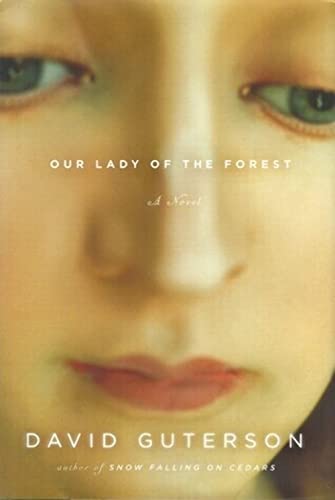
Synopsis
From the best-selling author of Snow Falling on Cedars—an emotionally charged, provocative new novel about a teenage girl who claims to see the Virgin Mary.
Ann Holmes seems an unlikely candidate for revelation. A sixteen-year-old runaway, she is an itinerant mushroom picker who lives in a tent. But on a November afternoon, in the foggy woods of North Fork, Washington, the Virgin comes to her, clear as day.
Father Collins—a young priest new to North Fork—finds Ann disturbingly alluring. But it is up to him to evaluate—impartially—the veracity of Ann’s sightings: Are they delusions, or a true calling to God? As word spreads and thousands, including the press, converge upon the town, Carolyn Greer, a smart-talking fellow mushroomer, becomes Ann’s disciple of sorts, as well as her impromptu publicity manager. And Tom Cross, an embittered logger who’s been out of work since his son was paralyzed in a terrible accident, finds in Ann’s visions a last chance for redemption for both himself and his son.
As Father Collins searches his own soul and Ann’s, as Carolyn struggles with her less than admirable intentions, as Tom alternates between despair and hope, Our Lady of the Forest tells a suspenseful, often wryly humorous, and deeply involving story of faith at a contemporary crossroads.
"synopsis" may belong to another edition of this title.
About the Author
David Guterson is the author of Snow Falling on Cedars and East of the Mountains, and of the story collection The Country Ahead of Us, the Country Behind. A Guggenheim Fellow and PEN/Faulkner Award winner, he lives in Washington State.
From the Back Cover
“This is Guterson’s best book.” –Chicago Sun-Times
“Another virtuoso performance from David Guterson . . . Gripping . . . Marks an expansion of his vision . . . Transporting . . . Balances on the tension between belief and despair without ever losing its sense of mystery.” –L.A. Times Book Review
“Spellbinding . . . Mesmerizing . . . Brilliantly conceived . . . A marvelous and affecting spectacle, both timeless and contemporary, that makes for electric reading.” –Seattle Times
“Explores a complex and challenging set of questions without a hint of condescension . . . The dimensions of this compelling novel are catholic in the larger sense.” –Christian Science Monitor
“An intense and affecting journey of faith, miracle and humanity.” –Denver Post
“Blends some of the appeal of Stephen King’s uncanny tales . . . and John Updike’s fables . . . Thoroughly absorbing . . . Guterson writes virtuoso dialogue.” –Seattle Weekly
“Magnificent . . . Reading it, I kept putting [Guterson] in the best possible literary company . . . I was in a state of elation while I was reading . . . A marvelous book, in every sense.” –Jonathan Raban
“An intense, gripping read . . . Finely etched characters, the most intriguing and fully realized cast in any Guterson novel . . . Should resonate with many readers searching for belief in the post-9/11 world.” –Seattle Post-Intelligencer
“Surely one of this year’s best novels . . . Outstanding . . . [Displays] heart, compassion, and a willingness to tackle the most fundamental, and insolvable questions of faith, belief, and personal responsibility.” –Pittsburgh Tribune-Review
From the Inside Flap
From the best-selling author of Snow Falling on Cedars an emotionally charged, provocative new novel about a teenage girl who claims to see the Virgin Mary.
Ann Holmes seems an unlikely candidate for revelation. A sixteen-year-old runaway, she is an itinerant mushroom picker who lives in a tent. But on a November afternoon, in the foggy woods of North Fork, Washington, the Virgin comes to her, clear as day.
Father Collins a young priest new to North Fork finds Ann disturbingly alluring. But it is up to him to evaluate impartially the veracity of Ann s sightings: Are they delusions, or a true calling to God? As word spreads and thousands, including the press, converge upon the town, Carolyn Greer, a smart-talking fellow mushroomer, becomes Ann s disciple of sorts, as well as her impromptu publicity manager. And Tom Cross, an embittered logger who s been out of work since his son was paralyzed in a terrible accident, finds in Ann s visions a last chance for redemption for both himself and his son.
As Father Collins searches his own soul and Ann s, as Carolyn struggles with her less than admirable intentions, as Tom alternates between despair and hope, Our Lady of the Forest tells a suspenseful, often wryly humorous, and deeply involving story of faith at a contemporary crossroads.
Reviews
Adult/High School-Guterson gives readers a contemporary world in which spiritual and ancient concerns are brought to the forefront of awareness. Subsisting as an itinerant mushroom picker in the rain forest of Washington, an abused runaway teen experiences visions of the Blessed Virgin Mary, who speaks to her and directs her to encourage the building of a shrine in the place of the visions' occurrence. A slightly older young woman, who has no belief in the tenets of any faith, introduces Ann to the local Roman Catholic priest, a man who is both intellectual and spiritual, and who is bothered by his own predilection for impure thoughts about the young seer. News of Ann's visions brings in hordes of believers and the curious, including another local, a middle-aged man who has isolated himself since the accident that paralyzed his teenaged son. Guterson keeps this diverse handful of central characters in constant tension, allowing readers to empathize with all of them while questioning their motives. Teens concerned with matters of faith, belief, the mysteries surrounding unbidden experiences with mythically powerful beings, and the fallible nature of both the best and the worst adults will find a lot here to ponder and discuss. Familiarity with Christianity isn't necessary to accessing this tale, although such a background will add another layer of complexity to readers' considerations of the story.
Francisca Goldsmith, Berkeley Public Library, CA
Copyright © Reed Business Information, a division of Reed Elsevier Inc. All rights reserved.
When Ann Holmes starts having visions of the Virgin Mary, the bedraggled teen runaway becomes the last hope for the inhabitants of a dank, economically depressed logging town and the hordes of miracle-seekers who descend on it. In this panoramic, psychologically dense novel, she also becomes a symbol of the intimate intertwining of the sacred and the profane in American life. Guterson (Snow Falling on Cedars; East of the Mountains), tells the story from the viewpoint of four lost souls groping for redemption: Ann; Carolyn, an aging, overeducated, cynical drifter who takes Ann under her wing to profit from her growing fame; a local priest wrestling with his doubts about, and lust for, the visionary; and a tormented ex-logger trying to atone for the accident that paralyzed his son. Guterson's evocative prose, pithy dialogue and piercing insights cut through the fog of sin and guilt that shadows these wounded characters like the overcast sky of the Pacific Northwest. And as Ann's visions stimulate a tourism boom and draw the attention of media vultures and a skeptical Catholic Church, Guterson explores larger social themes-the demise of blue-collar America; the ironic symbiosis of religious devotion and commercial exploitation; the replacement of faith in God by faith in psychopharmacology; and the link between the exaltation of women's saintliness and the reality of women's degradation. Searching for the miraculous in the mundane, this ambitious and satisfying work builds vivid characters and trenchant storytelling into a serious and compassionate look at the moral quandaries of modern life.
Copyright 2003 Reed Business Information, Inc.
Guterson follows up Snow Falling on Cedars (1994) and East of the Mountains (1999) with another novel set in the Pacific Northwest. The rain-sodden timber town of North Fork has been hit hard by the downturn in the timber industry, and the only businesses that thrive are the bars, patronized by out-of-work loggers and itinerant mushroom pickers. One of these, Ann Holmes, is a fragile teenage runaway who is convinced that the Virgin Mary visits her in the rain forest. Too many psilocybin mushrooms, or is Ann a true visionary? Before long, thousands of pilgrims arrive in North Fork, overrunning the local motels and laundromats, trampling the forest floor, and hanging religious gimcracks on bushes and trees. Meanwhile, the locals respond in different ways. Some, like Ann's cynical de facto manager Carolyn Greer, see a moneymaking opportunity. Father Collins, the young priest to whom Ann brings a message from the Virgin, has to reconcile his own skepticism, longings, and beliefs. And Tom Cross, whose life has imploded since a logging accident that paralyzed his son, is looking for redemption. Though some readers may be frustrated by the slow pace, Guterson's third novel is thoughtful, humane, richly detailed, and atmospheric. It should be welcomed by those who loved Snow Falling on Cedars. Mary Ellen Quinn
Copyright © American Library Association. All rights reserved
Excerpt. © Reprinted by permission. All rights reserved.
I
Annunciation
NOVEMBER 10-NOVEMBER 13, 1999
The girl's errand in the forest that day was to gather chanterelle mushrooms in a bucket to sell in town at dusk. According to her own account and the accounts of others in the North Fork Campground who would later be questioned by the diocesan committee, by Father Collins of Saint Joseph's of North Fork, by the bishop's representative, and by reporters covering the purported apparitions--including tabloid journalists who treated the story like a visitation by Martians or the birth of a two-headed infant--the girl left her camp before eight o'clock and walked alone into the woods. She wore a sweatshirt with its hood drawn tight. She didn't speak to others of her intentions. Setting out with no direction in mind, she crossed a maple bottom and a copse of alders, traversed a creek on a rotten log, then climbed a ridge into deep rain forest and began searching for mushrooms in earnest.
As she went the girl ate potato chips and knelt beside rivulets to drink. She swallowed the antihistamine that kept her allergies at bay. Other than looking for mushrooms, she listened for the lonely music of birds and--she confessed this later to Father Collins--stopped twice to masturbate. It was a still day with no rain or fog and no wind stirring branches in the trees, the kind of stillness that stops time, or seems to, for a hiker. The girl paused often to consider it and to acknowledge her aloneness. She prayed the rosary on her knees--it was Wednesday, November tenth, so she said the Glorious Mysteries--before following an elk trail into country she hadn't visited or perhaps didn't recall, a flat grown up with Douglas firs, choked by blowdowns and vine maple draped with witches'-hair. Here she lay in a bed of moss and was seized by a dream that she lay in moss while a shape, a form--a bird of prey, a luminous man--bore down on her from above.
Rising, she found chanterelles buried in the interstices of liverworts and in the shadows of windfalls. She cut them low, brushed them clean and set them carefully in her bucket. For a long time she picked steadily, moving farther into the woods, pleased because it was a rainless day on which she was finding enough mushrooms to justify being there. They drew her on like a spell.
At noon she read from her pocket catechism, then prayed--Give us this day our daily bread--before crossing herself and eating more potato chips and a package of two chocolate donuts. Resting, she heard the note of a thrush, but muted, faint, and distant. Sunlight now filtered through the trees on an angle through the highest branches and she sought out a broad, strong shaft of it, stippled with boiling dust and litterfall, and lay on her back in its luminous warmth, her face turned toward heaven. Again she slept and again she dreamed, this time of a furtive woman in the trees, lit in darkness as though by a spotlight, who exhorted her to rise from the ground and continue her search for chanterelles.
The girl got up and traveled on. She was lost now in an incidental way and the two strange dreams disturbed her. Feeling a vague desire again, she put her hand between her legs, aimlessly, still walking. A cold or flu had hold of her, she thought. Her allergies and asthma seemed heightened too. Her period had started.
The newspapers reported that her name was Ann Holmes, after her maternal grandmother, who died from sepsis and pneumonia a week before Ann was born. Ann and her mother, fifteen at Ann's birth, had lived with Ann's grandfather, a long-haul trucker, a man with complicated gambling debts, in a series of rental homes. The newspapers, though, did not uncover that her mother's boyfriend, a methamphetamine addict, had raped Ann opportunistically beginning when she was fourteen. Afterward he would lie beside her with an expression of antic, contorted suffering etching his hairless long face. Sometimes he cried or apologized, but more often he threatened to kill her.
When Ann was fifteen she took a driver's education class, which she missed only once, on a Friday afternoon, in order to have an abortion. Eight months later she expelled her second fetus into the toilet at a minimart on the heels of a bout with nausea. On her sixteenth birthday she bought a two-door car, dented or crumpled in more than one panel, for three hundred and fifty dollars earned foraging for truffles and chanterelles. The next morning, she drove away.
Ann was diminutive, sparrow-boned, and when she covered her head with her sweatshirt hood it was easy to mistake her for a boy of twelve, fair-skinned and dreamy. She often wheezed asthmatically, sneezed feebly, blew her nose, and coughed against her fist or palm. On most mornings her jeans were wet with the rain or dew transferred from the fronds of ferns and her hands looked pink and raw. She smelled of wood smoke, leaves and rank clothes and had lived for a month in the North Fork Campground in a canvas tent by the river. Others living there told reporters that she'd rigged up a plastic tarp with twine and often sat under it against a log, reading by firelight. Most described her as silent and subdued, though not unpleasant or inspiring unease, not threatening in her estrangement. Those who saw her in the woods that fall--other mushroom gatherers, mostly, but also several elk and deer hunters and once a Stinson Company timber cruiser--were struck by her inconsequence and by the wariness of her eyes in shadow underneath the drawn hood.
A mushroom picker named Carolyn Greer who lived in a van in the North Fork Campground claimed that on an evening in mid-October she had eaten dinner with Ann Holmes, sharing soup, bread and canned peaches and speaking with her of present matters but never of themselves, their histories. Ann had not had much to say. Mostly she stirred her soup pot, listened, and stared at the flames of the fire. She did indicate a concern for her car, whose transmission no longer allowed her to shift gears or to travel anywhere. The car's battery had petered out, and its windshield and windows appeared permanently clouded with an opaque, viscous vapor. It sat beside her canvas tent, gathering fallen cedar needles, both seats loaded with plastic bags, paper sacks, and cardboard boxes stuffed with her belongings.
Carolyn didn't tell the bishop's representative that while the soup was simmering they got high together. Primarily, it was nobody's business. Furthermore, it implicated her too. Carolyn indulged in pot regularly. It surprised her that Ann, after a few tokes, did not become effusive and talkative, like most stoned people around a campfire. Instead she became even more reserved, more hermetic and taciturn. Her face disappeared inside the hood of her sweatshirt. She spoke when spoken to, terse but polite, and poked incessantly at the wood coals. Her only subject was her dead car.
Stranded, Ann had resorted to the county bus, which stopped at a convenience store a half mile from the campground and dropped her in front of the MarketTime in North Fork for eighty-five cents, one way. She paid, the county driver reported, with exact change, sometimes using pennies, and replied in kind when he greeted her. Once he commented on the mushrooms in her bucket, on their number, size, and golden hue, and she gave him some loosely wrapped in newspaper she found at the back of the bus. On the highway, she slept with her head against the window. Frequently she read from a paperback book he eventually discerned was a catechism. When she got off in town she said thank you or good-bye, her hood still drawn around her face.
A half dozen times she accepted a ride from a mushroom and brush picker named Steven Mossberger, who wore a dense beard, Coke-bottle glasses, and a wool cap pulled low on his temples. Seeing her carrying her bucket of chanterelles and walking the road one afternoon, Mossberger rolled down the window of his pick-up, explained that he lived in the campground as she did, that he picked mushrooms just like her, then asked if she wanted a lift. Ann refused him without affront. No, thanks, she said. I'm okay.
The next time he saw her, in late October, he pulled over at dusk in a modest rain and she accepted without hesitating. When he leaned across to push ajar the door, she got in smelling of wet clothes and mushrooms, set the bucket of chanterelles on her lap, and said, It's a little wet out.
Where are you from? Mossberger asked.
Down in Oregon. Not far from the coast.
What's your name?
She gave him her first. He told her his full name. He put his hand out to shake hers and she slipped her hand into his.
He wanted to believe, afterward, that this moment was freighted with spiritual meaning, that in taking her hand he felt the hand of God, and he described it that way to the diocesan committee and to the bishop's representative--a hand that was more than other hands, he said, connecting him with something deeper than his own life--but in fact, he understood privately, what he felt was probably little more than the small thrill a man gets from shaking hands with a woman.
In North Fork, Ann sold her mushrooms to Bob Frame, a mechanic who worked on logging equipment and ran his mushroom business on the side. Garrulous and jocular most of the time, he spoke with an instinctive brevity and disdain to the first journalist who entreated him. The girl's mushrooms, Frame said, were always meticulously field cleaned, and her bucket contained few culls. Only once, on an evening of bitter rain, did she drink the coffee he kept about as a gratuity for his pickers. For a few minutes she sat by the electric heater, sipping from a Styrofoam cup, watching as he layered mushrooms in newspaper and weighed the day's take on a scale. It seemed to him, working close to her, that she hadn't bathed or laundered her clothing in a long time, maybe weeks. He did recall that she kept her pay in a leather pouch worn around her neck, not in the pocket of her jeans. Her shoes, he noted, were well-worn, the sole of one of them separating from the upper so that...
"About this title" may belong to another edition of this title.
Search results for Our Lady of the Forest

Stock Image
Our Lady of the Forest
Seller: World of Books (was SecondSale), Montgomery, IL, U.S.A.
Seller rating 5 out of 5 stars

Condition: Acceptable. Item in acceptable condition! Textbooks may not include supplemental items i.e. CDs, access codes etc. Seller Inventory # 00096843526
Stock Image
Our Lady of the Forest
Seller: World of Books (was SecondSale), Montgomery, IL, U.S.A.
Seller rating 5 out of 5 stars
Condition: Very Good. Item in very good condition! Textbooks may not include supplemental items i.e. CDs, access codes etc. Seller Inventory # 00102307057
Stock Image
Our Lady of the Forest
Seller: World of Books (was SecondSale), Montgomery, IL, U.S.A.
Seller rating 5 out of 5 stars
Condition: Good. Item in good condition. Textbooks may not include supplemental items i.e. CDs, access codes etc. Seller Inventory # 00068960872
Stock Image
Our Lady of the Forest
Seller: Gulf Coast Books, Cypress, TX, U.S.A.
Seller rating 5 out of 5 stars
hardcover. Condition: Good. Seller Inventory # 0375412115-3-27554858
Seller Image
Our Lady of the Forest
Seller: Zoom Books East, Glendale Heights, IL, U.S.A.
Seller rating 5 out of 5 stars
Condition: very_good. Book is in very good condition and may include minimal underlining highlighting. The book can also include "From the library of" labels. May not contain miscellaneous items toys, dvds, etc. . We offer 100% money back guarantee and 24 7 customer service. Seller Inventory # ZEV.0375412115.VG
Seller Image
Our Lady of the Forest
Seller: Greenworld Books, Arlington, TX, U.S.A.
Seller rating 5 out of 5 stars
Condition: very_good. Fast Free Shipping â" Very Good condition book with a firm cover and clean pages. Shows normal use and some light wear or limited notes markings. A solid, nice copy to enjoy. Seller Inventory # GWV.0375412115.VG
Stock Image
Our Lady of the Forest
Published by
Alfred A. Knopf (edition First Edition), 2003
ISBN 10: 0375412115
ISBN 13: 9780375412110
Used
Hardcover
First Edition
Seller: BooksRun, Philadelphia, PA, U.S.A.
Seller rating 5 out of 5 stars
Hardcover. Condition: Very Good. First Edition. With dust jacket. It's a well-cared-for item that has seen limited use. The item may show minor signs of wear. All the text is legible, with all pages included. It may have slight markings and/or highlighting. Seller Inventory # 0375412115-11-1-29
Stock Image
Our Lady of the Forest
Seller: More Than Words, Waltham, MA, U.S.A.
Seller rating 5 out of 5 stars
Condition: Good. A sound copy with only light wear. Overall a solid copy at a great price! Seller Inventory # BOS-S-08b-01448
Stock Image
Our Lady of the Forest
Seller: Once Upon A Time Books, Siloam Springs, AR, U.S.A.
Seller rating 4 out of 5 stars

Hardcover. Condition: Acceptable. This is a used book. It may contain highlighting/underlining and/or the book may show heavier signs of wear . It may also be ex-library or without dustjacket. This is a used book. It may contain highlighting/underlining and/or the book may show heavier signs of wear . It may also be ex-library or without dustjacket. Seller Inventory # mon0001012536
Stock Image
Our Lady of the Forest
Seller: Half Price Books Inc., Dallas, TX, U.S.A.
Seller rating 5 out of 5 stars
Hardcover. Condition: Very Good. Connecting readers with great books since 1972! Used books may not include companion materials, and may have some shelf wear or limited writing. We ship orders daily and Customer Service is our top priority! Seller Inventory # S_466306386