
Items related to Springing: New and Selected Poems
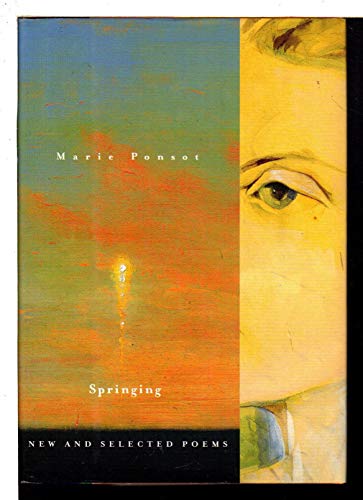
Synopsis
From the award-winning author of The Bird Catcher, this life-spanning volume offers the delight of both discovery and re-discovery, as Ponsot tends the unruly garden of her mind with her customary care and passion. The book opens with a group of new poems, including “What Would You Like to Be When You Grow Up?”—a question that has kept Ponsot’s work vital for more than five decades. Throughout the selections from her four earlier books and a trove of previously unpublished work covering the years 1946 to 1971, she offers us a “lost haven in a springing world.” Sometimes sharp in her self-perception, but always listing toward pleasure and elegance, unafraid of grief and the passage of time, Ponsot continually refreshes her language and the spirited self from which it emerges.
"synopsis" may belong to another edition of this title.
About the Author
Marie Ponsot’s first book of poems was True Minds (1956); later books are Admit Impediment (1981) and The Green Dark (1988). She is a native New Yorker who has enjoyed teaching at Queens College, Beijing United University, the Poetry Center of the YMHA, New York University, and Columbia University. Among her awards are an NEA Creative Writing grant, the Delmore Schwartz Memorial Prize, and the Shaughnessy Medal of the Modern Language Association. Ponsot’s most recent collection, The Bird Catcher, won the National Book Critics Circle Award for Poetry in 1998.
From the Back Cover
"Marie Ponsot's poetic achievement is fiercely independent. A courageous eloquence is sustained throughout her work, as she mounts up what Emerson called 'the stairway of surprise.'"
---Harold Bloom
From the Inside Flap
From the award-winning author of The Bird Catcher, this life-spanning volume offers the delight of both discovery and re-discovery, as Ponsot tends the unruly garden of her mind with her customary care and passion. The book opens with a group of new poems, including ?What Would You Like to Be When You Grow Up???a question that has kept Ponsot?s work vital for more than five decades. Throughout the selections from her four earlier books and a trove of previously unpublished work covering the years 1946 to 1971, she offers us a ?lost haven in a springing world.? Sometimes sharp in her self-perception, but always listing toward pleasure and elegance, unafraid of grief and the passage of time, Ponsot continually refreshes her language and the spirited self from which it emerges.
Reviews
"If leaf-trash chokes the stream bed, reach for rock-bottom as you rake the muck out," writes Ponsot in one of the 26 new poems of this collection, and the lines might well serve as its wry motto. Springing takes readers on a tour of a quirky, start-stop career, presenting, along with the new work, nine poems from True Minds (1956), 22 from Admit Impediment (1981), 26 from The Green Dark (1988), 19 from The Bird Catcher (which won the 1998 NBCC Award) and 26 other previously uncollected poems from 1948 to 1971. The 25-year pause in book publication would seem to reflect a period of domestic life, documented in the uncollected work ("watching you strike worldly poses flirting excited with someone's arch French wife") and ending in "For a Divorce," which opens the Admit Impediment section: "Asked why we ever married, I smile and mention the arbitrary fierce glance of the working artist that blazed sometimes in your face but can't picture it." Ponsot's poems are built around just such unflinching observations of intimate interactions and misfires, whether of familial relations ventriloquized through updated Greek dramatis personae, a French woman's accommodation of her mother's married lover or the self's castings about the natural world, "space recast as flatness, long diminishings of blue borne lightly." If the new and uncollected work doesn't have the focus of the trio of books beginning in the '80s, this selection evinces the larger-scale, muckraking pursuit of artifice's underside that Ponsot's speaker so wonderfully produces poem by poem, "smaller and more human than belief." As she writes in "Gliding": "I envision the next leap, the next thousand years of practice, the eventual skill become like independent flight, habitual." Readers will look forward to those practice sessions.
Copyright 2002 Cahners Business Information, Inc.
Even when they appear simple, Ponsot's poems can be difficult; they require both an attentive mind and a sharp ear. Her language is daring and playful, a challenge and a delight: "What would it be to be water, one body of water/ (what water is is another mystery)." In more than 50 years of writing, few subjects seem to have eluded Ponsot's attention. Here are poems of fable and history, of social and intellectual concern, but the strongest work by far is the personal: "What women wander?/ Not many. All. A few./ Most would, now & then,/ & no wonder./ Some, and I'm one,/ Wander sitting still." Ponsot's poetry is elegiac without shadowy regret. This is the thoughtful, and sometimes unsettling, work of one of the more powerful poets of this tempestuous generation, and the current collection is a chance to chart her fascinating evolution. Ponsot won the National Book Critics Circle Award for her previous collection, The Bird Catcher (1998). Her latest would be a strong addition to any contemporary poetry collection. Louis McKee, Painted Bride Arts Ctr., Philadelphia
Copyright 2002 Cahners Business Information, Inc.
Springing is exactly right: Ponsot's poetry does "dart and shoot" as the dictionary specifies, and it certainly does "issue with speed and force or as a stream." The full measure of her saucy and vigorous, neat and penetrating work is packaged here, including a set of vivifying uncollected poems from 1946 to 1971; selections from four previous collections, including the National Book Critics Circle Award winner, The Bird Catcher (1998); and a solid offering of new poems. Although cool and pinpoint, Ponsot's work flows from a deeply feminine sensibility, effusing her plant, water, and bird imagery with a healthy sensuality and tracking with stunning insight the revelations of each phase of girl- and womanhood. She prowls gardens, memories, the body's curves and bends, the Bible, and the works of classical poets, switching between seriousness and humor as she parses sex and love, intimates and strangers, mind and matter, the shimmering pageant of selves generated by one soul, and life's strange dynamic that has us forever "rising to fall, falling to rise." Donna Seaman
Copyright © American Library Association. All rights reserved
Excerpt. © Reprinted by permission. All rights reserved.
Springing
In a skiff on a sunrisen lake we are watchers.
Swimming aimlessly is luxury, just as walking
Loudly up a shallow stream is.
As we lean over the deep well, we whisper.
Friends at hearths are drawn to the one warm air;
stranger meet on beaches drawn to the one wet sea.
What wd it be to be water, one body of water
(what water is is another mystery). (We are
water divided.) It wd be a self without walls,
with surface tension, specific gravity, a local
exchange between bedrock and cloud of falling and rising,
rising to fall, falling to rise.
Old Jokes Appreciate
Up the long stairs I run
stumbling, expectant.
Impatience is hopelessly
desperate. Hope
takes time.
Sort out the private from the personal.
Advance on losses at a decent pace.
"Aside from all that, Mrs. Lincoln,
how did you like the play?"
Origin
The skull or shell
or wall of bone shaped
with its egg advantages
does not advertise
the gardens it contains,
the marriages, the furies,
or the city it shelters
(clangs, clouds, silences,
found souls crowding,
big dank cans where things
putrify)
or the glade it hides
for us to hide in, where
—our lives eased open—
we drowse by the pond and wake
beside ourselves with thirst,
where (dipping the cup we find)
we get of necessity
a drink of some depth
full of taste
and original
energy.
The darling face,
the fragrant chevelure,
even the beautiful ears
on the shell do not
boast about the workplace inside.
They prefer to appear to agree
they are just along for the ride.
"About this title" may belong to another edition of this title.
Search results for Springing: New and Selected Poems

Seller Image
Springing: New and Selected Poems
Seller: Zoom Books Company, Lynden, WA, U.S.A.
Seller rating 5 out of 5 stars

Condition: very_good. Book is in very good condition and may include minimal underlining highlighting. The book can also include "From the library of" labels. May not contain miscellaneous items toys, dvds, etc. . We offer 100% money back guarantee and 24 7 customer service. Seller Inventory # ZBV.0375413898.VG
Stock Image
Springing: New and Selected Poems
Seller: More Than Words, Waltham, MA, U.S.A.
Seller rating 5 out of 5 stars
Condition: Good. A sound copy with only light wear. Overall a solid copy at a great price! Seller Inventory # BOS-V-10h-01352
Stock Image
Springing New and Selected Poe
Seller: World of Books (was SecondSale), Montgomery, IL, U.S.A.
Seller rating 5 out of 5 stars
Condition: Good. Good condition ex-library book with usual library markings and stickers. Seller Inventory # 00108390757
Stock Image
Springing: New and Selected Poems
Seller: ThriftBooks-Dallas, Dallas, TX, U.S.A.
Seller rating 5 out of 5 stars
Hardcover. Condition: Good. No Jacket. Pages can have notes/highlighting. Spine may show signs of wear. ~ ThriftBooks: Read More, Spend Less. Seller Inventory # G0375413898I3N00
Stock Image
Springing: New and Selected Poems
Seller: ThriftBooks-Atlanta, AUSTELL, GA, U.S.A.
Seller rating 5 out of 5 stars
Hardcover. Condition: Good. No Jacket. Pages can have notes/highlighting. Spine may show signs of wear. ~ ThriftBooks: Read More, Spend Less. Seller Inventory # G0375413898I3N00
Stock Image
Springing : New and Selected Poems
Published by
Knopf Doubleday Publishing Group, 2002
ISBN 10: 0375413898
ISBN 13: 9780375413896
Used
Hardcover
First Edition
Seller: Better World Books, Mishawaka, IN, U.S.A.
Seller rating 5 out of 5 stars
Condition: Good. 1ST. Pages intact with minimal writing/highlighting. The binding may be loose and creased. Dust jackets/supplements are not included. Stock photo provided. Product includes identifying sticker. Better World Books: Buy Books. Do Good. Seller Inventory # 10574452-6
Stock Image
Springing : New and Selected Poems
Published by
Knopf Doubleday Publishing Group, 2002
ISBN 10: 0375413898
ISBN 13: 9780375413896
Used
Hardcover
First Edition
Seller: Better World Books, Mishawaka, IN, U.S.A.
Seller rating 5 out of 5 stars
Condition: Good. 1ST. Former library copy. Pages intact with minimal writing/highlighting. The binding may be loose and creased. Dust jackets/supplements are not included. Includes library markings. Stock photo provided. Product includes identifying sticker. Better World Books: Buy Books. Do Good. Seller Inventory # 470709-6
Stock Image
Springing: New and Selected Poems
Seller: HPB-Diamond, Dallas, TX, U.S.A.
Seller rating 5 out of 5 stars
Hardcover. Condition: Very Good. Connecting readers with great books since 1972! Used books may not include companion materials, and may have some shelf wear or limited writing. We ship orders daily and Customer Service is our top priority! Seller Inventory # S_467877526
Stock Image
Springing: New and Selected Poems
Seller: HPB-Emerald, Dallas, TX, U.S.A.
Seller rating 5 out of 5 stars
hardcover. Condition: Very Good. Connecting readers with great books since 1972! Used books may not include companion materials, and may have some shelf wear or limited writing. We ship orders daily and Customer Service is our top priority! Seller Inventory # S_471546587
Seller Image
Springing: New and Selected Poems
Seller: Southampton Books, Sag Harbor, NY, U.S.A.
Seller rating 5 out of 5 stars
Hardcover. Condition: Very Good. First Edition. First Edition, First Printing. Published by Knopf, 2002. Octavo. Hardcover. Book is very good. Dust jacket is very good. Seller Inventory # 506172