
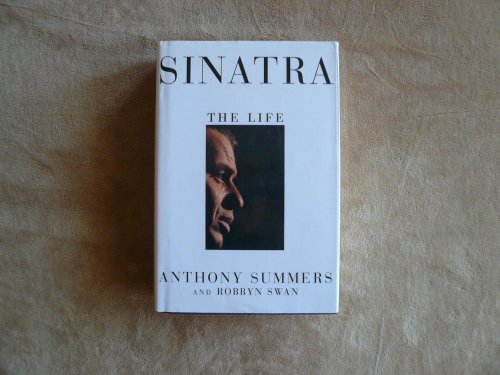
Synopsis
From the best-selling author of Goddess: The Secret Lives of Marilyn Monroe, the first fully documented, comprehensively researched, birth-to-death biography—the definitive life—of Frank Sinatra.
Sinatra is the story of an American icon who held the imagination of millions for more than fifty years and whose influence in popular music was unsurpassed in the twentieth century. As a child, he said, he had heard “symphonies from the universe” in his head. No one could have imagined where those sounds would lead him. Tracing the arc of this incredible life, from the humble beginnings in Hoboken to the twilight years as a living legend in Malibu, Sinatra follows a career built on raw talent, sheer willpower—and criminal connections.
Drawing on a treasure trove of documents and interviews, Anthony Summers and Robbyn Swan reveal stunning new information about Sinatra’s links to such Mafia figures as Sam Giancana and Lucky Luciano. And we see for the first time where the Mafia connection began, how and why it lasted, and how it impinged on others, not least President John F. Kennedy.
Here, too, is the core of the private Sinatra—alternately caustic and sympathetic—that the singer so long concealed. The heartbreaking truth about his passion for Ava Gardner emerges from never-before-published conversations with Gardner herself. In exclusive, intimate interviews, the women who loved Sinatra—some of them unknown to the public until now—share memories of the joy and pain of their relationships with him. And we learn what it was like to be the friend of a man who was generous and loyal to a fault, yet—as some of his fellow Rat Packers discovered—who could turn abruptly into a vindictive brute.
Dramatic, eye-opening, and unfailingly fair-minded, Sinatra is masterful biography: the revelatory story of a brilliant artist and an infinitely complex man.
"synopsis" may belong to another edition of this title.
About the Author
Anthony Summers, a former BBC journalist, is the author of six best-selling books, including The File on the Tsar, on the fate of the Romanovs; Conspiracy, on the assassination of President Kennedy; Official and Confidential, on J. Edgar Hoover; and The Arrogance of Power, on Richard Nixon. Robbyn Swan worked with Summers on the Hoover and Nixon biographies, and both authors have contributed to Vanity Fair and PBS’s Frontline.
From the Inside Flap
From the best-selling author of Goddess: The Secret Lives of Marilyn Monroe, the first fully documented, comprehensively researched, birth-to-death biography the definitive life of Frank Sinatra.
Sinatra is the story of an American icon who held the imagination of millions for more than fifty years and whose influence in popular music was unsurpassed in the twentieth century. As a child, he said, he had heard "symphonies from the universe" in his head. No one could have imagined where those sounds would lead him. Tracing the arc of this incredible life, from the humble beginnings in Hoboken to the twilight years as a living legend in Malibu, Sinatra follows a career built on raw talent, sheer willpower and criminal connections.
Drawing on a treasure trove of documents and interviews, Anthony Summers and Robbyn Swan reveal stunning new information about Sinatra s links to such Mafia figures as Sam Giancana and Lucky Luciano. And we see for the first time where the Mafia connection began, how and why it lasted, and how it impinged on others, not least President John F. Kennedy.
Here, too, is the core of the private Sinatra alternately caustic and sympathetic that the singer so long concealed. The heartbreaking truth about his passion for Ava Gardner emerges from never-before-published conversations with Gardner herself. In exclusive, intimate interviews, the women who loved Sinatra some of them unknown to the public until now share memories of the joy and pain of their relationships with him. And we learn what it was like to be the friend of a man who was generous and loyal to a fault, yet as some of his fellow Rat Packers discovered who could turn abruptly into a vindictive brute.
Dramatic, eye-opening, and unfailingly fair-minded, Sinatra is masterful biography: the revelatory story of a brilliant artist and an infinitely complex man.
Reviews
The second collaboration for the husband-and-wife team (after their Nixon bio, The Arrogance of Power) is hardly the first book about Frank Sinatra, and despite their claim to be the only objective biographers to address the crooner's final years, the book's later chapters feel rushed compared with the lengthy passages covering Sinatra's well-trod glory days. Furthermore, since Sinatra's musical genius and acting skills have been thoroughly analyzed by previous writers, Summers and Swan put in minimal effort there. Where their work does stand out is in firming up the evidence of organized crime's "continuing interest" in Sinatra, from affirming that the famous scene in The Godfather only slightly exaggerates how he got his breakthrough role in From Here to Eternity to exploring his possible role as a go-between for the mob and John F. Kennedy. The pair also break new ground in depicting what they describe as Sinatra's alcoholism, pointing out that he frequently drank all night long, and his abusive treatment of women, for which they cite cases. Yet even when the authors say Sinatra raped a woman or fathered another woman's child out of wedlock—and they make good cases for both—their delivery is a lot closer to objective biography than tabloid sensationalism. A&E's airing of a linked documentary, timed to coincide with the book's publication, as well as a first serial in Vanity Fair, will create significant interest in this latest Sinatra saga. 32 pages of photos. (May 17)
Copyright © Reed Business Information, a division of Reed Elsevier Inc. All rights reserved.
Veteran show-biz and political biographer (of Richard Nixon, J. Edgar Hoover, and Marilyn Monroe, among others) Summers teams up with his sometime collaborator Swan, shining an illuminating spotlight on Old Blue Eyes in this irresistible chronicle of the late, great crooner. Emphasizing the extreme manifestations that defined Sinatra's essential character--his ambition, his volatility, and his fervor--the authors paint a portrait of an astonishingly gifted singer who beat the odds by surviving and thriving over the course of several generations and a number of profound shifts in musical tastes and audience expectations. Aside from his natural abilities, Sinatra the man defied easy classification. Undeniably promiscuous, violent, and self-serving, he could also be tremendously compassionate, loyal, and generous. Beset by insecurities and inner demons and worried by the apparent death of his career in the late 1940s, he made several nods toward suicide but bounced back both emotionally and professionally. His host of love affairs, irrefutable Mob ties, singing and acting careers, political forays, and slow decline are all recorded in fascinating detail. This well-researched version--the authors have included more than 100 pages of notes--of Sinatra's life packs a powerful punch but is more balanced in tone and approach than Kitty Kelley's juicy, unauthorized expose. Margaret Flanagan
Copyright © American Library Association. All rights reserved
Excerpt. © Reprinted by permission. All rights reserved.
Debut
March 18, 1939.
In a studio on West 46th Street in New York City, a band was playing Rimsky-Korsakov’s “Flight of the Bumblebee.” It was a simple place, a room with couches and lamps, hung with drapes to muffle the echo from the walls. This was a big day for the musicians, who were recording for the first time.
A skinny young man listened as they played. The previous night, at the Sicilian Club near his home in New Jersey, he had asked if he could tag along. Now, as the band finished playing, he stepped forward and spoke to the bandleader. “May I sing?” he asked.
The bandleader glanced at the studio clock to see if they had time left, then told the young man to go ahead. He chose “Our Love,” a stock arrangement based on a melody from Tchaikovsky’s Romeo and Juliet. Standing at the rudimentary microphone, he launched into a saccharine lyric:
Our love, I feel it everywhere
Our love is like an evening prayer . . .
I see your face in stars above,
As I dream on, in all the magic of
Our love.
Unseasoned, a little reedy, the voice was transmitted through an amplifier to a recording device known as a lathe. The lathe drove the sound to a needle, and the needle carved a groove on a twelve-inch aluminum-based lacquer disc. The result was a record, to be played on a turntable at seventy-eight revolutions per minute.
The bandleader kept the record in a drawer for nearly sixty years. He would take it out from time to time, with delight and increasing nostalgia, to play for friends. The music on it sounds tinny, a relic of the infancy of recording technology. Yet the disc is kept in a locked safe. The attorney for the bandleader’s widow, an octogenarian on Social Security, says the singer’s heirs have demanded all rights and the lion’s share of any potential income derived from it, thus obstructing its release.
The disc is a valuable piece of musical history. Its tattered adhesive label, typed with an old manual machine, shows the recording was made at Harry Smith Studios, “electrically recorded” for bandleader Frank Mane. Marked “#1 Orig.,” it is the very first known studio recording of the thousand and more that were to make that skinny young man the most celebrated popular singer in history. For, under “Vocal chor. by,” it bears the immaculately handwritten legend:
Frank Sinatra
A year after making that first record, at twenty-five, Sinatra told a new acquaintance how he saw his future. “I’m going to be the best singer in the world,” he said, “the best singer that ever was.”
A Family from Sicily
Io sono Siciliano . . .” I am Sicilian.
At the age of seventy-one, in the broiling heat of summer in 1987, Frank Sinatra was singing, not so well by that time, in the land of his fathers. “I want to say,” he told a rapt audience at Palermo’s Favorita Stadium, “that I love you dearly for coming tonight. I haven’t been in Italy for a long time–I’m so thrilled. I’m very happy.”
The crowd roared approval, especially when he said he was Sicilian, that his father was born in Sicily. Sinatra’s voice cracked a little as he spoke, and he looked more reflective than happy. At another concert, in the northern Italian city of Genoa, he had a joke for his audience. “Two very important and wonderful people came from Genoa,” he quipped. “One . . . Uno: Christopher Columbus. Due: mia Mamma . . .”
This second crowd cheered, too, though a little less enthusiastically when he mentioned that his father was Sicilian. “I don’t think,” he said wryly, “that they’re too thrilled about Sicilia.” It was a nod to northern Italians’ feelings about the island off the southernmost tip of the country. They look down on its people as backward and slothful, and because, as all the world knows, it is synonymous with organized crime. It is the island of fire and paradox, the dismembered foot of the leg of Italy. Sicily: at ten thousand square miles the largest island in the Mediterranean, a cornucopia of history that remains more remote and mysterious than anywhere in Europe.
The island’s story has been a saga of violence. Its ground heaved to earthquakes, and its volcanoes spat fire and lava, long before Christ. Its population carries the genes of Greeks and Romans, of Germanic Vandals and Arabs, of Normans and Spaniards, all of them invaders who wrote Sicily’s history in blood.
“Sicily is ungovernable,” Luigi Barzini wrote. “The inhabitants long ago learned to distrust and neutralize all written laws.” Crime was endemic, so alarmingly so that a hundred years ago the island’s crime rate was said to be the worst in Europe. By then, the outside world had already heard the spectral name that has become inseparable from that of the island–Mafia.
The origin of that word is as much a mystery as the criminal brotherhood itself, but in Sicily “mafia” has one meaning and “Mafia”–with an upper case “M”–another. For the islanders, in Barzini’s view, the word “mafia” was originally used to refer to “a state of mind, a philosophy of life, a concept of society, a moral code.” At its heart is marriage and the family, with strict parameters. Marriage is for life, divorce unacceptable and impossible.
A man with possessions or special skills was deemed to have authority, and known as a padrone. In “mafia” with a small “m,” those who lived by the code and wielded power in the community were uomini rispettati, men of respect. They were supposed to behave chivalrously, to be good family men, and their word was their bond. They set an example, and they expected to be obeyed.
The corruption of the code and the descent to criminality was rapid. Well before the dawn of the twentieth century, the Mafia with a capital “M,” though never exactly an organization, was levying tribute from farmers, controlling the minimal water supply, the builders and the businessmen, fixing prices and contracts.
Cooperation was enforced brutally. Those who spoke out in protest were killed, whatever their station in life. The Mafia made a mockery of the state, rigging elections, corrupting the politicians it favored, and terrorizing opponents. From 1860 to 1924, not a single politician from Sicily was elected to the Italian parliament without Mafia approval. The island and its people, as one early visitor wrote, were “not a dish for the timid.”
Frank Sinatra’s paternal grandfather grew up in Sicily in the years that followed the end of foreign rule, a time of social and political mayhem. His childhood and early adult years coincided with the collapse of civil authority, brutally suppressed uprisings, and the rise of the Mafia to fill the power vacuum.
Beyond that, very little has been known about the Sinatra family’s background in Sicily. The grandfather’s obituary, which appeared in the New York Times because of his famous grandson, merely had him born “in Italy” in 1884 (though his American death certificate indicates he was born much earlier, in 1866). Twice, in 1964 and in 1987, Frank Sinatra told audiences that his family had come from Catania, about as far east as one can go in Sicily. Yet he told one of his musicians, principal violist Ann Barak, that they came from Agrigento on the southwestern side of the island. His daughter Nancy, who consulted her father extensively while working on her two books about his life, wrote that her great-grandfather had been “born and brought up” in Agrigento. His name, according to her, was John.
In fact he came from neither Catania nor Agrigento, was born earlier than either of the dates previously reported, and his true name was Francesco–in the American rendering, Frank.
Sicilian baptismal and marriage records, United States immigration and census data, and interviews with surviving grandchildren establish that Francesco Sinatra was born in 1857 in the town of Lercara Friddi, in the hills of northwest Sicily. It had about ten thousand inhabitants and it was a place of some importance, referred to by some as piccolo Palermo, little Palermo.
The reason was sulfur, an essential commodity in the paper and pharmaceutical industries, in which Sicily was rich and Lercara especially so. Foreign companies reaped the profits, however, and most locals languished in poverty. The town was located, in the words of a prominent Italian editor, in “the core territory of the Mafia.” The town lies fifteen miles from Corleone, a name made famous by The Godfather and in real life a community credited with breeding more future American mafiosi than any other place in Sicily. It is just twelve miles from the Mafia stronghold of Prizzi–as in Prizzi’s Honor, the Richard Condon novel about the mob and the film based on it that starred Jack Nicholson.
It was Lercara Friddi, however, that produced the most notorious mafioso of the twentieth century. Francesco Sinatra’s hometown spawned Lucky Luciano. Luciano was “without doubt the most important Italian-American gangster,” according to one authority, and “head of the Italian underworld throughout the land,” according to a longtime head of the Chicago Crime Commission. One of his own lawyers described him as having been, quite simply, “the founder of the modern Mafia.”
Luciano, whose real name was Salvatore Lucania, was born in Lercara Friddi in 1897. Old marriage and baptismal registers show that his parents and Francesco Sinatra and his bride, Rosa Saglimbeni, were married at the church of Santa Maria della Neve within two years of each other. Lu...
"About this title" may belong to another edition of this title.
Other Popular Editions of the Same Title

Search results for Sinatra: The Life

Stock Image
Sinatra: The Life
Seller: Your Online Bookstore, Houston, TX, U.S.A.
Seller rating 5 out of 5 stars

Hardcover. Condition: Fair. Seller Inventory # 0375414002-4-13959688
Stock Image
Sinatra: The Life
Seller: Gulf Coast Books, Cypress, TX, U.S.A.
Seller rating 5 out of 5 stars
Hardcover. Condition: Good. Seller Inventory # 0375414002-3-19460541
Stock Image
Sinatra: The Life
Seller: Orion Tech, Kingwood, TX, U.S.A.
Seller rating 5 out of 5 stars
Hardcover. Condition: Good. Seller Inventory # 0375414002-3-22935797
Stock Image
Sinatra: The Life
Seller: Gulf Coast Books, Cypress, TX, U.S.A.
Seller rating 5 out of 5 stars
Hardcover. Condition: Fair. Seller Inventory # 0375414002-4-22423514
Stock Image
Sinatra: The Life
Seller: World of Books (was SecondSale), Montgomery, IL, U.S.A.
Seller rating 5 out of 5 stars
Condition: Good. Item in good condition. Textbooks may not include supplemental items i.e. CDs, access codes etc. Seller Inventory # 00085055130
Stock Image
Sinatra: The Life
Seller: World of Books (was SecondSale), Montgomery, IL, U.S.A.
Seller rating 5 out of 5 stars
Condition: Acceptable. Item in acceptable condition! Textbooks may not include supplemental items i.e. CDs, access codes etc. Seller Inventory # 00090710934
Stock Image
Sinatra: The Life
Seller: Once Upon A Time Books, Siloam Springs, AR, U.S.A.
Seller rating 4 out of 5 stars

Hardcover. Condition: Acceptable. This is a used book. It may contain highlighting/underlining and/or the book may show heavier signs of wear . It may also be ex-library or without dustjacket. This is a used book. It may contain highlighting/underlining and/or the book may show heavier signs of wear . It may also be ex-library or without dustjacket. Seller Inventory # mon0001001824
Stock Image
Sinatra: The Life
Published by
Knopf (edition First Edition), 2005
ISBN 10: 0375414002
ISBN 13: 9780375414008
Used
Hardcover
First Edition
Seller: BooksRun, Philadelphia, PA, U.S.A.
Seller rating 5 out of 5 stars
Hardcover. Condition: Very Good. First Edition. With dust jacket. It's a well-cared-for item that has seen limited use. The item may show minor signs of wear. All the text is legible, with all pages included. It may have slight markings and/or highlighting. Seller Inventory # 0375414002-11-1-29
Stock Image
Sinatra: The Life
Seller: Hawking Books, Edgewood, TX, U.S.A.
Seller rating 4 out of 5 stars
Condition: Very Good. Very Good Condition. Five star seller - Buy with confidence! Seller Inventory # X0375414002X2
Stock Image
Sinatra: The Life
Seller: ThriftBooks-Dallas, Dallas, TX, U.S.A.
Seller rating 5 out of 5 stars
Hardcover. Condition: Very Good. No Jacket. Former library book; May have limited writing in cover pages. Pages are unmarked. ~ ThriftBooks: Read More, Spend Less. Seller Inventory # G0375414002I4N10