
Items related to Unforgivable Blackness: The Rise and Fall of Jack Johnson
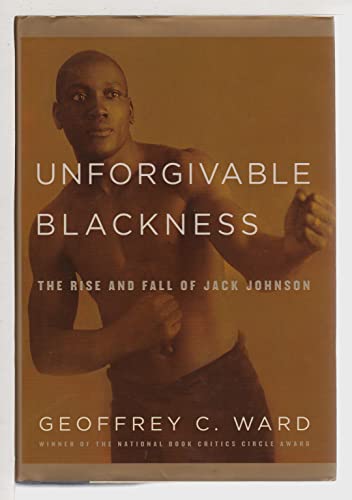
Synopsis
He was the first black heavyweight champion in history, the most celebrated–and most reviled–African American of his age. In Unforgivable Blackness, the prizewinning biographer Geoffrey C. Ward brings to vivid life the real Jack Johnson, a figure far more complex and compelling than the newspaper headlines he inspired could ever convey. Johnson battled his way from obscurity to the top of the heavyweight ranks and in 1908 won the greatest prize in American sports–one that had always been the private preserve of white boxers. At a time when whites ran everything in America, he took orders from no one and resolved to live as if color did not exist. While most blacks struggled just to survive, he reveled in his riches and his fame. And at a time when the mere suspicion that a black man had flirted with a white woman could cost him his life, he insisted on sleeping with whomever he pleased, and married three. Because he did so the federal government set out to destroy him, and he was forced to endure a year of prison and seven years of exile. Ward points out that to most whites (and to some African Americans as well) he was seen as a perpetual threat–profligate, arrogant, amoral, a dark menace, and a danger to the natural order of things.
Unforgivable Blackness is the first full-scale biography of Johnson in more than twenty years. Accompanied by more than fifty photographs and drawing on a wealth of new material–including Johnson’s never-before-published prison memoir–it restores Jack Johnson to his rightful place in the pantheon of American individualists.
"synopsis" may belong to another edition of this title.
About the Author
Geoffrey C. Ward won the National Book Critics Circle Award in 1989. With Ken Burns, he is coauthor of The Civil War and Jazz. He lives in New York City.
From the Inside Flap
He was the first black heavyweight champion in history, the most celebrated and most reviled African American of his age. In Unforgivable Blackness, the prizewinning biographer Geoffrey C. Ward brings to vivid life the real Jack Johnson, a figure far more complex and compelling than the newspaper headlines he inspired could ever convey. Johnson battled his way from obscurity to the top of the heavyweight ranks and in 1908 won the greatest prize in American sports one that had always been the private preserve of white boxers. At a time when whites ran everything in America, he took orders from no one and resolved to live as if color did not exist. While most blacks struggled just to survive, he reveled in his riches and his fame. And at a time when the mere suspicion that a black man had flirted with a white woman could cost him his life, he insisted on sleeping with whomever he pleased, and married three. Because he did so the federal government set out to destroy him, and he was forced to endure a year of prison and seven years of exile. Ward points out that to most whites (and to some African Americans as well) he was seen as a perpetual threat profligate, arrogant, amoral, a dark menace, and a danger to the natural order of things.
Unforgivable Blackness is the first full-scale biography of Johnson in more than twenty years. Accompanied by more than fifty photographs and drawing on a wealth of new material including Johnson s never-before-published prison memoir it restores Jack Johnson to his rightful place in the pantheon of American individualists.
Reviews
Jack Johnson, the first black man to win the world heavyweight championship, would have been worth remembering even if he were white. An elegant boxer who took great pride in his ability to evade a punch, he recited poetry from memory, played the bass viol, listened to opera on the gramophone, even negotiated his own contract for his 1910 "Fight of the Century" against Jim Jeffries.
Johnson dressed flamboyantly, showing up for one fight swathed head to toe in pink. Half a century before the arrival of Cassius Clay, he regularly predicted the round and even the time of his knockouts, a feat of prescience only occasionally helped by the circumstance that the bout was rigged. He readily admitted to being a "sport," someone who would proudly spend his last dollar on a cigar and a tip, and never lose his insouciance. He possessed what novelist Rex Beach called "the soul of a joy rider," and his escapades make for entertaining reading. He cross-examined a witness in London's magistrate court, danced the tango with his wife on a Vienna stage, hurried out of St. Petersburg, Russia, in August 1914 as the Great War began.
But it was the inescapable fact of Johnson's race, and the world's reaction to it, that makes him one of the most compelling sports figures of the 20th century, and a fitting subject for serious biography. From the time he emerged as a heavyweight contender in 1903 -- roughly halfway between the Emancipation Proclamation and Brown v. Board of Education -- he was a symbol of achievement and opportunity to African Americans, some of whom admired him despite his impetuous behavior, and some because of it. He refused to alter his behavior to fit the preconceived notions of others, black or white, and rejected the accommodating attitude of Booker T. Washington, the most respected African American of the era. "I have found no better way of avoiding race prejudice," he wrote, "than to act with people of other races as if prejudice did not exist."
Yet Johnson's skin color affected his existence, personal and professional, for every day of his boxing career and beyond. With the Ku Klux Klan thriving and even sober publications referring to blacks as "niggers" in print (usually quoting them in exaggerated dialect), the United States hardly seemed ready for a black heavyweight champion, let alone one who married white women three different times and often traveled with a retinue of several others. "All his life," Geoffrey Ward writes, "whites and blacks alike would ask him 'Just who do you think you are?' The answer, of course, was always 'Jack Johnson' -- and that would prove to be more than enough for turn-of-the-twentieth-century America to handle."
Ward, a frequent collaborator of documentary filmmaker and author Ken Burns, has written an engaging and well-researched popular biography, long on expository footnotes and short on perspective. But if his Jack Johnson behaves like a cartoon character, it's because Johnson was a cartoon character. He'd stride from place to place in his dandified attire, drive rapidly and dangerously (an auto enthusiast, by 1909 he owned five of the nation's fewer than half a million cars, and he once explained to a traffic judge that his constant speeding was an advertisement for himself and his lifestyle), drop off one attractive woman at the apartment he kept for her, then race off to collect another. Throughout the book, Johnson's energy never flags, and neither does our interest.
Johnson spent the first half of his career chasing potential white opponents (quite literally, in the case of the undersized Canadian heavyweight Tommy Burns, whom he shadowed to Europe and Australia, often showing up in hotel lobbies and restaurants to announce his availability to fight) and the second half defending himself from prosecution for various breaches of public decorum, real or invented. Though the details of Ward's narrative can be difficult to follow -- more dates would surely help, and an appendix detailing Johnson's career -- a portrait of a complicated man emerges.
As Johnson racks up one victory after another over lesser opposition, Ward focuses less on the details of each bout, more on Johnson's pursuit of the white champions of the day and their often comic determination to avoid fighting him. When he finally gained the title, beating Burns in Australia on Dec. 26, 1908, the achievement was undermined by Jeffries' absence from the ring (he had retired as champion three years earlier). It wasn't until Jeffries came out of retirement and Johnson managed to defeat him on July 4, 1910, that whites and blacks alike finally recognized him as the best heavyweight in the world. It was Johnson's finest moment, and Ward captures it well. The second half of the story centers on the series of relationships with white women that led to Johnson's downfall. His flouting of convention was too public, too indiscreet, even for many African Americans to bear. Arrested for everything from beating his fiancée to driving too slowly around New York City's Columbus Circle, he saw his white friends abandon him and his ability to earn a living as a professional prizefighter and entertainer dry up.
Most notable among the accusations was a charge of violating the Mann Act, which prohibits transporting a woman over state lines for immoral purposes. Created to stop the movement of prostitutes as business dictated, it was a potent weapon for those who believed that sex between a black man and a white woman was by definition immoral. Found guilty on the flimsiest of evidence while still champion, Johnson fled to Europe to avoid a jail sentence and found himself unable to get a fight. When he finally lost the heavyweight title in Havana to the lumbering giant Jess Willard in 1915, it was almost a relief. "Now all my troubles are over," Johnson said. "Maybe they'll let me alone."
Johnson returned home to face sentencing, eventually doing 10 months in Leavenworth, where he wrote his memoirs, applied for two patents, and played baseball for the prison team, which happened to be known as the Booker T. Washingtons. After his release in 1921, he fought seven more times spread over four countries. When his competitive career finally ended with a knockout of Big Bill Hartwell in Kansas City in 1928, he was nearly 50 years old and all but forgotten. "He would spend the rest of his life struggling to stay within the spotlight that gave his life meaning," Ward writes. "With time, that struggle would become more and more difficult. . . . Increasingly, Jack Johnson was old news." He died as he lived, at top speed, slamming his Lincoln Zephyr into a telephone pole in North Carolina in 1946.
Was Johnson the best prizefighter of the last century, as some experts maintain, or an undersized, overrated heavyweight who beat few rivals in their primes? Should he be considered a civil rights pioneer or merely a fast-living scofflaw who paid a greater price for his indiscretions because of his skin color? If Ward has an opinion on these matters, he doesn't let on, but he has drawn a portrait of a fascinating figure, whose oversized personality fills every page. The interpretative history can wait for someone else.
Reviewed by Bruce Schoenfeld
Copyright 2004, The Washington Post Co. All Rights Reserved.
Jack Johnson’s colorful personality and his impact on American racial politics make him a fascinating topic for a biography. Critics were interested in this account of his extraordinary life, but many had complaints. Foremost among these was Ward’s failure to provide historical analysis and context. Unforgivable Blackness doesn’t ask any probing questions about Johnson’s influence or his legacy; even though Ward did his research, those seeking an in-depth examination of his life will be disappointed. Ward may lack a historian’s detachment and sense of the larger picture. However, his work succeeds as a compelling portrait of a man determined to transcend his limits.
Copyright © 2004 Phillips & Nelson Media, Inc.
Johnson (1878–1946), boxing's first black heavyweight champion, was a lightning rod for controversy in early 20th-century America. Even many of his fellow African-Americans resented his unapologetic dominance of the ring and steady succession of white girlfriends and wives, viewing his behavior as a setback to race relations. Ward (A First-Class Temperament) depicts the fear and resentment Johnson spurred in white Americans in voluminous detail that may startle modern readers in its frankness. Contemporary journalists regularly referred to Johnson as a "nigger" and openly advocated his pummeling at white hands, though ample quotations from supporters in the Negro press balance the perspective. Ward first documents the obstacles the boxing world threw in Johnson's path (including prolonged refusals by top white boxers to fight against him), and then probes the government's prosecution of the champ under the Mann Act (which banned the interstate transport of females for "immoral purposes") for taking his girlfriends across state lines. Ward brings his award-winning biographical skills to this sympathetic portrayal, which practically bursts with his research—at times almost every page has its own footnote. Though the narrative drags slightly in Johnson's declining years, the champion's stubborn, uncompromising personality never lets up. Even readers who don't consider this a knockout will concede Ward a victory on points. Photos.
Copyright © Reed Business Information, a division of Reed Elsevier Inc. All rights reserved.
*Starred Review* Johnson rose from poverty in Galveston, Texas, to become the first black heavyweight boxing champion only to end up ruined by his affairs with white women, which landed him in prison on trumped-up charges of "white slavery." This compelling and exhaustively researched biography resurrects the story of a uniquely fascinating man. Ward draws mostly on contemporary newspapers (both black and white), drawing us into a time when most every white-owned newspaper in the country was unabashedly racist in its descriptions of and assumptions about African Americans. The racism of early-twentieth-century Europe and America is inextricably intertwined with Johnson's story, so much so that deadly race riots broke out throughout the country after Johnson's pummeling of Great White Hope Jim Jeffries. Ward brings us back into Johnson's life and times with exquisitely rendered details, and the fight scenes themselves are gripping: fights so bloody that referees have to change shirts midbout, for instance, and a manager who pulls a gun on his fighter to keep him from quitting. The authoritative biography of Johnson for sure, but also one of the best boxing books in recent memory. John Green
Copyright © American Library Association. All rights reserved
Excerpt. © Reprinted by permission. All rights reserved.
The Pure-Blooded American
In the spring of 1910, Halley’s comet returned to the heavens after an absence of seventy-five years. Some believed it a sign from God that the world was about to end. Nearly everyone saw it as a momentous event, and during the week of May 18, when astronomers predicted the earth would pass through the comet’s tail, adults and sleepy children all over the country stumbled out of their homes at night to see if they could get a glimpse of it.
On the Lower East Side of New York, thousands of tenement dwellers, mostly immigrants and their families, filled the streets to peer up at the cloudy skies, while on the roof of the Waldorf-Astoria hotel uptown, Speaker of the House Joseph G. Cannon led two hundred tuxedoed guests attending the annual dinner of the National Association of Manufacturers in a champagne toast to the comet’s passing. In Memphis, Tennessee, separate all-night revivals were held for white and black believers awaiting Judgment Day. In Chicago, panicked householders blocked their doors and windows against deadly gases they believed the comet would release.
And early one morning, at the fashionable Seal Rock House on Ocean Beach at San Francisco’s western edge, guests and staff members alike gathered on the sand beneath the stars, listening to the rhythm of the surf and waiting to chart the comet’s brilliant course above the sea.
But the hotel’s most celebrated guest—the most celebrated black man on earth—remained in bed in his suite on the second floor. A member of his entourage had slipped up the stairs a few minutes earlier and tried to rouse him, but the heavyweight champion of the world had ordered him out of the room. He saw no need to get up. Over the coming centuries there would be hundreds of comets, he said. “But there ain’t gonna be but one Jack Johnson.”
Like a good many of his claims, this one was both outrageous and entirely accurate. He had, after all, battered his way from obscurity to the top of the heavyweight ranks and won the greatest prize in American sports—a prize that had always been the private preserve of white combatants. At a time when whites ran everything in America, he took orders from no one and resolved to live always as if color did not exist. While most Negroes struggled merely to survive, he reveled in his riches and his fame. And at a time when the mere suspicion that a black man had flirted with a white woman could cost him his life, he insisted on sleeping with whomever he pleased. Most whites (and some Negroes as well) saw him as a perpetual threat—profligate, arrogant, amoral, a dark menace, and a danger to the natural order of things.
The real Jack Johnson was both more and less than those who loved or those who hated him ever knew. He embodied American individualism in its purest form; nothing—no law or custom, no person white or black, male or female—could keep him for long from whatever he wanted. He was in the great American tradition of self-invented men, too, and no one admired his handiwork more than he did. All his life, whites and blacks alike would ask him, “Just who do you think you are?” The answer, of course, was always “Jack Johnson”—and that would prove to be more than enough for turn-of-the-twentieth-century America to handle.
Johnson visited Paris for the first time in June of 1908, before sailing to Australia and his long-delayed battle with the heavyweight champion Tommy Burns. It may have been then that he and an unknown French journalist began laboring together over the manuscript that would become the first of his autobiographies.* The language of its opening passage seems stilted, especially in translation, but the thoughts are unmistakably Jack Johnson’s:
When a white man writes his memoirs . . . he anxiously begins with the history of his family from earliest times. It seems the higher one ascends the more interested one is in it. And I think that most authors embroider their genealogy. Basically, none of it interests anyone other than family members.
But I don’t want to exempt myself from this ancient custom and wish to say a few words about my genealogy.
Our [Negro] memories are handed down from father to son. Whites don’t think so, but we blacks are also proud of our ancestors and during long days and still longer nights, though we knew neither schools nor books, we still transmited memories of past centuries. I don’t doubt that the stories have been modified over time, but the salient facts remain. If some parts are merely fables it doesn’t matter much. Who can tell among the white stories what is fact and what is fable?
Facts about Johnson’s ancestry are hard to come by, and he was himself a cheerful fabulist when it came to retelling his own life. But the first thing he wanted people to understand about him was that because his enslaved forebears had arrived in America long “before the United States was dreamed of,” he was himself a “pure-blooded American.” And because he knew that that was what he was, he saw no reason ever to accept any limitations on himself to which other Americans were not also subject.*
Why he insisted on acting that way at a time when most American Negroes were relegated to second-class citizenship remains the essential mystery of his life. No amount of sleuthing will ever fully solve it, but a few clues may lie half-hidden in what little we know of his boyhood.
He was born Arthur John Johnson in Galveston, Texas, on March 31, 1878, the year after the last Union troops were withdrawn from the former Confederacy, leaving freed blacks to fend for themselves.† His parents, Henry and Tina (known as Tiny) Johnson, both ex-slaves, did just that. She was from either North or South Carolina; government records and her son’s various accounts differ. Henry was born in Maryland or Virginia sometime during the 1830s; after serving as a civilian teamster attached to the U.S. Army’s 38th (Colored) Infantry, he settled in Galveston in 1867. His son loyally remembered him as “the most perfect physical specimen I have ever seen.” In fact, Henry stood just five foot five and was severely disabled by an atrophied right leg, the result of exposure to cold and rain and snow in the trenches at Petersburg, Virginia, that had caused the “disease of rheumatism” to distort his right knee—or so his attorneys would later claim in one of several unsuccessful bids he made for a veteran’s pension.
Despite his injury, despite the fact that he could not read and that neither he nor his wife could write, Henry Johnson never failed to find ways to support his family. He worked as a porter in a saloon, then as a school janitor, finally as supervising janitor for Galveston’s East School District. His wife took in washing. Both were faithful Methodists, and Henry sometimes helped with the preaching on Sundays; Jack Johnson’s glib tongue and enthusiasm for public speaking may have been an inheritance from him.
The Johnsons had nine children, four of whom lived to adulthood. They kept them all fed and clothed, saw to it that they attended at least five years of school, and somehow managed to put enough money aside to buy a plot of land at 808 Broadway at the island’s eastern end, and build their own single-story home.
Jack was the Johnsons’ third child and first son, and from the beginning seems to have been the focus of his family’s attention. He was bright, talkative, and filled with energy, but, as he and his mother both remembered, he’d also been frail as a small boy and was still so thin at twelve that the family physician warned he might be tubercular. Like his sisters and brothers, he was expected from early childhood to help keep the family going. He swept out schoolrooms to ease his father’s burdens. “Those devilish brooms were taller than I was,” he remembered. “It was sure the joy of my early life to grow taller than the broomstick.” And he got an early morning job, riding along on a milk wagon to keep an eye on the horse when the milkman got down to make a delivery. Every Saturday night, he was paid ten cents and a brand-new pair of bright-red socks, of which his employer evidently had a limitless supply.
Otherwise, Jack remained at home with his older sisters, Lucy and Jennie, and his younger siblings, Henry and Fannie and an adopted brother named Charles. He was especially close to his mother, who told him again and again he was “the best boy in the world” and assured him he could do anything he wanted if he wanted it badly enough.
Jack Johnson seems to have needed little encouragement along those lines. He saw himself as someone special from the first—someone set apart, not subject to the limitations holding others back. His mother liked to recall what he told her one evening when he was still a small boy doing his homework by lamplight. As she told it,
Jack was reading in the Texas history book about great men, and he turns around to me and he allowed as how he was going to be a great man himself some one of these days. And I says, “Shucks, boy, what you talking about? What you think you’re going to be—president?” He said, no, he wasn’t figuring on being president, but he expects he’ll be something what’ll be just about as big. And that child sure was talking a parable that night.
Johnson would remain deeply devoted to Tiny Johnson until her death, lavishing her with gifts and telling reporters she had been responsible for all his success. After her death, he delivered a pulpit talk called “The Influence of My Christian Mother” before black congregations in several cities. In it, he urged his listeners to R...
"About this title" may belong to another edition of this title.
Search results for Unforgivable Blackness: The Rise and Fall of Jack Johnson

Seller Image
Unforgivable Blackness: The Rise and Fall of Jack Johnson
Seller: Dream Books Co., Denver, CO, U.S.A.
Seller rating 5 out of 5 stars

Condition: very_good. Pages are clean with no markings. May show minor signs of wear or cosmetic defects marks, cuts, bends, or scuffs on the cover, spine, pages, or dust jacket. May have remainder marks on edges. Seller Inventory # DBV.0375415327.VG
Stock Image
Unforgivable Blackness: The Rise and Fall of Jack Johnson
Seller: BooksRun, Philadelphia, PA, U.S.A.
Seller rating 5 out of 5 stars
Hardcover. Condition: Fair. With dust jacket. The item might be beaten up but readable. May contain markings or highlighting, as well as stains, bent corners, or any other major defect, but the text is not obscured in any way. Seller Inventory # 0375415327-7-1-29
Stock Image
Unforgivable Blackness: The Rise and Fall of Jack Johnson
Seller: ThriftBooks-Dallas, Dallas, TX, U.S.A.
Seller rating 5 out of 5 stars
Hardcover. Condition: Very Good. No Jacket. May have limited writing in cover pages. Pages are unmarked. ~ ThriftBooks: Read More, Spend Less. Seller Inventory # G0375415327I4N00
Stock Image
Unforgivable Blackness: The Rise and Fall of Jack Johnson
Seller: ThriftBooks-Dallas, Dallas, TX, U.S.A.
Seller rating 5 out of 5 stars
Hardcover. Condition: Fair. No Jacket. Former library book; Readable copy. Pages may have considerable notes/highlighting. ~ ThriftBooks: Read More, Spend Less. Seller Inventory # G0375415327I5N10
Stock Image
Unforgivable Blackness: The Rise and Fall of Jack Johnson
Seller: ThriftBooks-Dallas, Dallas, TX, U.S.A.
Seller rating 5 out of 5 stars
Hardcover. Condition: Good. No Jacket. Pages can have notes/highlighting. Spine may show signs of wear. ~ ThriftBooks: Read More, Spend Less. Seller Inventory # G0375415327I3N00
Stock Image
Unforgivable Blackness: The Rise and Fall of Jack Johnson
Seller: ThriftBooks-Atlanta, AUSTELL, GA, U.S.A.
Seller rating 5 out of 5 stars
Hardcover. Condition: Good. No Jacket. Pages can have notes/highlighting. Spine may show signs of wear. ~ ThriftBooks: Read More, Spend Less. Seller Inventory # G0375415327I3N00
Stock Image
Unforgivable Blackness: The Rise and Fall of Jack Johnson
Seller: ThriftBooks-Phoenix, Phoenix, AZ, U.S.A.
Seller rating 5 out of 5 stars
Hardcover. Condition: Very Good. No Jacket. May have limited writing in cover pages. Pages are unmarked. ~ ThriftBooks: Read More, Spend Less. Seller Inventory # G0375415327I4N00
Stock Image
Unforgivable Blackness: The Rise and Fall of Jack Johnson
Seller: ThriftBooks-Atlanta, AUSTELL, GA, U.S.A.
Seller rating 5 out of 5 stars
Hardcover. Condition: Very Good. No Jacket. May have limited writing in cover pages. Pages are unmarked. ~ ThriftBooks: Read More, Spend Less. Seller Inventory # G0375415327I4N00
Stock Image
Unforgivable Blackness: The Rise and Fall of Jack Johnson
Seller: ThriftBooks-Atlanta, AUSTELL, GA, U.S.A.
Seller rating 5 out of 5 stars
Hardcover. Condition: Very Good. No Jacket. Former library book; May have limited writing in cover pages. Pages are unmarked. ~ ThriftBooks: Read More, Spend Less. Seller Inventory # G0375415327I4N10
Stock Image
Unforgivable Blackness: The Rise and Fall of Jack Johnson
Seller: ThriftBooks-Reno, Reno, NV, U.S.A.
Seller rating 5 out of 5 stars
Hardcover. Condition: Very Good. No Jacket. May have limited writing in cover pages. Pages are unmarked. ~ ThriftBooks: Read More, Spend Less. Seller Inventory # G0375415327I4N00