
Items related to The Pen Commandments: A Guide for the Beginning Writer
Synopsis
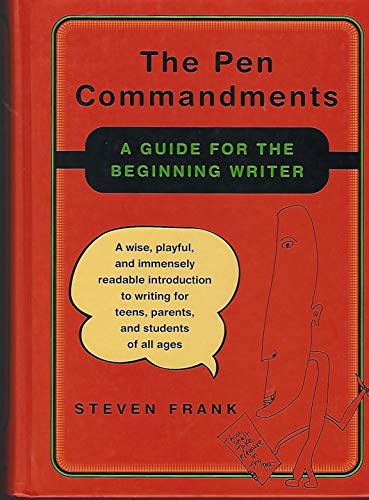
Thou Shalt Honor Thy Reader, Thou Shalt Not Waste Words, Thou Shalt Not Kill Thy Sentences—these are three of the “pen” commandments through which, with humor and an engaging sense of purpose, Steven Frank inspires his readers not just to write but to write well.
Thou Shalt Take Pleasure in Thy Pen: As Frank watches a group of students huddle around a boy who is gleefully explaining a mysterious scar, an infallible writing topic emerges—describe the grossest thing that’s ever happened to you. Thou Shalt Not Pick on the Puncts: Frank persuades a hyperkinetic teen to slow down long enough to let punctuation marks help the boy’s own natural storytelling ability come through. Thou Shalt Overcome Writer’s Block: With practical advice and compelling case studies, Frank unfreezes the pens of struggling writers all around him, from his mail carrier to a former student to his own mom.
Drawing on Frank’s considerable experience as an English teacher, his passion for writing, and his love of language, The Pen Commandments is a witty and accessible book that entertains as it instructs.
"synopsis" may belong to another edition of this title.
About the Author
Mr. Frank has been a high school English teacher for ten years. He lives in Los Angeles with his wife and two children.
From the Back Cover
“Steven Frank is the English teacher you wish you’d had in high school. That’s because he knows that education and humor make terrific team teachers. If thou wishest to become a better—and more joyful—writer, thou shalt follow The Pen Commandments.”
—Richard Lederer, author of The Write Way
From the Inside Flap
Thou Shalt Honor Thy Reader, Thou Shalt Not Waste Words, Thou Shalt Not Kill Thy Sentences―these are three of the “pen” commandments through which, with humor and an engaging sense of purpose, Steven Frank inspires his readers not just to write but to write well.<br><br>Thou Shalt Take Pleasure in Thy Pen: As Frank watches a group of students huddle around a boy who is gleefully explaining a mysterious scar, an infallible writing topic emerges―describe the grossest thing that’s ever happened to you. Thou Shalt Not Pick on the Puncts: Frank persuades a hyperkinetic teen to slow down long enough to let punctuation marks help the boy’s own natural storytelling ability come through. Thou Shalt Overcome Writer’s Block: With practical advice and compelling case studies, Frank unfreezes the pens of struggling writers all around him, from his mail carrier to a former student to his own mom.<br><br>Drawing on Frank’s considerable experience as an English teacher, his passion for writing, and his love of language,<b> The Pen Commandments</b> is a witty and accessible book that entertains as it instructs.
Reviews
While most guides for novice writers are penned by professional writers, this one comes from a high school teacher, and he knows from teaching writing to the unskilled. Judging from the anecdotes he relates, he is an inspired teacher who sparks a love of language in his students. He is an affable, entertaining and unintimidating guide as he reviews his basic rules for good writing: Thou Shalt Honor Thy Reader ("Your first reader is often a teacher... we're desperate to be entertained"); Thou Shalt Not Kill Thy Sentences (a sentence that is "unclear, undisciplined, or incomplete... will be DOA") and more. Some of the subrules are familiar ("Show, don't tell"), but Frank's illustrations-depicting literary devices such as "The Persuasive Staircase"-are so enjoyable, it won't matter. Although aimed at students, grown-up aspiring writers will relish Frank's book, too.
Copyright 2003 Reed Business Information, Inc.
"The first sentence can be as frightening as a first kiss." Funny, inspiring, practical, and rigorous, this writing guide draws on classroom exercises and anecdotes from Frank's 10 years of teaching middle school and high school. With quotes from the greats--J. K. Rowling, Mary Shelley, Herman Melville, Langston Hughes, Sandra Cisneros, and many more--Frank also includes personal, moving, often hilarious examples to illustrate his "pen" commandments of the rules of good writing. Of course, the mistakes make the best reading, such as Parallel Structure Disorder ("Standing in my room, a naked lady suddenly walked by"), but Frank manages to be just as entertaining about the solid basics of punctuation, grammar, and style. Always he shows and tells that writing is fun, but that it isn't easy ("an individual voice doesn't mean chatter"). A must for discussion groups, this will also encourage the hesitant writer to find discipline, direction, and the privacy offered by a room of one's own. Hazel Rochman
Copyright © American Library Association. All rights reserved
Excerpt. © Reprinted by permission. All rights reserved.
One
Thou Shalt Honor Thy Reader
On the first day of school where I teach, the students all line up in the yard according to grade. They mill about, getting reacquainted after a summer apart, and they tell stories. One year I heard someone cry out, "Ewwww, that's disgusting!" I turned and saw a small crowd huddled around a boy named Jason who was describing the oral surgery he had had back in June.
"They found out I had an extra tooth growing down from the roof of my mouth. If we did nothing, it would keep on growing till it touched my tongue. So the dentist said he'd have to pull it."
"Did it hurt?" asked one girl.
"Well, when he cut the hole around the tooth, that wasn't so bad. But then he took a pair of pliers and started twisting it back and forth, like a nail. That I felt."
"Was there a lot of blood?" a boy asked.
"That depends on how you define a lot. Let's just say I couldn't spit fast enough and kept swallowing instead. Finally he got the tooth out, jammed some cotton up there, and told me to hold it in place with my tongue."
"What's it look like now?"
Jason smiled a thin, wicked smile. Then he threw back his head and opened wide for all the kids to gaze at--and be grossed out by--the crater in the roof of his mouth. There was a roar of disgusted cries, and then one kid said, "Can I see that again?"
That's when it hit me: a writing assignment designed to gross us out, to keep us gathered around a composition the way the kids had all gathered around Jason. The topic: "An Accident That Happened." The goal: include so many gory details that at least five of your classmates will either hurl their lunch or skip their dinner. Now you may ask how a writer who incites mass vomiting is respecting his reader, but I invite you to visit my classroom on the day these compositions are read aloud. People love to hear the stories behind scars just as much as they love to tell them.
The Right Topic
The leading cause of writer apathy among today's students is bad topics. "Write about your summer vacation." "Describe your room." "Describe your family." "Write a letter to the editor." "Write a plot summary." "Write a character analysis." "Write a report about the uses of zinc oxide in a developed society." Write a this, write a that, write a write a write a write--why write at all?
If you're not inspired by a writing topic, ask to change it. Ask your teacher if you can describe your family from the dog's point of view, or the fish's. Ask if your plot summary can include blanks so that your classmates can try to guess the title when you read it aloud. Ask if your character analysis can include a literary personals ad to help your character find a date. Don't ask--send your letter to a real editor of a real newspaper. Or better yet, start a newspaper of your own. Sell subscriptions to pay for the Xeroxing costs. Do whatever you can to feel passionate about writing, because if you find the topic boring to write, your reader will find it just as boring to read.
When my brother-in-law Steve was a freshman in college, he had to write an essay entitled "A World Without Books." The professor had the poor judgment to announce the assignment in mid-March, just as the NCAA basketball tournament was getting under way. Steve was too busy placing bets to ponder a world without books, so he ignored the topic until the night before it was due. At eleven p.m., after UCLA had trounced Michigan and won Steve enough money for a weekend in Tahoe, he sat down to his Smith-Corona typewriter and wrote a perfectly suitable topic sentence: "A world without books would be a miserable place in which to live." Within seconds Steve's head fell forward and crashed onto the keys of his typewriter. Three hours later he woke up, squinted at his paper, and saw the topic sentence followed by a row of zzzzzzzzzzzzzzzzzzzzzz's.
Two cups of coffee and four No-Doz tablets later, Steve tried again. To warm up his typing fingers, he retyped the topic sentence: "A world without books would be a miserable place in which to live." The third cup of coffee was still steaming when his head lolled forward and thudded to the typewriter. At six o'clock the next morning, there was the same topic sentence, this time followed by a row of pppppppppppppppppppppppp's.
With z's and p's imprinted on his forehead and not much more on the page, and with the essay due in less than three hours, Steve got the sillies. He began to type over and over: "a world without books. a world without books. a world without books..." Near the bottom of the page he accidentally typed something different: a world without books. a world without books. a world without bookies. He stopped and reread that phrase: a world without bookies. "That's it!" he thought. "That's something I can write about."
He loaded a fresh sheet. "A world without bookies would be a miserable place in which to live," he began. And for the next hour and a half Steve wrote a college essay on a topic that thrilled him.
Do you know what his grade was?
A-plus. The professor was blown away by the originality and irreverence of his essay. Not only did he reward him with the highest grade in the class, he thanked him by reading the composition out loud to a lecture hall crammed with five hundred students. "Of the all the essays I read, this was the only one I enjoyed."
Your first reader is often a teacher. Honor thy reader: we're desperate to be entertained.
Show, Don't Tell
Once you've found a topic that keeps you awake, you can honor thy reader by keeping him awake too. While you can't control the flow of caffeine into your reader's blood, you can control the flow of words into his brain. Don't use too many, but be vivid with the ones you choose: show, don't tell.
Early in the school year I ask my students to write an outrageous excuse for why their homework wasn't done. If the excuse is convincing, I let them use it like a get-out-of-jail-free card instead of turning in one assignment during the semester.
One student who did not respect her reader dashed off the cliche, "My dog ate it." "My dog ate it" is as old as a bloodhound who's lost his sense of smell, but even it can be delivered with a little more panache. A more entertaining excuse might have gone, "My homework lay on the floor in slimy, torn pieces. There were teeth marks in the margins and paw prints on my opening paragraph. I followed the trail of slobber into the kitchen, where my dog sat with my conclusion in his mouth." That brief paragraph shows, through storytelling, what the first sentence merely tells, in flat uninteresting fact. It's more fun to read because it hooks you with an image--the slimy, torn pieces on the floor--and then leads you to another image--the dog with a conclusion in his mouth--to explain it. You, the reader, get to complete the puzzle. You aren't passively receiving information; you have to work for it, and the result is a sense of accomplishment and fun. (By the way, the rewritten version is the work of the student who wrote the dog excuse in the first place. With a little help from her classmates, she was able to improve her writing a thousand percent.)
You can always write, "Last night it rained." But isn't it more intriguing to show us that it rained by creating a picture or a sound for the morning after? "I was awakened by the sound of tires splashing through puddles of water. Pulling back the curtain, I saw that the sun had sliced through the clouds and was busy mopping up the streets."
Is this a violation of Pen Commandment 2, Thou Shalt Not Waste Words? It's true I'm using more words to express what could be stated in fewer, but I'm not just adding words to the sentence; I'm adding an image. "Last night it rained" won't stay with the reader nearly as long as the idea of puddles being mopped up by the sun. Less is sometimes less, and more is sometimes more.
Feed Your Reader Well
You can also honor thy reader by not serving him a skimpy meal. Your writing needs to cast a spell on the reader, lure him into a chair and keep him there, engaged, challenged, and well fed. If, for example, you're writing a realtor's brochure for a dream house in the year 2550, it's not enough to describe it as "an awesome home with all the comforts that technology can provide." Your reader wants to know what those comforts are. Will your dream house feature a shower bed that wakes you with a gentle spray of warm water? Will it come with a virtual closet that lets you see how you'll look in an outfit before you put it on? Will it know just the right music to play for your shifting moods?
If you are writing a composition called "______s Make the Best Pets," in which you describe the most outlandish nondomesticated animal you can imagine bringing home, try to write beyond the obvious. Sure, having a pet giraffe would force you to blow the roof off your house and plant many more trees, but how else would it change your life? Would you have to swap your sedan for a convertible? Would you make enemies at the movies every time you and your giraffe sat in the front row? Would you become the first pick on a basketball team if you and your pet were partners? You might even have to buy a skip loader to keep the backyard tidy.
Where do these ideas come from? For some people, right off the top of the head, but for most of us, the only thing that comes off the top of the head is dandruff. Ideas worthy of your reader come from someplace deeper and more satisfying to scratch. Give yourself enough time to reach there.
One effective technique is to brainstorm before you write. A brainstorm is the initial explosion of ideas you might have on a topic:
SAM...
"About this title" may belong to another edition of this title.
Search results for The Pen Commandments: A Guide for the Beginning Writer

Stock Image
The Pen Commandments: A Guide for the Beginning Writer
Seller: World of Books (was SecondSale), Montgomery, IL, U.S.A.
Seller rating 5 out of 5 stars

Hardback. Condition: Very Good. Thou Shalt Honor Thy Reader, Thou Shalt Not Waste Words, Thou Shalt Not Kill Thy Sentences--these are three of the pen commandments through which, with humor and an engaging sense of purpose, Steven Frank inspires his readers not just to write but to write well. Thou Shalt Take Pleasure in Thy Pen: As Frank watches a group of students huddle around a boy who is gleefully explaining a mysterious scar, an infallible writing topic emerges--describe the grossest thing that's ever happened to you. Thou Shalt Not Pick on the Puncts: Frank persuades a hyperkinetic teen to slow down long enough to let punctuation marks help the boy's own natural storytelling ability come through. Thou Shalt Overcome Writer's Block: With practical advice and compelling case studies, Frank unfreezes the pens of struggling writers all around him, from his mail carrier to a former student to his own mom. Drawing on Frank's considerable experience as an English teacher, his passion for writing, and his love of language, The Pen Commandments is a witty and accessible book that entertains as it instructs. From the Hardcover edition. Seller Inventory # 00095179672
Stock Image
The Pen Commandments: A Guide for the Beginning Writer
Seller: World of Books (was SecondSale), Montgomery, IL, U.S.A.
Seller rating 5 out of 5 stars
Hardback. Condition: Fair. Thou Shalt Honor Thy Reader, Thou Shalt Not Waste Words, Thou Shalt Not Kill Thy Sentences--these are three of the pen commandments through which, with humor and an engaging sense of purpose, Steven Frank inspires his readers not just to write but to write well. Thou Shalt Take Pleasure in Thy Pen: As Frank watches a group of students huddle around a boy who is gleefully explaining a mysterious scar, an infallible writing topic emerges--describe the grossest thing that's ever happened to you. Thou Shalt Not Pick on the Puncts: Frank persuades a hyperkinetic teen to slow down long enough to let punctuation marks help the boy's own natural storytelling ability come through. Thou Shalt Overcome Writer's Block: With practical advice and compelling case studies, Frank unfreezes the pens of struggling writers all around him, from his mail carrier to a former student to his own mom. Drawing on Frank's considerable experience as an English teacher, his passion for writing, and his love of language, The Pen Commandments is a witty and accessible book that entertains as it instructs. From the Hardcover edition. Seller Inventory # 00093260487
Stock Image
The Pen Commandments: A Guide for the Beginning Writer
Seller: World of Books (was SecondSale), Montgomery, IL, U.S.A.
Seller rating 5 out of 5 stars
Hardback. Condition: Good. Thou Shalt Honor Thy Reader, Thou Shalt Not Waste Words, Thou Shalt Not Kill Thy Sentences--these are three of the pen commandments through which, with humor and an engaging sense of purpose, Steven Frank inspires his readers not just to write but to write well. Thou Shalt Take Pleasure in Thy Pen: As Frank watches a group of students huddle around a boy who is gleefully explaining a mysterious scar, an infallible writing topic emerges--describe the grossest thing that's ever happened to you. Thou Shalt Not Pick on the Puncts: Frank persuades a hyperkinetic teen to slow down long enough to let punctuation marks help the boy's own natural storytelling ability come through. Thou Shalt Overcome Writer's Block: With practical advice and compelling case studies, Frank unfreezes the pens of struggling writers all around him, from his mail carrier to a former student to his own mom. Drawing on Frank's considerable experience as an English teacher, his passion for writing, and his love of language, The Pen Commandments is a witty and accessible book that entertains as it instructs. From the Hardcover edition. Seller Inventory # 00105212034
Stock Image
The Pen Commandments: A Guide for the Beginning Writer
Seller: Gulf Coast Books, Cypress, TX, U.S.A.
Seller rating 5 out of 5 stars
hardcover. Condition: Good. Seller Inventory # 0375422285-3-37342464
Stock Image
The Pen Commandments: A Guide for the Beginning Writer
Published by
Pantheon (edition First Edition), 2003
ISBN 10: 0375422285
ISBN 13: 9780375422287
Used
Hardcover
First Edition
Seller: BooksRun, Philadelphia, PA, U.S.A.
Seller rating 5 out of 5 stars
Hardcover. Condition: Very Good. First Edition. It's a well-cared-for item that has seen limited use. The item may show minor signs of wear. All the text is legible, with all pages included. It may have slight markings and/or highlighting. Seller Inventory # 0375422285-11-1
Stock Image
The Pen Commandments : A Guide for the Beginning Writer
Published by
Knopf Doubleday Publishing Group, 2003
ISBN 10: 0375422285
ISBN 13: 9780375422287
Used
Hardcover
Seller: Better World Books, Mishawaka, IN, U.S.A.
Seller rating 5 out of 5 stars
Condition: Very Good. Former library copy. Pages intact with possible writing/highlighting. Binding strong with minor wear. Dust jackets/supplements may not be included. Includes library markings. Stock photo provided. Product includes identifying sticker. Better World Books: Buy Books. Do Good. Seller Inventory # 5749926-6
Stock Image
The Pen Commandments : A Guide for the Beginning Writer
Published by
Knopf Doubleday Publishing Group, 2003
ISBN 10: 0375422285
ISBN 13: 9780375422287
Used
Hardcover
Seller: Better World Books, Mishawaka, IN, U.S.A.
Seller rating 5 out of 5 stars
Condition: Good. Former library copy. Pages intact with minimal writing/highlighting. The binding may be loose and creased. Dust jackets/supplements are not included. Includes library markings. Stock photo provided. Product includes identifying sticker. Better World Books: Buy Books. Do Good. Seller Inventory # 4284118-6
Seller Image
The Pen Commandments: A Guide for the Beginning Writer
Seller: -OnTimeBooks-, Phoenix, AZ, U.S.A.
Seller rating 5 out of 5 stars
Condition: very_good. Gently read. May have name of previous ownership, or ex-library edition. Binding tight; spine straight and smooth, with no creasing; covers clean and crisp. Minimal signs of handling or shelving. 100% GUARANTEE! Shipped with delivery confirmation, if you're not satisfied with purchase please return item! Ships USPS Media Mail. Seller Inventory # OTV.0375422285.VG
Stock Image
The Pen Commandments: A Guide for the Beginning Writer
Seller: World of Books Inc, Montgomery, IL, U.S.A.
Seller rating 4 out of 5 stars

Hardback. Condition: Good. Thou Shalt Honor Thy Reader, Thou Shalt Not Waste Words, Thou Shalt Not Kill Thy Sentences--these are three of the pen commandments through which, with humor and an engaging sense of purpose, Steven Frank inspires his readers not just to write but to write well. Thou Shalt Take Pleasure in Thy Pen: As Frank watches a group of students huddle around a boy who is gleefully explaining a mysterious scar, an infallible writing topic emerges--describe the grossest thing that's ever happened to you. Thou Shalt Not Pick on the Puncts: Frank persuades a hyperkinetic teen to slow down long enough to let punctuation marks help the boy's own natural storytelling ability come through. Thou Shalt Overcome Writer's Block: With practical advice and compelling case studies, Frank unfreezes the pens of struggling writers all around him, from his mail carrier to a former student to his own mom. Drawing on Frank's considerable experience as an English teacher, his passion for writing, and his love of language, The Pen Commandments is a witty and accessible book that entertains as it instructs. From the Hardcover edition. Seller Inventory # CIN0375422285G
Stock Image
The Pen Commandments: A Guide for the Beginning Writer
Seller: World of Books Inc, Montgomery, IL, U.S.A.
Seller rating 4 out of 5 stars
Hardback. Condition: Fair. Thou Shalt Honor Thy Reader, Thou Shalt Not Waste Words, Thou Shalt Not Kill Thy Sentences--these are three of the pen commandments through which, with humor and an engaging sense of purpose, Steven Frank inspires his readers not just to write but to write well. Thou Shalt Take Pleasure in Thy Pen: As Frank watches a group of students huddle around a boy who is gleefully explaining a mysterious scar, an infallible writing topic emerges--describe the grossest thing that's ever happened to you. Thou Shalt Not Pick on the Puncts: Frank persuades a hyperkinetic teen to slow down long enough to let punctuation marks help the boy's own natural storytelling ability come through. Thou Shalt Overcome Writer's Block: With practical advice and compelling case studies, Frank unfreezes the pens of struggling writers all around him, from his mail carrier to a former student to his own mom. Drawing on Frank's considerable experience as an English teacher, his passion for writing, and his love of language, The Pen Commandments is a witty and accessible book that entertains as it instructs. From the Hardcover edition. Seller Inventory # CIN0375422285A