
Items related to The Genius of Language: Fifteen Writers Reflect on...
Synopsis
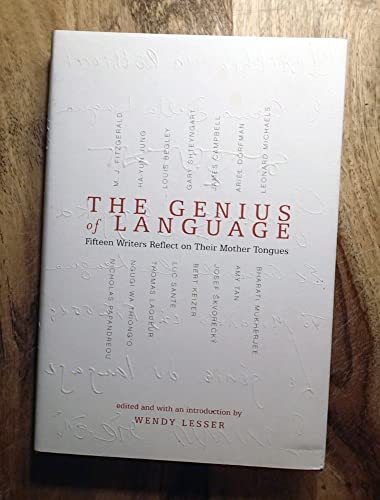
A collection of original essays reflects on their writers' formative experiences of language and culture, from Bharati Mukherjee's appreciation of the Bangla language after the Hindu-Muslim riots of 1946, to Amy Tan's frustration with comparisons between English and Chinese, to Josef Skvorecký's decision to learn English so he could write a fan letter. 25,000 first printing.
"synopsis" may belong to another edition of this title.
About the Author
Wendy Lesser is the founding editor of The Threepenny Review and the author of six books of nonfiction. Her reviews and essays appear in periodicals and newspapers around the country. She lives in Berkeley, California.
Reviews
Adult/High School - Luc Sante arrived from Belgium in the U.S. as a small boy, learned English, but kept his childhood French because of, among other things, his continuing access to comic books. M. J. Fitzgerald was born to American parents living abroad; the children in the family learned to understand their parents' spoken English but their own lives, and childhood literacy, happened in Italian. Ariel Dorfman's life, from infancy, has wavered back and forth from Spanish to English to Spanish to English again. These and the dozen other writers (Amy Tan, Bharati Mukherjee, Thomas Lacquer) who contributed to this collection share a past in a language other than English as the underpinning to an adult career as an English-language author. Arranged in the alphabetical order of their first languages, this anthology includes 20th-century writers from every continent except Australia. Scenes of childhood and adolescence are heavily and engagingly featured, as are cultural confusions and immigrant-family tensions. Each piece is strong and polished, making the whole a glowing collection. Teens who read, travel, or share aspects of these writers' experiences with learning English will enjoy this book with no pushing; teachers will find it excellent curriculum support material for world literature and expository writing classes. - Francisca Goldsmith, Berkeley Public Library, CA
Copyright © Reed Business Information, a division of Reed Elsevier Inc. All rights reserved.
The 15 writers gathered in this often delightful collection consider the impact their bilingualism has had on the development of their craft: they would all agree with Luc Sante, who writes of his inexorable "internal foreignness." All the writers argue that, in some sense, it was precisely that feeling of displacement, of not quite fitting into the surrounding environment, that made them writers at all. For Sante, as for others, foreignness is both a curse and a blessing, and French—his mother tongue—becomes both the barrier to his perfect assimilation into his new American surroundings and a treasured secret, a sanctuary of words. The experience of exile from linguistic security simultaneously allowed the contributors the freedom of unencumbered expression. In a book that asks its contributors—among them Amy Tan, Josef Skvorecký and Ariel Dorfman—to look back at their formative years, it becomes almost inevitable that the essays will indulge in more than a little nostalgia, even when the youth depicted would not seem to provide fodder for fond remembrance. The essays often follow a narrative long familiar to Americans: from the linguistic and cultural security of the family to the attempt at assimilation into the (mostly) American environment through the rejection of the older tongue, to a belated appreciation for the traditions and expressions of old. Despite the somewhat predictable plot line, these writers, gathered by the founding editor of Threepenny Review, vividly recount the process that anyone who loves words goes through: the process of falling under the spell of language's seemingly infinite potential.
Copyright © Reed Business Information, a division of Reed Elsevier Inc. All rights reserved.
What is it like to grow up speaking one language and then writing in another? Critic Lesser invited writers to contribute essays on both their mother and adopted tongues. The result is a set of 15 sparkling, incisive essays about 15 different mother tongues, 15 childhoods, 15 terms of exiles, and 15 embraces of English and forays into writing. Bharati Mukherjee opens the collection with a scintillating tribute to the wonderfully flexible diction of Bangla and the evolution of her British-taught, American-practiced English. Amy Tan writes about Chinese and Chinese etiquette in America. Louis Begley reveals that Polish is his mother tongue; Ngugi wa Thiong'o writes about colonialism and the African language Gikuyu, and the late Leonard Michaels writes of his Yiddish-steeped boyhood and of how that survivor's language flows like an undercurrent beneath his English. Donna Seaman
Copyright © American Library Association. All rights reserved
Excerpt. © Reprinted by permission. All rights reserved.
The Way Back
By Bharati Mukherjee
There is a reason why the language we inherit at birth is called our mother tongue. It is our mother, forgiving, embracing, naming the world and all its emotions. Though I have lived for the last forty years in cities where English or French is the language of the majority, it’s Bangla that exercises motherly restraint over my provisional, immigrant identity. Mother-Bangla is fixed; I haven’t learned a new word nor had new thought or feeling in Bangla for nearly half a century. I don’t need to. According to group-norms, as a native-born speaker, I have automatic membership in the world’s most articulate, most imaginative and most intelligent club. With its brazen appeals to love and vanity, enforced with coercive guilt, the language sabotages irony towards the community’s billowing self-esteem. Like a child whose mother might tipple or stray, I look for excuses, cannot condemn. To my inner Bengali I remain constant, as it does for me.
How exclusive can a club of nearly a quarter-billion members be? Bangla is the language of Bangladesh, the eighth most populous nation in the world, and of the Indian state of West Bengal, the second-largest linguistic group in India. Millions more, documented or not, have settled abroad. Impressive numbers aside, every Bengali, to her at least, is a majority of one. We harbor the faith, implanted by myth and history, of our exalted place in the hierarchy of breeding and culture.
To international relief agency workers, Bangla is the mother tongue of esurient poverty, but to the heirs of shonar bangla, golden Bengal of harvest-ready paddyfields and fish-filled rivers, it is the mother tongue of poetry, passion and abundance. It is also the language of nostalgia and of tentative hope: nostalgia for the Hindu-Muslim harmony that existed in undivided Bengal before its vindictive partition by the fleeing British; and hope for the shared mother tongue, devotion to the possible tomorrow that will transcend the religious furies exploited by today’s politicians. I think a shared language is stronger than divisive religions. (Based on my travels in Bangladesh, I think Hindu and Muslim Bengalis could cross the abyss between them. It’s the national politics of India and corrupt fiefdoms in Bangladesh that get in the way.)
Up to age eight, I lived exclusively in Bangla. My father was the sole support of forty to fifty relatives, who lived with us crowded together in the ground-floor apartment of a two-storied house in a homogenously Hindu, Bangla-speaking, middle-class neighborhood of Kolkata (until recently mispronounced and misspelled as Calcutta by colonialists). All the adults in our large household had been born in villages or towns in the Dhaka (then “Dacca”) district of East Bengal (now Bangladesh); all their children, my sisters and cousins, in the thriving capital, Kolkata, in West Bengal. Among themselves, the adults spoke the dialect of Dhaka, the children the Bangla of Kolkata. I had no idea as a child that linguists considered the Dhaka dialect “deviant,” and Kolkata the standard. In our home the Dhaka dialect, bangal, was the language of authenticity. You are what dialect your forefathers spoke even if you yourself have lost fluency in it be- cause of successive migrations. We were east Bengalis or bangal first, then Bengali. We distanced ourselves from west Bengalis or ghoti who surrounded us and considered us interlopers. We conducted ourselves as bangal, exiled permanently from our ancestral homeland.
To be born a displaced bangal was to inherit loss of, and longing for, one’s true home. Identity had to do with mother tongue, but home was the piece of land that our forefathers had owned, the soil that they had slept and walked on. To be cast out of your janma bhumi or ancestral birth-soil is to be forever doomed. Unlike dialects, which can be transported by migrants, the loss of janma bhumi is permanent. The diasporic Bengali may own real estate in the country of her adoption, but that real estate can only be her residence, as provisional as her immigrant identity, her home. I think now that this intimate braiding of inherited language, place and identity is why Bengalis never took to the British system of primogeniture. Generation by generation, the extent of ancestral land owned by an individual male was whittled down to specks and strips. It didn’t matter that the shrunken land was unprofitable for cultivation and support of large families. Second, third, fourth . . . eighth, ninth. Sons didn’t emigrate; they just stayed and got poorer. Evaluation was symbolic, not economic.
Even as a child I picked up on our linguistic nuancing of house (basha, bari ), room (ghar), land (jomi), soil (bhumi) and homeland (desh). My cousins and I were alert to the moral of the countless children’s stories about villagers willing to starve rather than sell off inherited strips of bhumi. The most menacing refrain from a popular poem we learned by rote was a rich, greedy landowner’s threatening a desperately poor farmer, “Do you get it, Upen / I’m going to buy up your land.” Even now in comfortable San Francisco, with every mortgage and property tax payment, I can be thrown into panic by that simple refrain. (Refinance? Never! Lock it in and forget about it, like immigrants or Depression-era survivors who distrust banks.) The in- herited culture insists that accidents of impulse and geography have made homelessness my permanent condition; the adopted culture tries to persuade me that home is where I choose to invest love and loyalty.
Better colleges, better job opportunities, natural disasters like floods and famines, and periodic flarings of Hindu-Muslim antago- nism had induced my parents’ immediate families to migrate to Kolkata in the 1920s and 1930s, though they still owned land in their hometowns. My father had been sent to Kolkata to stay with a childless aunt and uncle-in-law so that he could get a sound English-language undergraduate education at St. Xavier’s College, run by Jesuits from Belgium. By then a scholarship student, he stayed for graduate degrees in applied chemistry. After that, as the most educated though not the eldest of nine sons, he dutifully looked for a job in Kolkata, the most prosperous of Bengal’s cities. Dependents and family friends also in need of free food and lodging started arriving from the east as soon as they’d heard that he was job-hunting. For a while, the houseguests commuted from Kolkata to their homes in provincial towns of eastern Bengal, where they still jointly owned an ancestral strip.
The Hindu-Muslim riots of 1946, the fiercest in communal memory, drove the last of the Mukherjee clan out of their hometown, where Muslims constituted an overwhelming majority. The refugees brought with them tales of arson, rape and looting. From their tears and nightmare-hour screams, I learned the special resonance that bhoi, the Bangla word for fear, carries. There is no English equivalence for the scale of terror that bhoi implies. In words such as bhoi, the individual experience of fear is shot through with the memory of unspeakable communal suffering. The partitioning of Bengal in 1947 transformed my vast, extended family from commuters shuttling between residence of convenience and homeland to political refugees stranded in a city where they could never belong. Kolkata was their begrudged place of asylum.
That exilic melancholy was passed on to me in infancy. We refugees were different from, and superior to, ghoti Bengalis. Which end of the soft-boiled egg do you crack, and should we go to war over it? We rejected matchmaking between ghoti families and ours. We made fun of the ghoti inability to pronounce the “l” sound in lebu (lemon) and loochi (deep-fried bread). Whenever the East Bengal soccer team played Mohun Bagan, the West Bengal team, we conducted ourselves not as well-brought-up young women but as rowdy soccer fans. The ghoti, in turn, stereotyped us as provincial bumpkins. We directed our Us- versus-Them pugnacity to people who spoke dialects other than the Dhaka one within the bangal community. Long before I had heard of Freud, I had enacted “the narcissism of small differences.”
In our house, bangal was the language of passion and of discipline. Unhappy wives threatened death by fasting in bangal; virtuous virgins gossipped about neighborhood sluts in it; headstrong young uncles swore at each other in it. Whenever my father had to assume the unwelcome role of patriarch and punish unseemly behavior by a relative, he first, in bangal, consulted his widowed mother, an autocratic upholder of conservative traditions. I remember bangal, however, mainly for the ancient doggerels that my paternal grandmother’s coterie of tobacco-chewing, osteoporosis-bent widows recited for their deft delivery of sexist cruelty. Day in and day out, these widows tormented my mother for having borne three daughters and no sons. I may be walking on Haight Street, but I still hear them repeat their malicious couplets: Puter mutey kori / Meyer galai dori (There’s money to be made off a son’s piss / There’s rope to hang a daughter with).
My mother tongue transmitted unambiguously the society’s values and taboos. Literacy turned women rebellious, unsubmissive, and unmarriageable. My mother, who had been married off the moment she had finished high school, was abused regularly by her in-laws, first for daring to express the hope that she might enroll in a women’s college, and later for wanting to send her three daughters to the best elementary school for girls, which happened not to be in our neighborhood. There were harangues and beatings. I didn’t realize at the time that I was not just a child-spectator of a scene of authorized sado-masochism, but that I was witness to the last chapters of a long, cultural mega-upheaval. Only very recently, while researching the battle bet...
"About this title" may belong to another edition of this title.
Search results for The Genius of Language: Fifteen Writers Reflect on...

Stock Image
The Genius of Language
Seller: World of Books (was SecondSale), Montgomery, IL, U.S.A.
Seller rating 5 out of 5 stars

Hardback. Condition: Good. Seller Inventory # 00094288657
Stock Image
The Genius of Language: Fifteen Writers Reflect on Their Mother Tongues
Published by
Pantheon (edition First Edition), 2004
ISBN 10: 0375422382
ISBN 13: 9780375422386
Used
Hardcover
First Edition
Seller: BooksRun, Philadelphia, PA, U.S.A.
Seller rating 5 out of 5 stars
Hardcover. Condition: Very Good. First Edition. With dust jacket. It's a well-cared-for item that has seen limited use. The item may show minor signs of wear. All the text is legible, with all pages included. It may have slight markings and/or highlighting. Seller Inventory # 0375422382-8-1-29
Stock Image
The Genius of Language: Fifteen Writers Reflect on Their Mother Tongues
Seller: Evergreen Goodwill, Seattle, WA, U.S.A.
Seller rating 5 out of 5 stars
hardcover. Condition: Good. Seller Inventory # mon0000729842
Stock Image
The Genius of Language: Fifteen Writers Reflect on Their Mother Tongues
Seller: The Maryland Book Bank, Baltimore, MD, U.S.A.
Seller rating 5 out of 5 stars
hardcover. Condition: Very Good. First Edition. Used - Very Good. Seller Inventory # 1-z-3-1385
Stock Image
The Genius of Language: Fifteen Writers Reflect on Their Mother Tongues
Seller: ThriftBooks-Dallas, Dallas, TX, U.S.A.
Seller rating 5 out of 5 stars
Hardcover. Condition: Very Good. No Jacket. May have limited writing in cover pages. Pages are unmarked. ~ ThriftBooks: Read More, Spend Less. Seller Inventory # G0375422382I4N00
Stock Image
The Genius of Language: Fifteen Writers Reflect on Their Mother Tongues
Seller: ThriftBooks-Atlanta, AUSTELL, GA, U.S.A.
Seller rating 5 out of 5 stars
Hardcover. Condition: Good. No Jacket. Former library book; Pages can have notes/highlighting. Spine may show signs of wear. ~ ThriftBooks: Read More, Spend Less. Seller Inventory # G0375422382I3N10
Stock Image
The Genius of Language: Fifteen Writers Reflect on Their Mother Tongues
Seller: ThriftBooks-Dallas, Dallas, TX, U.S.A.
Seller rating 5 out of 5 stars
Hardcover. Condition: As New. No Jacket. Pages are clean and are not marred by notes or folds of any kind. ~ ThriftBooks: Read More, Spend Less. Seller Inventory # G0375422382I2N00
Stock Image
The Genius of Language : Fifteen Writers Reflect on Their Mother Tongues
Published by
Knopf Doubleday Publishing Group, 2004
ISBN 10: 0375422382
ISBN 13: 9780375422386
Used
Hardcover
Seller: Better World Books: West, Reno, NV, U.S.A.
Seller rating 5 out of 5 stars
Condition: Good. Pages intact with minimal writing/highlighting. The binding may be loose and creased. Dust jackets/supplements are not included. Stock photo provided. Product includes identifying sticker. Better World Books: Buy Books. Do Good. Seller Inventory # 3223754-75
Stock Image
The Genius of Language : Fifteen Writers Reflect on Their Mother Tongues
Published by
Knopf Doubleday Publishing Group, 2004
ISBN 10: 0375422382
ISBN 13: 9780375422386
Used
Hardcover
Seller: Better World Books, Mishawaka, IN, U.S.A.
Seller rating 5 out of 5 stars
Condition: Very Good. Former library copy. Pages intact with possible writing/highlighting. Binding strong with minor wear. Dust jackets/supplements may not be included. Includes library markings. Stock photo provided. Product includes identifying sticker. Better World Books: Buy Books. Do Good. Seller Inventory # 13904742-6
Stock Image
The Genius of Language
Seller: World of Books Inc, Montgomery, IL, U.S.A.
Seller rating 4 out of 5 stars

Hardback. Condition: Good. Seller Inventory # CIN0375422382G