
Items related to Your Inner Fish: A Journey into the 3.5-Billion-Year...
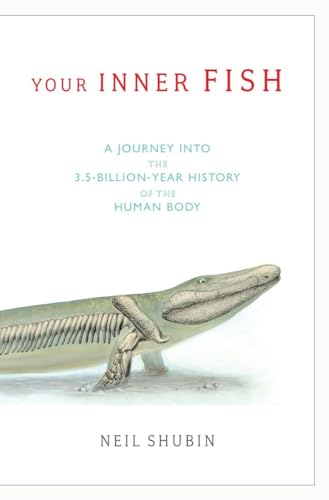
Synopsis
Why do we look the way we do? What does the human hand have in common with the wing of a fly? Are breasts, sweat glands, and scales connected in some way? To better understand the inner workings of our bodies and to trace the origins of many of today's most common diseases, we have to turn to unexpected sources: worms, flies, and even fish.
Neil Shubin, a leading paleontologist and professor of anatomy who discovered Tiktaalik—the "missing link" that made headlines around the world in April 2006—tells the story of evolution by tracing the organs of the human body back millions of years, long before the first creatures walked the earth. By examining fossils and DNA, Shubin shows us that our hands actually resemble fish fins, our head is organized like that of a long-extinct jawless fish, and major parts of our genome look and function like those of worms and bacteria.
Shubin makes us see ourselves and our world in a completely new light. Your Inner Fish is science writing at its finest—enlightening, accessible, and told with irresistible enthusiasm.
"synopsis" may belong to another edition of this title.
About the Author
NEIL SHUBIN is provost of The Field Museum as well as a professor of anatomy at the University of Chicago, where he also serves as an associate dean. Educated at Columbia, Harvard, and the University of California at Berkeley, he lives in Chicago.
Reviews
Reviewed by Barbara J. King
For the first time, Americans have the chance to meet an ancient ancestor. Lucy, the famous 3.2-million-year-old, human-like fossil from Ethiopia, is here on tour. For the next six years, you can visit her at museums across the country and stare into the mirror of your own past.
But in Your Inner Fish, Neil Shubin describes a fossil named Tiktaalik that makes Lucy's time on Earth seem like just yesterday. At 375 million years old, Tiktaalik (which means "large freshwater fish" in Inuit) sports a curious mix of features that mark it as an evolutionary milestone, a "beautiful intermediate between fish and land-living animals." In its fossilized bones, we see a flat head and body, a functional neck and other features that presage what's to come, all mixed in with fish features like fins and scales. Most surprising of all, Tiktaalik has a wrist joint. "Bend your wrist back and forth," Shubin instructs his readers. "Open and close your hand. When you do this, you are using joints that first appeared in the fins of fish like Tiktaalik."
Shubin, a paleontologist and professor of anatomy, made the astounding discovery of Tiktaalik, the first find of its kind, with colleagues in the Canadian Arctic in 2004. He has clearly fallen in love with this ancient fish, and conveys its significance with both precision and exuberance. "Seeing Lucy," writes Shubin, "we can understand our history as highly advanced primates. Seeing Tiktaalik is seeing our history as fish." In fact, Shubin wants us to see our history not only as primates and fish, but also as insects and worms. Exploring the 3.5-billion-year history of life on Earth, Shubin says, will yield a deeper grasp of how our bodies came to be what they are. "Inside our bodies are connections to a menagerie of other creatures. Some parts resemble parts of jellyfish, others parts of worms, still others parts of fish. These aren't haphazard similarities. . . . It is deeply beautiful to see that there is an order in all these features."
Shubin, then, turns Tiktaalik the ancient fish into a poster fossil for the elegant connections across all life-forms on our planet. This evolutionary continuity, so basic to biology, paleontology and anthropology, is the real message of the book. Shubin reveals its practical applications: The better we understand the long history of our joints and organs, the better we will be able to treat trauma and disease in our bodies.
Genes are the co-stars, with bones, of Your Inner Fish. As Shubin puts it, "DNA is an extraordinarily powerful window into life's history and the formation of bodies and organs." When scientists make a fly that lacks a certain gene, the fly's midsection is missing or altered. Frankenstein-like research of this nature helps scientists to understand more about how genes influence developmental processes. Yet how relevant is such research for understanding human development, which unfolds according to rich interaction between our genes and our environment? It's hard not to wince when thinking about the subjects of this DNA-altering lab work.
Nevertheless, Shubin's melding of fossil and genetic data is deft, and it prepares us for his central conclusion. Our lives reflect the evolutionary principle of descent with modification: "Looking back through billions of years of change, everything innovative or apparently unique in the history of life is really just old stuff that has been recycled, repurposed, or otherwise modified for new uses." How our senses work, why we get sick and even why we get the hiccups can be explained by this principle. For instance, hiccups are inherited from fish and tadpoles. We hiccup when a nerve spasm causes muscles in the diaphragm, neck and throat to contract. We gasp and take in some air, and the glottis in the back of our throat snaps shut. This tortuous path that nerves take in our body and the brain stem's response when they spasm are marvelous adaptations for gill-breathers, Shubin explains, but not entirely ideal for us.
Shubin's message convinces. Read Your Inner Fish, and you'll never again be able to look a fish in the eye (or eat seafood) without thinking about shared evolution. In two ways, though, Shubin takes a good thing too far. His passion for science enlivens every page, but some of his sentences ("True, big fish tend to eat littler fish") are overly simplified. He could have trusted his readers more.
Even more worrisome is Shubin's tendency to oversell the relatedness of fish and humans. Our common ancestry with apes is far more recent than with fish, and as a result, our inner ape dominates our inner fish. This fact is most evident when we consider behavior as well as anatomy. Do fish empathize with sick companions, grieve for dead ones or express empathy? Certainly not to the extent that apes do. Or consider the wrist joint which, as we have seen, Shubin uses to link Tiktaalik with humans. Enhanced mobility of the ape wrist joint allows chimpanzees and gorillas to gesture in ways more varied and expressive even than monkeys, a capacity that in turn enriches social communication among them.
We humans are first and foremost primates. Nevertheless, Shubin is dead right: The elegance and full emotional power of our connection with the natural world compel us to reach further back in time and deeper into the Earth's fossil layers. Visit Lucy, think Tiktaalik, and feel the connection.
Copyright 2008, The Washington Post. All Rights Reserved.
Neil Shubin, Professor of Biology and Anatomy at the University of Chicago, made headlines in April 2006 with his discovery of a 375-million-year-old fossil called Tiktaalik, the missing link between ancient sea creatures and land dwellers. The reviewers, mostly science writers, embraced Shubin’s popular science book, which offers a new perspective on evolution, a subject on which most people feel like they’ve already made up their minds. While many Americans doubt Darwinism, hardly anyone discounts anatomy, so it is a logical place to reopen the debate. All critics agreed that Shubin, with his clear examples and explanations, makes (yet another) convincing argument. A few critics, in fact, were so excited by it that they seemed ready to enroll in Shubin’s anatomy course themselves.
Copyright © 2004 Phillips & Nelson Media, Inc.
Fish paleontologist Shubin illuminates the subject of evolution with humor and clarity in this compelling look at how the human body evolved into its present state. Parsing the millennia-old genetic history of the human form is a natural project for Shubin, who chairs the department of organismal biology and anatomy at the University of Chicago and was co-discoverer of Tiktaalik, a 375-million-year-old fossil fish whose flat skull and limbs, and finger, toe, ankle and wrist bones, provide a link between fish and the earliest land-dwelling creatures. Shubin moves smoothly through the anatomical spectrum, finding ancient precursors to human teeth in a 200-million-year-old fossil of the mouse-size part animal, part reptile tritheledont; he also notes cellular similarities between humans and sponges. Other fossils reveal the origins of our senses, from the eye to that wonderful Rube Goldberg contraption the ear. Shubin excels at explaining the science, making each discovery an adventure, whether it's a Pennsylvania roadcut or a stony outcrop beset by polar bears and howling Arctic winds. I can imagine few things more beautiful or intellectually profound than finding the basis for our humanity... nestled inside some of the most humble creatures that ever lived, he writes, and curious readers are likely to agree. Illus. (Jan. 15)
Copyright © Reed Business Information, a division of Reed Elsevier Inc. All rights reserved.
Excerpt. © Reprinted by permission. All rights reserved.
FINDING YOUR INNER FISH
Typical summers of my adult life are spent in snow and sleet, cracking rocks on cliffs well north of the Arctic Circle. Most of the time I freeze, get blisters, and find absolutely nothing. But if I have any luck, I find ancient fish bones. That may not sound like buried treasure to most people, but to me it is more valuable than gold.
Ancient fish bones can be a path to knowledge about who we are and how we got that way. We learn about our own bodies in seemingly bizarre places, ranging from the fossils of worms and fish recovered from rocks from around the world to the DNA in virtually every animal alive on earth today. But that does not explain my confidence about why skeletal remains from the past—and the remains of fish, no less—offer clues about the fundamental structure of our bodies.
How can we visualize events that happened millions and, in many cases, billions of years ago? Unfortunately, there were no eyewitnesses; none of us was around. In fact, nothing that talks or has a mouth or even a head was around for most of this time. Even worse, the animals that existed back then have been dead and buried for so long their bodies are only rarely preserved. If you consider that over 99 percent of all species that ever lived are now extinct, that only a very small fraction are preserved as fossils, and that an even smaller fraction still are ever found, then any attempt to see our past seems doomed from the start.
DIGGING FOSSILS—SEEING OURSELVES
I first saw one of our inner fish on a snowy July afternoon while studying 375-million-year-old rocks on Ellesmere Island, at a latitude about 80 degrees north. My colleagues and I had traveled up to this desolate part of the world to try to discover one of the key stages in the shift from fish to land-living animals. Sticking out of the rocks was the snout of a fish. And not just any fish: a fish with a flat head. Once we saw the flat head we knew we were onto something. If more of this skeleton were found inside the cliff, it would reveal the early stages in the history of our skull, our neck, even our limbs.
What did a flat head tell me about the shift from sea to land? More relevant to my personal safety and comfort, why was I in the Arctic and not in Hawaii? The answers to these questions lie in the story of how we find fossils and how we use them to decipher our own past.
Fossils are one of the major lines of evidence that we use to understand ourselves. (Genes and embryos are others, which I will discuss later.) Most people do not know that finding fossils is something we can often do with surprising precision and predictability. We work at home to maximize our chances of success in the field. Then we let luck take over.
The paradoxical relationship between planning and chance is best described by Dwight D. Eisenhower’s famous remark about warfare: “In preparing for battle, I have found that planning is essential, but plans are useless.” This captures field paleontology in a nutshell. We make all kinds of plans to get us to promising fossil sites. Once we’re there, the entire field plan may be thrown out the window. Facts on the ground can change our best-laid plans.
Yet we can design expeditions to answer specific scientific questions. Using a few simple ideas, which I’ll talk about below, we can predict where important fossils might be found. Of course, we are not successful 100 percent of the time, but we strike it rich often enough to make things interesting. I have made a career out of doing just that: finding early mammals to answer questions of mammal origins, the earliest frogs to answer questions of frog origins, and some of the earliest limbed animals to understand the origins of land-living animals.
In many ways, field paleontologists have a significantly easier time finding new sites today than we ever did before. We know more about the geology of local areas, thanks to the geological exploration undertaken by local governments and oil and gas companies. The Internet gives us rapid access to maps, survey information, and aerial photos. I can even scan your backyard for promising fossil sites right from my laptop. To top it off, imaging and radiographic devices can see through some kinds of rock and allow us to visualize the bones inside.
Despite these advances, the hunt for the important fossils is much what it was a hundred years ago. Paleontologists still need to look at rock—literally to crawl over it—and the fossils within must often be removed by hand. So many decisions need to be made when prospecting for and removing fossil bone that these processes are difficult to automate. Besides, looking at a monitor screen to find fossils would never be nearly as much fun as actually digging for them.
What makes this tricky is that fossil sites are rare. To maximize our odds of success, we look for the convergence of three things. We look for places that have rocks of the right age, rocks of the right type to preserve fossils, and rocks that are exposed at the surface. There is another factor: serendipity. That I will show by example.
Our example will show us one of the great transitions in the history of life: the invasion of land by fish. For billions of years, all life lived only in water. Then, as of about 365 million years ago, creatures also inhabited land. Life in these two environments is radically different. Breathing in water requires very different organs than breathing in air. The same is true for excretion, feeding, and moving about. A whole new kind of body had to arise. At first glance, the divide between the two environments appears almost unbridgeable. But everything changes when we look at the evidence; what looks impossible actually happened.
In seeking rocks of the right age, we have a remarkable fact on our side. The fossils in the rocks of the world are not arranged at random. Where they sit, and what lies inside them, is most definitely ordered, and we can use this order to design our expeditions. Billions of years of change have left layer upon layer of different kinds of rock in the earth. The working assumption, which is easy to test, is that rocks on the top are younger than rocks on the bottom; this is usually true in areas that have a straightforward, layer-cake arrangement (think the Grand Canyon). But movements of the earth’s crust can cause faults that shift the position of the layers, putting older rocks on top of younger ones. Fortunately, once the positions of these faults are recognized, we can often piece the original sequence of layers back together.
The fossils inside these rock layers also follow a progression, with lower layers containing species entirely different from those in the layers above. If we could quarry a single column of rock that contained the entire history of life, we would find an extraordinary range of fossils. The lowest layers would contain little visible evidence of life. Layers above them would contain impressions of a diverse set of jellyfish-like things. Layers still higher would have creatures with skeletons, appendages, and various organs, such as eyes. Above those would be layers with the first animals to have backbones. And so on. The layers with the first people would be found higher still. Of course, a single column containing the entirety of earth history does not exist. Rather, the rocks in each location on earth represent only a small sliver of time. To get the whole picture, we need to put the pieces together by comparing the rocks themselves and the fossils inside them, much as if working a giant jigsaw puzzle.
That a column of rocks has a progression of fossil species probably comes as no surprise. Less obvious is that we can make detailed predictions about what the species in each layer might actually look like, by comparing them with species of animals that are alive today; this information helps us to predict the kinds of fossils we will find in ancient rock layers. In fact, the fossil sequences in the world’s rocks can be predicted by comparing ourselves with the animals at our local zoo or aquarium.
How can a walk through the zoo help us predict where we should look in the rocks to find important fossils? A zoo offers a great variety of creatures that are all distinct in many ways. But let’s not focus on what makes them distinct; to pull off our prediction, we need to focus on what different creatures share. We can then use the features common to all species to identify groups of creatures with similar traits. All the living things can be organized and arranged like a set of Russian nesting dolls, with smaller groups of animals comprised in bigger groups of animals. When we do this, we discover something very fundamental about nature.
Every species in the zoo and the aquarium has a head and two eyes. Call these species “Everythings.” A subset of the creatures with a head and two eyes has limbs. Call the limbed species “Everythings with limbs.” A subset of these headed and limbed creatures has a huge brain, walks on two feet, and speaks. That subset is us, humans. We could, of course, use this way of categorizing things to make many more subsets, but even this threefold division has predictive power.
The fossils inside the rocks of the world generally follow this order, and we can put it to use in designing new expeditions. To use the example above, the first member of the group “Everythings,” a creature with a head and two eyes, is found in the fossil record well before the first “Everything with limbs.” More precisely, the first fish (a card-carrying member of the “Everythings”) appears before the first amphibian (an “Everything with limbs”). Obviously, we refine this by looking at more kinds of animals and many more characteristics that groups of them share, as well as by assessing the actual age of the rocks themselves.
In our labs, we do exactly this type of analysis with thousands upon thousands of characteristics and species. We look at every bit of anatomy we can, and often at large chunks of DNA. There are so much data that we often need powerful computers to show us the groups within groups. This approach is the foundation of biology, because it enables us to make hypotheses about how creatures are related to one another.
Besides helping us refine the groupings of life, hundreds of years of fossil collection have produced a vast library, or catalogue, of the ages of the earth and the life on it. We can now identify general time periods when major changes occurred. Interested in the origin of mammals? Go to rocks from the period called the Early Mesozoic; geochemistry tells us that these rocks are likely about 210 million years old. Interested in the origin of primates? Go higher in the rock column, to the Cretaceous period, where rocks are about 80 million years old.
The order of fossils in the world’s rocks is powerful evidence of our connections to the rest of life. If, digging in 600-million-year-old rocks, we found the earliest jellyfish lying next to the skeleton of a woodchuck, then we would have to rewrite our texts. That woodchuck would have appeared earlier in the fossil record than the first mammal, reptile, or even fish—before even the first worm. Moreover, our ancient woodchuck would tell us that much of what we think we know about the history of the earth and life on it is wrong. Despite more than 150 years of people looking for fossils—on every continent of earth and in virtually every rock layer that is accessible—this observation has never been made.
Let’s now return to our problem of how to find relatives of the first fish to walk on land. In our grouping scheme, these creatures are somewhere between the “Everythings” and the “Everythings with limbs.” Map this to what we know of the rocks, and there is strong geological evidence that the period from 380 million to 365 million years ago is the critical time. The younger rocks in that range, those about 360 million years old, include diverse kinds of fossilized animals that we would all recognize as amphibians or reptiles. My colleague Jenny Clack at Cambridge University and others have uncovered amphibians from rocks in Greenland that are about 365 million years old. With their necks, their ears, and their four legs, they do not look like fish. But in rocks that are about 385 million years old, we find whole fish that look like, well, fish. They have fins, conical heads, and scales; and they have no necks. Given this, it is probably no great surprise that we should focus on rocks about 375 million years old to find evidence of the transition between fish and land-living animals.
We have settled on a time period to research, and so have identified the layers of the geological column we wish to investigate. Now the challenge is to find rocks that were formed under conditions capable of preserving fossils. Rocks form in different kinds of environments and these initial settings leave distinct signatures on the rock layers. Volcanic rocks are mostly out. No fish that we know of can live in lava. And even if such a fish existed, its fossilized bones would not survive the superheated conditions in which basalts, rhyolites, granites, and other igneous rocks are formed. We can also ignore metamorphic rocks, such as schist and marble, for they have undergone either superheating or extreme pressure since their initial formation. Whatever fossils might have been preserved in them have long since disappeared. Ideal to preserve fossils are sedimentary rocks: limestones, sandstones, siltstones, and shales. Compared with volcanic and metamorphic rocks, these are formed by more gentle processes, including the action of rivers, lakes, and seas. Not only are animals likely to live in such environments, but the sedimentary processes make these rocks more likely places to preserve fossils. For example, in an ocean or lake, particles constantly settle out of the water and are deposited on the bottom. Over time, as these particles accumulate, they are compressed by new, overriding layers. The gradual compression, coupled with chemical processes happening inside the rocks over long periods of time, means that any skeletons contained in the rocks stand a decent chance of fossilizing. Similar processes happen in and along streams. The general rule is that the gentler the flow of the stream or river, the better preserved the fossils.
"About this title" may belong to another edition of this title.
Search results for Your Inner Fish: A Journey into the 3.5-Billion-Year...

Stock Image
Your Inner Fish: A Journey into the 3.5-Billion-Year History of the Human Body
Seller: Used Book Company, Egg Harbor Township, NJ, U.S.A.
Seller rating 5 out of 5 stars

Condition: Very Good. Former library copy. Shows minimal signs of wear and previous use. Can include notes/highlighting. A portion of your purchase benefits nonprofits! - Note: Edition & format may differ from what is shown in stock photo & item details. May not include supplementary material (toys, access code, dvds, etc). Seller Inventory # ubc.0375424474.VG
Stock Image
Your Inner Fish: a Journey into the 3.5-billion-year History of the Human Body
Seller: World of Books (was SecondSale), Montgomery, IL, U.S.A.
Seller rating 5 out of 5 stars
Condition: Good. Why do we look the way we do? What does the human hand have in common with the wing of a fly? Are breasts, sweat glands, and scales connected in some way? To better understand the inner workings of our bodies and to trace the origins of many of today's most common diseases, we have to turn to unexpected sources: worms, flies, and even fish. Neil Shubin, a leading paleontologist and professor of anatomy who discovered Tiktaalik--the missing link that made headlines around the world in April 2006--tells the story of evolution by tracing the organs of the human body back millions of years, long before the first creatures walked the earth. By examining fossils and DNA, Shubin shows us that our hands actually resemble fish fins, our head is organized like that of a long-extinct jawless fish, and major parts of our genome look and function like those of worms and bacteria. Shubin makes us see ourselves and our world in a completely new light. Your Inner Fish is science writing at its finest--enlightening, accessible, and told with irresistible enthusiasm. Seller Inventory # 00105992548
Stock Image
Your Inner Fish: A Journey into the 3.5-Billion-Year History of the Human Body
Seller: Wonder Book, Frederick, MD, U.S.A.
Seller rating 5 out of 5 stars
Condition: Good. Good condition. Good dust jacket. A copy that has been read but remains intact. May contain markings such as bookplates, stamps, limited notes and highlighting, or a few light stains. Seller Inventory # I24A-03930
Stock Image
Your Inner Fish: a Journey into the 3.5-billion-year History of the Human Body
Seller: World of Books Inc, Montgomery, IL, U.S.A.
Seller rating 4 out of 5 stars

Condition: Good. Why do we look the way we do? What does the human hand have in common with the wing of a fly? Are breasts, sweat glands, and scales connected in some way? To better understand the inner workings of our bodies and to trace the origins of many of today's most common diseases, we have to turn to unexpected sources: worms, flies, and even fish. Neil Shubin, a leading paleontologist and professor of anatomy who discovered Tiktaalik--the missing link that made headlines around the world in April 2006--tells the story of evolution by tracing the organs of the human body back millions of years, long before the first creatures walked the earth. By examining fossils and DNA, Shubin shows us that our hands actually resemble fish fins, our head is organized like that of a long-extinct jawless fish, and major parts of our genome look and function like those of worms and bacteria. Shubin makes us see ourselves and our world in a completely new light. Your Inner Fish is science writing at its finest--enlightening, accessible, and told with irresistible enthusiasm. Seller Inventory # CIN0375424474G
Stock Image
Your Inner Fish: A Journey into the 3.5-Billion-Year History of the Human Body
Seller: ThriftBooks-Reno, Reno, NV, U.S.A.
Seller rating 5 out of 5 stars
Hardcover. Condition: Good. No Jacket. Pages can have notes/highlighting. Spine may show signs of wear. ~ ThriftBooks: Read More, Spend Less. Seller Inventory # G0375424474I3N00
Stock Image
Your Inner Fish: A Journey into the 3.5-Billion-Year History of the Human Body
Seller: ThriftBooks-Dallas, Dallas, TX, U.S.A.
Seller rating 5 out of 5 stars
Hardcover. Condition: Good. No Jacket. Pages can have notes/highlighting. Spine may show signs of wear. ~ ThriftBooks: Read More, Spend Less. Seller Inventory # G0375424474I3N00
Stock Image
Your Inner Fish: A Journey into the 3.5-Billion-Year History of the Human Body
Seller: ThriftBooks-Atlanta, AUSTELL, GA, U.S.A.
Seller rating 5 out of 5 stars
Hardcover. Condition: Good. No Jacket. Missing dust jacket; Pages can have notes/highlighting. Spine may show signs of wear. ~ ThriftBooks: Read More, Spend Less. Seller Inventory # G0375424474I3N01
Stock Image
Your Inner Fish: A Journey into the 3.5-Billion-Year History of the Human Body
Seller: ThriftBooks-Atlanta, AUSTELL, GA, U.S.A.
Seller rating 5 out of 5 stars
Hardcover. Condition: Good. No Jacket. Pages can have notes/highlighting. Spine may show signs of wear. ~ ThriftBooks: Read More, Spend Less. Seller Inventory # G0375424474I3N00
Stock Image
Your Inner Fish: A Journey into the 3.5-Billion-Year History of the Human Body
Seller: ThriftBooks-Dallas, Dallas, TX, U.S.A.
Seller rating 5 out of 5 stars
Hardcover. Condition: Good. No Jacket. Missing dust jacket; Pages can have notes/highlighting. Spine may show signs of wear. ~ ThriftBooks: Read More, Spend Less. Seller Inventory # G0375424474I3N01
Stock Image
Your Inner Fish: A Journey into the 3.5-Billion-Year History of the Human Body
Seller: ThriftBooks-Atlanta, AUSTELL, GA, U.S.A.
Seller rating 5 out of 5 stars
Hardcover. Condition: Very Good. No Jacket. May have limited writing in cover pages. Pages are unmarked. ~ ThriftBooks: Read More, Spend Less. Seller Inventory # G0375424474I4N00