
Items related to King of the World: Muhammad Ali and the Rise of an...
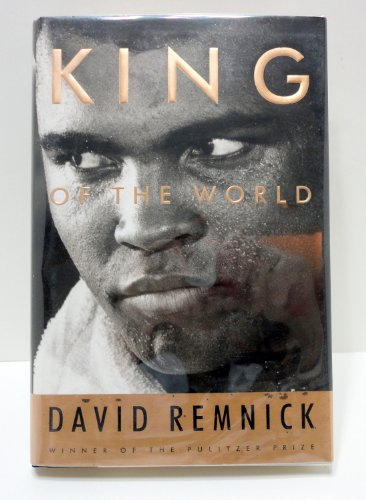
Synopsis
There were mythic sports figures before him--Jack Johnson, Babe Ruth, Joe Louis, Joe DiMaggio--but when Cassius Clay burst onto the sports scene from his native Louisville in the 1950s, he broke the mold. He changed the world of sports and went on to change the world itself. As Muhammad Ali, he would become the most recognized face on the planet. Ali was a transcendent athlete and entertainer, a heavyweight Fred Astaire, a rapper before rap was born. He was a mirror of his era, a dynamic figure in the racial and cultural battles of his time. This unforgettable story of his rise and self-creation, told by a Pulitzer Prize-winning writer, places Ali in a heritage of great American originals.
Cassius Clay grew up in the Jim Crow South and came of athletic age when boxers were at the mercy of the mob. From the start, Clay rebelled against everything and everyone who would keep him and his people down. He refused the old stereotypes and refused the glad hand of the mob. And, to the confusion and fury of white sportswriters, who were far more comfortable with the self-effacing Joe Louis, Clay came forward as a rebel, insistent on his political views, on his new religion, and, eventually, on a new name. His rebellion nearly cost him the chance to fight for the heavyweight championship of the world.
King of the World features some of the pivotal figures of the 1960s--Malcolm X, Elijah Muhammad, John F. Kennedy--and its pivotal events: the civil rights movement, political assassinations, the war in Vietnam. Muhammad Ali is a great hero and a beloved figure in American life. King of the World takes us back to the days when his life was a series of battles, inside the ring and out. A master storyteller at the height of his powers, David Remnick has written a book worthy of America's most dynamic modern hero.
"synopsis" may belong to another edition of this title.
About the Author
David Remnick is the editor of The New Yorker. He began his career as a sportswriter for The Washington Post and won the Pulitzer Prize in 1994 for Lenin's Tomb. He is also the author of Resurrection and The Devil Problem and Other True Stories, a collection of essays. He lives in New York City with his wife and two sons.
From the Back Cover
"By using the Clay--Liston battle as a pivot and placing Muhammad Ali in an accurate social context, David Remnick constructs a narrative very much like Ali himself: astute, double-hearted, irresistible. He is so completely in charge of his craft that it becomes an art." --Toni Morrison
Reviews
A literate, intelligent evocation of the great heavyweight champion. Remnick (Resurrection, 1997, etc.), the Pulitzer Prize winner who is now editor of the New Yorker, openswiselywith the September 1962 fight between Floyd Patterson and Sonny Liston. His profiles of both men are remarkable studies of the sociological backdrop for Ali's entrance upon the scene. Patterson was cast as the good, humble Negro aligned with God; Liston, an ex-con who worked as an enforcer for the mob, as the big, bad, scary black. The brash, poetry-spouting Cassius Clay (as he was still known) fit neither stereotype. Despite his 1960 Olympic gold medal, his obvious speed, and his boxing skills, sportswriters hated the impudent young fighter. He was ``considered . . . little more than a light-hitting loudmouth.'' Clay was no one's pick to steal the title from the overpowering Liston. Remick does a fantastic job of setting the stage for that February 1964 fight, noting that even Clay's people had their doubts: One insider merely hoped ``that Clay wouldn't get hurt.'' The jabbering, taunting Clay pummeled the plodding, dispirited Liston, who simply quit after the sixth round. It was shortly after the fight that Ali's association with the Nation of Islam was revealed. His friendship with Malcolm X and his espousal of the Black Muslim creed, along with his promotional rantings of ``I am the greatest!,'' did not endear him to the public. But he kept winning, beating Liston yet again in 1965 in the most controversial hit in heavyweight history. Remnick's reenactment of that one-punch, ``phantom punch'' knockout in the first round is brilliant. Remnick tails off with Ali's 1967 refusal of the military draft and his subsequent suspension, not going into quite enough depth to explain Alis virtual canonization by the American press and public. But no matter: This is a great look at a warrior who came to symbolize love.'' (16 pages b&w photos, not seen) (Author tour) -- Copyright ©1998, Kirkus Associates, LP. All rights reserved.
David Remnick is no fan of boxing, which he calls "a sport designed to stun the brain" and "finally indefensible," but he gives us an eloquent picture of a man destroyed by his game and ennobled by life, a man who doesn't have to show anything anymore because he has become a symbol and symbols don't have to do but only to be.
"I ain't got no quarrel with them Vietcong," Ali said in 1967 on refusing to be drafted. He was sentenced to five years in prison, and though the Supreme Court would overturn his conviction four years later, principle lost himAtemporarilyAhis title, big bucks, the support of many admirers and the best years of his fighting life. Vietnam postdates most of New Yorker editor Remnick's (Lenin's Tomb) coverage, as he writes little about Ali in the post-Sonny Liston era. At its best, the book recalls the boxing writings of A.J. Liebling, while Remnick's frequent use of Ali's hilarious "rapper" doggerel adds to the melancholy humor through which he describes the Louisville kid who beat gambling odds on the way to the heavyweight title but couldn't beat the medical odds. "The history of [prize] fighters," Remnick writes, "is the history of men who end up damaged." Only in his middle 50s, the once graceful Ali, last seen worldwide clutching the Atlanta Olympic torch in a trembling hand, is disabled by degenerative Parkinson's disease. To many, though, he was disabled even earlier by his conversion to Elijah Muhammad's Nation of Islam, which, whatever its controversial separatist image, "orders [Ali's] life and helps him cope with his illness," according to Remnick. The author smartly records Ali's defiant besting of adversaries in and out of the ring and shows him to be a champion human being. 16 pages of b&w photos.
Copyright 1998 Reed Business Information, Inc.
David Remnick, author of the Pulitzer Prize^-winning Lenin's Tomb (1993), describes the opening moments of Muhammad Ali's first fight with Sonny Liston, when the then Cassius Clay began his signature dance, "moving in and out, his head twitching from side to side, as if freeing himself from a neck crick early in the morning, easy and fluid." The bull-like Liston lunged with a jab, which missed by two feet: "At that moment, Clay hinted at what . . . he was about to introduce to boxing and to sports in general--the marriage of mass and velocity."
In this completely fresh and utterly compelling account of Ali's early career--through his refusal to be inducted into the army ("I ain't got no quarrel with them Vietcong")--Remnick manages to capture what has largely eluded a host of other starstruck writers (Mailer, et al.): a balanced mix of the myth and the reality of Ali, a sense of how the gestalt of a nation in transition happened to land on the beautiful brown shoulders of a cocky young man from Louisville. How does Remnick do it? By avoiding the tendency to become swept away, as Mailer was, by Ali as metaphor and, instead, by carefully turning the soil of his early years and, especially, by looking closely at the supporting players in the drama of those first fights. Remnick's portraits of Floyd Patterson, the sensitive champion, beloved by civil-rights advocates (but, ultimately, despised by Ali) and of Sonny Liston, the evil bear, are not only remarkably humanizing, stereotype-shattering character studies in their own right but also make us realize more clearly than ever just how subversive Ali's unique mix of flamboyance, commitment, and playfulness must have seemed to an establishment mindset comfortable only with the polarized view of blacks symbolized by Patterson and Liston. "I'm free to be what I want," Ali declared when he joined the Nation of Islam, and if such declarations have become the stuff of cliche today, fodder for The Jerry Springer Show, they were anything but that in 1964, when the howls of press and public made clear that, in most minds, Ali was only free to be . . . Sonny Liston or Floyd Patterson. This is the best book ever on Muhammad Ali and one of the best on America in the 1960s. Bill Ott
Pulitzer Prize winner Remnick (Lenin's Tomb), now editor of The New Yorker, turns what could have been a simple sports homage into a sophisticated portrait of Sixties America and the metamorphosis of Cassius Clay into Muhammad Ali. Ali?the mouthy, beautiful 7-1 underdog who "shook up the world" by beating Sonny Liston in 1964, severing the Mob's claim on the heavyweight title, and trading in his "slave name" for a Muslim identity?is a transcendent enough social figure to draw on all of Remnick's journalistic powers. The battles with Liston, Patterson, and the draft board that ended Ali's career for three and a half years make for a fascinating political journey.
Copyright 1999 Reed Business Information, Inc.
Excerpt. © Reprinted by permission. All rights reserved.
HYPE
The promoter of the Liston-Clay fight was William B. MacDonald, a former bus conductor who had made so great a fortune that he now got around in two Rolls-Royces and a fifty-foot cruiser named Snoozie. MacDonald was born in Butte in 1908, the descendant, he said, of generations of sheep thieves. There being few sheep to steal in Butte, he came to Miami and made his money in the parking business, then in laundry and dry cleaning, then in restaurant management, trucking, mobile homes, and a mortgage company based in San Juan. He married a Polish woman named Victoria and, just for fun, bought a stud farm in Delray Beach and a Class D baseball team called the Tampa Tarpons. MacDonald handed out gold cuff links like Chiclets. He lived in a quarter-million-dollar house in Bal Harbour and retained an assistant named Sugar Vallone, late of the bartending trade. His generosity as a father was unparalleled. He built his daughter a tree house with drapes and carpeting matching the main house, and for his daughter's eighth birthday he installed a jukebox in the tree. Bill MacDonald had a good time. He smoked his cigars and ate his steaks. He played golf and decorated his walls with the many marlin he had pulled out of the Atlantic. On the golf course, driving his cart, he held a Coke in his right hand and a root beer in his left, and steered with his forearms and his belly. He was very fat.
MacDonald had enjoyed his experience so far in the boxing business. He made some money, if not a lot, promoting the third Patterson-Johansson fight. When he first talked to Chris Dundee about a Liston-Clay title bout, it seemed a no-lose proposition. There was money to be made, what with all the big-money tourists and the winter crowds in Miami in February. How could it flop? Liston was already the most fearsome presence in boxing since Louis and Marciano, and Clay, with his mouth flapping, would sell as many tickets as the Miami fire laws would permit. No lose. And so MacDonald, who had $800,000 invested in the fight, serenely pegged the top ticket at an unprecedented $250.
MacDonald envisioned a great night, the ring surrounded by movie people and all the usual hustlers, the big-roll guys. He wanted all the big faces up close. "A guy calls me, for instance, wants to buy a hundred-dollar seat for Andy Williams," he told a reporter for Sports Illustrated. "I tell him Andy Williams's got to be up there with the big kids. I can't imagine him sitting back there with the little kids. He's got to be in there with the wheels, not the hubcaps."
Although MacDonald was not exactly expert in boxing, he was smart enough to tell the writers he was acutely aware of the possibility of surprise in the fight. "I figure Clay to win it," he said. "He'll take the title if he stays away, jabs and runs, but the little jerk is so egotistical--he's getting hysterical--he thinks he can punch Liston's nose sideways. It's liable to be a stinky fight to watch, but if Clay gets by seven or eight he's likely to win it." One could appreciate the sentiment if not the subtlety of MacDonald's maneuver. You don't sell tickets when David has no shot at Goliath.
MacDonald did not expect Liston to get into a verbal war with Clay before the fight. Liston had become so accustomed to hearing about himself as the indomitable champion, a seven-to-one favorite at the minimum, that he trained at the Surfside Civic Auditorium in North Miami Beach with a smug air of business as usual. In contrast to Clay's gloriously dismal surroundings at the Fifth Street Gym, Liston sparred with air-conditioning. An announcer would intone the next station of the cross--"The champion at the heavy bag"--and Liston would pound away for a short while. Then his cornermen, led by Willie Reddish, would rush to him and towel him off as if he were Cleopatra. Reddish would wing a medicine ball at Liston's gut a dozen times and then Liston would skip rope to "Night Train," as he had on The Ed Sullivan Show.
"Note that the champion's heels never touch the board," the master of ceremonies announced. "He does all this off his toes."
Liston trained the way Liberace played piano; it was a garish representation of a boxer at work. If Liston was taking Clay at all seriously, it was very hard to tell. He would not even deign to pretend to loathe his challenger. "I don't hate Cassius Clay," he said. "I love him so much I'm giving him twenty-two and a half percent of the gate. Clay means a lot to me. He's my baby, my million-dollar baby. I hope he keeps well and I sure hope he shows up." Liston's only health concern, he allowed, was for the destiny of his vaunted left fist: "It's gonna go so far down his throat, it'll take a week for me to pull it out again."
The columnists may not have liked Liston, but they respected him as a fighter. They figured him an easy winner over Clay. Lester Bromberg of the New York World-Telegram said the fight would "follow the pattern" of the two Liston-Patterson fights, the only difference being that this would last longer: "It will last almost the entire first round." Nearly all the columnists were middle-aged, raised on Joe Louis, and they were inclined to like Clay even less than Liston. Jim Murray of the Los Angeles Times predicted that the Liston-Clay matchup would be "the most popular fight since Hitler and Stalin--180 million Americans rooting for a double knockout. The only thing at which Clay can beat Liston is reading the dictionary. . . . His public utterances have all the modesty of a German ultimatum to Poland but his public performances run more to Mussolini's navy."
At the Fifth Street Gym, of course, Clay was exerting considerable energy in his post-training-session press conferences. Day after day he described how he would spend the first five rounds circling "the big ugly bear," tiring him out, and then tear him apart with hooks and uppercuts until finally Liston would drop to all fours in submission. "I'm gonna put that ugly bear on the floor, and after the fight I'm gonna build myself a pretty home and use him as a bearskin rug. Liston even smells like a bear. I'm gonna give him to the local zoo after I whup him. People think I'm joking. I'm not joking. I'm serious. This will be the easiest fight of my life." He told the visiting reporters that now was their chance to "jump on the bandwagon." He was taking names, he said, keeping track of all the naysayers, and when he won "I'm going to have a little ceremony and some eating is going on--eating of words." Day after day he would replay his homage to Gorgeous George when describing what he'd do in case of a Liston win: "You tell this to your camera, your newspaper, your TV man, your radio man, you tell this to the world: If Sonny Liston whups me, I'll kiss his feet in the ring, crawl out of the ring on my knees, tell him he's the greatest, and catch the next jet out of the country." Most spectacularly, he composed in honor of the occasion what was surely his best poem. Over the years, Clay would farm out some of his poetical work. "We all wrote lines here and there," Dundee said. But this one was all Clay. Ostensibly, it was a prophetic vision of the eighth round, and no poem, before or after, could beat it for narrative drive, precise scansion, and wit. It was his "Song of Myself":
Clay comes out to meet Liston
And Liston starts to retreat
If Liston goes back any further
He'll end up in a ringside seat.
Clay swings with a left,
Clay swings with a right,
Look at young Cassius
Carry the fight.
Liston keeps backing
But there's not enough room
It's a matter of time.
There, Clay lowers the boom.
Now Clay swings with a right,
What a beautiful swing,
And the punch raises the bear,
Clear out of the ring.
Liston is still rising
And the ref wears a frown,
For he can't start counting,
Till Sonny comes down.
Now Liston disappears from view.
The crowd is getting frantic,
But our radar stations have picked him up
He's somewhere over the Atlantic.
Who would have thought
When they came to the fight
That they'd witness the launching
Of a human satellite?
Yes, the crowd did not dream
When they laid down their money
That they would see
A total eclipse of the Sonny!
I am the greatest!
Nearly all the writers regarded Clay's bombast, in prose and verse, as the ravings of a lunatic. But not only did Clay have a sense of how to fill a reporter's notebook and, thus, a promoter's arena, he had a sense of self. The truth (and it was a truth he shared with almost no one) was that Cassius Clay knew that for all his ability, for all his speed and cunning, he had never met a fighter like Sonny Liston. In Liston, he was up against a man who did not merely beat his opponents, but hurt them, damage them, shame them in humiliatingly fast knockouts. Liston could put a man away with his jab; he was not much for dancing, but then neither was Joe Louis. Liston was the prototype of what a heavyweight champion should be: he threw bomb after unforgiving bomb. When he hit a man in the solar plexus the glove seemed lost up to the cuff; he was too powerful to grab and clinch; nothing hurt him. Clay was too smart, he had watched too many films, not to know that. "That's why I always knew that all of Clay's bragging was a way to convince himself that he could do what he said he'd do," Floyd Patterson told me many years later. "I never liked all his bragging. It took me a long time to understand who Clay was talking to. Clay was talking to Clay."
Very few people would ever know how true that was and how much Clay feared Liston. One evening, just before signing the contracts for the fight, he visited Sports Illustrated's offices on the twentieth floor of the Time-Life Building in midtown Manhattan. It was seven-thirty and Clay stood at the window looking out at the lights blinking along Sixth Av...
"About this title" may belong to another edition of this title.
Search results for King of the World: Muhammad Ali and the Rise of an...

Stock Image
King of the World: Muhammad Ali and the Rise of an American Hero
Seller: Gulf Coast Books, Cypress, TX, U.S.A.
Seller rating 5 out of 5 stars

hardcover. Condition: Fair. Seller Inventory # 0375500650-4-36869650
Stock Image
King of the World: Muhammad Ali and the Rise of an American Hero
Seller: Your Online Bookstore, Houston, TX, U.S.A.
Seller rating 5 out of 5 stars
Hardcover. Condition: Good. Seller Inventory # 0375500650-3-23217227
Stock Image
King of the World: Muhammad Ali and the Rise of an American Hero
Seller: Orion Tech, Kingwood, TX, U.S.A.
Seller rating 5 out of 5 stars
Hardcover. Condition: Good. Seller Inventory # 0375500650-3-24566885
Stock Image
King of the World: Muhammad Ali and the Rise of an American Hero
Seller: World of Books (was SecondSale), Montgomery, IL, U.S.A.
Seller rating 5 out of 5 stars
Hardback. Condition: Very Good. Succeeds more than any previous book in bringing Ali into focus . . . as a starburst of energy, ego and ability whose like will never be seen again.--The Wall Street Journal Best Nonfiction Book of the Year--Time Penetrating . . . reveal[s] details that even close followers of [Ali] might not have known. . . . An amazing story. --The New York Times On the night in 1964 that Muhammad Ali (then known as Cassius Clay) stepped into the ring with Sonny Liston, he was widely regarded as an irritating freak who danced and talked way too much. Six rounds later Ali was not only the new world heavyweight boxing champion: He was a new kind of black man who would shortly transform America's racial politics, its popular culture, and its notions of heroism. No one has captured Ali--and the era that he exhilarated and sometimes infuriated--with greater vibrancy, drama, and astuteness than David Remnick, the Pulitzer Prize-winning author of Lenin's Tomb (and editor of The New Yorker). In charting Ali's rise from the gyms of Louisville, Kentucky, to his epochal fights against Liston and Floyd Patterson, Remnick creates a canvas of unparalleled richness. He gives us empathetic portraits of wisecracking sportswriters and bone-breaking mobsters; of the baleful Liston and the haunted Patterson; of an audacious Norman Mailer and an enigmatic Malcolm X. Most of all, King of the World does justice to the speed, grace, courage, humor, and ebullience of one of the greatest athletes and irresistibly dynamic personalities of our time. Nearly pulse-pounding narrative power . . . an important account of a period in American social history. --Chicago Tribune A pleasure . . .haunting . . . so vivid that one can imagine Ali saying, 'How'd you get inside my head, boy?' --Wilfrid Sheed, Time. Seller Inventory # 00094196593
Stock Image
King of the World: Muhammad Ali and the Rise of an American Hero
Seller: World of Books (was SecondSale), Montgomery, IL, U.S.A.
Seller rating 5 out of 5 stars
Hardback. Condition: Fair. Succeeds more than any previous book in bringing Ali into focus . . . as a starburst of energy, ego and ability whose like will never be seen again.--The Wall Street Journal Best Nonfiction Book of the Year--Time Penetrating . . . reveal[s] details that even close followers of [Ali] might not have known. . . . An amazing story. --The New York Times On the night in 1964 that Muhammad Ali (then known as Cassius Clay) stepped into the ring with Sonny Liston, he was widely regarded as an irritating freak who danced and talked way too much. Six rounds later Ali was not only the new world heavyweight boxing champion: He was a new kind of black man who would shortly transform America's racial politics, its popular culture, and its notions of heroism. No one has captured Ali--and the era that he exhilarated and sometimes infuriated--with greater vibrancy, drama, and astuteness than David Remnick, the Pulitzer Prize-winning author of Lenin's Tomb (and editor of The New Yorker). In charting Ali's rise from the gyms of Louisville, Kentucky, to his epochal fights against Liston and Floyd Patterson, Remnick creates a canvas of unparalleled richness. He gives us empathetic portraits of wisecracking sportswriters and bone-breaking mobsters; of the baleful Liston and the haunted Patterson; of an audacious Norman Mailer and an enigmatic Malcolm X. Most of all, King of the World does justice to the speed, grace, courage, humor, and ebullience of one of the greatest athletes and irresistibly dynamic personalities of our time. Nearly pulse-pounding narrative power . . . an important account of a period in American social history. --Chicago Tribune A pleasure . . .haunting . . . so vivid that one can imagine Ali saying, 'How'd you get inside my head, boy?' --Wilfrid Sheed, Time. Seller Inventory # 00092223129
Stock Image
King of the World: Muhammad Ali and the Rise of an American Hero
Seller: World of Books (was SecondSale), Montgomery, IL, U.S.A.
Seller rating 5 out of 5 stars
Hardback. Condition: Good. Succeeds more than any previous book in bringing Ali into focus . . . as a starburst of energy, ego and ability whose like will never be seen again.--The Wall Street Journal Best Nonfiction Book of the Year--Time Penetrating . . . reveal[s] details that even close followers of [Ali] might not have known. . . . An amazing story. --The New York Times On the night in 1964 that Muhammad Ali (then known as Cassius Clay) stepped into the ring with Sonny Liston, he was widely regarded as an irritating freak who danced and talked way too much. Six rounds later Ali was not only the new world heavyweight boxing champion: He was a new kind of black man who would shortly transform America's racial politics, its popular culture, and its notions of heroism. No one has captured Ali--and the era that he exhilarated and sometimes infuriated--with greater vibrancy, drama, and astuteness than David Remnick, the Pulitzer Prize-winning author of Lenin's Tomb (and editor of The New Yorker). In charting Ali's rise from the gyms of Louisville, Kentucky, to his epochal fights against Liston and Floyd Patterson, Remnick creates a canvas of unparalleled richness. He gives us empathetic portraits of wisecracking sportswriters and bone-breaking mobsters; of the baleful Liston and the haunted Patterson; of an audacious Norman Mailer and an enigmatic Malcolm X. Most of all, King of the World does justice to the speed, grace, courage, humor, and ebullience of one of the greatest athletes and irresistibly dynamic personalities of our time. Nearly pulse-pounding narrative power . . . an important account of a period in American social history. --Chicago Tribune A pleasure . . .haunting . . . so vivid that one can imagine Ali saying, 'How'd you get inside my head, boy?' --Wilfrid Sheed, Time. Seller Inventory # 00107327918
Seller Image
King of the World: Muhammad Ali and the Rise of an American Hero
Seller: 3Brothers Bookstore, Egg harbor township, NJ, U.S.A.
Seller rating 5 out of 5 stars
Condition: very_good. Cover may have light wear, pages in very good condition and binding is sturdy; may have other light shelf wear or creases. May have notes or highlighting. Seller Inventory # EVV.0375500650.VG
Seller Image
King of the World: Muhammad Ali and the Rise of an American Hero
Seller: Zoom Books Company, Lynden, WA, U.S.A.
Seller rating 5 out of 5 stars
Condition: very_good. Book is in very good condition and may include minimal underlining highlighting. The book can also include "From the library of" labels. May not contain miscellaneous items toys, dvds, etc. . We offer 100% money back guarantee and 24 7 customer service. Seller Inventory # ZBV.0375500650.VG
Seller Image
King of the World: Muhammad Ali and the Rise of an American Hero
Seller: Zoom Books East, Glendale Heights, IL, U.S.A.
Seller rating 5 out of 5 stars
Condition: good. Book is in good condition and may include underlining highlighting and minimal wear. The book can also include "From the library of" labels. May not contain miscellaneous items toys, dvds, etc. . We offer 100% money back guarantee and 24 7 customer service. Seller Inventory # ZEV.0375500650.G
Seller Image
King of the World: Muhammad Ali and the Rise of an American Hero
Seller: Zoom Books East, Glendale Heights, IL, U.S.A.
Seller rating 5 out of 5 stars
Condition: very_good. Book is in very good condition and may include minimal underlining highlighting. The book can also include "From the library of" labels. May not contain miscellaneous items toys, dvds, etc. . We offer 100% money back guarantee and 24 7 customer service. Seller Inventory # ZEV.0375500650.VG