
Items related to Real Boys: Rescuing Our Sons from the Myths of Boyhood
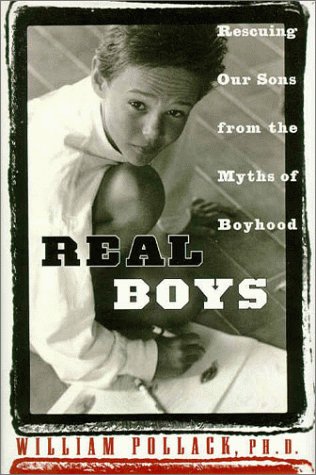
Synopsis
Boys today are in crisis. On the surface, many boys may appear tough, confident, and cheerful, but underneath, many of them are sad,
lonely, and confused. As the bestselling Reviving Ophelia took us into the worlds of girls, this groundbreaking book reveals the worlds of
boys to show how society's mixed messages to boys put more of them at risk today than ever before. Boys' voices and experiences rise up
from these pages as Dr. William Pollack of the Harvard Medical School draws on almost two decades of work with boys as well as on a recent
study called "Listening to Boys' Voices" to present new findings about the true nature of boys and new insights into how to raise them to
become happier, more confident, more successful men.
"I get a little down," says Adam,"but I hide it very well. I'd say I wear a mask of some sort. Even when kids call me names or try to taunt me,
I'd never show them how much it was crushing me inside. I'd keep it all in."
Pollack reveals how many boys today are like Adam, whose confident exterior hides painful feelings of loneliness and isolation.
Other boys are in trouble overtly--depressed, suicidal, doing less well at school than they could, having trouble with drugs or with friends.
Real Boys shows why, and what to do about it. Pollack describes how outdated gender stereotypes push boys to conform to society's inhibiting
Boy Code, even as boys are pressured to relate to girls in new ways. Boys conceal themselves behind a mask of independence, which not only
prevents them from truly knowing themselves but makes it difficult for us to know them. Conventional expectations about masculinity still
encourage people to treat boys like "little men," and to raise them through a toughening process. Illuminating the daily lives of boys of all ages,
Real Boys lets us know what boys are really like, revealing new findings about the expressive nature of boys, how they are different from girls and
how they are similar to them, and wh
at they are thinking and feeling.
Pollack addresses a wide range of topics--boys and their mothers, fathers, friends; boys in school, sports, and adolescence; how boys can
develop more self-confidence, and the emotional savvy they need to deal with issues they may have to confront--such as depression, love and
sexuality, drugs and alcohol, divorce, violence.
After you read this original and insightful book, you will see every boy you know in an entirely new way.
Based on new research into the inner worlds and daily lives of boys today, Real Boys explores in depth the following:
¸ The loneliness of "normal" boys today--what we do to cause it, and what we can
do to prevent it
¸ Low self-esteem--why more boys today are suffering from low self-esteem and
what we can do about it
¸ The power of mothers and fathers--how to help boys become more confident,
loving, and able to lead happier lives as men
¸ Adolescence as a "second chance"--how to use adolescence as a new opportunity
to grow closer to a boy and to help him deal with such topics as smoking, drinking,
and sex
¸ Getting boys to talk--the timed-silence syndrome and how to encourage boys to
talk and share their feelings
¸ Overcoming depression--the hidden crisis of boyhood depression: how to spot it,
and what to do about it
¸ Violence, alcohol, drugs, and much, much more
"synopsis" may belong to another edition of this title.
About the Author
William S. Pollack, Ph.D., a clinical psychologist, is the codirector of the Center for Men at McLean Hospital/Harvard Medical School, an assistant
clinical professor of psychiatry at the Harvard Medical School, and a founding member and Fellow of the Society for the Psychological Study of Men and Masculinity of the American Psychological Association. He is coauthor of In a Time of Fallen Heroes: The Re-Creation of Masculinity and coeditor of A New Psychology for Men. He and his family live in Massachusetts.
From the Back Cover
"Just as Reviving Ophelia opened our eyes to the challenges faced by adolescent girls, Real Boys helps us hear and respond to the needs of growing boys. Illuminating, exciting, and courageous, this book should be read by everyone concerned about boys. It is a beacon of hope and a gift to all of us."
-Judith V. Jordan, Ph.D., assistant professor in psychiatry, Harvard Medical School
"This book does for boys and men what important books have done to help us better understand girls and women. Anyone who lives or works with boys and men should read William Pollack's revealing Real Boys."
-Gail Sheehy, author of The Silent Passage and Understanding Men's Passages
From the Inside Flap
re in crisis. On the surface, many boys may appear tough, confident, and cheerful, but underneath, many of them are sad, <br>lonely, and confused. As the bestselling Reviving Ophelia took us into the worlds of girls, this groundbreaking book reveals the worlds of <br>boys to show how society's mixed messages to boys put more of them at risk today than ever before. Boys' voices and experiences rise up <br>from these pages as Dr. William Pollack of the Harvard Medical School draws on almost two decades of work with boys as well as on a recent <br>study called "Listening to Boys' Voices" to present new findings about the true nature of boys and new insights into how to raise them to <br>become happier, more confident, more successful men.<br> "I get a little down," says Adam,"but I hide it very well. I'd say I wear a mask of some sort. Even when kids call me names or try to taunt me,<br> I'd never show them how m
Reviews
It was probably inevitable, but is nonetheless welcome, that the troubled American conversation about the sexes would one day open up into a thoughtful consideration of what boys are fundamentally like and how they might best thrive. Until just past the midpoint of this century, the health and educational establishments drew their analyses from and directed their prescriptions to children generally. Sex-related peculiarities and differences were implicitly held to be less compelling than the universality of childhood experience. Thus, classic guides to child development from Benjamin Spock to Erik Erikson discuss childhood more or less generically. And although Erikson might point out "inclusive" and "intrusive" patterns of spatial organization and play on the part of girls and boys, both were seen as complementary expressions of a "phallic stage" of development believed to arrive on the same timetable, for the same reasons, and with the same urgency for boys and girls alike.
It makes for a fascinating exercise to reread Erikson in the light of today's sensitivities, for without question he assumes male experience as normative for both sexes. His observations of childhood are focused primarily on boys, to the extent that when he analyzes the difficulties of, say, culturally assimilating Dakota Indian children, he points out the disjunction between a pattern of nurturance that once prepared young bison hunters and the contemporary mandate to ready Dakota children for American public schools. In other words, the problem is a boy problem. Not surprisingly, Erikson's often luminous studies of historically transformative figures -- Luther, Gandhi, Gorky, Hitler -- all focus on males.
For the past quarter-century, there has been a virtual tidal wave of correction to the tendency to see boyhood as emblematic of childhood. Bolstered by widely held feminist assumptions, an altogether revised popular view of sex and sex roles has come to prominence in nursery and school room. The society of children is now seen as a battleground where, if ideological vigilance is relaxed, the little heirs of the patriarchy will establish a misogynist, violent regime in which the privileges and prizes will be hoarded by the boys.
Underlying this fear is the unstated assumption that males, and especially males banded together, are inherently toxic. As such they should be watched, disarmed, and diluted with feminine influence. Such notions have been given voice by distinguished college presidents, who, untroubled by any objective data, have declared to the press the peculiar formula "girls' schools are best for girls; coed schools are best for boys" -- which raises, among other objections, the monstrous prospect of sacrificing what is best for girls in order to ameliorate the badness of boys.
Some of the honest confusion visited on child rearing and schooling over the past three decades is the result of an ill-considered tendency to impose valid concerns about sexual inequity in various arenas of adult life, especially the workplace, onto developing children. As a result, boys and boyhood have begun to be reconstructed, with the result that it has become increasingly difficult for a boy to find himself in playground, schoolroom, and story. Perhaps more darkly, it appears that we might be medicating and mending not just sick and deficient boys, but boyhood itself.
Out of this unhelpful climate, some hopeful and healing voices are being raised, including that of William Pollack, author of Real Boys. Pollack, a clinical psychologist who also codirects the Harvard-McLean Hospital Center for Men, has been thinking hard about the contemporary masculine condition for over a decade.
Coauthor, with R. William Betcher, of In a Time of Fallen Heroes: The Recreation of Masculinity (New York: Atheneum, 1993) and an editor of A New Psychology of Men (New York: Basic Books, 1995), Pollack has looked closely at infant boys' earliest parental relationships and found what he calls a normative trauma, "normative" in that every boy faces sex-specific challenges in coming to terms with his mother and his differences from his mother. There are both healing resolutions and pathologic arrests in response to the male trauma, and much of what Pollack has to say regarding boys is about how parents and educators can promote the former. Here, perhaps, Pollack is at his very best. He maintains that the saving development in a boy's experience is empathy -- but empathy understood in a somewhat enlarged way. Pollack faults previous studies for defining empathic transactions so narrowly as to exclude more robust, more playful behavior. Or simply, we have tended to limit our understanding of empathy to its traditionally feminine expressions. Starved of empathy (rightly conceived), boys defensively inflate themselves in unattractive, antisocial posturings; nurtured empathically -- with men doing their part -- boys evolve into strong, multidimensional, empathic men themselves.
Real Boys is composed of summarized research findings, clinical observations, and straightforward advice on how to advance boys along their developmental trajectory. Pollack steers a sensible middle course through the potentially divisive issues. For instance, he alerts readers to the easy tendency to misread ordinary male development as attention-deficit disorder or attention-deficit-hyperactivity disorder, yet he reminds us that in some instances, medical and remedial intervention is good practice.
Pollack is in solid scientific control of current research, and he provides a lucid, objective guide to such sensitive issues as the origin of homosexual orientation and how to respond humanely to emerging homosexual boys. In conversational, nontechnical terms Pollack points the way through our most serious worries about contemporary masculinity: irrational preoccupation with arms and mayhem, a rising tendency to self-destruction, substantially poorer scholastic performance than that of girls, a worrying tendency toward risky and delinquent behavior.
Both individual care givers and institutions will find much to ponder in Real Boys. And again, the best news may be that we can consider what is good for boys without unnecessary ideological guilt. For it is perhaps no overstatement to suggest that the contemporary American view of childhood has been clouded. The undisputedly right assumption of the equal worth of every child has been mistranslated as a mandate for treating boys and girls the same. In consequence, we discover dubious gaps and deficits and entitlements where we once found distinctive masculine and feminine behavior. Or worse, we attempt to medicate or reshape one sex into the contours of the other -- or those of a putatively "normal" child.
Real Boys is a thoughtful step in clearing the ideological air. Perhaps with an equally acute and generous Real Girls, we might set about addressing the needs of children from an appropriately respectful and loving perspective.
Reviewed by Richard A. Hawley, Ph.D.
In a lucidly written primer for parents, Harvard Medical School psychiatry professor Pollack dismantles what he terms "the Boy Code"?society's image of boys as tough, cool, rambunctious and obsessed with sports, cars and sex. These stereotypes, he argues, thwart creativity and originality in boys. Linking clinical insights to practical suggestions, Pollack advises caregivers how to help boys repair their fragile self-esteem, develop empathy and explore their sensitive sides. Drawing on his clinical experience as well as an ongoing Harvard research project, he offers advice on "attention deficit disorder"? which, he maintains, is often a misdiagnosis for normal high-energy behavior? recognizing signs of depression, discouraging violence and helping boys cope with their parents' divorce. In discussing homosexuality, he notes that many of the assumptions of the psychiatric profession have been shown to be incorrect, such as that homosexuality was abnormal, a psychological disorder. Pollack's glorification of sports as an arena for self-transformation and emotional openness is counterbalanced by his recognition that athletics often encourages brutal competitiveness. His proposal that schools adopt curricula "on traditionally 'male' and 'female' topics" to spark separately the interests of boys and girls seems at odds with his own imperative to break through gender stereotypes. On balance, though, his manual is enlightening and stimulating. Author tour.
Copyright 1998 Reed Business Information, Inc.
Following in the footsteps of Carol Gilligan, a study showing that boys learn to hide their real selves and may suffer from it more than girls do. Schools, parents, and society fail boys by demanding that they fit into an unwritten ``Boy Code,'' says psychiatrist Pollack (co-director of the Center for Men at Harvard Medical School). The code challenges boys to be self-reliant and confident, risk takers, powerful and dominant and unemotional. The toughening process begins as early as preschool, when according to Pollack, boys are encouraged to separate from their parents--in particular their mothers--far too early and are shamed into hiding their fears and sorrow. The shaming process (don't be a wimp, don't be a wuss) continues into adulthood, perpetuated sometimes unconsciously by parents, teachers, and peers. Boys can become confused, frustrated, lonely, sad, and disconnected as they learn to bury feelings and behavior that would lead to taunts or teasing. Their confusion can lead to actions that on one end of the scale are characterized as ``boys will be boys''--calling out in class, daring each other to new exploits--but on the other end are violent and suicidal. School statistics, which show far more boys than girls diagnosed as learning disabled or emotionally disturbed, support Pollack's findings. The book is divided into three parts, the first an overview of the Boy Code and its effect on boys' development. The second section gives advice to mothers and fathers on how to offset social pressure, so boys can develop into their ``real selves.'' Part three is a discussion of sadness, suicide, and depression, often misdiagnosed in boys, because they may try to hide it with bravado. There is a section generally approving sports as molder of boys character but warning of tyrannical and insensitive coaches, and a section on homosexuality. Sympathetic, but with little that's new, this project unfortunately has a kind of ``Hey, we're sensitive too'' quality. Better to wait for Gilligan's study of boys, now in the works. (Author tour) -- Copyright ©1998, Kirkus Associates, LP. All rights reserved.
Harvard clinical psychologist Pollack thinks we should give as much and as careful attention to the emotional development of boys as, thanks to such goads as Mary Pipher's best-seller Reviving Ophelia (1994), we do to that of girls. In our society, concern for a child's emotional health should start earlier with boys than with girls, Pollack says, for a boy's problems arise from being cut off from mother's comfort when he is sent to school and from both parents' support when he reaches adolescence and supposedly must learn to "sink or swim." Both those disconnections occur because society unthinkingly observes what Pollack calls the "Boy Code." The Boy Code dictates conformity to the stereotype of the "real" male as silent, tough, and totally independent, and it enjoins a panoply of shaming techniques for its enforcement. It does more harm than good to developing males, especially now when, because of renewed concern for women, boys are also expected to become sensitive and caring. Pollack skillfully cites true instances of boys and parents both running afoul of the Boy Code and prevailing against it to bolster his arguments. In the long second section of the three-part book, he advises school personnel as well as parents on how to overcome the Boy Code, and in the third, he relates how pathologies such as severe depression and violence develop and how to detect and deal with them. A cogent and moving demonstration that Hamlet needs help, too. Ray Olson
"About this title" may belong to another edition of this title.
Search results for Real Boys: Rescuing Our Sons from the Myths of Boyhood

Stock Image
Real Boys: Rescuing Our Sons
Seller: World of Books (was SecondSale), Montgomery, IL, U.S.A.
Seller rating 5 out of 5 stars

Hardback. Condition: Good. Based on William Pollack's groundbreaking research at Harvard Medical School over two decades, Real Boys explores this generation's silent crisis: why many boys are sad, lonely, and confused although they may appear tough, cheerful, and confident. Pollack challenges conventional expectations about manhood and masculinity that encourage parents to treat boys as little men, raising them through a toughening process that drives their true emotions underground. Only when we understand what boys are really like, says Pollack, can we help them develop more self-confidence and the emotional savvy they need to deal with issues such as depression, love and sexuality, drugs and alcohol, divorce, and violence.Just as Reviving Ophelia opened our eyes to the challenges faced by adolescent girls, Real Boys helps us hear and respond to the needs of growing boys. --Judith Jordan, Ph.D., Harvard Medical SchoolFeaturing a new preface by the author on how parents can make a difference. Seller Inventory # 00026079740
Seller Image
Real Boys: Rescuing Our Sons from the Myths of Boyhood
Seller: Used Book Company, Egg Harbor Township, NJ, U.S.A.
Seller rating 5 out of 5 stars
Condition: Very Good. Former library copy. Shows minimal signs of wear and previous use. Can include minimal notes/highlighting. A portion of your purchase benefits nonprofits! - Note: Edition & format may differ from what is shown in stock photo & item details. May not include supplementary material (toys, access code, dvds, etc). Seller Inventory # 584ZSU0006T7_ns
Stock Image
Real Boys: Rescuing Our Sons from the Myths of Boyhood
Seller: More Than Words, Waltham, MA, U.S.A.
Seller rating 5 out of 5 stars
Condition: Good. A sound copy with only light wear. Overall a solid copy at a great price! Seller Inventory # BOS-C-01d-02033
Stock Image
Real Boys: Rescuing Our Sons from the Myths of Boyhood
Seller: More Than Words, Waltham, MA, U.S.A.
Seller rating 5 out of 5 stars
Condition: Very Good. A bright, square, and overall a nice copy. Seller Inventory # BOS-H-09e-01929
Seller Image
Real Boys: Rescuing Our Sons from the Myths of Boyhood
Seller: Greenworld Books, Arlington, TX, U.S.A.
Seller rating 5 out of 5 stars
Condition: like_new. Fast Free Shipping â" Excellent condition book with clean cover and pages. Barely handled, with minimal wear. An outstanding copy, close to enjoy! Seller Inventory # GWV.0375501312.LN
Seller Image
Real Boys: Rescuing Our Sons from the Myths of Boyhood
Seller: Greenworld Books, Arlington, TX, U.S.A.
Seller rating 5 out of 5 stars
Condition: good. Fast Free Shipping â" Good condition. It may show normal signs of use, such as light writing, highlighting, or library markings, but all pages are intact and the book is fully readable. A solid, complete copy that's ready to enjoy. Seller Inventory # GWV.0375501312.G
Seller Image
Real Boys: Rescuing Our Sons from the Myths of Boyhood
Seller: Greenworld Books, Arlington, TX, U.S.A.
Seller rating 5 out of 5 stars
Condition: very_good. Fast Free Shipping â" Very Good condition book with a firm cover and clean pages. Shows normal use and some light wear or limited notes markings. A solid, nice copy to enjoy. Seller Inventory # GWV.0375501312.VG
Seller Image
Real Boys: Rescuing Our Sons from the Myths of Boyhood
Seller: ZBK Books, Carlstadt, NJ, U.S.A.
Seller rating 5 out of 5 stars
Condition: very_good. Fast & Free Shipping â" Very Good condition book with a firm cover and clean pages. Shows normal use and some light wear or limited notes markings. A solid, nice copy to enjoy. Seller Inventory # ZWV.0375501312.VG
Stock Image
Real Boys: Rescuing Our Sons from the Myths of Boyhood
Seller: Evergreen Goodwill, Seattle, WA, U.S.A.
Seller rating 5 out of 5 stars
hardcover. Condition: Good. Seller Inventory # mon0000762728
Stock Image
Real Boys: Rescuing Our Sons from the Myths of Boyhood
Seller: BookHolders, Towson, MD, U.S.A.
Seller rating 5 out of 5 stars
Condition: Good. [ No Hassle 30 Day Returns ][ Ships Daily ] [ Underlining/Highlighting: NONE ] [ Writing: NONE ] [ Edition: first ] Publisher: Random House Pub Date: 5/26/1998 Binding: Hardcover Pages: 447 first edition. Seller Inventory # 6517284