
Items related to Faith Works: Lessons from the Life of an Activist Preacher
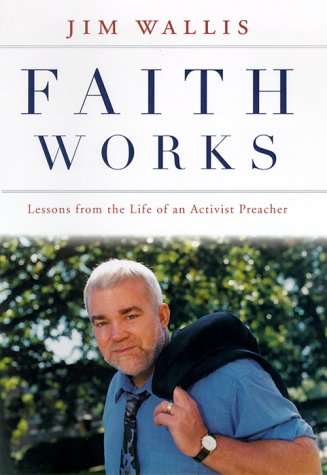
Synopsis
Today more than ever, many people are hungry for spirituality and community. But the most powerful and meaningful spirituality shows itself through action. Jim Wallis is the charismatic preacher, activist, and leader of Call to Renewal, a dynamic new movement that is uniting politics and spirituality to ignite social change and overcome poverty. In his timely, exciting new book, he shows us how we can enrich our own lives by serving our communities. Wallis believes that the making of the modern Christian, Muslim, or Jew is through action. A preacher who spends his time working for justice rather than just speaking from a pulpit, Wallis compellingly demonstrates how going out and putting your belief to work is what really counts. Faith shows itself in works—faith works.
Named by Time magazine as one of the "50 Faces for America's Future," a regular contributor to NPR, MSNBC, and major newspapers, and editor in chief of Sojourners magazine, Jim Wallis is a well-known media figure. His advice is increasingly sought by leading politicians who want to tap into the growing power of faith-based organizations and the Call to Renewal movement. A lifelong activist, he has been putting his faith to work for more than three decades. His anecdotal, exhilarating, and engaging book is part memoir, part inspirational game plan for transforming our own lives and our society, and part primer on how faith communities are changing neighborhoods. It is filled with dramatic human stories of men and women who will move and inspire us. Faith Works will appeal to religious people looking to bring more meaning to their faith and to spiritually hungry people looking for direction in their lives.
"synopsis" may belong to another edition of this title.
About the Author
Jim Wallis is a preacher, an activist, an author, the convener of Call to Renewal, and the editor in chief of Sojourners magazine. His previous books include Who Speaks for God?, The Soul of Politics, and The Call to Conversion. He has just completed a year as a fellow at the new Center for the Study of Values in Public Life at Harvard Divinity School and now teaches at the university's John F. Kennedy School of Government. Wallis travels extensively, giving more than two hundred talks each year. He lives in Washington, D.C., with his wife, Joy, and son, Luke.
From the Back Cover
"What a riveting account, compelling, provocative, and inspirational, of the kind of faith that can move mountains, that can certainly move people and communities--an engaged, vibrant faith because it proves faith works. Just the recipe as we begin a new year and a new millennium. God be praised for Jim Wallis."
--Archbishop Desmond Tutu
"Jim Wallis's brilliant insights on spirituality in action, based upon his rich experiences as an activist preacher, will inspire socially conscious readers across the ideological and political spectrum. Faith Works is an engaging and thoughtful book. Wallis's positive vision of faith, including his view of the role of faith-based organizations in addressing poverty and other pressing national problems, is moving and compelling."
--William Julius Wilson, professor, Harvard University
"Shimmering with the vitality and passion of its author, this remarkable book speaks to both policy makers searching for ways to overcome poverty and to ordinary citizens hoping to make a difference beyond their own lives. If it will take a movement--as it always does--to challenge the status quo and bring about social justice, Faith Works should be its manifesto. The next time a politician asks himself, 'What Would Jesus Do?,' hand him this book. Jim Wallis provides the answer."
--Arianna Huffington, syndicated columnist and
author of How to Overthrow the Government
"Lovely and practical, Faith Works is a gentle and inspiring guidebook to being a good citizen and a good human being."
--George Stephanopoulos
"In his wonderful book Faith Works, Reverend Wallis shows us how to turn faith and love into action and how to transform our beliefs, hopes, and good intentions into catalysts for needed changes in our world."
--Marian Wright Edelman, president, Children's Defense Fund
From the Inside Flap
han ever, many people are hungry for spirituality and community. But the most powerful and meaningful spirituality shows itself through action. Jim Wallis is the charismatic preacher, activist, and leader of Call to Renewal, a dynamic new movement that is uniting politics and spirituality to ignite social change and overcome poverty. In his timely, exciting new book, he shows us how we can enrich our own lives by serving our communities. Wallis believes that the making of the modern Christian, Muslim, or Jew is through action. A preacher who spends his time working for justice rather than just speaking from a pulpit, Wallis compellingly demonstrates how going out and putting your belief to work is what really counts. Faith shows itself in works faith works.
Named by Time magazine as one of the "50 Faces for America's Future," a regular contributor to NPR, MSNBC, and major newspapers, and editor in chief of Sojourners magazine, Jim Wallis is a well
Reviews
Wallis has correctly surmised that people long for an alternative to the blame-placing, cynicism-producing and often hate-filled debate between the Left and the Right about social issues. In this engaging and timely collection of sermonlike essays, Wallis, the pastor who founded Sojourners Magazine and the Sojourners community in Washington, D.C., tells story after story of people living out just such an alternative, and in doing so, shows that meaningful activism is possible, palatable, soul-healing and even fun. Arguing that the health of a society can be measured by the way it treats the poor, he chides conservatives and liberals alike for their failures in this area but also affirms their strengths and challenges them to work together toward values both groups share, such as child welfare. Wallis validates the most sensible ideas of liberals and conservatives, in the church and in politics. While he never shies away from harsh truths about the widening wage gap in the U.S., devastating poverty in the developing world and our wealth-obsessed culture's apathetic response, Wallis ultimately inspires as much hope as he does outrage. Hope, in fact, is a theme in this book, which sets it apart from the angry bulk of anti-poverty literature. Wallis sees this hope as a gift from God; he believes that one must have a spiritual well to drink from in order to maintain hope. His book is a welcome primer for any aspiring activist, regardless of spiritual inclination. (Mar.)
Copyright 2000 Reed Business Information, Inc.
Wallis, a charismatic activist preacher and the leader of Call to Renewal, eludes all stereotypes--he is a speaker, author (The Soul of Politics), organizer, and mediator who brings together unlikely bedfellows to do the "impossible": provide community services that break the cycle of poverty and restore the hopeless to hope and productivity. Born into an insular, conservative evangelical faith in Chicago, Wallis drifted from the church and became a secular activist who was proud of his ability to put 10,000 people on the street within two hours. His discovery that true spirituality in the traditional faith does indeed include a deep commitment to ministry to the poor followed a fascinating chain of events coupled with his disappointment in the failure of activists' and politicians' methods. Wallis devotes the bulk of the book to explicating what we can do and how to do it in 15 logical steps. He eschews all old, entrenched labels and animosities and exhibits an amazing ability to get liberal and conservative to work together. Highly recommended as an inspiring book that should be read by everyone.
-Eugene O. Bowser, Univ. of Northern Colorado, Greeley
Copyright 2000 Reed Business Information, Inc.
Excerpt. © Reprinted by permission. All rights reserved.
Lesson Two: Get Out of the House More Often
You are the salt of the earth....you are the light of the world.
(Matthew 5:13-14)
There is a story about a young priest who was very nervous about his new responsibilities. He was especially worried about leading the Eucharistic liturgy. The priest has to say the right words in the right order-for instance, "The Lord be with You," to which the congregation duly responds, "And also with you." The new cleric was concerned that he might foul up his parts of the liturgy, causing the congregation to get their parts wrong too. The whole thing might fall apart, and he would feel like a failure. So you can imagine the young man's panic when he got up before the gathered parish that first Sunday morning, only to realize that his microphone had gone dead. Frantically, the rattled priest began to tap his finger hard on the silent microphone and exclaimed, "Something is wrong with this microphone." The congregation replied, "And also with you!"
I sometimes start with that story when I'm on the road speaking because it's always fun to begin with a good laugh. But the story also helps me introduce my next point. After the laughter dies down, I suggest that something is wrong in our society, and that most people feel it-all across the political spectrum. At that point, the heads begin to nod in agreement.
Despite the constant claims by politicians, Wall Street's elite, and the media pundits about what "good times" these are, most people sense that some things have gone wrong at the moral core of our society. Something about our values just doesn't seem right, and sometimes, things really seem to be unraveling. But what is actually happening to us, and why, and what can we do about it? That
we're not quite so sure about. To figure it out, we are going to have to understand our problems at a deeper level. Raising questions is a good start, but we soon have to decide how far we're going to pursue the answers. To go farther, we need to get some new perspectives. We learn that we can't just take this journey in our heads. We have to reach out to broaden our experience, to move beyond familiar places, and even cross boundaries we never have before. So, our second lesson is "Get out of the house more often!"
The Journey Begins
To change our world, or our community, we first have to understand it. To understand it usually requires a change in our thinking. And for that to happen, we have to experience more of the world than we can know inside the comfortable confines of our lives. We have to cross the barriers that divide people and, indeed, that separate whole worlds from one another. Most of us are deeply programmed not to venture past those invisible but powerful signs that silently scream at us: No Trespassing! You shouldn't be here! You don't belong here! It's not safe! You won't be accepted! Stay where you are!
But I've found that those very powerful cultural messages are usually false, designed in part to keep us from seeing and experiencing people and parts of life that may change our perspective. Oh, it's not a big conspiracy; rather it's all ingrained cultural conditioning that keeps people in their own world and prevents them from experiencing another one.
Most of the people I've met who are deeply committed to social change will trace their own transformation to the time when they first went to a third world country, or even just across town to the inner city. There, in a world very different from their own, they had "conversion experiences" that would shape the rest of their lives. It wasn't so much reading a great book or hearing an inspiring lecture that changed them but rather their experience in a war zone, a refugee camp, a youth center, a women's shelter, or an urban church trying to hold a community together. Time studying at the university can, ultimately, be less educational for social change than time spent on a reservation, in a ghetto, in a barrio, or up a mountain holler. Lesson Two is that you've got to get out of the house more! Once you do, you'll discover a whole new perspective.
You'll see things, meet people, and experience worlds that you otherwise never would. And it will change you. When I talk to people about how change really happens, the first thing I try to impress upon them is that it is both possible and worth it to cross the normal boundaries of our lives, to escape our comfort zones and experience a different reality. That's always the first step. You can stay home and keep accepting the easy answers, or you can step out and make some new discoveries. If you don't get out, you'll never know what's really going on; if you do, a whole new world opens up.
And it's the more in-depth, longer-term experiences outside of your own world that can have the most lasting impact. My wife, Joy, is an example of that. At the age of eighteen, she spent a year working in the countryside of Haiti, the Western Hemisphere's poorest nation. Taking a year off before college, she plunged into a world very different from anything she had ever known. Joy had grown up in the working-class neighborhoods of South London, but she had never seen poverty like what she encountered in Haiti.
The actual work she did was in a project to bring clean and safe drinking water to people in a rural area. There is probably nothing more taken for granted in developed countries than clean water; yet the lack of safe water is a leading cause of disease and death all around the world. It is estimated that more than five million people, including two and a half million children, die each year from illnesses related to unsafe water and improper sanitation.
Living and working with some of the poorest people on earth for a year had a profound effect upon this English schoolgirl. Joy was forever sensitized to the plight of people at the bottom, those who are always shut out and left behind. Later, she became a priest in the Church of England. But she always stayed in the inner city, and paid special attention to people who are poor, homeless, mentally and emotionally disabled, aged, immigrant, or outcast. Something got into her blood in Haiti and it's never left her. Now she talks about starting a new church for the poor in Washington, D.C.
You also won't really know yourself if you stay inside the carefully constructed boxes of your life. Getting out of the house is actually the first step on a spiritual journey; take it and your life will begin to change. That is both the promise and the challenge. Only by the challenges encountered in stepping out do you learn what resources you have and what contribution you can make. What you gain is self-understanding as well as spiritual awareness. The path of self-discovery is critically linked to the process of social and political transformation. But the first step is to walk outside of the old, familiar places.
John Fife was a Presbyterian pastor in Tucson, Arizona. He was a preacher in cowboy boots, and his Southside Presbyterian Church was set in the beautiful landscape of the American Southwest. Pastors like John are expected to play it safe in regard to controversial social issues. But that would soon all change.
One day, in the early 1980s, an Immigration lawyer told John that a professional "coyote" (one who smuggled illegal immigrants across the border) had abandoned a group of Salvadorans in the desert. Half of them had died of dehydration, and the other half were picked up by the border patrol and hospitalized. As soon as they had recovered, the deportation process would begin.
The attorney said, "We've been talking to these people, and they're terrified of being sent back to El Salvador." At that time, most illegal immigrants from El Salvador were fleeing for their lives from their country's military government and death squads. Many of them were Christians, said the attorney. "The churches need to help us."
John Fife didn't really know where El Salvador was. "I don't think I could have even found it on a map!" said the Presbyterian pastor. When I later asked John why he had become involved with the refugees, he told me he had remembered the words of Jesus from the Gospel of Matthew: "I was a stranger and you took me in." So that's what John decided to do. What he didn't know at the time was how much that decision would change his life.
John and his church began a journey. First, they started a weekly prayer vigil for the people of Central America. Then they began to raise money to bail people out of detention and help relocate them. Many problems in our communities remain relatively hidden until we become involved in them. Then you can hardly understand why you never noticed such a big crisis before. The people in Southside Presbyterian Church began with the first group of refugees in trouble, but soon their relationships extended to many more. Members of the church got to know refugee families-sharing meals, stories, tears, and, yes, faith. Before long, John and his church members met others in Tucson who were befriending the new strangers in the community. Lots of ordinary people began to get involved-retired ranchers, teachers, nurses, students, nuns, priests, and homemakers. After about two years of this, they took the next step of helping to create an "underground railroad" for the fleeing refugees. The little church became deeply engaged in sheltering refugees from El Salvador and other countries in Central Arnerica that were caught up in terrible civil wars.
John and his parishioners got to know the U.S.-Mexican border quite well, assisting refugees on their difficult and dangerous journey to safety and settlement with sympathetic families. These citizens of Tucson not only took in the refugee families but became involved with their lives. People listened and learned from one another, and everyone was changed in the process.
Finally, the parishioners began to ...
"About this title" may belong to another edition of this title.
Search results for Faith Works: Lessons from the Life of an Activist Preacher

Stock Image
Faith Works: Lessons from the Life of an Activist Preacher
Seller: World of Books (was SecondSale), Montgomery, IL, U.S.A.
Seller rating 5 out of 5 stars

Hardback. Condition: Good. Seller Inventory # 00095669627
Stock Image
Faith Works: Lessons from the Life of an Activist Preacher
Seller: World of Books (was SecondSale), Montgomery, IL, U.S.A.
Seller rating 5 out of 5 stars
Hardback. Condition: Fair. Seller Inventory # 00110631448
Seller Image
Faith Works: Lessons from the Life of an Activist Preacher
Seller: Greenworld Books, Arlington, TX, U.S.A.
Seller rating 5 out of 5 stars
Condition: like_new. Fast Free Shipping â" Excellent condition book with clean cover and pages. Barely handled, with minimal wear. An outstanding copy, close to enjoy! Seller Inventory # GWV.0375501762.LN
Stock Image
Faith Works: Lessons from the Life of an Activist Preacher
Published by
Random House (edition Edition Unstated), 2000
ISBN 10: 0375501762
ISBN 13: 9780375501760
Used
Hardcover
Seller: BooksRun, Philadelphia, PA, U.S.A.
Seller rating 5 out of 5 stars
Hardcover. Condition: Very Good. Edition Unstated. With dust jacket. It's a well-cared-for item that has seen limited use. The item may show minor signs of wear. All the text is legible, with all pages included. It may have slight markings and/or highlighting. Seller Inventory # 0375501762-11-1-29
Stock Image
Faith Works: Lessons from the Life of an Activist Preacher
Seller: ThriftBooks-Atlanta, AUSTELL, GA, U.S.A.
Seller rating 5 out of 5 stars
Hardcover. Condition: As New. No Jacket. Pages are clean and are not marred by notes or folds of any kind. ~ ThriftBooks: Read More, Spend Less. Seller Inventory # G0375501762I2N00
Stock Image
Faith Works: Lessons from the Life of an Activist Preacher
Seller: ThriftBooks-Dallas, Dallas, TX, U.S.A.
Seller rating 5 out of 5 stars
Hardcover. Condition: As New. No Jacket. Pages are clean and are not marred by notes or folds of any kind. ~ ThriftBooks: Read More, Spend Less. Seller Inventory # G0375501762I2N00
Stock Image
Faith Works: Lessons from the Life of an Activist Preacher
Seller: The Maryland Book Bank, Baltimore, MD, U.S.A.
Seller rating 5 out of 5 stars
hardcover. Condition: Very Good. Edition Unstated. Used - Very Good. Seller Inventory # 12-K-2-0231
Stock Image
Faith Works: Lessons from the Life of an Activist Preacher
Seller: World of Books Inc, Montgomery, IL, U.S.A.
Seller rating 4 out of 5 stars

Hardback. Condition: Good. Seller Inventory # CIN0375501762G
Stock Image
Faith Works: Lessons from the Life of an Activist Preacher
Seller: World of Books Inc, Montgomery, IL, U.S.A.
Seller rating 4 out of 5 stars
Hardback. Condition: Fair. Seller Inventory # CIN0375501762A
Stock Image
Faith Works: Lessons from the Life of an Activist Preacher
Published by
Random House, 2000
ISBN 10: 0375501762
ISBN 13: 9780375501760
Used
Hardcover
First Edition
Seller: Charles Berry, Bookseller, Lakeport, CA, U.S.A.
Seller rating 5 out of 5 stars
Hardcover. Condition: Fine. Dust Jacket Condition: Fine. First Edition. First edition (stated) hardcover and dust jacket in excellent, next-to-pristine condition: unmarked, slightest handling suggested by DJ. 357 pages. [1.3 lbs]. Book. Seller Inventory # 46382