
Items related to Millennials Rising: The Next Great Generation
Synopsis
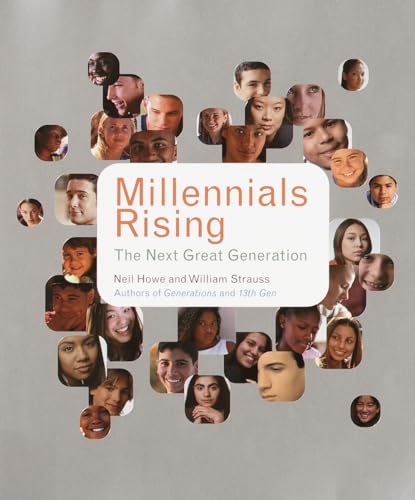
By the authors of the bestselling 13th Gen, an incisive, in-depth examination of the Millennials--the generation born after 1982.
In this remarkable account, certain to stir the interest of educators, counselors, parents, and people in all types of business as well as young people themselves, Neil Howe and William Strauss provide the definitive analysis of a powerful generation: the Millennials. Having looked at oceans of data, taken their own polls, talked to hundreds of kids, parents, and teachers, and reflected on the rhythms of history, Howe and Strauss explain how Millennials have turned out to be so dramatically different from Xers and boomers. Millennials Rising provides a fascinating narrative of America's next great generation.
"synopsis" may belong to another edition of this title.
About the Author
William Strauss and Neil Howe originally coined the term “Millennial Generation” in 1991 and wrote the pioneering book on this generation, Millennials Rising, in 2000. They are also the authors of Generations: The History of America's Future and 13th-GEN, and write and lecture frequently on generational issues. Strauss is the cofounder and director of the Capitol Steps, a political cabaret. Howe, an historian and economist, is a senior adviser for the Concord Coalition. They both live in the Washington, D.C., area.
From the Back Cover
in the '60s, it was the Boomers. In the '90s, it was the Xers. Now, it's the Millennials -- who are graduating from high school and flooding the nation's college campuses. In Millennials Rising, bestselling authors Howe and Strauss reveal who these kids are and where they're going. They explain ...
-- Why Millennials are protected, pressured, and celebrated far more than Boomers or Gen Xers ever were
-- Why civic spirit and test scores are up, and crime and risky behavior down
-- Why today's kids are held to higher standards than adults apply to themselves
-- Why Millennials are a lot less violent, vulgar, and sexually charged than the teen culture older people are producing for them
A decade ago, in Generations, Howe and Strauss predicted many of the youth trends we are beginning to see today. Now, in this remarkable new book -- one that is certain to spark a heated national debate about the next generation -- the authors provide startling proof for how today's Millennial teens are defying conventional wisdom about youth.
Having taken their own polls, weighed all the data, talked with hundreds of kids, parents, and teachers, and reflected on the rhythms of history, Howe and Strauss offer this powerful conclusion: Before the decade is over, Millennials will reject the Gen X pop culture, rebel against Boomer politics, dramatically redefine what it means to be young, and, in time, become America's next great generation.
From the Inside Flap
By the authors of the bestselling 13th Gen, the first in-depth examination of the Millennials--the generation born after 1982.
"Over the next decade, the Millennial Generation will entirely recast the image of youth from downbeat and alientated to upbeat and engaged--with potentially seismic consequences for America." --from Millennials Rising
In this remarkable account, certain to stir the interest of educators, counselors, parents, and people in all types of business as well as young people themselves, Neil Howe and William Strauss introduce the nation to a powerful new generation: the Millennials. They will also explain:
Why today's teens are smart, well-behaved, and optimisitc, and why you won't hear older people say that.
Why they get along so well with their Boomer and Xer parents.
Why Millennial collegians will bring a new youth revolution to America's campuses.
Why names like "Generation Y" and "Echo Boom" just don't work for today's kids.
Having looked at oceans of data, taken their own polls, and talked to hundreds of kids, parents, and teachers, Howe and Strauss explain how Millennials are turning out to be so dramatically different from Xers and boomers and how, in time, they will become the next great generation.
Reviews
The phrase "kids these days" is infused with new meaning in this look at the generation born between 1982 and 2000. Arguing against the conventional wisdom that junior high and high school kids are disrespectful, violent and alienated, Howe and Strauss (Generations; 13th Gen) demonstrate that the children of boomers and of older members of Generation X are actually harder workers and better community builders than any generation since the G.I.s'. "Millennials," the authors argue, are different from Gen-Xers: they have grown up in a multicultural country and have never known a recession; they are wanted children (as the increase in both birth control and fertility drugs demonstrate); and protected by an unprecedented number of child-centered laws. Since birth, they have been spurred to achievement in the home, by yuppie parents, and at school, by standardized tests and "zero tolerance" disciplinary measures. The authors show how easily Millennials have swallowed all the efforts on their behalf. School uniforms, as well as uniform-like Gap and Abercrombie & Fitch clothing, are popular. Teen sex is less frequent, and virginity seems to be a cool new trend. Howe and Strauss run into a bit of trouble when they insist that each generation corrects the mistakes of the previous one. They also attempt to link Millennials to the G.I. generation, suggesting that "hero generations" come in cycles. Despite these stabs at pop sociology, this well-substantiated demographic and cultural overview of the teen landscape is intriguing and highly amusing. Charts, graphs, cartoons. (Sept.)
Copyright 2000 Reed Business Information, Inc.
The Millennials, the generation "born in or after 1982--the 'Babies on Board' of the early Reagan years"--will be a force to reckon with in the twenty-first century, according to the authors. More numerous and culturally diverse than their forefathers, this generation will also be better educated and more affluent. Using a wealth of marketing reports, statistics, graphs, and testimonials, the authors convincingly argue that the millennials are returning to conservative family values, emphasizing cooperation rather than creativity, and showing a new respect for rules. The book explores the roots of this turnaround generation, who they are now, and where they are headed. Although some of the statistics seem to be bent slightly to conform to the trends, the very readable narrative and thorough analysis of popular culture will prompt serious discussion among old and young. Candace Smith
Copyright © American Library Association. All rights reserved
"About this title" may belong to another edition of this title.
Search results for Millennials Rising: The Next Great Generation

Stock Image
Millennials Rising The Next Gr
Seller: World of Books (was SecondSale), Montgomery, IL, U.S.A.
Seller rating 5 out of 5 stars

Condition: Very Good. Matson, R.J. (illustrator). Item in very good condition! Textbooks may not include supplemental items i.e. CDs, access codes etc. Seller Inventory # 00086282134
Stock Image
Millennials Rising: The Next Great Generation
Seller: World of Books (was SecondSale), Montgomery, IL, U.S.A.
Seller rating 5 out of 5 stars
Paperback. Condition: Good. Matson, R.J. (illustrator). By the authors of the bestselling 13th Gen, an incisive, in-depth examination of the Millennials--the generation born after 1982. In this remarkable account, certain to stir the interest of educators, counselors, parents, and people in all types of business as well as young people themselves, Neil Howe and William Strauss provide the definitive analysis of a powerful generation: the Millennials.Having looked at oceans of data, taken their own polls, talked to hundreds of kids, parents, and teachers, and reflected on the rhythms of history, Howe and Strauss explain how Millennials have turned out to be so dramatically different from Xers and boomers. Millennials Risingprovides a fascinating narrative of America's next great generation. Seller Inventory # 00084566552
Stock Image
Millennials Rising: The Next Great Generation
Seller: Your Online Bookstore, Houston, TX, U.S.A.
Seller rating 5 out of 5 stars
Paperback. Condition: Good. Matson, R.J. (illustrator). Seller Inventory # 0375707190-3-21936966
Stock Image
Millennials Rising: The Next Great Generation
Seller: Orion Tech, Kingwood, TX, U.S.A.
Seller rating 5 out of 5 stars
paperback. Condition: Good. Matson, R.J. (illustrator). Seller Inventory # 0375707190-3-27050611
Stock Image
Millennials Rising: The Next Great Generation
Seller: Gulf Coast Books, Cypress, TX, U.S.A.
Seller rating 5 out of 5 stars
paperback. Condition: Good. Matson, R.J. (illustrator). Seller Inventory # 0375707190-3-31266484
Seller Image
Millennials Rising: The Next Great Generation
Seller: 3Brothers Bookstore, Egg harbor township, NJ, U.S.A.
Seller rating 5 out of 5 stars
Condition: very_good. Matson, R.J. (illustrator). Cover may have light wear, pages in very good condition and binding is sturdy; may have other light shelf wear or creases. May have notes or highlighting. Seller Inventory # EVV.0375707190.VG
Stock Image
Millennials Rising: The Next Great Generation
Seller: More Than Words, Waltham, MA, U.S.A.
Seller rating 5 out of 5 stars
Condition: Good. Matson, R.J. (illustrator). A sound copy with only light wear. Overall a solid copy at a great price! Seller Inventory # BOS-N-14d-01543
Seller Image
Millennials Rising: The Next Great Generation
Seller: Greenworld Books, Arlington, TX, U.S.A.
Seller rating 5 out of 5 stars
Condition: very_good. Matson, R.J. (illustrator). Fast Free Shipping â" Very Good condition book with a firm cover and clean pages. Shows normal use and some light wear or limited notes markings. A solid, nice copy to enjoy. Seller Inventory # GWV.0375707190.VG
Seller Image
Millennials Rising: The Next Great Generation
Seller: Greenworld Books, Arlington, TX, U.S.A.
Seller rating 5 out of 5 stars
Condition: good. Matson, R.J. (illustrator). Fast Free Shipping â" Good condition. It may show normal signs of use, such as light writing, highlighting, or library markings, but all pages are intact and the book is fully readable. A solid, complete copy that's ready to enjoy. Seller Inventory # GWV.0375707190.G
Seller Image
Millennials Rising: The Next Great Generation
Seller: ZBK Books, Carlstadt, NJ, U.S.A.
Seller rating 5 out of 5 stars
Condition: good. Matson, R.J. (illustrator). Fast & Free Shipping â" Good condition. It may show normal signs of use, such as light writing, highlighting, or library markings, but all pages are intact and the book is fully readable. A solid, complete copy that's ready to enjoy. Seller Inventory # ZWV.0375707190.G