
Items related to First Cut
Synopsis
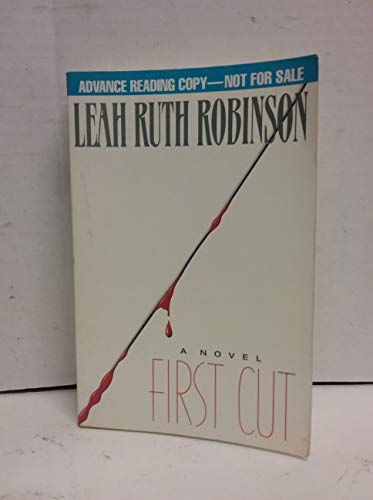
Calmly observing the handiwork of a serial murderer known as the "Babydoll Killer," ER resident Dr. Evelyn Sutcliffe throws herself headlong into the case when she loses a close friend to the killer, a psychopath who had once targeted Evelyn herself
"synopsis" may belong to another edition of this title.
About the Author
Leah Ruth Robinson taught Basic Life Support for several years at Lenox Hill Hospital, in New York.
Reviews
Adrenaline and chaos are what emergency room doctors thrive on. So will readers of First Cut, Leah Ruth Robinson's second medical thriller, in which political, financial and psychologically motivated crimes combine with vivid E.R. realism to create just what the doctor ordered -- a therapeutic summer escape for lawyerly readers.
Even for a seen-everything New York emergency room resident like Dr. Evelyn Sutcliffe, things seem to be getting a bit out of hand. There's a serial killer loose in the neighborhood, anti-abortion activists have shot a clinic doctor and bombed a bus stop, and Dr. Sutcliffe is inexplicably assaulted on her way to work at six o'clock in the morning. Upon discovering that she knew one of the serial killer's victims, Dr. Sutcliffe decides to seek clues to the killer's identity. When a medical student helping Dr. Sutcliffe investigate is found stabbed in the doctors' residence hall and the serial killer's signature baby doll is found at the scene, Dr. Sutcliffe begins to fear that her life might also be in danger.
And that's just the first 100 pages. As she tends to the parade of emergencies rolling through the hospital doors from one day of an August heat wave to the next, Dr. Sutcliffe begins to suspect one after another of her stressed-out co-workers of committing blackmail, Medicaid fraud and even murder.
The excitement of the chase is tonic for Dr. Sutcliffe, who loves the extreme nature of the emergency room and its crew of "adrenaline junkies" like herself. To her, the E.R. is "the center of the world . . .. Mount Olympus, the temple of the gods. The sanctum sanctorum, where God reaches down from the heavens with a finger pointing at Adam and says, 'Stay,' or 'Come.'"
Refreshingly, however, the book prizes realism over nonstop manufactured heroics. It insists that the practice of E.R. medicine is not one episode of high drama after another; rather, "Contrary to popular opinion, shaped by too many TV programs where all patients seemed to enter the E.R. propelled at 50 miles an hour on their stretchers, with medics shouting out vitals and signs and symptoms, life in an inner-city emergency room could be boring and repetitive."
Even the E.R.'s commotion can be banal: "At 7 a.m., phones were ringing, stretchers were caroming by, people were raising their voices, and patients were staggering around, wanting the bathroom, or their doctors, or their breakfasts. The usual bedlam." The near-disorder of the E.R. mirrors the chaos of New York City, where "[citizens] got pushed in front of subways by crazy people, 13-year-olds shot one another in Harlem; you name it, it happened." Still, Dr. Sutcliffe finds the world of the emergency ward so intense that it prompts "the question that sometimes came to mind after a particularly distressing day in the E.R.: which is the real world, this or the emergency room?"
Lawyers will relate to the constant presence of stress in the book, and might begin to entertain the gratifying suspicion that their jobs are remarkably low-key by contrast. Even without the added worry of the neighborhood murders and related events, the book's doctors are a stressed-out bunch. For Dr. Sutcliffe, it all "shows in [her] face: eyes and mouth full of exhaustion and concern, mascara smudged, lipstick slightly askew." One excitable intern must periodically run to the bathroom to soak his head in a sinkful of cold water, especially while feuding with a paramedic. Another physician's childhood psychiatric history turns up, revealing a worrisome potential instability.
The only truly relaxed character in the book is Dr. Sutcliffe's psychiatrist boyfriend, who calmly dispenses fascinating analyses of each suspect's character quirks and the motivations each might have for committing the crimes. His roomy, air-conditioned apartment provides a physical and mental oasis for the overextended heroine.
Despite the nearly unmanageable demands on her attention, Dr. Sutcliffe remains irreverently amusing in the tradition of many great fiction al sleuths. It's great fun to spend nearly 400 pages inside the earthy and somewhat jaded mind of one who has "endured medical school, internship, a year of residency with four to go, little sleep, bad hospital food, and patients' vomiting on [her] shoes." The book is an idiosyncratic guided tour of the emergency room's singular culture, enriched with entertaining glimpses of the personal lives of the E.R. doctors and of Dr. Sutcliffe, a wise-cracking feminist who loves men and fears commitment. Her edgy wit and ready-for-anything attitude make Dr. Sutcliffe's character and first-person voice one of First Cut's triumphs.
As the book hurtles towards its conclusion, the plot reveals itself to be rewardingly complex and unpredictable. Despite a slightly overlong middle section, the action-packed resolution is exceptionally well paced. For lawyers seeking catharsis and an enjoyable break from the ordinary, First Cut is good medicine.
By the time its edgy title phrase shows up in Robinson's medical thriller--page 365--a lot of other disquieting stuff has happened: rape, murders, assaults, and antiabortion violence. As the story opens, Evelyn Sutcliffe, emergency room resident in a big New York hospital, is knocked down by a jogger type who, to avoid being recognized, pulls her shirt over her head. Evelyn gets enough of a view, though, to realize that her assailant looks disturbingly familiar. Much of the later violence takes place in the hospital's doctors' residence. There fourth-year medical student Lisa Chiu, one of Evelyn's closest friends, is stabbed multiple times, and although Evelyn's psychiatrist boyfriend inventively uses a turkey baster to suction Lisa's blood, neither this nor the standard ER procedure saves her life: she is apparently one more victim of the "babydoll killer." The inevitable chase scene, involving Evelyn and another woman physician, proceeds imaginatively through construction-in-process at the hospital proper. Throughout, characters lovingly describe a great variety of trendy food and drink (many readers will find that they must take sustenance: Pavlovian conditioning works!). Although it verges on soap opera, First Cut should grab enough thriller fans to justify Avon's 125,000-copy first printing. William Beatty
"About this title" may belong to another edition of this title.
Search results for First Cut

Stock Image
First Cut
Published by
Avon Books, New York, 1997
ISBN 10: 0380974584
ISBN 13: 9780380974580
Used
Hardcover
First Edition
Seller: Faith In Print, Cumming, GA, U.S.A.
Seller rating 5 out of 5 stars

Hard Back. Condition: Very Good. Dust Jacket Condition: Very Good. First Edition. very good clean copy with some very light overall wear. clean tight covers. pages clean and unmarked. dust jacket has only very light edge rubbing and no chips or tears. 387 pages. Seller Inventory # 016516
Stock Image
First Cut
Published by
Avon Books (edition First Edition), 1997
ISBN 10: 0380974584
ISBN 13: 9780380974580
Used
Hardcover
First Edition
Seller: BooksRun, Philadelphia, PA, U.S.A.
Seller rating 5 out of 5 stars
Hardcover. Condition: Very Good. First Edition. With dust jacket. It's a well-cared-for item that has seen limited use. The item may show minor signs of wear. All the text is legible, with all pages included. It may have slight markings and/or highlighting. Seller Inventory # 0380974584-11-18-29
Stock Image
First Cut
Seller: Wonder Book, Frederick, MD, U.S.A.
Seller rating 5 out of 5 stars
Condition: Very Good. Very Good condition. Very Good dust jacket. A copy that may have a few cosmetic defects. May also contain light spine creasing or a few markings such as an owner's name, short gifter's inscription or light stamp. Seller Inventory # V10L-02181
Stock Image
First Cut
Published by
HarperCollins Publishers, 1997
ISBN 10: 0380974584
ISBN 13: 9780380974580
Used
Hardcover
Seller: Better World Books, Mishawaka, IN, U.S.A.
Seller rating 5 out of 5 stars
Condition: Good. Former library copy. Pages intact with minimal writing/highlighting. The binding may be loose and creased. Dust jackets/supplements are not included. Includes library markings. Stock photo provided. Product includes identifying sticker. Better World Books: Buy Books. Do Good. Seller Inventory # 45632903-6
Stock Image
First Cut
Seller: ThriftBooks-Dallas, Dallas, TX, U.S.A.
Seller rating 5 out of 5 stars
Hardcover. Condition: As New. No Jacket. Pages are clean and are not marred by notes or folds of any kind. ~ ThriftBooks: Read More, Spend Less. Seller Inventory # G0380974584I2N00
Stock Image
First Cut
Seller: HPB-Emerald, Dallas, TX, U.S.A.
Seller rating 5 out of 5 stars
hardcover. Condition: Very Good. Connecting readers with great books since 1972! Used books may not include companion materials, and may have some shelf wear or limited writing. We ship orders daily and Customer Service is our top priority! Seller Inventory # S_478180312
Seller Image
First Cut
Seller: Fort Hill International LLC, HILLSBORO, OH, U.S.A.
Seller rating 5 out of 5 stars
hardcover. Condition: Very Good. Good condition but not perfect, Cover has minor nicks and tears, spine shows some creases from use. Ask Questions and request photos if your buying for the cover and not the content. STOCK PHOTOS MAY VARY FROM THE ACTUAL ITEM. ACTUAL PHOTOS AVAIL. UPON REQUEST. Seller Inventory # 4ZF000000PFL
Stock Image
First Cut
Published by
Avon Books April 1997, 1997
ISBN 10: 0380974584
ISBN 13: 9780380974580
Used
Hardcover
First Edition
Seller: Dunaway Books, St. Louis, MO, U.S.A.
Seller rating 4 out of 5 stars

Hardcover. Condition: Good. Dust Jacket Condition: Good. First Edition. Binding tight and square, Pages are clean and unmarked. Seller Inventory # 317373
Stock Image
First Cut
Seller: Library House Internet Sales, Grand Rapids, OH, U.S.A.
Seller rating 5 out of 5 stars
Hardcover. Condition: Good. Dust Jacket Condition: Good. Calmly observing the handiwork of a serial murderer known as the "Babydoll Killer," ER resident Dr. Evelyn Sutcliffe throws herself headlong into the case when she loses a close friend to the killer, a psychopath who had once targeted Evelyn herself. First page is cut out Moderate edgewear on the boards. Binding is so loose that the book will stay open to any given page. Please note the image in this listing is a stock photo and may not match the covers of the actual item. Book. Seller Inventory # 123637124
Stock Image
The First Cut
Published by
Avon Books, Dresden, Tennessee, U.S.A., 1997
ISBN 10: 0380974584
ISBN 13: 9780380974580
Used
Hardcover
First Edition
Seller: Frank J. Raucci, Bookseller, Wallingford, CT, U.S.A.
Seller rating 5 out of 5 stars
Hardcover. Condition: Fine. Dust Jacket Condition: Near Fine. First Edition. ADVANCED READER'S COPY with publisher's promotional literature laid-in. Murder mystery. Author's second novel. "A serial murderer is prowling Manhattan's Upper West Side, leaving a child's doll at the scene of each brutal crime. Evelyn Sutcliffe has already crossed paths with the faceless, cold-blooded psychopath.and she survived. Others have not been as lucky". 387 pages. GB1. Seller Inventory # 000876