
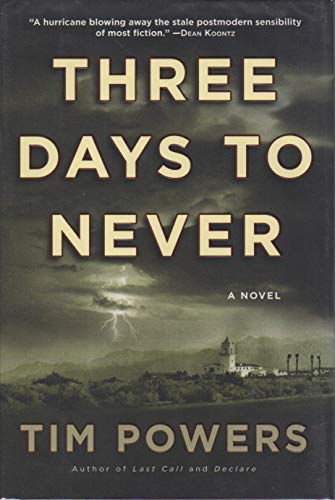
Items related to Three Days to Never: A Novel
Synopsis
When Albert Einstein told Franklin Roosevelt in 1939 that the atomic bomb was possible, he did not tell the president about another discovery he had made, something so extreme and horrific it remained a secret . . . until now. This extraordinary new novel from one of the most brilliant talents in contemporary fiction is a standout literary thriller in which one man stumbles upon the discovery Einstein himself tried to keep hidden.
When twelve-year-old Daphne Marrity takes a videotape labeled Pee-wee's Big Adventure from her grandmother's house, neither she nor her college-professor father, Frank Marrity, has any idea that the theft has drawn the attention of both the Israeli Secret Service and an ancient European cabal of occultists—or that within hours they'll be visited by her long-lost grandfather, who is also desperate to get that tape.
And when Daphne's teddy bear is stolen, a blind assassin nearly kills Frank, and a phantom begins to speak to her from a switched-off television set, Daphne and her father find themselves caught in the middle of a murderous power struggle that originated long ago in Israel and Germany but now crashes through Los Angeles and out to the Mojave Desert. To survive, they must quickly learn the rules of a dangerous magical chess game and use all their cleverness and courage—as well as their love and loyalty to each other—to escape a fate more profound than death.
A pulse-pounding epic adventure that blurs the lines between espionage and the supernatural; good and evil; past, present and future, Three Days to Never is an exhilarating masterwork of speculative suspense from the always remarkable imagination of the incomparable Tim Powers.
"synopsis" may belong to another edition of this title.
About the Author
Tim Powers is the author of numerous novels including Hide Me Among the Graves, Three Days to Never, Declare, Last Call, and On Stranger Tides, which inspired the feature film Pirates of the Caribbean: On Stranger Tides. He has won the Philip K. Dick Memorial Award twice, and the World Fantasy Award three times. He lives in San Bernardino, California.
Reviews
In 1990, Karen Joy Fowler published "Lieserl," a piquant and moving tribute to Albert Einstein's daughter, a woman largely neglected by history and, sad to say, the great scientist himself. As the story unfolds, the young Einstein, ensconced in a space-time bubble, receives a series of letters from his first wife, Mileva Maric, recounting Lieserl's birth, preschool years, adolescence and death. In the final scene, a quiet indictment of Einstein's passive parenting, the scientist imagines sketching a valentine and then writing his daughter's name within its borders: "He loved Lieserl. He cut the word in half, down the S with the stroke of his nail. The two halves of the heart opened and closed, beating against each other, faster and faster, like wings, until they split apart and vanished from his mind."
"Lieserl" is a tough act to follow, but in Three Days to Never Tim Powers has done so with brio, bravado and a salutary measure of lunacy. The author imagines Lieserl Einstein-Maric maturing into a New Age eccentric with a talent for elementary particle physics. Not only does this quantum-mechanical witch contribute to her father's most momentous discovery, a maschinchen ("little machine") capable of considerable metaphysical mischief -- traveling through time, tampering with the past -- she also single-handedly raises the two offspring of her ne'er-do-well son.
When the story begins, Lieserl's grandson is now a parent himself, and so Powers gives us a second father-daughter pairing: widower Frank Marrity -- the name is a variation on Maric -- and 12-year-old Daphne. Much of the novel's labyrinthine plot concerns Frank and Daphne's efforts to survive three deliriously eventful days in 1987, right after the Harmonic Convergence of hippie lore, when various political, religious and eschatological factions try to steal Einstein's maschinchen along with other components possessed by his hapless descendants.
Although I've never visited Powers's house, I wouldn't be surprised to find a strange vehicle in his basement, equine in appearance and festooned with brass knobs and crystalline levers, that allows him to travel among all known modalities of fiction. Three Days to Never is a beguiling genre omelet, a mélange of forms ranging from alternate history to science fiction, urban fantasy to occult cliffhanger, espionage adventure to Ross Macdonald-style Southern California hardboiled detective thriller.
This magical mystery tour de force offers up one MacGuffin after another. Consider the moldering, disembodied human head through which the Vespers cult receives broadcasts from the dead. Not to mention the VHS cassette of "A Woman of the Sea," a lost 1926 Josef von Sternberg film, produced and edited by Charlie Chaplin, that somehow augments the maschinchen's power. And then there's the famous, and famously missing, cement slab bearing Chaplin's handprints and footprints, which the actor once created in the Grauman's Chinese Theatre forecourt, likewise crucial to upgrading Einstein's bizarre device.
At first blush, Three Days to Never looks like the sort of fast-paced confection that reviewers routinely compare to roller-coaster rides, but Powers's novel is more like a ride on a roller coaster affixed to a centrifuge plummeting from the top of Mt. Shasta. Nearly every page introduces yet another crypto-supernatural trope: poltergeists, astral bodies, Aeons, dybbuks, holographic talismans, electronic Ouija boards, clairvoyance, pyrokinesis. Before too long I found myself saying, with apologies to my favorite physicist, "Surely you're joking, Mr. Powers!" And yet despite this surfeit of conceits, or perhaps because of it, the book won me over. With its exuberant genre-scrambling, to say nothing of its philosophical hijinks, low-jinks and nether-jinks, it's a postmodern work par excellence that will have you counting the days -- far more than three, alas -- until the next Tim Powers valentine appears.
Reviewed by James Morrow
Copyright 2006, The Washington Post. All Rights Reserved.
Tim Powers's fiction has consistently defied description for three decades. Three Days to Never is no exception, with its "off-the-wall-yet-vaguely-plausible scenario" (San Francisco Chronicle). Powers, whose previous novels include Declare (2000), The Anubis Gates (1983), and a trilogy exploring the Fisher King myth, combines fantasy, thriller, and historical fiction in a novel that will win new fans for the author, even if Powers disciples will recognize some of the material and tricks from earlier books. Still, most critics agree with the sentiment of The Denver Post, which deems Powers's latest effort "the summer sleeper hit of 2006."
Copyright © 2004 Phillips & Nelson Media, Inc.
Starred Review. Powers (Declare) delivers another top-notch supernatural spy thriller. When Frank Marrity's grandmother dies unexpectedly during 1987's New Age Harmonic Convergence, his 12-year-old daughter, Daphne, steals a videotape from the old woman's Pasadena house that turns out to be a Chaplin film long believed lost. Before Daphne can finish watching the film, its powerful symbolism awakens a latent pyrokinetic ability in her that burns the tape. Frank later discovers letters that prove his grandmother was Albert Einstein's illegitimate daughter. This comes to the attention of a special branch of the Mossad specializing in the Kabbalah as well as a shadowy Gnostic sect interested in a potential weapon discovered by Einstein that he didn't offer to FDR during WWII—a weapon more terrible in its way than the atomic bomb. In typical Powers fashion, his characters' spiritual need to undo past sins or mistakes propels the ingenious plot, which manages to be intricate without becoming convoluted, to its highly satisfying conclusion. (Aug.)
Copyright © Reed Business Information, a division of Reed Elsevier Inc. All rights reserved.
Imagine a world where time travel is possible. Now imagine a world where the mummified head of an Einstein clone is helping a secret sect, led by a quasi-hermaphroditic ghost who speaks in iambic pentameter, track down and locate the time machine, an integral component of which is Charlie Chaplin's footprints in a cement slab, and you'll begin to get a grasp on just how bizarrely populated Powers' world is. Almost despite its wonderful weirdness, this thriller maneuvers at a frantic clip as Frank Marrity, Einstein's great-grandson, must pit his wits against not only the malicious secret society bent on attaining immortality but also a specialized paranormal branch of Israel's Mossad, who'd like to use the time machine to avert the Six Days' War of 1967, a stunning psychic assassin who can only see out of other people's eyes, and none other than his own bitter, alcoholic future Frank Marrity self to save his daughter, Daphne, from not merely death but from never having been. Powers' metaphysics come off a tad muddled, almost as if he is making them up as he goes along, but their very outlandishness makes the story all the more compelling, no matter how ludicrous. Ian Chipman
Copyright © American Library Association. All rights reserved
"About this title" may belong to another edition of this title.
Search results for Three Days to Never: A Novel

Stock Image
Three Days to Never: A Novel
Seller: Gulf Coast Books, Cypress, TX, U.S.A.
Seller rating 5 out of 5 stars

Hardcover. Condition: Very Good. Seller Inventory # 0380976536-2-20977246
Stock Image
Three Days to Never
Seller: World of Books (was SecondSale), Montgomery, IL, U.S.A.
Seller rating 5 out of 5 stars
Hardback. Condition: Good. Albert Einstein's groundbreaking scientific discoveries made possible the creation of the most terrible weapon the world had ever known. But he made another discovery that he chose to reveal to no one--to keep from human hands a power that dwarfed the atomic bomb.When twelve-year-old Daphne Marrity takes a videotape labeled Pee-Wee's Big Adventure from her recently deceased grandmother's house, neither she nor her college professor father, Frank, realize what they now have in their possession. In an instant they are thrust into the center of a world-altering conspiracy, drawing the dangerous attentions of both the Israeli Secret Service and an ancient European cabal of occultists. Now father and daughter have three days to learn the rules of a terrifying magical chess game in order to escape a fate more profound than death--because the Marritys hold the key to the ultimate destruction of not only what's to come . . . but what already has been.--Booklist. Seller Inventory # 00107528505
Stock Image
Three Days to Never: A Novel
Seller: World of Books (was SecondSale), Montgomery, IL, U.S.A.
Seller rating 5 out of 5 stars
Condition: Acceptable. Item in acceptable condition! Textbooks may not include supplemental items i.e. CDs, access codes etc. Seller Inventory # 00084200107
Stock Image
Three Days to Never: A Novel
Seller: New Legacy Books, Annandale, NJ, U.S.A.
Seller rating 5 out of 5 stars
hardcover. Condition: Good. This is an ex library book, stickers and markings accordingly. Fast shipping and order satisfaction guaranteed. A portion of your purchase benefits Non-Profit Organizations, First Aid and Fire Stations! Seller Inventory # mon0000167513
Stock Image
Three Days to Never: A Novel
Published by
William Morrow (edition First Edition), 2006
ISBN 10: 0380976536
ISBN 13: 9780380976539
Used
Hardcover
First Edition
Seller: BooksRun, Philadelphia, PA, U.S.A.
Seller rating 5 out of 5 stars
Hardcover. Condition: Very Good. First Edition. With dust jacket. It's a well-cared-for item that has seen limited use. The item may show minor signs of wear. All the text is legible, with all pages included. It may have slight markings and/or highlighting. Seller Inventory # 0380976536-11-22-29
Stock Image
Three Days to Never
Published by
William Morrow & Company, 2006
ISBN 10: 0380976536
ISBN 13: 9780380976539
Used
Hardcover
Seller: World of Books Inc, Montgomery, IL, U.S.A.
Seller rating 4 out of 5 stars

Hardback. Condition: Fair. Albert Einstein's groundbreaking scientific discoveries made possible the creation of the most terrible weapon the world had ever known. But he made another discovery that he chose to reveal to no one--to keep from human hands a power that dwarfed the atomic bomb.When twelve-year-old Daphne Marrity takes a videotape labeled Pee-Wee's Big Adventure from her recently deceased grandmother's house, neither she nor her college professor father, Frank, realize what they now have in their possession. In an instant they are thrust into the center of a world-altering conspiracy, drawing the dangerous attentions of both the Israeli Secret Service and an ancient European cabal of occultists. Now father and daughter have three days to learn the rules of a terrifying magical chess game in order to escape a fate more profound than death--because the Marritys hold the key to the ultimate destruction of not only what's to come . . . but what already has been.--Booklist. Seller Inventory # CIN0380976536A
Stock Image
Three Days to Never
Seller: World of Books Inc, Montgomery, IL, U.S.A.
Seller rating 4 out of 5 stars
Hardback. Condition: Good. Albert Einstein's groundbreaking scientific discoveries made possible the creation of the most terrible weapon the world had ever known. But he made another discovery that he chose to reveal to no one--to keep from human hands a power that dwarfed the atomic bomb.When twelve-year-old Daphne Marrity takes a videotape labeled Pee-Wee's Big Adventure from her recently deceased grandmother's house, neither she nor her college professor father, Frank, realize what they now have in their possession. In an instant they are thrust into the center of a world-altering conspiracy, drawing the dangerous attentions of both the Israeli Secret Service and an ancient European cabal of occultists. Now father and daughter have three days to learn the rules of a terrifying magical chess game in order to escape a fate more profound than death--because the Marritys hold the key to the ultimate destruction of not only what's to come . . . but what already has been.--Booklist. Seller Inventory # CIN0380976536G
Stock Image
Three Days to Never: A Novel
Seller: ThriftBooks-Dallas, Dallas, TX, U.S.A.
Seller rating 5 out of 5 stars
Hardcover. Condition: Very Good. No Jacket. May have limited writing in cover pages. Pages are unmarked. ~ ThriftBooks: Read More, Spend Less. Seller Inventory # G0380976536I4N00
Stock Image
Three Days to Never: A Novel
Seller: ThriftBooks-Atlanta, AUSTELL, GA, U.S.A.
Seller rating 5 out of 5 stars
Hardcover. Condition: Very Good. No Jacket. Missing dust jacket; May have limited writing in cover pages. Pages are unmarked. ~ ThriftBooks: Read More, Spend Less. Seller Inventory # G0380976536I4N01
Stock Image
Three Days to Never: A Novel
Seller: ThriftBooks-Dallas, Dallas, TX, U.S.A.
Seller rating 5 out of 5 stars
Hardcover. Condition: Very Good. No Jacket. Missing dust jacket; May have limited writing in cover pages. Pages are unmarked. ~ ThriftBooks: Read More, Spend Less. Seller Inventory # G0380976536I4N01