
Items related to Gib Rides Home
Synopsis
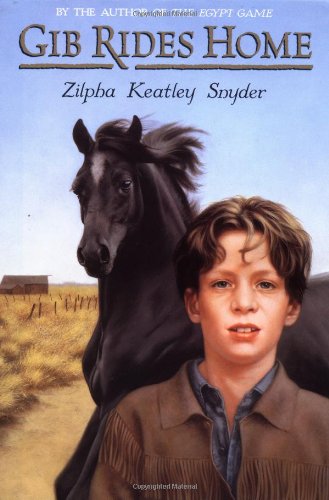
Gib Whittaker's life at Lovell House Orphanage in the early 1900s is pretty bleak. But along with hours of chores, bad food, and paddlings, the boys do get some schooling, and reading and writing are better than scrubbing floors. Still, Gib's fondest dream is to have a real family. So when Georgie Olson is adopted, Gib can't help being jealous, even when he finds out that the "adoption" really means being farmed out to work as unpaid labor until the age of 18.
Then one freezing January morning Gib finds Georgie hiding in the barn, his hands heavily bandaged. Constantly whipped by his master, then sent to work outside without mittens, Georgie ran away when they threatened to cut off his frostbitten hands. Is this the only kind of adoption there is? When Gib himself is farmed out, he arrives at the home he has always dreamed of. But he's soon aware of barely concealed tensions and secrets kept hidden from him. Will Gib end up like poor Georgie?
"synopsis" may belong to another edition of this title.
About the Author
Raised in California, in the country--with no television and few movies to watch--three-time Newbery Honor winner Zilpha Keatley Snyder filled her childhood with animals, games, and books. Among her earliest acquaintances were cows, goats, ducks, chickens, rabbits, dogs, cats, and horses. In fact, her family's animals were her closest friends, and a nearby library was a constant source of magic, adventure, and excitement for her. And when she wasn't reading or playing with animals, Snyder made up games and stories to entertain herself.
While Zilpha Keatley Snyder was growing up, interesting stories filled her household. Both of her parents spent a lot of time relating accounts of past events in their lives, so Snyder came by her storytelling instincts early. But unlike her parents, when Zilpha had something to tell, she had, as she says, "an irresistible urge to make it worth telling. And without the rich and rather lengthy past that my parents had to draw on, I was forced to rely on the one commodity of which I had an adequate supply--imagination." Consequently, at the age of eight, Zilpha Keatley Snyder decided to become a writer.
As a student, Snyder was very proficient in reading and writing, and experienced few problems in the small country schools she attended until the end of sixth grade. But upon entering the seventh grade in the city of Ventura, she was, as she recalls, "suddenly a terrible misfit." Snyder retreated further into books and daydreams, and admits: "Book were the window from which I looked out of a rather meager and decidedly narrow room, onto a rich and wonderful universe. I loved the look and feel of them, even the smell. . . . Libraries were treasure houses. I always entered them with a slight thrill of disbelief that all their endless riches were mine for the borrowing."
Snyder attended Whittier College in Southern California, where she says she "grew physically and socially as well as intellectually." There she also met her future husband, Larry Snyder. While ultimately planning to be a writer, after graduation Snyder decided to teach school temporarily. But she found teaching to be an extremely rewarding experience and taught in the upper elementary grades for a total of nine years, three of them as a master teacher for the University of California at Berkeley. Zilpha and Larry were married in June of 1950, and went on to have three children, Melissa, Douglas, and Ben.
In the early sixties, when all of her children were finally in school, Snyder began to think about writing again. "Writing for children hadn't occurred to me when I was younger, but nine years of teaching in the upper elementary grades had given me a deep appreciation of the gifts and graces that are specific to individuals with ten or eleven years of experience as human begins. Remembering a dream I'd had when I was twelve years old, about some strange and wonderful horses, I sat down and began to write."
Season of Ponies, Zilpha Keatley Snyder's first book, was published in 1964. Her most recent novel, Gib Rides Home, follows an orphan boy who shows strength and courage as he endures harsh treatment during his five years at the orphanage before he finds a family of his own. Gib's story is a tribute to the memory of Snyder's father who grew up in an orphanage in Oklahoma.
Zilpha Keatley Snyder's three Newbery Honor books are: The Egypt Game, The Headless Cupid, and The Witches of Worm. Other books for Bantam Doubleday Dell are The Trespassers, an American Bookseller Pick of the List; Cat Running, a School Library Journal Best Book of the Year and winner of the 1995 John and Patricia Beatty Award; and her newest work, The Gypsy Game, companion to The Egypt Game.
Zilpha Keatley Snyder currently lives in Mill Valley, a small town near San Francisco. In her spare time, she loves reading and traveling, and of course, writing, which besides being her occupation has always been her favorite hobby.
From the Inside Flap
Gib Whittaker's life at Lovell House Orphanage in the early 1900s is pretty bleak. But along with hours of chores, bad food, and paddlings, the boys do get some schooling, and reading and writing are better than scrubbing floors. Still, Gib's fondest dream is to have a real family. So when Georgie Olson is adopted, Gib can't help being jealous, even when he finds out that the "adoption" really means being farmed out to work as unpaid labor until the age of 18.
Then one freezing January morning Gib finds Georgie hiding in the barn, his hands heavily bandaged. Constantly whipped by his master, then sent to work outside without mittens, Georgie ran away when they threatened to cut off his frostbitten hands. Is this the only kind of adoption there is? When Gib himself is farmed out, he arrives at the home he has always dreamed of. But he's soon aware of barely concealed tensions and secrets kept hidden from him. Will Gib end up like poor Georgie?
Reviews
Grade 4-8?Gib is six when he arrives at an orphanage in the early 1900s. He dreams of having a family, but discovers that the older he gets, the less likely it is for him to be adopted, and that most of the older boys are "farmed out" as cheap labor. At 10, that fate befalls him when Mr. Thornton takes him to help with his farm and his horses. Gib, who remembers very little of his life before the orphanage, is surprised to recognize the hired man as someone he knew as a small child. Despite having been warned not to ask any questions of the Thorntons, the boy slowly begins to piece together his early childhood as a neighbor of the family. Although the work is difficult, Gib is well fed, comfortable, and happy; he loves caring for the horses and has an amazing talent for working with them. Not everything is perfect, though. Mrs. Thornton is crippled and often ill; her husband is extremely cold; and their daughter resents him. Slowly Livy and Gib become friends as he teaches her to ride, but when Livy decides to ride the high-strung horse that caused her mother's paralyzing fall, Gib is blamed and returned to the orphanage. Kinder and gentler than Susan Beth Pfeffer's Nobody's Daughter (Delacorte, 1995), this story has the pathos and hopefulness of Joan Lowery Nixon's "Orphan Train Quartet" (Delacorte). In a book inspired by the life of the author's father, the novel delivers an engaging glimpse of history as well as a compelling story. With well-drawn, complex characters and a touch of mystery, it has surefire appeal.?Janet Hilbun, Sam Houston Middle School, Garland, TX
Copyright 1998 Reed Business Information, Inc.
Snyder (The Gypsy Game, 1997, etc.) recreates life in a boy's orphanage at the dawn of this century in a sobering and poignant novel. There is little to distinguish Gibson Whittaker, 11, from his fellows at the Lovell House Orphanage, where poor food, severe whippings, and staff ambivalence are everyday facts of life. When Gib is adopted by the affluent Thornton family, he dares to dream that he's found a loving home at last, only to realize that he has been ``farmed out''--a routine practice of the era, where older orphans were adopted but expected to work as field hands. Gib is disheartened, although the workers and owners of the Rocking M Ranch feed him well and treat him kindly. A soap-opera plot twist thrusts Gib back into the orphanage one more time before he takes his place with the Thorntons for keeps. A good look at the period, with moments that are searing, and a heartfelt author's note that readers are sure to find particularly compelling. (Fiction. 8-12) -- Copyright ©1997, Kirkus Associates, LP. All rights reserved.
Gr. 5^-8. Snyder's take on the orphan tale is rooted in her father's stories of his childhood in a Nebraska orphanage, where a boy was more likely to be farmed out to perform grueling menial tasks than he was to be adopted. Gib Whittaker's calm, steadfast personality helps him survive both the petty meanness and larger cruelties of living in the Lovell House Home for Orphaned and Abandoned Boys. When he is sent to the well-to-do Thornton family, his life improves considerably. Even though he works from dawn to dusk, he still has the opportunity to discover an inborn love of horses, to learn more about his own circumstances, and to see firsthand the tensions and compromises of family life. Deft pacing and characterization, along with a background rich in sensory detail (as in most orphan stories, food plays an especially important role), make this a touching, satisfying tribute to Snyder's father and to all children who face difficult lives with courage. Susan Dove Lempke
Excerpt. © Reprinted by permission. All rights reserved.
An Excerpt from Gib Rides Home
Winter melted into spring, and spring had begun to green toward summer,
when one morning at breakfast Buster came into the hall with a report
notice for Gib. The notice said that Gibson Whittaker was to report to
the headmistress's office at one o'clock.
"The office?" Bobby asked him. "What did you do now, Gib? And how come
the office, I wonder, instead of Harding's torture chamber?"
"I don't know," Gib said. "I guess it'll be the Repentance Room, but I
don't know why. What do you suppose I did this time?"
"I'll bet it's 'cause you laughed at the wrong time again," Jacob said.
"When Offenbacher was reading the chore assignments and she almost said
Bacob and Jobby. You know, when she said, 'Bacob and Job--er--Jacob and
Bobby will be in the laundry.'"
Gib shook his head. "I didn't even smile," he said. "I'm pretty sure I
didn't."
"You must have," Jacob insisted. "Anyway, I think you're mighty lucky
getting sent to the Repentance Room instead of the laundry with Bobby
and me." He grinned. "I mean, since ghosts and stuff like that don't bother
you none, you can just repent a little and then curl up and have a nice
long nap."
"Yeah," Bobby agreed. "While me and Jacob are breaking our backs and wearing
the skin off our knuckles."
Gib grinned, too. "I'll be thinking about you and those old scrubbing
boards while I'm having a good long nap up there in the Repentance Room."
He'd made that up to tease Jacob and Bobby, but on the way to the office
he did try to tell himself that the Repentance Room really wouldn't be
too bad on such a warm day. It was at least a slightly comforting thought,
but Bobby and Jacob and the weather and everything else faded from his
mind a moment later when he walked into Miss Offenbacher's office.
For a horrible moment Gib thought the man who was sitting in front of
Miss Offenbacher's desk was the same one who had taken Georgie Olson.
Like Mr. Bean, the man had gray hair and a lean, gray-bearded face. But
after the shock of that first glance began to wear off, Gib could see
that it wasn't the same man at all. This man's beard was shorter and more
neatly trimmed, and his eyes were wider and not so deep-set.
When Gib began to come out of his terrified paralysis Miss Offenbacher
was saying, "Here he is, Mr. Thornton. I take it this is the boy you had
in mind?"
"Yes, yes," the man said, getting to his feet and motioning for Gib to
approach. "I believe so." Putting his hand on Gib's shoulder, he asked,
"What is your name, boy? And how old are you?"
"G-Gib," Gib stammered. "Gibson Whittaker, sir. Ten, sir. Eleven in December."
The man nodded slowly and then asked, "Where were you born?"
Gib was shaking his head when Miss Offenbacher interrupted. "We've made
it a policy not to give full orphans any information of that sort. We've
found that in some cases it only leads to attempts to--"
"I see," the man interrupted. "That's quite all right. I'm satisfied that
this is the boy I'm looking for."
Releasing Gib's shoulder, he turned away, sat down at the desk, and as
Gib's mind reeled with fear and dread, and then the faintest echo of old
hopes, the gray-bearded man signed the papers that transferred to his
care and guidance one Gibson Whittaker, ten-year-old ward of the state
and resident of the Lovell House Home for Orphaned and Abandoned Boys.
"About this title" may belong to another edition of this title.
Search results for Gib Rides Home

Stock Image
Gib Rides Home
Published by
Delacorte Books for Young Readers, 1998
ISBN 10: 0385322674
ISBN 13: 9780385322676
Used
Hardcover
Seller: World of Books (was SecondSale), Montgomery, IL, U.S.A.
Seller rating 5 out of 5 stars

Condition: Very Good. Item in very good condition! Textbooks may not include supplemental items i.e. CDs, access codes etc. Seller Inventory # 00099452291
Stock Image
Gib Rides Home
Published by
Delacorte Books for Young Readers, 1998
ISBN 10: 0385322674
ISBN 13: 9780385322676
Used
Hardcover
Seller: World of Books (was SecondSale), Montgomery, IL, U.S.A.
Seller rating 5 out of 5 stars
Condition: Acceptable. Item in acceptable condition! Textbooks may not include supplemental items i.e. CDs, access codes etc. Seller Inventory # 00107617695
Stock Image
Gib Rides Home
Published by
Delacorte Books for Young Readers, 1998
ISBN 10: 0385322674
ISBN 13: 9780385322676
Used
Hardcover
Seller: Orion Tech, Kingwood, TX, U.S.A.
Seller rating 5 out of 5 stars
Hardcover. Condition: Good. Seller Inventory # 0385322674-3-20603662
Stock Image
Gib Rides Home
Published by
Delacorte Books for Young Readers (edition First Edition), 1998
ISBN 10: 0385322674
ISBN 13: 9780385322676
Used
Hardcover
First Edition
Seller: BooksRun, Philadelphia, PA, U.S.A.
Seller rating 5 out of 5 stars
Hardcover. Condition: Very Good. First Edition. With dust jacket. It's a well-cared-for item that has seen limited use. The item may show minor signs of wear. All the text is legible, with all pages included. It may have slight markings and/or highlighting. Seller Inventory # 0385322674-11-1-29
Stock Image
Gib Rides Home
Seller: World of Books Inc, Montgomery, IL, U.S.A.
Seller rating 4 out of 5 stars

Hardback. Condition: Very Good. Seller Inventory # CIN0385322674VG
Stock Image
Gib Rides Home
Published by
Delacorte Books for Young Readers, 1998
ISBN 10: 0385322674
ISBN 13: 9780385322676
Used
Hardcover
Seller: ThriftBooks-Dallas, Dallas, TX, U.S.A.
Seller rating 5 out of 5 stars
Hardcover. Condition: Good. No Jacket. Former library book; Pages can have notes/highlighting. Spine may show signs of wear. ~ ThriftBooks: Read More, Spend Less. Seller Inventory # G0385322674I3N10
Stock Image
Gib Rides Home
Published by
Delacorte Books for Young Readers, 1998
ISBN 10: 0385322674
ISBN 13: 9780385322676
Used
Hardcover
Seller: ThriftBooks-Dallas, Dallas, TX, U.S.A.
Seller rating 5 out of 5 stars
Hardcover. Condition: Very Good. No Jacket. Former library book; May have limited writing in cover pages. Pages are unmarked. ~ ThriftBooks: Read More, Spend Less. Seller Inventory # G0385322674I4N10
Stock Image
Gib Rides Home
Published by
Delacorte Books for Young Readers, 1998
ISBN 10: 0385322674
ISBN 13: 9780385322676
Used
Hardcover
Seller: ThriftBooks-Atlanta, AUSTELL, GA, U.S.A.
Seller rating 5 out of 5 stars
Hardcover. Condition: Very Good. No Jacket. Former library book; Missing dust jacket; May have limited writing in cover pages. Pages are unmarked. ~ ThriftBooks: Read More, Spend Less. Seller Inventory # G0385322674I4N11
Stock Image
Gib Rides Home
Published by
Delacorte Books for Young Readers, 1998
ISBN 10: 0385322674
ISBN 13: 9780385322676
Used
Hardcover
Seller: Hawking Books, Edgewood, TX, U.S.A.
Seller rating 4 out of 5 stars
Condition: Acceptable. Ex-library book with usual markings. Worn corners, boards showing. Acceptable Condition. Five star seller - Buy with confidence! Seller Inventory # X0385322674X4
Stock Image
Gib Rides Home
Published by
Random House Children's Books, 1998
ISBN 10: 0385322674
ISBN 13: 9780385322676
Used
Hardcover
First Edition
Seller: Better World Books, Mishawaka, IN, U.S.A.
Seller rating 5 out of 5 stars
Condition: Good. First Edition. Former library copy. Pages intact with minimal writing/highlighting. The binding may be loose and creased. Dust jackets/supplements are not included. Includes library markings. Stock photo provided. Product includes identifying sticker. Better World Books: Buy Books. Do Good. Seller Inventory # 484020-75