
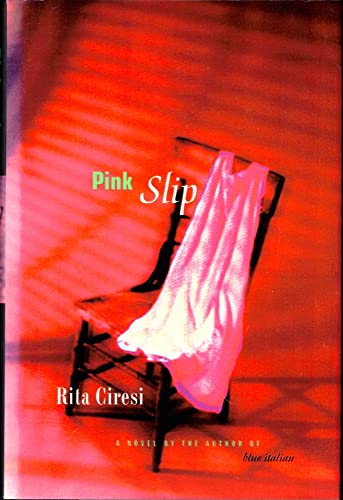
Synopsis
A novel about the inescapable bonds of family and personal history, Pink Slip asks the question, in love, what must we reveal about ourselves?
Twenty-five-year-old Lisa Diodetto needed a change. Her job editing holocaust memoirs for a prestigious New York publishing company barely paid the rent, and an ill-thought out affair with a married man had left her flattened by the wheels of romance. At the urging of her first cousin and lifelong best friend Dodie, she left New York for a job upstate in the editorial department of a big pharmaceutical company. It was a clean slate far from her working class upbringing in an Italian-American New Haven neighborhood, and she planned to make the most of it.
Enter Mr. Eben Strauss, Vice-President of Corporate Development. A man of careful composure, a restrained sense of humor, and impeccable manners. A man who certainly wouldn't appreciate Lisa's big mouth and hot temper. A man who would never dream of compromising his position or anyone else's with any kind of workplace impropriety. A man surprisingly attracted by--and attractive to--Lisa.
The relationship that ensues illustrates the very real dangers of falling in love-particularly falling in love with your boss, particularly falling in love with a boss who doesn't know the half of your personal history. Lisa is embarrassed to tell Strauss about her past--her crazy family, her wild escapades with Dodie--but she soon discovers that Strauss is keeping secrets, too. How both of them try to accept the truth about each other makes for a funny, sharp, and moving novel about the difficulties of intimacy and the imperfections of love.
"synopsis" may belong to another edition of this title.
About the Author
Rita Ciresi is the author of Mother Rocket, which won the Flannery O'Connor Award for Short Fiction, and the novels Pink Slip and Blue Italian. She lives with her husband and daughter in Florida.
From the Trade Paperback edition.
From the Inside Flap
t the inescapable bonds of family and personal history, <i>Pink Slip</i> asks the question, in love, what must we reveal about ourselves?<br><br>Twenty-five-year-old Lisa Diodetto needed a change. Her job editing holocaust memoirs for a prestigious New York publishing company barely paid the rent, and an ill-thought out affair with a married man had left her flattened by the wheels of romance. At the urging of her first cousin and lifelong best friend Dodie, she left New York for a job upstate in the editorial department of a big pharmaceutical company. It was a clean slate far from her working class upbringing in an Italian-American New Haven neighborhood, and she planned to make the most of it.<br><br>Enter Mr. Eben Strauss, Vice-President of Corporate Development. A man of careful composure, a restrained sense of humor, and impeccable manners. A man who certainly wouldn't appreciate Lisa's big mouth and hot temper. A man who would never dream of compromising his position or anyone
Reviews
A young woman's intraoffice, interfaith love affair collides with her devotion to her Italian-American family in another wise-cracking, romantic novel from Flannery O'Connor Award winner Ciresi. As in her Blue Italian, the protagonists in a problematical romance are an Italian woman and a Jewish man. Second-generation Sicilian Lisa Diodetto has just turned a mouthy 25 and shucked her job in New York and her rat-infested apartment in Brooklyn to take the improbable position of assistant manager in the editorial division of Boorman Pharmaceuticals, in Ossining, N.Y. There, she promptly falls in love with her available, rather uptight boss, Eben Strauss, who turns out to be the descendant of Holocaust survivors whose stories are in a collection of interviews Lisa has edited. Meanwhile, Lisa is working on her own work, Stop It Some More, a graphic corporate novel. The "excerpt" from the interviews offers a snippet of Ciresi's writing at its finest?thoughtful and lyrical. The novel, Lisa admits, is often "artificially witty," and, alas, Ciresi's believable but uneven romance too often merits this same description. The chain-of-command and divergent background problems of Lisa and Eben ring true and cliche-free. What drives the big wedge between them is a crisis involving Lisa's beloved gay cousin, Dodie, that reminds the reader how long ago the book's time frame?1985?really is. Author tour. (Jan.) FYI: Pink Slip won the 1997 Pirate's Alley Faulkner Award for Fiction.
Copyright 1998 Reed Business Information, Inc.
Excerpt. © Reprinted by permission. All rights reserved.
I Know You Are, But What Am I?--1985
On my twenty-fifth birthday, my mother gave me a man.
This was unusual. I hadn't received a gift from Mama since my father had a massive coronary four years before. After Daddy's death, Mama claimed I didn't appreciate her last birthday gifts (the turquoise nylon briefs and the plastic Pagliacci shower cap), nor did I carry the tote bag she had ordered after sending in sixteen blue stickers off the Chiquita bananas--so that would be the end of any largesse from her social-security check, thank you very much.
I started to protest, then thought better of it. "Fine by me," I told Mama. Because the tote bag showed a dancing twelve-inch Carmen Miranda banana shaking a pair of maracas to this message: just put one in your mouth. I needed those kinds of gifts like I needed the kind of whopper crotch infection I got after wearing those polyester birthday briefs Mama surely had picked out of a Railroad Salvage Store bin labeled: CHOO-CHOO CHEAPO ASKS SHOPPERS--CAN YOU BEAT THIS PRICE? FIVE FOR A BUCK! Mama must have been having trouble with her bifocals that day, because not a single one of the five briefs was the right size. Either that, or she didn't like how skinny I was getting and hoped I would eat enough to fill out first a size six, then a size seven, and then three size eights.
Twenty-five was a big birthday for me--if only to put twenty-four behind me. On the cusp of my quarter-of-a-century anniversary on earth, I found in my kitchen cabinet a monstrous rodent chewing himself blue in the face on a Brillo pad, causing me to bag Brooklyn and my grunt job in publishing and move out to the 'burbs--Ossining, to be exact, where I had landed an assistant-manager position in the Editorial division of Boorman Pharmaceuticals, whose corporate headquarters squatted like a behemoth battleship in the middle of the lush Hudson River Valley. The job--or rather, the seemingly hefty paycheck attached to it--permitted me to rent an apartment with a closet and a real bathroom sink. I bought my first car--a silver Toyota Corolla--and wondered, as I drove it back to Connecticut to show it off to my mother and sister, if I would get free samples of drugs.
It was unusually hot for May, and my T-shirt was soaked through by the time I made it to New Haven. The only way I could afford the car was to have the dealer strip it of the power brakes, the power steering, the floor mats, the cassette player--and, unfortunately, the air-conditioning.
"You want me to remove the engine too?" the salesman asked.
"You can keep that in," I said, as I signed on the bottom line. After he asked me, too pointedly, if I'd like to take a ride up to Hyde Park in his fully air-conditioned Celica, I told him, "Sorry, I need to stay home and clean out my vegetable crisper." I honked my horn long and loud when I left the lot. Cocky men like that gave me the creeps--yet sometimes they had their uses. In my brief but wanton sexual career in the city, I prided myself on having whipped more than a few hopeless characters into datable shape--or at the very least I had pulled the plug on one sheepskin-lined water bed and trained its owner not to wear black shoes with tan pants, and vice versa. But the quest for a tolerable Friday-night escort was slow going. A girl could easily get discouraged. She also could get desperate. I posted the car salesman's business card on my freezer door, underneath a magnet that said MONEY STINKS, BUT BOY DO I LOVE THE SMELL! just as a reminder of that.
At home I found my older sister, Carol, parked on my mother's red plaid couch. Why Carol ever had gotten married was beyond me. She moved only two blocks away and visited Mama every afternoon. Her husband's name was Alfonso. Everyone called him Al. His middle name was Dante. Carol didn't even think this was funny. Al Dante was the ultimate in guido: He used to work for our father's cement business before Daddy died and the company went under. Al drove a gold Cutlass with a jacked-up rear. Al said, "Whazzadoin' now?" whenever he got annoyed at Carol--which was practically every time she opened her mouth--and every Friday night he took his bowling bag down to the Ten Pin. Once Carol begged me to come along to watch, and I actually saw Al make the sign of the cross before he sent the big black ball barreling down the alley. "Fuggin' A!" he hollered when the Holy Mother granted him a strike.
But Al loved Carol, in a way no man yet had loved me. I knew it from the way he came up behind her and licked--like a kitten lapping at a bowl of milk--the back of her neck as she washed the dinner dishes. And Carol loved Al, in a way I had yet to love any man--I knew it from the way she squawked, "Get outta here," and jumped so hard that dish soap flew like joyous Spumante bubbles over the faucet and dishwater dripped from the sink.
Sometimes I envied what my sister and her husband had together: a closeness that allowed them to sit in silence after dinner, Al crushing walnuts with my father's old pewter nutcracker and Carol using a silver dentistlike implement to pick out the meat, saving the particularly good-looking nuts to pop into Al's mouth. Other times I thought that what Carol and Al had between them was nothing more than what my own parents had possessed: a beat-up car, a chipped front porch, and a worn shag carpet. Like my mother, Carol wore an apron every day. Like my father, Al never dressed up except to go to a wedding or funeral. On such occasions Al would not let Carol wear high heels, because then she would be taller than he was. "Why don't you just tell Al to go blow?" I asked once, and Carol said, "Oh, for God's sake, Lisa, until you get married yourself, you just won't get it. You don't get it." Then she sighed as she bent over the creaking wicker laundry basket and sorted Al's underwear into one pile and hers into another. His and hers. His and hers. I watched her, horrified. If that was marriage, I thought, those two could have it.
The back door of my mother's house usually was locked against murderers, burglars, and aunts who wanted to borrow (without asking) my mother's prized no-stick lasagne pan. But the early advent of summer apparently had melted down Mama's caution. I let myself in through the screen door.
On the couch, Carol dropped her knitting needles and clutched the double skein of white yarn in her lap. "Lisa, you scared me. I lost count of my purls. Besides, you could have been a rapist!"
"Why don't you lock the door if you're so scared of that?" I asked.
"Because it's ninety degrees outside!"
"Tell me about it," I said, wiping my face on my wet T-shirt. "How can you knit in this heat?"
Carol resumed clacking her teal-green needles together. "I just got these new number nines," she said. "And this great white yarn for half price--" Then she brayed up the stairs, "Ma. Maaaaa! The working girl is here!"
There was a thud--my mother's feet hitting the ground as she rolled out of bed from her afternoon nap--and then the dull sound of something being dragged along the bare wooden floor. My mother came downstairs the way things usually got done in my family, culo avanti--or in regular English, bass ackwards. On each step Mama bumped a long brown box that reminded me of the cardboard coffin my cousin Dodici and I used to fashion out of the container that held our five-foot artificial Christmas tree.
Dodie and I were strange kids. We liked to play funeral.
"What's that?" Carol asked.
"For the birthday girl," Mama said. After making a real production out of dragging the box downstairs, Mama hoisted it up so easily I suspected there was nothing but tissue paper inside. She motioned me to sit down on the couch and put the box in front of my feet. Carol made annoyed clucking sounds as she gathered up her white yarn and looked so enviously at the box I could tell she hadn't a clue about the contents. The sheer size of the box seemed to promise that whatever was inside would make up for all those past bad gifts and prove that Mama was a real mother.
Then I remembered how the words real mother always were used as an insult in junior high.
YOUR UNIQUE SECURITY PRODUCT HAS ARRIVED! the outside of the box announced in green letters. With the sewing scissors Carol reluctantly offered me, I slit the tape. When I turned down the flaps, a man mannequin--dressed in a white V-neck T-shirt--solemnly gazed back at me. He was naked from the waist down. On his head he wore a navy Yankees cap exactly like the one that had belonged to my father.
"It's a dead man," Carol said. "In Daddy's baseball cap!"
"It's not a real uomo," Mama said. "Not a real man."
"I can tell that, Mother," I said, as I checked his groin and found only two white buttons--big as cream doughnuts--that connected his limp cloth legs to his more substantial body.
From the Trade Paperback edition.
"About this title" may belong to another edition of this title.
Other Popular Editions of the Same Title

Search results for Pink Slip

Stock Image
Pink Slip
Seller: Wonder Book, Frederick, MD, U.S.A.
Seller rating 5 out of 5 stars

Condition: Very Good. Very Good condition. Good dust jacket. A copy that may have a few cosmetic defects. May also contain light spine creasing or a few markings such as an owner's name, short gifter's inscription or light stamp. Seller Inventory # E05N-02237
Stock Image
Pink Slip
Seller: Wonder Book, Frederick, MD, U.S.A.
Seller rating 5 out of 5 stars
Condition: Good. Good condition. Very Good dust jacket. A copy that has been read but remains intact. May contain markings such as bookplates, stamps, limited notes and highlighting, or a few light stains. Seller Inventory # P11H-02439
Stock Image
Pink Slip
Seller: HPB-Movies, Dallas, TX, U.S.A.
Seller rating 4 out of 5 stars

hardcover. Condition: Very Good. Connecting readers with great books since 1972! Used books may not include companion materials, and may have some shelf wear or limited writing. We ship orders daily and Customer Service is our top priority! Seller Inventory # S_457791927
Stock Image
Pink Slip
Published by
Delacorte Press, 1998
ISBN 10: 038532362X
ISBN 13: 9780385323628
Used
Hardcover
First Edition
Seller: Dan A. Domike, Hoquiam, WA, U.S.A.
Seller rating 4 out of 5 stars
Hardcover. Condition: Very Good. Dust Jacket Condition: Very Good. 1st Edition. Minor corner bumping with light soiling to the top edge. Very light edge wear to the dust jacket with a slight curl to the front top edge. Otherwise a clean, tight and unmarked copy. Seller Inventory # ABE-1537478007275
Seller Image
Pink Slip
Seller: MERS Goodwill, Saint Louis, MO, U.S.A.
Seller rating 5 out of 5 stars
Condition: acceptable. Used - Acceptable: All pages and the cover are intact, but shrink wrap, dust covers, or boxed set case may be missing. Pages may include limited notes, highlighting, or minor water damage but the text is readable. Pages may include limited notes and highlighting, but the text cannot be obscured or unreadable. Any access codes or passwords originally included with the book may be expired, used or no longer valid. Image is stock photo and cover art edition may be different than pictured. Seller Inventory # MERV.038532362X.A
Stock Image
Pink Slip
Published by
Delacorte Press, New York, NY, U.S.A., 1999
ISBN 10: 038532362X
ISBN 13: 9780385323628
Used
Hardcover
Seller: Top Notch Books, Tolar, TX, U.S.A.
Seller rating 5 out of 5 stars
Hard Cover. Condition: Very Good. Dust Jacket Condition: Very Good. Jacket has light edgewear. Boards have minor shelfwear. Pages are clean, text has no markings, binding is sound. Size: 8vo - over 7¾" - 9¾" tall. Seller Inventory # 328981
Stock Image
Pink Slip
Seller: Garys Books-Log Cabin Books, Apache Junction, AZ, U.S.A.
Seller rating 5 out of 5 stars
Hardcover. Condition: Fine. Dust Jacket Condition: Fine. 038532362X Fine First edition, First printing. Not inscribed clipped or otherwise marked. Shipped in a box. Complete # line 10987654321. F/F. Seller Inventory # 001470
Stock Image
Pink Slip
Published by
Delacorte Press 1998/12/29 00:00:00.000, 1998
ISBN 10: 038532362X
ISBN 13: 9780385323628
Used
Hardcover
Seller: Colorado's Used Book Store, Englewood, CO, U.S.A.
Seller rating 2 out of 5 stars

Hardcover. Condition: Good. Ciresi,Rita Pink Slip Slight wear to dust jacket. All Orders Shipped With Tracking And Delivery Confirmation Numbers. Seller Inventory # 248505
Stock Image

Stock Image
Pink Slip
Published by
Delacorte Press, New York, 1999
ISBN 10: 038532362X
ISBN 13: 9780385323628
Used
Hardcover
Seller: Willis Monie-Books, ABAA, Cooperstown, NY, U.S.A.
Seller rating 5 out of 5 stars
Hardcover. Condition: Very Good. Dust Jacket Condition: Very Good. First Printing. Seller Inventory # 102997