
Items related to A Still Small Voice
Synopsis
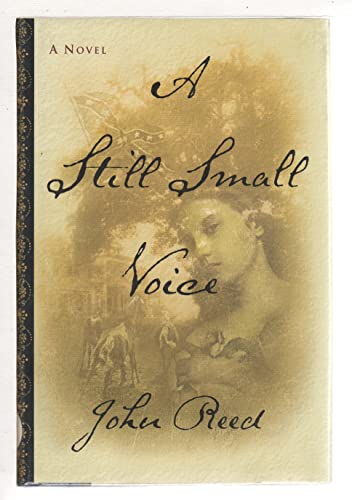
Written with a storyteller's grace and a poet's touch, A Still Small Voice is the magnificent work of a gifted young novelist. Taking its place beside the great novels of the Civil War, John Reed's sweeping saga is at once a passionate love story and a powerful human drama set against a vivid backdrop of a nation at war.
"synopsis" may belong to another edition of this title.
About the Author
John Reed attended Hampshire College and received an MFA in Creative Writing from Columbia University. His poetry and short stories have appeared in numerous literary magazines, and he was a contributing editor for Open City. He lives in New York City. A Still Small Voice is his first novel.
From the Back Cover
Grand in scope, filled with small miracles of language, A Still Small Voice is a stirring adventure of the heart, a historical saga of extraordinary power and depth. Haunting, heartbreaking, and unforgettable, this is storytelling at its very best. Advance Praise for John Reed's Debut Novel, "A Still Small Voice":
With gorgeous writing and a powerful sense of history, John Reed makes a stunning debut. You'll fall into this remarkable novel from the first sentence. Reed is a heartthrob of a writer, and A Still Small Voice shines with his passion. - Molly Peacock, author of Paradise, "Piece by Piece"
Who would have thought that a 21st-century Yankee could write such a lovely book about the 19th-century South? John Reed's prose style is a heady mix of restraint and exuberance. In A Still Small Voice, Reed combines the attentiveness of a naturalist, the factual accuracy of an historian, and the compassion of, well, a really good novelist. - Matthew Sharpe, author of "Nothing Is Terrible" and "Stories from the Tube"
Touching, scrupulously researched, John Reed's historical novel is a resonant invocation of voice, time, and place. Reed is an extraordinary new talent. - Fran Gordon, author of Paisley Girl
A fine first novel by a young writer of great promise. - Paul Auster
Of the romance of the Old South and its destruction, John Reed writes from a discreet distance. He writes of the betrayal of the innocent trust of children and of horses and how that trust is renewed by the spirits of nature, by time, and by love. But most of all he writes with an immediate speech of a woman of those troubled times and we are right there with him. -James Sherry, author of "Our Nuclear Heritage"
From the Inside Flap
The year is 1859. As this breathtaking novel opens, seven-year-old Alma Flynt arrives in the small Kentucky town of Cotterpin Creek to begin a new life in her aunt's home. There, a whole new world opens up before her eyes-a world of impossible grace and comfort, of lush pastures and billowing bluegrass. And there, Alma will meet a family who will shape the course of her life.
The Clevelands, with their sprawling mansion and gleaming thoroughbred horses, are magnificent. But from the beginning, one Cleveland draws all her attention-the youngest son, John Warren. Of their childhood bond, Alma later recalls: "The stubborn fact was, without the slightest hint of imagination, that it was clear to him, and to me, and to everyone, that we were meant to be together."
But like a swift storm cloud, the Civil War descends on Cotterpin Creek, taking men from the land and husbands from wives, never to return. Swept into the chaos are the Clevelands, and John Warren himself, leaving their fading mansion and sprawling horse farm behind. Against this turbulent backdrop, Alma will come of age. And when the fighting is over, the story of a brave young man riding off to battle becomes a haunting journey of vengeance, loss, and redemption. But for Alma, yet another journey begins on the day a strange, battered, starved, and tormented young soldier staggers back into her life.
Reviews
The simple, homespun narrative voice of elderly Alma Flynt establishes the tone of this often cloying historical novel. Alma looks back on her childhood in a small Kentucky town from 1859, when she is seven, to the late 19th century, having survived the Civil War and many of life's vicissitudes. An innocent, beautiful and unsullied orphan, she evolves into an innocent, beautiful and unsullied young woman. As Kentucky is a neutral state, some of the families in the town of Cotterpin Creek are pro-Union while others are Confederates, but all are as honorable as they are one-dimensional. Similarly, the slaves and ex-slaves who occasionally make appearances invariably wear their hearts of gold on their sleeves and carry themselves with a quiet dignity born of inner strength. Horses are the most prominent symbol in this book, and just as his canny characters find a use for every part of the possums and pigs they kill during hard times, so Reed manages to squeeze every last drop of meaning from his various equines, who represent slaves, human nature and just about everything else. Even when Alma is a child, she possesses a mystical moral certainty that serves as a convenient alternative to any character development. Describing her first childhood meeting with her future true love, she remarks, "I believe it was that when he saw me, and I saw him, our two souls lightened, and curled up together, rising on a breeze as faint as a horse's breath." Simplistic and sentimental, the narrative is at best a quick summer read. (Aug.)
Copyright 2000 Reed Business Information, Inc.
In 1859, seven-year-old orphan Alma Flynt begins a new life with her aunt in Cotterpin Creek, KY, where she falls under the spell of the wealthy Cleveland family. Her admiration for the thoroughbred horses they raise is exceeded only by her devotion to the youngest Cleveland, John Warren. That infatuation persists through the Civil War, which divides community and country. Soldiers from both armies appear intermittently to pillage and destroy, but Alma cares about only one of them: the wounded and defeated John Warren, fleeing his pursuers. Years after the war, she rejects suitors as she waits and pines for his return. Alma recounts these events for her grandchildren, which may explain the lack of urgency in the telling. Self-conscious reflections deaden the pace, while tedious passages about horses, gardens, and excursions read more like a dissertation than a narrative. How can a first novel with this setting achieve such plodding dullness? Not a necessary purchase, but because extensive advertising campaigns are slated, public libraries should anticipate some media-generated demand."Kathy Piehl, Minnesota State Univ., Mankato
Copyright 2000 Reed Business Information, Inc.
Excerpt. © Reprinted by permission. All rights reserved.
Spring '52
I was born with very red hair.
But it was not red like a strawberry or cherry. It was red like the red of a sun ripened peach.
I was delivered by my aunt at 7 a.m. on April 11, 1852. I can't say for certain if I really do remember that day or if I just have an active imagination. Perhaps it is just something that my people told me--but I know that the sun was soft that morning on the hanging curtains, and that there was a glint of it on the wooden bowl which held the warm water and the sponge of my first bath.
My mum and dad lived in Richmond, in a cottage with white lilies in the garden and green vines on the brick. Mother's name was Ellen Flynt--her maiden name, Penrose. She sewed fancy carrying bags for ladies. Father was Philip Flynt, a cobbler with a shop beside the house. He was a light haired man who matured too quickly, and relied heavily on his wife for picnics. Her eyes were green like mine. That is what I have heard.
I have heard other things.
I have heard that my mother once grew a six pound squash in the garden, and that she would not cook it. I have heard that my father was not overly concerned with things of a worldly nature, and that at our table, he always set an extra place for wanderers and travelers.
I have heard that my crib was made of young birch and that it smelled sweet like a bowl of fruit. . . .
I have also heard that of those who came to America from Europe, many had set out to escape some extraordinarily trying circumstances. And I have heard that of those who came from China, many immigrated due to similar conditions (though the Chinese especially seemed to endure more hardships in the years to come, with the building of the railroads across the west). And I have heard from some that the Irish brought cholera. And I have heard from others that the Chinese brought cholera. And still others have told me that nobody is to blame for cholera--that sometimes it simply grows, like moss on a rock.
There is a baker, a Mister Joseph Brintons, whose shop was beside the old cobbler's house in Richmond. When I visited there, he told me that when my mother and father were infected with cholera, two soldiers were posted outside of our home. They pushed provisions through the windows, and were given instructions to fire on anyone who tried to enter the house. Mister Brintons does not know under whose authority they were acting, and he is not sure that it was the right thing. But he is also not sure that it was the wrong thing, as nobody else was infected. He told me that in the spring of '56, a doctor named Wickersham stood at the front door shouting instructions to my father, and then to me, when, like my mother, my father became too sick to stand. "Mix salt and molasses into warm water," said the doctor, "and make them drink it." Mister Brintons said that I never fell ill, and that though I was a young girl (just four years old) I dutifully accomplished the doctor's ministrations. He said that by the second day there was a collection of friends and neighbors who stood outside the house holding candles--gathered in prayer. But that is something I do not recall.
My recollection begins with a dying woman that I do not remember knowing. She was pale, and lay under a white blanket on a brass bed. She called me her princess, and asked that I promise to take care of my father, who was downstairs on a bed in the kitchen. I did. He was lying on a mattress on the dining table. I patted him with a damp cloth, and squeezed water into his mouth with a sponge. He had a tea towel over his face that he would not let me remove. He was afraid his breathing would infect me. Before sunrise, he too had rested his fingers in his palm, his last breath expired.
I do remember rather well the loneliness of the time that followed. I have heard it was a day. I have heard it was a week. I have heard it was much too long for a child to be alone. And that, I believe. . . .
Many times, the old cobbler's house on Peach Road has been described to me. It was a two story white house with a brick wall in the back. There was a steep staircase to the second floor. The rooms were narrow. The windows were small. I was told that the bricks of the hearth were re-used to build the hearth of the house that now stands on that lot. And I have seen that house--but it is simply a stranger's house, and there is nothing to make me feel that it was ever my own.
Richmond is now regrown--reblossomed, like a flower from a bulb. And when I stood in the streets of the rebuilt town, I did not recognize a single pebble--not a stone, not a shrub, not a tree, not the color of the sky.
And my childhood seemed a long time ago indeed--as I stood there on New Peach Road, and listened to the clop of horse hooves on cobblestone, to children tossing beanbags and jumping rope, to merchants selling flowers, and a man selling popped corn. I listened to the sound of hammering and sawing, and the shouts of men rebuilding--to all those sounds of Richmond from twenty-five years before. And then I heard the echo of ten years before that--of cannon and miniZ balls whistling overhead, of mad cries, and the long silences when air set still. And from beyond those years, in all the multitude of sounds between me and my girlhood, I strained to hear the sound of my own soft footsteps, and the sound of my own child's brush drawing through my own red hair. . . .
But all I heard was the sound of horse hooves clop on the cobblestone, of children tossing beanbags and jumping rope, of merchants selling flowers and a man selling popped corn.
Even so, since that visit, I sometimes imagine my mum and dad--Mum in a blue dress and a white apron, and Dad with his thin blond hair. They are standing in the slender stairwell with their hands outstretched. I cannot hear their voices, but I read their moving lips.
That's it, Alma, they say to me, as I rise from my hands and knees to take my first step. . . .
"About this title" may belong to another edition of this title.
Search results for A Still Small Voice

Stock Image
A Still Small Voice
Published by
Delacorte Press (edition ), 2000
ISBN 10: 0385334052
ISBN 13: 9780385334051
Used
Hardcover
Seller: BooksRun, Philadelphia, PA, U.S.A.
Seller rating 5 out of 5 stars

Hardcover. Condition: Very Good. With dust jacket. It's a well-cared-for item that has seen limited use. The item may show minor signs of wear. All the text is legible, with all pages included. It may have slight markings and/or highlighting. Seller Inventory # 0385334052-11-1-29
Stock Image
A Still Small Voice
Seller: ThriftBooks-Atlanta, AUSTELL, GA, U.S.A.
Seller rating 5 out of 5 stars
Hardcover. Condition: Good. No Jacket. Former library book; Pages can have notes/highlighting. Spine may show signs of wear. ~ ThriftBooks: Read More, Spend Less. Seller Inventory # G0385334052I3N10
Stock Image
A Still Small Voice
Seller: HPB-Diamond, Dallas, TX, U.S.A.
Seller rating 5 out of 5 stars
hardcover. Condition: Very Good. Connecting readers with great books since 1972! Used books may not include companion materials, and may have some shelf wear or limited writing. We ship orders daily and Customer Service is our top priority! Seller Inventory # S_469967677
Stock Image
A Still Small Voice
Seller: HPB-Emerald, Dallas, TX, U.S.A.
Seller rating 5 out of 5 stars
hardcover. Condition: Very Good. Connecting readers with great books since 1972! Used books may not include companion materials, and may have some shelf wear or limited writing. We ship orders daily and Customer Service is our top priority! Seller Inventory # S_474791120
Stock Image
A Still Small Voice
Published by
Random House Publishing Group, 2000
ISBN 10: 0385334052
ISBN 13: 9780385334051
Used
Hardcover
Seller: Better World Books, Mishawaka, IN, U.S.A.
Seller rating 5 out of 5 stars
Condition: Very Good. Pages intact with possible writing/highlighting. Binding strong with minor wear. Dust jackets/supplements may not be included. Stock photo provided. Product includes identifying sticker. Better World Books: Buy Books. Do Good. Seller Inventory # 38825255-6
Stock Image
A Still Small Voice
Published by
Delacorte, 2000, 2000
ISBN 10: 0385334052
ISBN 13: 9780385334051
Used
Hardcover
First Edition
Seller: Reed's Rare Books, Palm Springs, CA, U.S.A.
Seller rating 5 out of 5 stars
Hardcover. Condition: Fine. Dust Jacket Condition: Fine. 1st Edition. 1st edition F/F. Seller Inventory # 5201
Stock Image
A Still Small Voice
Seller: CornerCoffeehouseBooks, Hopkinsville, KY, U.S.A.
Seller rating 3 out of 5 stars

hardcover. Condition: Very Good. Possible ex-library copy. Protective cover. Pages are clean and unmarked. Seller Inventory # CCB1147
Stock Image
A STILL SMALL VOICE
Published by
Delacorte Press, 2000
ISBN 10: 0385334052
ISBN 13: 9780385334051
Used
Hardcover
First Edition
Seller: Columbia Books, ABAA/ILAB, MWABA, Columbia, MO, U.S.A.
Seller rating 5 out of 5 stars
2000 Reed, John A STILL SMALL VOICE NY: Delacorte Press, c2000 first printing 351pp 8vo As new hardcover in d/j. Seller Inventory # 78722
Stock Image
A STILL SMALL VOICE
Published by
Delacorte Press, 2000
ISBN 10: 0385334052
ISBN 13: 9780385334051
Used
Hardcover
First Edition
Seller: Ilium Books, Somerville, MA, U.S.A.
Seller rating 5 out of 5 stars
Condition: Fine. First Edition. Delacorte Press, (2000). 1st Edition. 351 p. Hardbound with DJ. A bright and clean copy. Review copy with publisher's press release and author's photo laid-in. The author's first novel. Fine/Fine. Seller Inventory # 913
Stock Image
A STILL SMALL VOICE
Published by
Delacorte Press, New York, New York, U.S.A., 2000
ISBN 10: 0385334052
ISBN 13: 9780385334051
Used
Hardcover
First Edition
Seller: Joe Staats, Bookseller, Los Angeles, CA, U.S.A.
Seller rating 4 out of 5 stars

Hardcover. Condition: As New. Dust Jacket Condition: Fine. 1st Edition. Author's first novel. As new, unread, first edition, first printing, in fine, mylar-protected dust jacket.{Not remainder-marked or price-clipped} L112. Seller Inventory # 10234