
Items related to Martyr
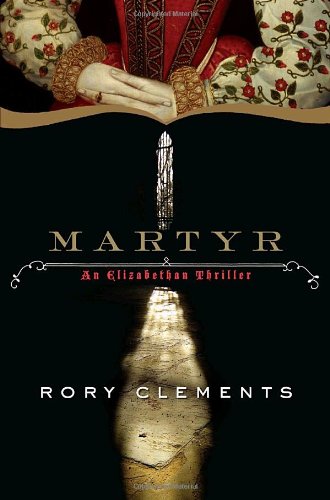
Synopsis
In this ingenious debut, Rory Clements introduces John Shakespeare, Elizabethan England’s most remarkable investigator, and delivers a tale of murder and conspiracy that succeeds brilliantly as both historical fiction and a crime thriller.
In a burnt-out house, one of Queen Elizabeth’s aristocratic cousins is found murdered, her young flesh marked with profane symbols. At the same time, a plot to assassinate Sir Francis Drake, England’s most famous sea warrior, is discovered—a plot which, if successful, could leave the country utterly defenseless against a Spanish invasion. It’s 1587, the Queen’s reign is in jeopardy, and one man is charged with the desperate task of solving both cases: John Shakespeare. With the Spanish Armada poised to strike, Mary Queen of Scots awaiting execution, and the pikes above London Bridge decorated with the grim evidence of treachery, the country is in peril of being overwhelmed by fear and chaos. Following a trail of illicit passions and family secrets, Shakespeare travels through an underworld of spies, sorcerers, whores, and theater people, among whom is his own younger brother, the struggling playwright, Will. Shadowed by his rival, the Queen’s chief torturer, who employs his own methods of terror, Shakespeare begins to piece together a complex and breathtaking conspiracy whose implications are almost too horrific to contemplate. For a zealous and cunning killer is stalking England’s streets. And as Shakespeare threatens to reveal a madman’s shocking identity, he and the beautiful woman he desires come ever closer to becoming the next martyrs to a passion for murder and conspiracy whose terrifying consequences might still be felt today….
"synopsis" may belong to another edition of this title.
About the Author
Rory Clements is a former national newspaper journalist. He now writes full-time in Norfolk, England. Bantam will publish his second John Shakespeare thriller, Revenger.
Reviews
From The Washington Post's Book World/washingtonpost.com Reviewed by Patrick Anderson It is 1587, and all is not well in merrie olde England. Queen Elizabeth continues to dither about executing her long-imprisoned cousin, Mary Queen of Scots, who has been convicted of treason for plotting against Elizabeth's life. In Spain, the hated Philip II is assembling a vast armada intended to defeat the English navy and launch an invasion that will end with the Protestant Elizabeth imprisoned or dead, along with thousands of her followers, and a Catholic on the English throne. England's best hope of survival seems to rest with its great sea-captain Sir Francis Drake, who has sailed around the world, defeated the Spanish in previous battles and, in his role as the queen's favorite pirate, relieved Spanish treasure ships of millions of pounds in gold and other valuables from the New World. He is now supervising the construction of a new English navy that might destroy the armada. But England also faces a more immediate threat: Elizabeth's spymaster, Sir Francis Walsingham, has evidence that the Spanish have sent a skilled assassin into England to assassinate Drake and thus assure their conquest of England. Enter the hero of this engrossing thriller, John Shakespeare, age 28, Walsingham's chief investigator, whose loyalty to the queen does not stop him from being a decent and compassionate man in an era of extreme violence. Shakespeare? We'll get to that. The plot of "Martyr" recalls that of Frederick Forsyth's 1971 classic "The Day of the Jackal," in which an assassin, armed with the latest weaponry, sets out to kill French President Charles de Gaulle. In "Martyr" the assassin, also armed with the latest weaponry -- a gun that can fire accurately for more than 100 yards -- stalks Drake. Shakespeare seeks to find the assassin by questioning Catholic priests and nobles who might be supporting him. He often clashes with his arch-rival Richard Topcliffe, a favorite of the queen's who eagerly uses torture to force the truth (or at least a confession) out of Catholics; Shakespeare, on the other hand, tries to work within the law. This is an extremely violent novel, but it seems to accurately reflect the times. The book made me wonder if we do not often romanticize Elizabeth and her reign. I can imagine two reasons that we might. First, although there is much violence in Shakespeare's plays, the beauty of his writing tends to cast a gentle glow over much of the era. Second, Elizabeth has had the good fortune to be portrayed in recent years by Cate Blanchett and Helen Mirren, two actresses whose abundant charms might make us forget, as this novel does not, that Elizabeth was a hard woman and that, starting with her execution of Mary, she did little to discourage the bloodlust of the period she personified. As the book reminds us, the heads of Catholics decorated London Bridge, men were disemboweled, drawn and quartered; women and even children were put upon the rack. It takes the better part of a page to describe the four days of torture meted out to one Catholic assassin. Sample: "Pieces of his flesh were torn, to the bone, from six parts of his body with pincers; boiling fat was poured over his back; carpenters' nails were driven under the nails of his fingers." We see in grievous detail the beheading of Mary Queen of Scots, which required two strokes of the ax and some sawing -- deliberate incompetence, some thought. Many scenes and quotations in the novel echo the current debate over "enhanced interrogation techniques," which we common folk call torture. Walsingham cautions Shakespeare that they must use "whatever's necessary in these days of threatened war and invasion." We are told of Shakespeare: "Torture repulsed him, as it did most Englishmen," but there is little evidence for the latter assertion. The torture, although ultimately political, is cloaked in piety -- Protestant vs. Catholic -- and most Englishmen in these pages agree with the sadistic Topcliffe: "It is God's will, Shakespeare. That is all. God and Her Majesty." There is a great deal going on in this novel -- too much perhaps -- but one's interest does not fade. A beautiful and highborn young woman, a cousin of the queen, is found tortured to death, in a manner that suggests a Catholic killer. Another woman's beloved infant is kidnapped and a deformed infant left in its place. We glimpse England's "first ever state funeral for a nonroyal," that of the beloved soldier and poet Sir Philip Sidney: "Seven hundred official mourners followed the cortege as it wove slowly through the streets of London from Aldgate to St Paul's." Shakespeare encounters a witch and falls in love with a beautiful Catholic, not a good career move. Clements, a former London journalist, shows us not only great lords and ladies in his first novel but also whores and cutthroats. We meet the delightfully named prostitutes Starling Day and Parsimony Field and the brave soldier Boltfoot Cooper. Do those names recall some in Shakespeare? The author does have Shakespeare on his mind, in that his hero has a younger brother named William, an actor. The handsome and resourceful Will appears only briefly in "Martyr," but given that the novel is presented as the first of a series, we can expect to see more of the brothers Shakespeare. On the basis of this outing, they will be welcome.
Copyright 2009, The Washington Post. All Rights Reserved.
Starred Review. William Shakespeare's older brother, John, plays sleuth in Clements's excellent debut, billed as an Elizabethan thriller. While Queen Elizabeth hesitates to sign the death warrant for Mary, Queen of Scots, her spymaster, Sir Francis Walsingham, fears the Spanish have sent an assassin to England to kill the country's greatest naval hero, Sir Francis Drake. John, Walsingham's assistant secretary and chief intelligencer, suspects the conspiracy against Drake may be connected with a murder John's investigating—the stabbing death of Lady Blanche Howard, whose mutilated corpse was found in a burning London building. His inquiries put him at odds with Richard Topcliffe, a fanatical servant of the queen known for his taste for torture and anti-Catholic zeal, who threatens to expose John's father's secret Catholic sympathies. The characters, action and period detail are all solid, though some may wish the end notes had provided information on the historical John Shakespeare. (May)
Copyright © Reed Business Information, a division of Reed Elsevier Inc. All rights reserved.
Excerpt. © Reprinted by permission. All rights reserved.
Chapter One
ROSE DOWNIE SAT ON THE COLD COBBLES, CRADLING a swaddled baby that was not hers.
She leaned her aching back against the wall of the imposing stone house, close to its arched oak door. Under any other circumstance, nothing could have brought her near this building where baleful apprehension hung heavy in the air like the stink of tallow, but the man who lived here, Richard Topcliffe, was her last hope. She had been to the court of law, and the justice merely shook his head dismissively and said that even had he believed her-and that, he said with a scowl, was as unlikely as apple blossom in November-there was nothing he could do for her.
The constable had been no more helpful. “Mistress Downie,” he said, “put the baby in a bag like a kitten and throw it in the Thames. What use is it alive? I promise you, in God's name, that I will not consider the killing a crime but an act of mercy, and you shall never hear another word of the matter.”
Now, outside Topcliffe's house in the snow-flecked street, close by St. Margaret's churchyard in Westminster, Rose sat and waited. She had knocked at the door once already, and it had been answered by a sturdy youth with a thin beard who looked her up and down with distaste and told her to go away. She refused and he closed the door in her face. The intense cold would have driven anyone else home to sit at the fireside wrapped in blankets, but Rose would not go until she had seen Topcliffe and begged him to help.
The bitter embers of sunlight dipped behind the edifices of St. Margaret's and the Abbey, and the cold grew deeper. Rose was fair, young, no more than seventeen with a face that, in other times, sparkled with smiles. She shivered uncontrollably in her heavy gowns and clutched the baby close to share what little warmth she had. Occasionally she lifted a large, well-formed breast from her garments to feed the infant; the milk was free-flowing and rich and her need of relief was almost as insistent as the child's hunger. Steam rose from her breast in the icy winter air. The child sucked at her with ferocity and she was thankful for it. Monstrous as she considered the baby, some instinct still made her keep it and feed it, even though it was not hers. The day moved on into darkness, but she was as immovable as stone.
"About this title" may belong to another edition of this title.
Search results for Martyr

Stock Image
Martyr
Published by
Bantam Books (edition First Edition), 2009
ISBN 10: 0385342829
ISBN 13: 9780385342827
Used
Hardcover
First Edition
Seller: BooksRun, Philadelphia, PA, U.S.A.
Seller rating 5 out of 5 stars

Hardcover. Condition: Very Good. First Edition. With dust jacket. It's a well-cared-for item that has seen limited use. The item may show minor signs of wear. All the text is legible, with all pages included. It may have slight markings and/or highlighting. Seller Inventory # 0385342829-8-1-29
Seller Image
Martyr
Seller: Bay State Book Company, North Smithfield, RI, U.S.A.
Seller rating 5 out of 5 stars
Condition: very_good. Seller Inventory # BSM.19ZA9
Stock Image
Martyr
Seller: ThriftBooks-Atlanta, AUSTELL, GA, U.S.A.
Seller rating 5 out of 5 stars
Hardcover. Condition: Very Good. No Jacket. Former library book; May have limited writing in cover pages. Pages are unmarked. ~ ThriftBooks: Read More, Spend Less. Seller Inventory # G0385342829I4N10
Stock Image
Martyr
Seller: ThriftBooks-Dallas, Dallas, TX, U.S.A.
Seller rating 5 out of 5 stars
Hardcover. Condition: Good. No Jacket. Pages can have notes/highlighting. Spine may show signs of wear. ~ ThriftBooks: Read More, Spend Less. Seller Inventory # G0385342829I3N00
Stock Image
Martyr
Seller: ThriftBooks-Atlanta, AUSTELL, GA, U.S.A.
Seller rating 5 out of 5 stars
Hardcover. Condition: Good. No Jacket. Pages can have notes/highlighting. Spine may show signs of wear. ~ ThriftBooks: Read More, Spend Less. Seller Inventory # G0385342829I3N00
Stock Image
Martyr
Seller: ThriftBooks-Atlanta, AUSTELL, GA, U.S.A.
Seller rating 5 out of 5 stars
Hardcover. Condition: Good. No Jacket. Former library book; Pages can have notes/highlighting. Spine may show signs of wear. ~ ThriftBooks: Read More, Spend Less. Seller Inventory # G0385342829I3N10
Stock Image
Martyr
Seller: ThriftBooks-Dallas, Dallas, TX, U.S.A.
Seller rating 5 out of 5 stars
Hardcover. Condition: Good. No Jacket. Former library book; Pages can have notes/highlighting. Spine may show signs of wear. ~ ThriftBooks: Read More, Spend Less. Seller Inventory # G0385342829I3N10
Stock Image
Martyr
Seller: Evergreen Goodwill, Seattle, WA, U.S.A.
Seller rating 5 out of 5 stars
hardcover. Condition: Good. Seller Inventory # mon0000235886
Stock Image
Martyr
Seller: Open Books, Chicago, IL, U.S.A.
Seller rating 5 out of 5 stars
hardcover. Condition: Very Good. Open Books is a nonprofit social venture that provides literacy experiences for thousands of readers each year through inspiring programs and creative capitalization of books. Seller Inventory # mon0000850447
Stock Image
Martyr
Published by
Random House Publishing Group, 2009
ISBN 10: 0385342829
ISBN 13: 9780385342827
Used
Hardcover
Seller: Better World Books, Mishawaka, IN, U.S.A.
Seller rating 5 out of 5 stars
Condition: Good. Former library copy. Pages intact with minimal writing/highlighting. The binding may be loose and creased. Dust jackets/supplements are not included. Includes library markings. Stock photo provided. Product includes identifying sticker. Better World Books: Buy Books. Do Good. Seller Inventory # GRP96549637