
Items related to CONSCIENCE AND COURAGE
Synopsis
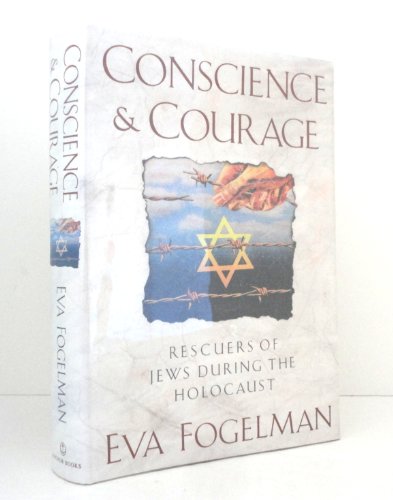
In this brilliantly researched and insightful book, psychologist Eva Fogelman presents compelling stories of rescuers of Jews during the Holocaust--and offers a revealing analysis of their motivations. Based on her extensive experience as a therapist treating Jewish survivors of the Holocaust and those who helped them, Fogelman delves into the psychology of altruism,illuminating why these rescuers chose to act while others simply stood by. While analyzing motivations, Conscience And Courage tells the stories of such little-known individuals as Stefnaia Podgorska Burzminska, a Polish teenager who hid thirteen Jews in her home; Alexander Roslan, a dealer in the black market who kept uprooting his family to shelter three Jewish children in his care, as well as more heralded individuals such as Oskar Schindler, Raoul Wallenberg, ad Miep Gies. Speaking to the same audience that flocked to Steven Spielberg's Academy Award-winning movie, Schindler's List, Conscience And Courage is the first book to go beyond the stories to answer the question: Why did they help?
"synopsis" may belong to another edition of this title.
From the Back Cover
"Fogelman has made a monor contribution to Holocaust studies in collcting these accounts of conscience and courage." --The Washington Post Book World.
"By evoking the noble along with the horrible, Ms. Fogelman helps to add a dimension to our understanding of the Holocaust. And, more than that, hers is a work of remembrance." --The New York Times Book Review
From the Inside Flap
liantly researched and insightful book, psychologist Eva Fogelman presents compelling stories of rescuers of Jews during the Holocaust--and offers a revealing analysis of their motivations. Based on her extensive experience as a therapist treating Jewish survivors of the Holocaust and those who helped them, Fogelman delves into the psychology of altruism,illuminating why these rescuers chose to act while others simply stood by. While analyzing motivations, <i>Conscience And Courage</i> tells the stories of such little-known individuals as Stefnaia Podgorska Burzminska, a Polish teenager who hid thirteen Jews in her home; Alexander Roslan, a dealer in the black market who kept uprooting his family to shelter three Jewish children in his care, as well as more heralded individuals such as Oskar Schindler, Raoul Wal
Reviews
YA-This is not just another Holocaust book. Instead of presenting a detailed factual account of what happened during the war, Fogelman explores the altruistic personalities of individuals who risked their lives and those of their families to help people considered to be enemies of the State. The stories of Oskar Schindler and Raoul Wallenberg are told along with those of lesser-known individuals such as Alexander Roslan and Louisa Steenstra, who went to extraordinary means to help Jews. The book is divided into three parts-"The Rescuers," "The Motivation," and "Postwar." Each section, complete with personal accounts, forms a mosaic of courage and conviction on the part of both the rescuers and the rescued.
Roberta Lisker, W.T. Woodson High School, Fairfax, VA
Copyright 1994 Reed Business Information, Inc.
Some sheltered one Jew for a night; others hid several Jews for years. Some performed a single spontaneous act of heroism, like the baker who saved the author's father in Poland in 1942; others were part of an anonymous network. These brave people, along with the well-known rescuers Oskar Schindler and Raoul Wallenberg, had this in common: they were gentiles who risked their lives to save Jews from the Nazi regime. In her deeply affecting book, Fogelman recounts the stories of these Europeans --housewives, businessmen, telephone operators, farmers, diplomats, nurses--and tells how the state of Israel has honored them with the title "Righteous Among the Nations." The author, a New York City social psychologist who directs the Jewish Foundation for Christian Rescuers, ponders deep questions: Why did these particular individuals become rescuers? Can moral integrity be taught and then applied? Is there such a thing as altruism? She explains that one of her reasons for writing the book was "to give altruism back its good name." Her study of extraordinary instances of moral courage will appeal to a broad audience. Fogelman wrote and co-produced the PBS series Breaking the Silence: The Generations After the Holocaust.
Copyright 1994 Reed Business Information, Inc.
Fogelman's survey of heroic subversion of the Nazi genocide of the Jews by non-Jews begins with the story of her own father, Simcha Fogelman, rescued by a Russian baker in the Byelorussian town of Illya in 1942. The odd thing about many of these rescuers- -like the currently famous Oskar Schindler or Swedish diplomat Raoul Wallenburg--is that they were frequently notorious rakes, thieves, and embezzlers--in other words, outright criminals. Fogelman (Center for Social Research/CUNY) tries in this ample study to understand the particular background and conditioning that produces a ``rescuer'' as opposed to either a passive bystander or an active accessory. And an extraordinary gallery of characters is brought to life: Angel Sanz-Briz, the Spanish minister in Budapest who issued thousands of phony Spanish passports to Hungarian Jews; Miep Gies, the rescuer--for a time--of Anne Frank; Stefaniz Podgorska, a teenage girl who smuggled food into the ghetto of Przemysl and hid refugees from it; Alexander Roslan, who built a hiding cupboard in his apartment and when visited by suspicious Gestapo agents wined and dined them until they were too drunk to remember why they had come; Louisa Steenstra, a former secretary at a Jewish-owned furniture factory in Groningen who ventured into the local concentration camp to get a suitcase of clothes to a Jewish friend. Perhaps one of the strangest stories is that of the Japanese consul in Kovno, Lithuania, Sempo Sugihara, who ignored his diplomatic instructions and issued illegal transit visas to Jews via Japan--visas that his own government kept refusing to validate. At the end of each day, his hands would be so numb from writing these fake visas that his wife would have to massage them back to life. It is estimated that he saved between 4,500 and 10,000 Jews. Perhaps inexplicable but uplifting stories of humanity. -- Copyright ©1994, Kirkus Associates, LP. All rights reserved.
Fogelman, a social psychologist and Holocaust film producer, attempts to explain why the rescuers of Holocaust victims acted as they did. Rescuers generally fall into five categories: those driven by moral and ethical reasons; those who had a special relationship to the Jewish people; those who opposed Third Reich policies and joined rescuer networks; those who were in professions such as medicine and social work who naturally provided assistance to people in need; and children who became involved through their families. Many individuals acted alone, while others were part of rescuer networks. Fogelman emphasizes the ordinary rescuer but also discusses better-known people like Oskar Schindler, Raoul Wallenberg, and Miep Gies. Besides offering a psychological reason for the rescuers' sacrifices, Fogelman tells the fascinating stories of people who risked their lives to help individuals in trouble. Recommended for academic and large public libraries. Previewed in Prepub Alert, LJ 12/93.
- Mary Salony, West Virginia Northern Community Coll. Lib., Wheeling
Copyright 1994 Reed Business Information, Inc.
"About this title" may belong to another edition of this title.
Search results for CONSCIENCE AND COURAGE

Stock Image
CONSCIENCE AND COURAGE
Seller: World of Books (was SecondSale), Montgomery, IL, U.S.A.
Seller rating 5 out of 5 stars

Condition: Good. Item in good condition. Textbooks may not include supplemental items i.e. CDs, access codes etc. Seller Inventory # 00096918290
Stock Image
CONSCIENCE AND COURAGE
Seller: World of Books (was SecondSale), Montgomery, IL, U.S.A.
Seller rating 5 out of 5 stars
Condition: Acceptable. Item in acceptable condition! Textbooks may not include supplemental items i.e. CDs, access codes etc. Seller Inventory # 00106817990
Seller Image
CONSCIENCE AND COURAGE
Seller: Zoom Books Company, Lynden, WA, U.S.A.
Seller rating 5 out of 5 stars
Condition: very_good. Book is in very good condition and may include minimal underlining highlighting. The book can also include "From the library of" labels. May not contain miscellaneous items toys, dvds, etc. . We offer 100% money back guarantee and 24 7 customer service. Seller Inventory # ZBV.0385420277.VG
Stock Image
CONSCIENCE AND COURAGE
Seller: Evergreen Goodwill, Seattle, WA, U.S.A.
Seller rating 5 out of 5 stars
hardcover. Condition: Good. Seller Inventory # mon0000751897
Stock Image
CONSCIENCE AND COURAGE
Seller: Half Price Books Inc., Dallas, TX, U.S.A.
Seller rating 5 out of 5 stars
hardcover. Condition: Very Good. Connecting readers with great books since 1972! Used books may not include companion materials, and may have some shelf wear or limited writing. We ship orders daily and Customer Service is our top priority! Seller Inventory # S_440828873
Stock Image
CONSCIENCE AND COURAGE
Seller: HPB-Emerald, Dallas, TX, U.S.A.
Seller rating 5 out of 5 stars
hardcover. Condition: Very Good. Connecting readers with great books since 1972! Used books may not include companion materials, and may have some shelf wear or limited writing. We ship orders daily and Customer Service is our top priority! Seller Inventory # S_428471359
Stock Image
Conscience and Courage
Published by
Bantam Doubleday Dell Publishing Group Inc, 1994
ISBN 10: 0385420277
ISBN 13: 9780385420273
Used
Hardcover
Seller: World of Books Inc, Montgomery, IL, U.S.A.
Seller rating 4 out of 5 stars

Hardback. Condition: Good. Seller Inventory # CIN0385420277G
Stock Image
CONSCIENCE AND COURAGE
Published by
Doubleday, 1994
ISBN 10: 0385420277
ISBN 13: 9780385420273
Used
Hardcover
First Edition
Seller: The Maryland Book Bank, Baltimore, MD, U.S.A.
Seller rating 5 out of 5 stars
hardcover. Condition: Very Good. First Edition. Used - Very Good. Seller Inventory # 14-A-4-0208
Stock Image
CONSCIENCE AND COURAGE
Seller: Wonder Book, Frederick, MD, U.S.A.
Seller rating 5 out of 5 stars
Condition: Good. Good condition. Very Good dust jacket. A copy that has been read but remains intact. May contain markings such as bookplates, stamps, limited notes and highlighting, or a few light stains. Seller Inventory # V18A-06278
Stock Image
Conscience and Courage : The Rescuers of the Jews During the Holocaust
Published by
Doubleday Religious Publishing Group, The, 1994
ISBN 10: 0385420277
ISBN 13: 9780385420273
Used
Hardcover
First Edition
Seller: Better World Books, Mishawaka, IN, U.S.A.
Seller rating 5 out of 5 stars
Condition: Fine. 1st. Used book that is in almost brand-new condition. May contain a remainder mark. Better World Books: Buy Books. Do Good. Seller Inventory # 55985960-6