
Items related to The Web of Life: A New Scientific Understanding of...
Synopsis
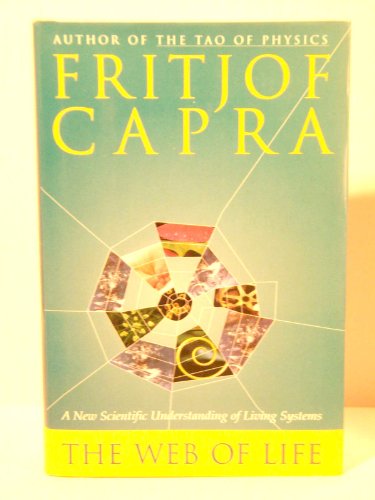
The vitality and accessibility of Fritjof Capra's ideas have made him perhaps the most eloquent spokesperson of the latest findings emerging at the frontiers of scientific, social, and philosophical thought. In his international bestsellers The Tao of Physics and The Turning Point, he juxtaposed physics and mysticism to define a new vision of reality. In The Web of Life, Capra takes yet another giant step, setting forth a new scientific language to describe interrelationships and interdependence of psychological, biological, physical, social, and cultural phenomena--the "web of life."
During the past twenty-five years, scientists have challenged conventional views of evolution and the organization of living systems and have developed new theories with revolutionary philosophical and social implications. Fritjof Capra has been at the forefront of this revolution. In The Web of Life, Capra offers a brilliant synthesis of such recent scientific breakthroughs as the theory of complexity, Gaia theory, chaos theory, and other explanations of the properties of organisms, social systems, and ecosystems. Capra's surprising findings stand in stark contrast to accepted paradigms of mechanism and Darwinism and provide an extraordinary new foundation for ecological policies that will allow us to build and sustain communities without diminishing the opportunities for future generations.
Now available in paperback for the first time, The Web of Life is cutting-edge science writing in the tradition of James Gleick's Chaos, Gregory Bateson's Mind and Matter, and Ilya Prigogine's Order Out of Chaos.
From the Trade Paperback edition.
"synopsis" may belong to another edition of this title.
From the Back Cover
and accessibility of Fritjof Capra's ideas have made him perhaps the most eloquent spokesperson of the latest findings emerging at the frontiers of scientific, social, and philosophical thought. In his international bestsellers The Tao of Physics and The Turning Point, he juxtaposed physics and mysticism to define a new vision of reality. In The Web of Life, Capra takes yet another giant step, setting forth a new scientific language to describe interrelationships and interdependence of psychological, biological, physical, social, and cultural phenomena--the "web of life."
During the past twenty-five years, scientists have challenged conventional views of evolution and the organization of living systems and have developed new theories with revolutionary philosophical and social implications. Fritjof Capra has been at the forefront of this revolution. In The Web of Life, Capra offers a brilliant synthesis of such r
From the Inside Flap
and accessibility of Fritjof Capra's ideas have made him perhaps the most eloquent spokesperson of the latest findings emerging at the frontiers of scientific, social, and philosophical thought. In his international bestsellers The Tao of Physics and The Turning Point, he juxtaposed physics and mysticism to define a new vision of reality. In The Web of Life, Capra takes yet another giant step, setting forth a new scientific language to describe interrelationships and interdependence of psychological, biological, physical, social, and cultural phenomena--the "web of life."
During the past twenty-five years, scientists have challenged conventional views of evolution and the organization of living systems and have developed new theories with revolutionary philosophical and social implications. Fritjof Capra has been at the forefront of this revolution. In The Web of Life, Capra offers a brilliant synthesis of such r
Reviews
In his bestsellers, The Tao of Physics and The Turning Point, physicist Capra charted a paradigm shift from a mechanistic to an ecological worldview. In his new book, a rewarding synthesis that will challenge serious readers, he claims that a comprehensive theory of living systems is now emerging. Applicable to cells, chemical structures, people, ecosystems and social systems, such a theory flows from deep ecology (which assumes humanity's embeddedness in nature's processes), systems thinking and the new mathematics of complexity. Capra identifies a pattern of organization common to all living systems, characterized by internal feedback loops and self-organizing behavior. His own theorizing builds upon the work of important scientists, including American microbiologist Lynn Margulis and British atmospheric chemist James Lovelock, the co-founders of the Gaia hypothesis, who see planet Earth as a living, self-regulating organism. Capra also draws from the work of Chilean neuroscientists Francisco Varela and Humberto Maturana, whose theory of autopoiesis ("self-making") defines organisms as "network patterns" whose components continually transform one another. Extrapolating from ecosystems research, he sets forth guidelines for building sustainable human communities based on interdependence, cyclical flow of resources, partnership and conflict resolution. Illustrated.
Copyright 1996 Reed Business Information, Inc.
The acclaimed author of The Tao of Physics puts modern biology and ecology under his revisionist scrutiny. Capra's whole approach is based on the premise that earlier schools of science falsely attempted to force their subjects into mechanistic, easily quantifiable models, in opposition to the holistic awareness of today's scientific revolutionaries. Systems thinking and fractal geometry replace traditional analytical tools and methods. In biological terms, this means abandoning the traditional emphasis on the cell as a fundamental building block of life. Instead, the modern cell emerges as a symbiotic partnership between a number of formerly independent entities, now playing the roles of nucleus, mitochondria, ribosomes, chloroplasts, and so forth. Indeed, the emphasis on cooperation is a keynote of Capra's vision. The Gaia hypothesis, in which Earth itself is seen as a single self-regulating biological entity, plays a large role in his vision. Likewise, he believes that the Darwinian vision of struggle for survival aided by chance mutations is refuted by the discovery that microorganisms can in effect cooperate by passing genetic material from one to another across species lines--a discovery that he feels calls into question the entire notion of separate species. But Capra pushes his thesis too eagerly and with too little attention to mundane details. A reader up on the subject will catch him in innumerable small errors (for example, he seems unaware that most biologists see modern apes not as human ancestors but as collateral descendants of a common ancestor). He likes to replace well-established terminology with new jargon, much of it rather condescending; readers of a book like this are unlikely to need him to substitute ``southern ape'' for the scientific term Australopithecus. He too often states sweeping and unprovable assumptions--such as that Cro-Magnons possessed ``fully developed language''--as fact. Surveys a great deal of fascinating ground, but from the standpoint of a true believer rather than of an objective explorer. (Author tour) -- Copyright ©1996, Kirkus Associates, LP. All rights reserved.
In previous books (The Tao of Physics, Shambhala, 1991; Belonging to the Universe, LJ 2/1/92), Capra was never timid about expounding grand, scientific/philosophical theories of the physical universe. Now, he offers this sweeping discourse on the life sciences. Incorporating elements from such contemporary schools of thought as the Gaia hypothesis, deep ecology, complexity theory, systems theory, and even eco-feminism, Capra herein pronounces a new synthesis that integrates all into a single conceptual context. Many of these ideas are still being developed, though, and many disputes remain unresolved. Advocates will find Capra's theories intellectually and spiritually satisfying. Others will quibble; some will rage. For this to become a true synthesis, it must gain consensus, which will be difficult. Regardless, this book is breathtakingly ambitious and certain to generate response. Public and academic libraries will need it.?Gregg Sapp, Univ. of Miami Lib., Coral Gables, Fla.
Copyright 1996 Reed Business Information, Inc.
"About this title" may belong to another edition of this title.
Search results for The Web of Life: A New Scientific Understanding of...

Stock Image
The Web of Life: A New Scientific Understanding of Living Systems
Seller: Gulf Coast Books, Cypress, TX, U.S.A.
Seller rating 5 out of 5 stars

hardcover. Condition: Fair. Seller Inventory # 0385476752-4-36310691
Stock Image
The Web of Life: A New Scientific Understanding of Living Systems
Seller: Your Online Bookstore, Houston, TX, U.S.A.
Seller rating 5 out of 5 stars
Hardcover. Condition: Very Good. Seller Inventory # 0385476752-2-21642884
Stock Image
The Web of Life
Published by
Bantam Doubleday Dell Publishing Group Inc, 1996
ISBN 10: 0385476752
ISBN 13: 9780385476751
Used
Hardcover
Seller: World of Books (was SecondSale), Montgomery, IL, U.S.A.
Seller rating 5 out of 5 stars
Hardback. Condition: Good. The vitality and accessibility of Fritjof Capra's ideas have made him perhaps the most eloquent spokesperson of the latest findings emerging at the frontiers of scientific, social, and philosophical thought. In his international bestsellers The Tao of Physics and The Turning Point, he juxtaposed physics and mysticism to define a new vision of reality. In The Web of Life, Capra takes yet another giant step, setting forth a new scientific language to describe interrelationships and interdependence of psychological, biological, physical, social, and cultural phenomena--the web of life. During the past twenty-five years, scientists have challenged conventional views of evolution and the organization of living systems and have developed new theories with revolutionary philosophical and social implications. Fritjof Capra has been at the forefront of this revolution. In The Web of Life, Capra offers a brilliant synthesis of such recent scientific breakthroughs as the theory of complexity, Gaia theory, chaos theory, and other explanations of the properties of organisms, social systems, and ecosystems. Capra's surprising findings stand in stark contrast to accepted paradigms of mechanism and Darwinism and provide an extraordinary new foundation for ecological policies that will allow us to build and sustain communities without diminishing the opportunities for future generations. Now available in paperback for the first time, The Web of Life is cutting-edge science writing in the tradition of James Gleick's Chaos, Gregory Bateson's Mind and Matter, and Ilya Prigogine's Order Out of Chaos. Seller Inventory # 00084335738
Stock Image
The Web of Life
Published by
Bantam Doubleday Dell Publishing Group Inc, 1996
ISBN 10: 0385476752
ISBN 13: 9780385476751
Used
Hardcover
Seller: World of Books (was SecondSale), Montgomery, IL, U.S.A.
Seller rating 5 out of 5 stars
Hardback. Condition: Very Good. The vitality and accessibility of Fritjof Capra's ideas have made him perhaps the most eloquent spokesperson of the latest findings emerging at the frontiers of scientific, social, and philosophical thought. In his international bestsellers The Tao of Physics and The Turning Point, he juxtaposed physics and mysticism to define a new vision of reality. In The Web of Life, Capra takes yet another giant step, setting forth a new scientific language to describe interrelationships and interdependence of psychological, biological, physical, social, and cultural phenomena--the web of life. During the past twenty-five years, scientists have challenged conventional views of evolution and the organization of living systems and have developed new theories with revolutionary philosophical and social implications. Fritjof Capra has been at the forefront of this revolution. In The Web of Life, Capra offers a brilliant synthesis of such recent scientific breakthroughs as the theory of complexity, Gaia theory, chaos theory, and other explanations of the properties of organisms, social systems, and ecosystems. Capra's surprising findings stand in stark contrast to accepted paradigms of mechanism and Darwinism and provide an extraordinary new foundation for ecological policies that will allow us to build and sustain communities without diminishing the opportunities for future generations. Now available in paperback for the first time, The Web of Life is cutting-edge science writing in the tradition of James Gleick's Chaos, Gregory Bateson's Mind and Matter, and Ilya Prigogine's Order Out of Chaos. Seller Inventory # 00079770008
Seller Image
The Web of Life: A New Scientific Understanding of Living Systems
Seller: Zoom Books Company, Lynden, WA, U.S.A.
Seller rating 5 out of 5 stars
Condition: very_good. Book is in very good condition and may include minimal underlining highlighting. The book can also include "From the library of" labels. May not contain miscellaneous items toys, dvds, etc. . We offer 100% money back guarantee and 24 7 customer service. Seller Inventory # ZBV.0385476752.VG
Seller Image
The Web of Life: A New Scientific Understanding of Living Systems
Seller: Zoom Books East, Glendale Heights, IL, U.S.A.
Seller rating 5 out of 5 stars
Condition: good. Book is in good condition and may include underlining highlighting and minimal wear. The book can also include "From the library of" labels. May not contain miscellaneous items toys, dvds, etc. . We offer 100% money back guarantee and 24 7 customer service. Seller Inventory # ZEV.0385476752.G
Seller Image
The Web of Life: A New Scientific Understanding of Living Systems
Seller: Zoom Books East, Glendale Heights, IL, U.S.A.
Seller rating 5 out of 5 stars
Condition: very_good. Book is in very good condition and may include minimal underlining highlighting. The book can also include "From the library of" labels. May not contain miscellaneous items toys, dvds, etc. . We offer 100% money back guarantee and 24 7 customer service. Seller Inventory # ZEV.0385476752.VG
Seller Image
The Web of Life: A New Scientific Understanding of Living Systems
Seller: Greenworld Books, Arlington, TX, U.S.A.
Seller rating 5 out of 5 stars
Condition: good. Fast Free Shipping â" Good condition. It may show normal signs of use, such as light writing, highlighting, or library markings, but all pages are intact and the book is fully readable. A solid, complete copy that's ready to enjoy. Seller Inventory # GWV.0385476752.G
Stock Image
The Web of Life: A New Scientific Understanding of Living Systems
Published by
Anchor Books/Doubleday (edition First Edition), 1996
ISBN 10: 0385476752
ISBN 13: 9780385476751
Used
Hardcover
First Edition
Seller: BooksRun, Philadelphia, PA, U.S.A.
Seller rating 5 out of 5 stars
Hardcover. Condition: Fair. First Edition. With dust jacket. The item might be beaten up but readable. May contain markings or highlighting, as well as stains, bent corners, or any other major defect, but the text is not obscured in any way. Seller Inventory # 0385476752-7-22-29
Seller Image
The Web of Life: A New Scientific Understanding of Living Systems
Seller: ZBK Books, Carlstadt, NJ, U.S.A.
Seller rating 5 out of 5 stars
Condition: good. Fast & Free Shipping â" Good condition. It may show normal signs of use, such as light writing, highlighting, or library markings, but all pages are intact and the book is fully readable. A solid, complete copy that's ready to enjoy. Seller Inventory # ZWV.0385476752.G