Synopsis
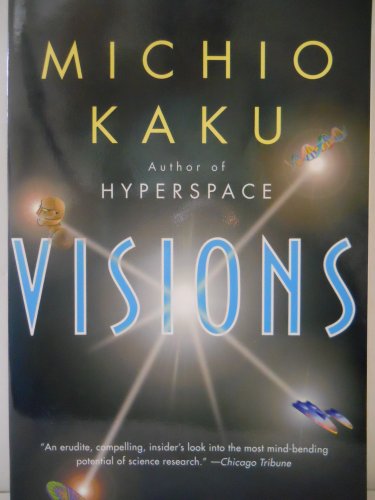
In a spellbinding narrative that skillfully weaves together cutting-edge research among today's foremost scientists, theoretical physicist Michio Kaku--author of the bestselling book Hyperspace--presents a bold, exhilarating adventure into the science of tomorrow.
In Visions, Dr. Kaku examines in vivid detail how the three scientific revolutions that profoundly reshaped the twentieth century--the quantum, biogenetic, and computer revolutions--will transform the way we live in the twenty-first century. The fundamental elements of matter and life--the particles of the atom and the nucleus of the cell--have now been decoded, closing one of the great chapters of scientific history. But this is just the preface to an even more far-reaching scientific revolution, as we make the transition from being passive observers of the mysteries of nature to becoming masters of nature, able to manipulate matter, life, and intelligence to remold the world around us.
In the first part of Visions, Dr. Kaku discusses the cyber future, when millions of microprocessors are scattered throughout our environment; when the iron principle that has ruled the computer industry, Moore's Law, finally collapses, forcing scientists to adopt startling new designs like DNA computers and quantum computers; and when artificial intelligence systems finally arrive.
In the next section, Dr. Kaku shows how the decoding of DNA will allow us to conquer devastating genetic diseases, defeat many cancers at the molecular level, synthesize new medicines using virtual reality, grow new organs, conquer aging and reshape our genetic inheritance.
Finally, he explores how quantum physicists will perfect new ways to harness the cosmic energy of the universe--from molecular machines to supermagnets that may energize a second industrial revolution, to powerful fusion engines that one day may take us to the stars.
What makes Michio Kaku's vision of the future of science so compelling and authoritative is that it is based on the groundbreaking research already underway at leading laboratories around the world. Weaving interviews with over 150 scientists--several of them Nobel laureates--into a rich, inspiring narrative, Dr. Kaku reveals the growing consensus among key scientists about how science will likely evolve through the early, middle, and late years of the twenty-first century.
An intimate, thrilling tour through the next century of science, Visions is a riveting, essential map to how scientists will reshape our future.
"synopsis" may belong to another edition of this title.
About the Author
Michio Kaku is the Henry Semat Professor of Theoretical Physics at the City College of New York. Cofounder of string field theory, he is the author of the critically acclaimed and bestselling Hyperspace, as well as Beyond Einstein (with Jennifer Thompson), Quantum Field Theory: A Modern Introduction, and Introduction to Superstrings. He hosts an hour-long weekly radio science program that is nationally syndicated.
From the Inside Flap
nding narrative that skillfully weaves together cutting-edge research among today's foremost scientists, theoretical physicist Michio Kaku--author of the bestselling book <i>Hyperspace</i>--presents a bold, exhilarating adventure into the science of tomorrow.<br><br>In <i>Visions,</i> Dr. Kaku examines in vivid detail how the three scientific revolutions that profoundly reshaped the twentieth century--the quantum, biogenetic, and computer revolutions--will transform the way we live in the twenty-first century. The fundamental elements of matter and life--the particles of the atom and the nucleus of the cell--have now been decoded, closing one of the great chapters of scientific history. But this is just the preface to an even more far-reaching scientific revolution, as we make the transition from being passive observers of the mysteries of nature to becoming masters of nature, able to manipulate matter, life, and intelligence to remold the world around us.<br
Reviews
Here's another entry in the game of predicting what science and technology will come up with after the turn of the millennium, this one from a theoretical physicist. Kaku, author of Hyperspace (1994), defines his central thesis in a few words: We humans are about to make the transition ``from being passive observers of Nature to active choreographers of Nature.'' He forecasts major breakthroughs in three specific areas: computer science, molecular biology, and quantum physics. While all three of these disciplines have already had a significant impact on our daily lives, Kaku finds a broad consensus among scientists, many of whom believe that everything we have seen so far is merely a prelude to what lies in store. In particular, while the development to date of these areas of science has been marked by extreme specialization, the 21st century is likely to be an age of synergy, in which each area builds on the discoveries of the others. On a 20-year time frame, computer chips will become smaller, cheaper, and almost ubiquitous; genetic therapy will have cured many diseases, possibly including most cancers. But beyond that point, it appears that fundamental bottlenecks in both computer science and molecular biology will necessitate new breakthroughs, many of which will derive from quantum physics. This may fuel a new round of technological innovations, among them artificial intelligence (a robot in every home), tailor-made organisms (new foods and medicines), nanotechnology, and new energy sources. Kaku does not ignore the potential downside of these developments, examining such nightmare scenarios as robot killing machines fighting future wars and a revived eugenics movement. But if all goes well, says Kaku, we may well develop into a true planetary society, the first step toward making the entire universe our home. With this fascinating volume, Kaku positions himself as a worthy successor to the late Carl Sagan as a spokesman for the potential of science to revolutionize our lives. (Author tour) -- Copyright ©1997, Kirkus Associates, LP. All rights reserved.
Excerpt. © Reprinted by permission. All rights reserved.
Choreographers of Matter, Life, and Intelligence
"There are three great themes in science in the twentieth century--the atom, the computer, and the gene."
--Harold Varmus, NIH Director
"Prediction is very hard, especially when it's about the future."
--Yogi Berra
Three centuries ago, Isaac Newton wrote: ". . . to myself I seem to have been only like a boy playing on a seashore, and diverting myself in now and then finding a smoother pebble or a prettier shell than ordinary, whilst the great ocean of truth lay all undiscovered before me." When Newton surveyed the vast ocean of truth which lay before him, the laws of nature were shrouded in an impenetrable veil of mystery, awe, and superstition. Science as we know it did not exist.
Life in Newton's time was short, cruel, and brutish. People were illiterate for the most part, never owned a book or entered a classroom, and rarely ventured beyond several miles of their birthplace. During the day, they toiled at backbreaking work in the fields under a merciless sun. At night, there was usually no entertainment or relief to comfort them except the empty sounds of the night. Most people knew firsthand the gnawing pain of hunger and chronic, debilitating disease. Most people would live not much longer than age thirty, and would see many of their ten or so children die in infancy.
But the few wondrous shells and pebbles picked up by Newton and other scientists on the seashore helped to trigger a marvelous chain of events. A profound transformation occurred in human society. With Newton's mechanics came powerful machines, and eventually the steam engine, the motive force which reshaped the world by overturning agrarian society, spawning factories and stimulating commerce, unleashing the industrial revolution, and opening up entire continents with the railroad.
By the nineteenth century, a period of intense scientific discovery was well underway. Remarkable advances in science and medicine helped to lift people out of wretched poverty and ignorance, enrich their lives, empower them with knowledge, open their eyes to new worlds, and eventually unleash complex forces which would topple the feudal dynasties, fiefdoms, and empires of Europe.
By the end of the twentieth century, science had reached the end of an era, unlocking the secrets of the atom, unraveling the molecule of life, and creating the electronic computer. With these three fundamental discoveries, triggered by the quantum revolution, the DNA revolution, and the computer revolution, the basic laws of matter, life, and computation were, in the main, finally solved.
That epic phase of science is now drawing to a close; one era is ending and another is only beginning.
This book is about this new dynamic era of science and technology which is now unfolding before our eyes. It focuses on science in the next 100 years, and beyond. The next era of science promises to be an even deeper, more thoroughgoing, more penetrating one than the last.
Clearly, we are on the threshold of yet another revolution. Human knowledge is doubling every ten years. In the past decade, more scientific knowledge has been created than in all of human history. Computer power is doubling every eighteen months. The Internet is doubling every year. The number of DNA sequences we can analyze is doubling every two years. Almost daily, the headlines herald new advances in computers, telecommunications, biotechnology, and space exploration. In the wake of this technological upheaval, entire industries and lifestyles are being overturned, only to give rise to entirely new ones. But these rapid, bewildering changes are not just quantitative. They mark the birth pangs of a new era.
Today, we are again like children walking on the seashore. But the ocean that Newton knew as a boy has largely disappeared. Before us lies a new ocean, the ocean of endless scientific possibilities and applications, giving us the potential for the first time to manipulate and mold these forces of Nature to our wishes.
For most of human history, we could only watch, like bystanders, the beautiful dance of Nature. But today, we are on the cusp of an epochmaking transition, from being passive observers of Nature to being active choreographers of Nature. It is this tenet that forms the central message of Visions. The era now unfolding makes this one of the most exciting times to be alive, allowing us to reap the fruits of the last 2,000 years of science. The Age of Discovery in science is coming to a close, opening up an Age of Mastery.
Emerging Consensus Among Scientists
What will the future look like? Science fiction writers have sometimes made preposterous predictions about the decades ahead, from vacationing on Mars to banishing all diseases. And even in the popular press, all too often an eccentric social critic's individual prejudices are substituted for the consensus within the scientific community. (ln 1996, for example, The New York Times Magazine devoted an entire issue to life in the next 100 years. Journalists, sociologists, writers, fashion designers, artists, and philosophers all submitted their thoughts. Remarkably, not a single scientist was consulted.)
The point here is that predictions about the future made by professional scientists tend to be based much more substantially on the realities of scientific knowledge than those made by social critics, or even those by scientists of the past whose predictions were made before the fundamental scientific laws were completely known.
It is, I think, an important distinction between Visions, which concerns an emerging consensus among the scientists themselves, and the predictions in the popular press made almost exclusively by writers, journalists, sociologists, science fiction writers, and others who are consumers of technology, rather than by those who have helped to shape and create it. (One is reminded of the prediction made by Admiral William Leahy to President Truman in 1945: "That is the biggest fool thing we have ever done. . . . The [atomic] bomb will never go off, and I will speak as an expert in explosives." The admiral, like many "futurists" today, was substituting his own prejudices for the consensus of physicists working on the bomb.)
As a research physicist, I believe that physicists have been particularly successful at predicting the broad outlines of the future. Professionally, I work in one of the most fundamental areas of physics, the quest to complete Einstein's dream of a "theory of everything." As a result, I am constantly reminded of the ways in which quantum physics touches many of the key discoveries that shaped the twentieth century.
In the past, the track record of physicists has been formidable: we have been intimately involved with introducing a host of pivotal inventions (TV, radio, radar, X-rays, the transistor, the computer, the laser, the atomic bomb), decoding the DNA molecule, opening new dimensions in probing the body with PET, MRI, and CAT scans, and even designing the Internet and the World Wide Web. Physicists are by no means seers who can foretell the future (and we certainly haven't been spared our share of silly predictions!). Nonetheless, it is true that some of the shrewd observations and penetrating insights of leading physicists in the history of science have opened up entirely new fields.
There undoubtedly will be some astonishing surprises, twists of fate, and embarrassing gaps in this vision of the future: I will almost inevitably overlook some important inventions and discoveries of the twenty-first century. But by focusing on the interrelations between the three great scientific revolutions, and by consulting with the scientists who are actively bringing about this revolution and examining their discoveries, it is my hope that we can see the direction of science in the future with considerable insight and accuracy.
Over the past ten years, while working on this book, I have had the rare privilege of interviewing over 150 scientists, including a good many Nobel Laureates, in part during the course of preparing a weekly national science radio program and producing science commentaries.
These are the scientists who are tirelessly working in the trenches, who are laying the foundations of the twenty-first century, many of whom are opening up new avenues and vistas for scientific discovery. In these interviews, as well as through my own work and research, I was able to go back over the vast panorama of science laid out before me and draw from a wide variety of expertise and knowledge. These scientists have graciously opened their offices and their laboratories and shared their most intimate scientific ideas with me. In this book, I've tried to return the favor by capturing the raw excitement and vitality of their scientific discoveries, for it is essential to instill the romance and excitement of science in the general public, especially the young, if democracy is to remain a vibrant and resonating force in an increasingly technological and bewildering world.
The fact is that there is a rough consensus emerging among those engaged in research about how the future will evolve. Because the laws behind the quantum theory, computers, and molecular biology are now well established, it is possible for scientists to generally predict the paths of scientific progress in the future. This is the central reason why the predictions made here, I f...
"About this title" may belong to another edition of this title.
Other Popular Editions of the Same Title

Search results for Visions

Stock Image
Visions
Seller: Gulf Coast Books, Cypress, TX, U.S.A.
Seller rating 5 out of 5 stars

hardcover. Condition: Good. Seller Inventory # 0385484984-3-30024618
Stock Image
Visions
Seller: Orion Tech, Kingwood, TX, U.S.A.
Seller rating 5 out of 5 stars
hardcover. Condition: Good. Seller Inventory # 0385484984-3-35242830
Stock Image
Visions
Seller: World of Books (was SecondSale), Montgomery, IL, U.S.A.
Seller rating 5 out of 5 stars
Condition: Good. Item in good condition. Textbooks may not include supplemental items i.e. CDs, access codes etc. Seller Inventory # 00091410298
Stock Image
Visions
Seller: Half Price Books Inc., Dallas, TX, U.S.A.
Seller rating 5 out of 5 stars
hardcover. Condition: Very Good. Connecting readers with great books since 1972! Used books may not include companion materials, and may have some shelf wear or limited writing. We ship orders daily and Customer Service is our top priority! Seller Inventory # S_430077768
Stock Image
Visions
Seller: Wonder Book, Frederick, MD, U.S.A.
Seller rating 5 out of 5 stars
Condition: Good. Good condition. Very Good dust jacket. A copy that has been read but remains intact. May contain markings such as bookplates, stamps, limited notes and highlighting, or a few light stains. Seller Inventory # B12A-03609
Stock Image
Visions
Seller: HPB-Ruby, Dallas, TX, U.S.A.
Seller rating 5 out of 5 stars
Hardcover. Condition: Very Good. Connecting readers with great books since 1972! Used books may not include companion materials, and may have some shelf wear or limited writing. We ship orders daily and Customer Service is our top priority! Seller Inventory # S_437215485
Stock Image
Visions
Seller: HPB-Emerald, Dallas, TX, U.S.A.
Seller rating 5 out of 5 stars
hardcover. Condition: Very Good. Connecting readers with great books since 1972! Used books may not include companion materials, and may have some shelf wear or limited writing. We ship orders daily and Customer Service is our top priority! Seller Inventory # S_430977258
Stock Image
Visions
Seller: HPB-Diamond, Dallas, TX, U.S.A.
Seller rating 5 out of 5 stars
Hardcover. Condition: Very Good. Connecting readers with great books since 1972! Used books may not include companion materials, and may have some shelf wear or limited writing. We ship orders daily and Customer Service is our top priority! Seller Inventory # S_427325329
Stock Image
Visions
Seller: Wonder Book, Frederick, MD, U.S.A.
Seller rating 5 out of 5 stars
Condition: Good. Good condition. Good dust jacket. A copy that has been read but remains intact. May contain markings such as bookplates, stamps, limited notes and highlighting, or a few light stains. Bundled media such as CDs, DVDs, floppy disks or access codes may not be included. Seller Inventory # O05A-02214
Stock Image
Visions
Seller: Wonder Book, Frederick, MD, U.S.A.
Seller rating 5 out of 5 stars
Condition: As New. Like New condition. Very Good dust jacket. A near perfect copy that may have very minor cosmetic defects. Seller Inventory # E10A-03741