
Items related to The Particulars of Rapture: Reflections on Exodus
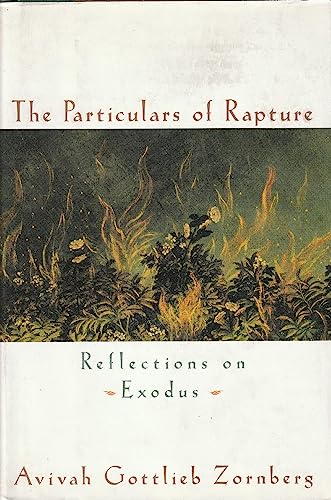
Synopsis
Avivah Zornberg grew up in a world of rabbinic tradition and scholarship and received a Ph.D. in English literature from Cambridge University. The Particulars of Rapture, the sequel to her award-winning study of the Book of Genesis, takes its title from a line by the American poet Wallace Stevens about the interdependence of opposite things, such as male and female, and conscious and unconscious. To her reading of the familiar story of the Israelites and their flight from slavery in Egypt, Avivah Zornberg has brought a vast range of classical Jewish interpretations and Midrashic sources, literary allusions, and ideas from philosophy and psychology. Her quest in this book, as she writes in the introduction, is "to find those who will hear with me a particular idiom of redemption," who will hear "within the particulars of rapture . . . what cannot be expressed."
Zornberg's previous book, The Beginning of Desire: Reflections on Genesis, won the National Jewish Book Award for nonfiction in 1995 and has become a classic among readers of all religions. The Particulars of Rapture will enhance Zornberg's reputation as one of today's most original and compelling interpreters of the biblical and rabbinic traditions.
"synopsis" may belong to another edition of this title.
About the Author
Avivah Gottlieb Zornberg earned a Ph.D. in English literature from Cambridge University, and worked as a lecturer in the English Department at Hebrew University before turning to the teaching of religion. She has conducted classes in Torah for thousands of students at several different institutions in Israel. She also lectures widely in the United States, Canada, and the United Kingdom, and holds a visiting lectureship at the London School of Jewish Studies, an affiliate of the University of London.
From the Inside Flap
erg grew up in a world of rabbinic tradition and scholarship and received a Ph.D. in English literature from Cambridge University. The Particulars of Rapture, the sequel to her award-winning study of the Book of Genesis, takes its title from a line by the American poet Wallace Stevens about the interdependence of opposite things, such as male and female, and conscious and unconscious. To her reading of the familiar story of the Israelites and their flight from slavery in Egypt, Avivah Zornberg has brought a vast range of classical Jewish interpretations and Midrashic sources, literary allusions, and ideas from philosophy and psychology. Her quest in this book, as she writes in the introduction, is "to find those who will hear with me a particular idiom of redemption," who will hear "within the particulars of rapture . . . what cannot be expressed."
Zornberg's previous book, The Beginning of Desire: Reflections on Genesis, won the
Reviews
A stellar sequel to Zornberg's book on Genesis (The Beginning of Desire, which won the Jewish Book Award in 1995), this hefty volume offers a literary look at the second book of the Bible. Zornberg, who has taught English literature at Hebrew University in Jerusalem, is especially interested in women, exploring why, after women play such a vital role in Genesis, they are all but absent from Exodus. Even when Zornberg departs from that questionAand from the larger biblical themes of exodus and redemptionAshe offers clever analysis on almost every page. For Bible-readers who rely on English translations, Zornberg explains some of the Torah's Hebrew word-plays (such as the repetition of the Hebrew root for "life" when Pharaoh, who ordered the midwives to kill all Hebrew baby boys, asks them why they have instead let the babies live). Zornberg shows the literary similarities between the conversion of Jethro (Moses' father-in-law) and the revelation of the Torah on Mount Sinai. She weaves together insights from the Talmud, Emmanuel Levinas, Rav Kook, Franz Rosenzweig and T.S. Eliot. The book will be a challenge for readers who aren't highly literate in Judaism, which means that many interested Jewish and Christian readers will find themselves lost, wondering too often, "Who is the Sefath Emeth? Who or what is the Targum?" This is unfortunate, because this book's many riches should be accessible to the entire Exodus-reading world. (Feb.)
Copyright 2000 Reed Business Information, Inc.
In his poem "Notes Toward a Supreme Fiction," Wallace Stevens wrote of "the particulars of rapture" that come when "two things of opposite natures...depend on one another." In these essays, Zornberg (Jewish studies, Univ. of London; The Beginnings of Desire: Reflections on Genesis) reflects on the "multiple alternative narratives" that coexist both in the Book of Exodus as well as in its many and various midrashic interpretations. Indeed, she demonstrates that the biblical text cannot stand alone but depends on the stories provided by the commentary and interpretation to fill in the gaps in the written text. To a wealth of midrashic commentary (from the Babylonian and Jerusalem Talmuds to the Zohar and the writings of the Baal Shem Tov, Maimonides, and Rashi), Zornberg adds her own wide-ranging literary critiques (of Kafka, Mann, William Blake, among others) and psychoanalytic analyses (of Freud, Gaston Bachelard, D.W. Winnocott, et al.). Zornberg's essays provide rich, rapturous, and brilliant insight into the themes of Exodus's "grand narrative": revelation, betrayal, and the quest for "God in our midst." Highly recommended.DMarcia Welsh, formerly with Guilford Free Lib., CT
Copyright 2001 Reed Business Information, Inc.
Zornberg's beautifully written reading of Exodus is a remarkably effective engagement with both midrashic and psychoanalytic traditions. General readers well may find it challenging, for Zornberg draws on a spectacular array of literary sources, centuries of interpretation, and a complex biblical text that delights in playing with fire (but then so does Zornberg). Those who take up the challenge will be richly rewarded, especially if they appreciate the creative fire at the heart of poetic language, and they may be startled by the lyrical power of the familiar text on which Zornberg's meditation is based. They will come away with better understanding of Exodus certainly, but also of the analytic exposition called midrash, of psychoanalytic contributions to the study of language and narrative, and of a tradition of Jewish mysticism that is unsurpassed in its appreciation of the creative power to see what the poet Wallace Stevens, source of the book's title, called the "nothing that is not there and the nothing that is." Steven Schroeder
Copyright © American Library Association. All rights reserved
"About this title" may belong to another edition of this title.
Search results for The Particulars of Rapture: Reflections on Exodus

Stock Image
The Particulars of Rapture: Reflections of Exodus
Seller: World of Books (was SecondSale), Montgomery, IL, U.S.A.
Seller rating 5 out of 5 stars

Hardback. Condition: Fair. Seller Inventory # CIN0385491522A
Stock Image
The Particulars of Rapture: Reflections of Exodus
Seller: World of Books (was SecondSale), Montgomery, IL, U.S.A.
Seller rating 5 out of 5 stars
Hardback. Condition: Good. Seller Inventory # 00107102341
Stock Image
The Particulars of Rapture: Reflections of Exodus
Seller: World of Books Inc, Montgomery, IL, U.S.A.
Seller rating 4 out of 5 stars

Hardback. Condition: Fair. Seller Inventory # CIN0385491522A
Stock Image
The Particulars of Rapture: Reflections of Exodus
Seller: World of Books Inc, Montgomery, IL, U.S.A.
Seller rating 4 out of 5 stars
Hardback. Condition: Good. Seller Inventory # CIN0385491522G
Stock Image
The Particulars of Rapture: Reflections on Exodus
Seller: Wonder Book, Frederick, MD, U.S.A.
Seller rating 5 out of 5 stars
Condition: Good. Good condition. Very Good dust jacket. A copy that has been read but remains intact. May contain markings such as bookplates, stamps, limited notes and highlighting, or a few light stains. Seller Inventory # P07R-00004
Stock Image
The Particulars of Rapture: Reflections on Exodus
Seller: ThriftBooks-Atlanta, AUSTELL, GA, U.S.A.
Seller rating 5 out of 5 stars
Hardcover. Condition: Fair. No Jacket. Missing dust jacket; Readable copy. Pages may have considerable notes/highlighting. ~ ThriftBooks: Read More, Spend Less. Seller Inventory # G0385491522I5N01
Stock Image
The Particulars of Rapture: Reflections on Exodus
Seller: ThriftBooks-Dallas, Dallas, TX, U.S.A.
Seller rating 5 out of 5 stars
Hardcover. Condition: Good. No Jacket. Pages can have notes/highlighting. Spine may show signs of wear. ~ ThriftBooks: Read More, Spend Less. Seller Inventory # G0385491522I3N00
Seller Image
The Particulars of Rapture: Reflections on Exodus
Seller: Windflower Bookstore, Rockford, IL, U.S.A.
Seller rating 4 out of 5 stars
Condition: good. Seller Inventory # WFBV.0385491522.G
Stock Image
The Particulars of Rapture : Reflections on Exodus
Published by
Doubleday Religious Publishing Group, The, 2001
ISBN 10: 0385491522
ISBN 13: 9780385491525
Used
Hardcover
Seller: Better World Books: West, Reno, NV, U.S.A.
Seller rating 5 out of 5 stars
Condition: Very Good. Pages intact with possible writing/highlighting. Binding strong with minor wear. Dust jackets/supplements may not be included. Stock photo provided. Product includes identifying sticker. Better World Books: Buy Books. Do Good. Seller Inventory # 5609879-6
Stock Image
The Particulars of Rapture : Reflections on Exodus
Published by
Doubleday Religious Publishing Group, The, 2001
ISBN 10: 0385491522
ISBN 13: 9780385491525
Used
Hardcover
Seller: Better World Books, Mishawaka, IN, U.S.A.
Seller rating 5 out of 5 stars
Condition: Good. Pages intact with minimal writing/highlighting. The binding may be loose and creased. Dust jackets/supplements are not included. Stock photo provided. Product includes identifying sticker. Better World Books: Buy Books. Do Good. Seller Inventory # 3235597-6