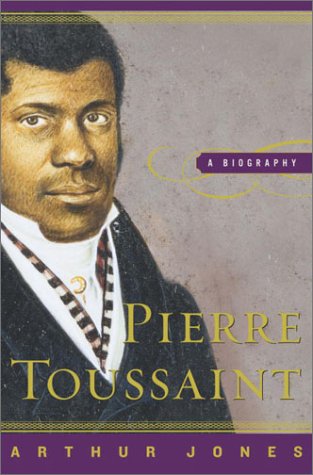
Pierre Toussaint: A Biography - Hardcover

Jones, Arthur

  • 3.89 out of 5 stars
    9 ratings by Goodreads
 
9780385499941: Pierre Toussaint: A Biography

Synopsis

This richly detailed portrait of Pierre Toussaint, who was born into slavery, became one of the most admired men of his time, and is now a candidate for canonization, reveals both the journey of an extraordinary man and a fascinating glimpse into nineteenth-century America.
Pierre Toussaint was born in Saint Domingue (now known as Haiti) in 1781. The child of a slave on a plantation owned by the Bérards, a prosperous French family, he was raised as a devout Catholic. When a slave uprising forced the Bérards to flee the island in 1797, Toussaint came to New York City as the family’s servant. As a black man and as a Catholic, Toussaint found that his new home held dangers of its own: Slaves were brutalized by their owners, free blacks were beaten on the streets, and anti-Catholic sentiment was rampant. But New York also offered him new opportunities. When Toussaint’s talents as a hairstylist—along with his charming, refined manners—made him a favorite of the women in New York’s upper-class families, he began earning a substantial income. He was given his freedom in 1807, married in 1811, and devoted his life to helping former slaves, supporting the Church, and taking care of the poor and oppressed, all while helping to raise funds for the city’s first cathedral.
In the first biography of Toussaint written for a mainstream audience, Arthur Jones charts a life buffeted and scarred by poverty, prejudice, and political upheavals, and shows how Toussaint’s faith, independence of mind, and sense of personal dignity served as lifelong sources of strength. Drawing on letters from Toussaint’s friends and admirers, black and white alike, as well as a wealth of historical sources, he brings to life a man who, by defying the strictures of a racist society became an example not only for other black people, but for oppressed and maligned immigrants of all backgrounds.

"synopsis" may belong to another edition of this title.

About the Author

ARTHUR JONES is editor-at-large of the National Catholic Reporter and a contributor to The Tablet (London), England’s leading Catholic weekly. A former editor and bureau chief of Forbes magazine and a former correspondent for the Financial Times (London), Financial World, and World Trade, he is the author of eight books, including Capitalism and Christians, and is coauthor of the recently published The Race for the White House. He lives in California.

From the Back Cover

Praise for Arthur Jones
New Catholics for a New Century
“Arthur Jones provides a fascinating glance at roads we have traveled in the history of the Catholic Church. His hope of a Catholic public presence founded on issues around life, dignity, and creation for a new century is enlightening and encouraging.” —Annette Kane, National Council of Catholic Women
“For anyone who cares about what the Catholic Church in America is today and is personally concerned about where it is going in the future, this book is well worth reading.” Rev. Theodore M. Hesburgh, President Emeritus of Notre Dame
Facing Fear with Faith with Dolores Leckey
Facing Fear with Faith is a living beatitude: the authors offer a feast of healing words for the naked, hungry, and weary heart and soul. True medicine.” Clarissa Pinkola Estes, Ph.D., author of Women Who Run with the Wolves

Capitalism and Christians
“Many books are available on the relationship between capitalism and Christianity, but this latest provides a distinctive point of view. The author, a journalist with an economics background, has written for Forbes and was editor-in-chief of the National Catholic Reporter. Jones sees business as good but easily corrupted and opines that the undesirable form of capitalism has become dominant . . . This book can be understood by any educated person. Study questions for each chapter add to its usefulness.” Library Journal

From the Inside Flap

<p>This richly detailed portrait of Pierre Toussaint, who was born into slavery, became one of the most admired men of his time, and is now a candidate for canonization, reveals both the journey of an extraordinary man and a fascinating glimpse into nineteenth-century America. <br>Pierre Toussaint was born in Saint Domingue (now known as Haiti) in 1781. The child of a slave on a plantation owned by the Bérards, a prosperous French family, he was raised as a devout Catholic. When a slave uprising forced the Bérards to flee the island in 1797, Toussaint came to New York City as the family’s servant. As a black man and as a Catholic, Toussaint found that his new home held dangers of its own: Slaves were brutalized by their owners, free blacks were beaten on the streets, and anti-Catholic sentiment was rampant. But New York also offered him new opportunities. When Toussaint’s talents as a hairstylist―along with his charming, refined manners―made him a favorite of the women in New York’s upper-class families, he began earning a substantial income. He was given his freedom in 1807, married in 1811, and devoted his life to helping former slaves, supporting the Church, and taking care of the poor and oppressed, all while helping to raise funds for the city’s first cathedral.<br>In the first biography of Toussaint written for a mainstream audience, Arthur Jones charts a life buffeted and scarred by poverty, prejudice, and political upheavals, and shows how Toussaint’s faith, independence of mind, and sense of personal dignity served as lifelong sources of strength. Drawing on letters from Toussaint’s friends and admirers, black and white alike, as well as a wealth of historical sources, he brings to life a man who, by defying the strictures of a racist society became an example not only for other black people, but for oppressed and maligned immigrants of all backgrounds. <br><b></b></p>

Reviews

Born a slave in Haiti in 1781, Pierre Toussaint survived the bloody Haitian revolution and made his way to New York, where he became a much sought-after hairdresser. Coping with war, racism and changing coiffures with equal aplomb, Toussaint was stylist and confidant to the city's richest women (he numbered Alexander Hamilton's wife and granddaughter among his clients), becoming both a fixture in white society and a pillar of the black and Catholic communities. Through this sociologically fascinating figure, Jones, an editor for the National Catholic Reporter and author of Capitalism and Christians, explores the economy and society of pre-revolutionary Haiti and early Republican New York, the culture of Caribbean-French expatriates, and the racial and ethnic tensions within the American Catholic Church. Unfortunately, this often illuminating commentary is overshadowed by the author's hagiographic agenda. There is a movement afoot to have Toussaint canonized, and Jones seems eager to advance it by spotlighting his kindness to widows and orphans, selfless ministrations to the sick and dying, and willingness to run incessant personal errands for friends, all despite his own 70-hour workweek. Through it all, Toussaint remains a "cheerful, refined, loving, religious and considerate" man, "funny" and "imaginative" but with "an aura of personal dignity," who "tried to live the beatitudes" and whose "pity for the suffering seemed to partake of the character of the Savior's tenderness." To polish Toussaint's halo, Jones periodically interrupts his disjointed narrative with lengthy quotations from a mountain of adoring letters, eulogies and miscellaneous tributes, which distract from the book's interesting historical content.
Copyright 2003 Reed Business Information, Inc.

Toussant, born a slave in Saint-Domingue (now called Haiti) in 1781, came to exemplify the principles of the Catholic faith to such an extent that he has become a candidate for canonization. In this first biography for a mainstream audience, Jones, editor of the National Catholic Reporter, draws on correspondence and historical documentation to detail the life of an extraordinary man who overcame poverty, racism, and political upheaval to eventually help establish one of the first orphanages and to help finance the first cathedral in New York, where he fled in 1797 from the turmoil of Saint-Domingue following a slave uprising. In America, he confronted virulent racial attitudes and anti-Catholic sentiment. Maintaining a humble demeanor with dignity, while in service as a hairdresser to New York's elite, Toussant continued to support the Catholic Church, the poor, and former slaves, maintaining consciousness of issues of race and class. Jones offers a perspective on race and religion at a turbulent time in American history in this biography of a man once widely admired who had fallen into near obscurity. Vernon Ford
Copyright © American Library Association. All rights reserved

Excerpt. © Reprinted by permission. All rights reserved.

ONE


SAINT DOMINGUE,

FRENCH ANTILLES, 1781


The dozen or so huts, each with its small plot of land for cultivation, were placed within sight of the plantation house without much regard for organization or appearance. Typically, these huts would be close to the chateau, close enough so that someone with a loud voice could call from the rear of the huge tree-shaded mansion and attract the attention of servant-slaves who lived in them.

Yet the distance between the two forms of accommodation--the French chateau built in a tropical near-wilderness, and the huts on its northwest perimeter--was the widest humanity can measure. It was the distance between master and slave. It was the distance between the plantation-owning French aristocrats in Saint Domingue--today's Haiti--and the West Africans who toiled for them.

These Africans were a captive people torn from family, fields, and traditions; a people kidnapped, landed, branded, and worked to death in the fields before they reached midlife.

The slaves in these nearby huts were not field hands. They were the second-tier household servants. First-tier household servants had rooms in the chateau's internal slave quarters. Inside quarters were reserved for the "body servants," the intimate personal servants of the family: the ladies' maids and the valets.

These plantation chateaus, abutted by little hamlets of huts, were commonplace enough around the French colony of Saint Domingue, the crab claw-shaped western third of the island of Santo Domingo. At almost eleven thousand square miles, Saint Domingue was slightly smaller than the state of Maryland.

The mansions' styles were those of the French city and countryside, and few changes had taken place in their architecture to make them suitable for the Caribbean. The exception, in some, was that the corridors and windows tended to be wider to allow any cooling breeze to waft through.

That breeze was perennially laden with tropical scents: the heavy perfume of lush flowers and blooms, the after-rain aromas laden with dewy, moisture-soaked soils, blossoms, and leaves. Without thinking about it the inhabitants could tell what the weather was like, or recently had been, simply by sniffing the air. One variety of scents lingered after squalls and storms, another came with the tang from strong offshore winds. Cloying, perhaps, but always comforting and familiar for those born to it.

Smells linger long in the memory; one's nose rarely forgets the scents of childhood. Particularly the delightful smells from the kitchen, or those carried in on a breeze.

What breezes blew this day in 1781?

In the French part of the island of Santo Domingo--the eastern two-thirds were Spanish--there were rarely sufficient breezes to combat the unrelenting, stifling April-to-September heat and humidity. Rainfall ranged from twenty to one hundred inches a year, depending on the location. Temperatures rarely dropped below eighty-seven degrees Fahrenheit in winter and usually remained at or above ninety-five degrees throughout the summer. Not until October did the weather break, and in November the rainy season set in for most of the island.

Saint Domingue's (Haiti's) three provinces were the cultured, more closely settled North Province; the isolated, underpopulated South Province; and, located between them, the West Province where this chateau, L'Artibonite, was located. L'Artibonite commanded thousands of acres of the West Province's Artibonite Valley, irrigated by the 174-mile-long river of that name. L'Artibonite plantation owned hundreds of slaves to make it profitable. And made its owners as comfortable as French people could be when their real goal was to make enough money to live out their lives in Paris.

The West Province was bordered at its western edge by the sea, yet hemmed in by mountain chains that kept the rainy season at bay. The eighteenth-century plantations depended on irrigation from the Artibonite River for their abundant harvests. What precipitation came was borne in with the unpredictable but violent thunderstorms that could batter and howl with property-wrecking violence. Floods were common, and with that trick of fate that cruelly afflicts flood regions, droughts were not unknown.

Either temporarily in the L'Artibonite mansion's slave quarters, or more likely in one of the huts, was Ursule Julien Toussaint. She was in labor. The young woman, she'd be about seventeen or eighteen, was a chambermaid to the lady of the house, Madame Berard du Pithon. This was her third child. In time and with seniority, Ursule would graduate to a room inside the house, just like her impressive and redoubtable mother, Zenobie Julien. Normally, Zenobie, who ran the chateau as a combination housekeeper and manager, would have been on hand to assist at the childbirth.

But this year, the slave Zenobie was in France. She went periodically, charged with transporting the Berard children to Paris for their education.

Instead, Ursule's grandmother, the slave Tonette, was likely with her. Tonette had probably sent someone to the chateau for additional help with the imminent delivery. Perhaps Ursule's sister, Marie Bouquement, came. Bouquement often visited L'Artibonite with her mistress, Marie Elisabeth Bossard, from the Bossard plantation up north at Dondon in Marmalade. Ursule's two other young children would have been temporarily farmed out to play elsewhere. Her husband would have been at work.

Ursule's baby was a boy, christened Pierre Toussaint. ("Pierre" was for Pierre Berard du Pithon, L'Artibonite plantation's owner.) Legend has it Pierre was born on All Saints' Day, November 2; hence his last name, Toussaint, French for All Saints. While possible, it is not likely. It would be too curious a coincidence. "Toussaint" was the paternal family name. Pierre's father is known to history as "Old Toussaint," and Pierre's sister, Marie-Louise, refers to their older brother (whose first name may have been Antoine) as "Toussaint."

In many Catholic cultures, people customarily celebrated their "saint's name day" rather than their birthday. That seems to be the case with Pierre Toussaint. (Forty years hence, Toussaint's adopted daughter, his niece Euphemie, in letters to her uncle Pierre, honors his birthday on November 2.)

Pierre's father, "Old Toussaint," was not one of the brutalized field hands, nor was he particularly old. Among the slave population, "old" was a relative term frequently used as an honorific once a man's hair turned gray. Few male slaves lived that long--at least half of Saint Domingue's male slave population was dead before the age of forty.

Five-year-old De Pointe (Aurore) Berard, the white household's youngest child, was godmother to this newborn Toussaint. Child godparents were not unusual among French plantation families. In Pierre's case, the newborn would start out as a real-live baby doll for his five-year-old godmother, and grow into a playmate--simultaneously her constant companion and servant. There were other playmates, his siblings, Aurore's siblings, cousins (children of his aunt Marie), and the scores of other plantation families.

For slave children of household servants it was possible to form outside friendships on other plantations visited by the owners, or after church on Sundays, or in the streets around the town houses most plantation owners had in a nearby city. In the Berards' case, the town house was either in St. Marc, the port city where they attended church, or more likely in Port-au-Prince, the colonial capital. L'Artibonite, the Berard plantation, was in St. Marc parish, about fifty miles inland from Port-au-Prince and thirteen miles from St. Marc port.

Aurore Berard, his little godmother, was one of the three people who most influenced Toussaint's early life. Of those three, she was the only one in the colony the day Pierre was born. Grandmother Zenobie was in Paris delivering the two older Berard girls to their convent boarding school. Jean Jacques Berard, L'Artibonite plantation's oldest son and heir, who would later be master and mentor to Toussaint, was already at school in Paris.

To return home, Zenobie would soon undertake yet again the seemingly endless seven- to ten-week voyage from Le Havre to Le Cap Francois, Saint Domingue's cultural and commercial capital on the North Province's coast. There she would board a small barque to travel west around the top point of the crab claw, then east-southeast into the small port of St. Marc.

Zenobie's transatlantic traveling would not go on forever, and as the returned grandmother held her newborn grandson for the first time, she was aware that within five years, once Jean Jacques was done with school, the end of the her ocean journeying would be near.

Once Jean Jacques completed his education and returned, the young Berard would take over L'Artibonite from his father and run the fortune-creating family enterprise. Then his parents and the remaining brothers and sisters would move permanently to Paris, the ideal of every planter family in Saint Domingue.

Saint Domingue was a troubled land. The whites were there to exploit it; the blacks were there to be exploited and to create unimaginable wealth for the plantation owners. The mulattoes, those with mixed blood, were hated by the whites with an intensity greater than their disdain for the slaves. By far the majority of mulattoes were gens de couleur, free people of color. Ostensibly, gens de couleur had the same rights as whites. In fact, the white planters (known, along with the white colonial officials who ran the government and the military establishment, as grands blancs) worked extremely hard to deprive the mulattoes of any vestige of rights or independence.

The social pecking order was this: The colony was dominated by opportunists--in the top rank, the wealthy planters, who were in Saint Domingue solely to make money. Next in financial importance, but dominant i...

"About this title" may belong to another edition of this title.

Other Popular Editions of the Same Title

9780976875109: Pierre Toussaint: A Biography

Featured Edition

ISBN 10:  0976875101 ISBN 13:  9780976875109
Publisher: Capparoe Books, 2021
Softcover