
Items related to A Stake in the Outcome: Building a Culture of Ownership...
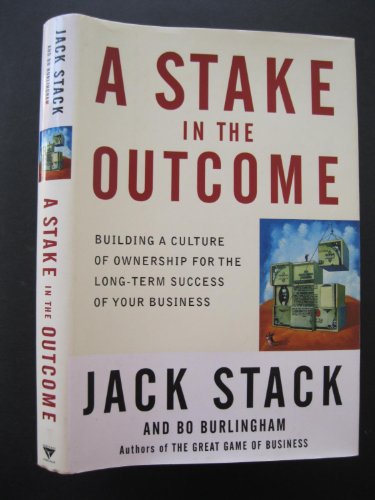
A Stake in the Outcome: Building a Culture of Ownership for the Long-Term Success of Your Business - Hardcover
Synopsis
The First Management Classic of the New Millennium!
A bold experiment is taking place these days, as leading-edge companies turn upside down the management paradigm that has dominated corporate thinking for more than one hundred years. Southwest Airlines is perhaps the most visible practitioner, soaring through economic downturns while its competitors slash their budgets and order massive layoffs, but you can find other pioneers of the new approach in almost every industry and market niche. Their secret: a culture of ownership that allows them to tap into the most underutilized resource in business today–namely, the enthusiasm, intelligence, and creativity of working people everywhere.
No one knows more about building a culture of ownership than CEO Jack Stack, who’s been working on one for the past twenty years with his colleagues at SRC Holdings Corporation (formerly Springfield ReManufacturing Corporation). Along the way, they’ve turned their company into what Business Week has called a “management Mecca,” attracting thousands of people representing hundreds of businesses to SRC’s home in Springfield, Missouri. There the visitors learn how to incorporate the ideals and values of SRC’s remarkable corporate culture into their own organizations–and then they go back and do it.
Now, in A Stake in the Outcome, Stack offers a master class on creating a culture of ownership, presenting the hard-won lessons of his own twenty-year journey and explaining what it really takes to build for long-term success. The pioneer of “open-book management” (described in the best-selling classic The Great Game of Business), Stack and twelve other managers began their journey in 1982, when they purchased their factory from its struggling parent company. SRC grew 15 percent a year, while adding almost a thousand new jobs, and the company’s stock price rocketed from 10 cents to $81.60 per share. In the process, Stack discovered that long-term success required constant innovation–and that building a culture of ownership involved much more than paying bonuses, handing out stock options, or setting up an employee stock ownership plan. In a successful ownership culture, every employee had to take the fate of the company as personally as an individual owner would. Achieving that level of commitment was extraordinarily difficult, but Stack realized that the payoff would be enormous: a company that was consistently able to outperform the market.
A Stake in the Outcome isn’t about theory–it’s about practice. Stack draws from his own successes and failures at SRC to show how any company can teach its employees to think and act like owners, including how to implement an effective equity-sharing program, how to promote continuous learning at every level of the organization, how to fire up employees’ competitive juices, how to broaden the concept of leadership and delegate responsibility for the business, and how to build a workforce that is fast on its feet and ready to take advantage of every opportunity. You’ll also learn about other companies that have succeeded in building cultures of ownership–and the lessons they can teach the rest of us.
Written in Jack Stack’s straightforward, witty, no-beating-around-the-bush style, A Stake in the Outcome is like having a one-on-one session with a master entrepreneur and business innovator. It shows managers and executives of companies both large and small how to build a ferociously motivated workforce that is energized and committed to meeting and overcoming the most daunting challenges a company can face.
"synopsis" may belong to another edition of this title.
About the Author
JACK STACK is President and CEO of SRC Holding Corporation, an employee-owned company that supplies remanufactured engines to the transportation industries. He lives in Springfield, Missouri. BO BURLINGHAM is an editor-at-large of Inc. magazine and lives in Cambridge, Massachusetts. They are the authors of the bestseller The Great Game of Business.
From the Inside Flap
<b>The First Management Classic of the New Millennium!<br></b>A bold experiment is taking place these days, as leading-edge companies turn upside down the management paradigm that has dominated corporate thinking for more than one hundred years. Southwest Airlines is perhaps the most visible practitioner, soaring through economic downturns while its competitors slash their budgets and order massive layoffs, but you can find other pioneers of the new approach in almost every industry and market niche. Their secret: a culture of ownership that allows them to tap into the most underutilized resource in business today–namely, the enthusiasm, intelligence, and creativity of working people everywhere.<br><br>No one knows more about building a culture of ownership than CEO Jack Stack, who’s been working on one for the past twenty years with his colleagues at SRC Holdings Corporation (formerly Springfield ReManufacturing Corporation). Along the way, they’ve turned their company into what <i>Business Week</i> has called a “management Mecca,” attracting thousands of people representing hundreds of businesses to SRC’s home in Springfield, Missouri. There the visitors learn how to incorporate the ideals and values of SRC’s remarkable corporate culture into their own organizations–and then they go back and do it.<br><br>Now, in <i>A Stake in the Outcome</i>, Stack offers a master class on creating a culture of ownership, presenting the hard-won lessons of his own twenty-year journey and explaining what it really takes to build for long-term success. The pioneer of “open-book management” (described in the best-selling classic <i>The Great Game of Business</i>), Stack and twelve other managers began their journey in 1982, when they purchased their factory from its struggling parent company. SRC grew 15 percent a year, while adding almost a thousand new jobs, and the company’s stock price rocketed from 10 cents to $81.60 per share. In the process, Stack discovered that long-term success required constant innovation–and that building a culture of ownership involved much more than paying bonuses, handing out stock options, or setting up an employee stock ownership plan. <b>In a successful ownership culture, every employee had to take the fate of the company as personally as an individual owner would.</b> Achieving that level of commitment was extraordinarily difficult, but Stack realized that the payoff would be enormous: a company that was consistently able to outperform the market.<br><br><i>A Stake in the Outcome </i>isn’t about theory–it’s about practice. Stack draws from his own successes and failures at SRC to show how any company can teach its employees to think and act like owners, including how to implement an effective equity-sharing program, how to promote continuous learning at every level of the organization, how to fire up employees’ competitive juices, how to broaden the concept of leadership and delegate responsibility for the business, and how to build a workforce that is fast on its feet and ready to take advantage of every opportunity. You’ll also learn about other companies that have succeeded in building cultures of ownership–and the lessons they can teach the rest of us.<br><br>Written in Jack Stack’s straightforward, witty, no-beating-around-the-bush style, <i>A Stake in the Outcome</i> is like having a one-on-one session with a master entrepreneur and business innovator. It shows managers and executives of companies both large and small how to build a ferociously motivated workforce that is energized and committed to meeting and overcoming the most daunting challenges a company can face.
Reviews
A refreshingly sensitive and sensible guide to motivating employees, this new volume by Stack and Burlingham (The Great Game of Business) is a standout in its crowded genre. Stack is the president and CEO of SRC Holdings Corporation, an employee-owned supplier of renovated engines to auto companies and a celebrated business success story. In 1983, when it looked like SRC's parent company, International Harvester, might shut down its southwestern Missouri "remanufacturing" plant, Stack and 12 other employees bought the place and fashioned a system of employee ownership that turned SRC into a corporation of 22 companies with more than $100 million in sales. Using the experiences of SRC as well as other companies with "ownership cultures" as examples, Stack and Burlingham, an editor at Inc. magazine, give the lowdown on how to keep employees energized, creative and acting like true owners of their company (beyond offering stock options). Their strategy, which is especially resonant after the Enron debacle, hinges largely on opening up the books to all employees and keeping the staff posted on financial matters. Also fascinating is the authors' idea of spinning workers off into an entirely new company as a way of stirring up new ideas from entrenched employees. This is an invigorating and surprisingly helpful text for those who want a humane but profitable way to manage their company.
Copyright 2002 Cahners Business Information, Inc.
In The Great Game of Business (1992), Stack and Burlingham showed how Stack's experience with open management at the Springfield ReManufacturing Corporation (SRC) brought the concept of employee ownership to new levels. Here they extend the concept to show how the company was designed as a community where employees have a real stake in the business. While telling the SRC story, they delve into the core issues of ownership, such as the trouble with equity and why it can be a problem when your stock rises; why you don't really find out what problems are until you're successful; why businesses get bought and sold; and the stages of growth beyond mere survival. The authors emphasize how the culture of ownership brings meaning to the lives of all employees, but that the model is fluid; and when companies grow beyond a certain size, outside interest may become inevitable. The SRC model may be the ultimate goal, but because no two companies are alike, some may use the SRC model as a reference rather than as a blueprint. David Siegfried
Copyright © American Library Association. All rights reserved
Excerpt. © Reprinted by permission. All rights reserved.
1 A Culture of Ownership
There's a great experiment going on in business today that involves literally thousands of companies and millions of people, but it's one of the best-kept secrets around. I know about the experiment because my company, SRC Holdings Corporation (formerly Springfield ReManufacturing Corporation), is part of it. For twenty years now, my colleagues and I have been trying to develop a particular type of culture at SRC. In the process, we've come into contact with thousands upon thousands of people who are trying to do the same thing at their companies.
A lot of those people have visited us in southwestern Missouri. By conservative estimates, we've had more than 4,600 people from 1,600 companies come to see what we're doing and learn about the Great Game of Business, the management system we've developed to teach everybody in our company about business and to turn our employees into owners. That's prompted Business Week to label SRC a "management Mecca." Another 5,000 people from 1,700 companies have attended the various conferences we hold for current and would-be practitioners of open-book management, which is the generic term for what we do. There we've been joined by our kindred spirits in the corporate world, including some of the most revered companies around--Southwest Airlines, Harley-Davidson, VeriFone, Outback Steakhouse, AES Corp., Whole Foods Market, Kingston Technology, and ServiceMaster, to name a few.
Meanwhile, the book we wrote about our management system in 1992 has sold more than 200,000 copies and been translated into Russian, Spanish, Hungarian, Chinese, and Korean. People have applied the principles of the Game to an awesome array of businesses--from oil companies to hair salons, from Internet start-ups to roller coaster manufacturers, from fast-food chains to law firms, landscapers, mining operations, even not-for-profit social service organizations.
Not just in the United States, either. SRC has become famous in places we once barely knew existed. There are companies in Zambia and Malaysia that practice the Great Game of Business. The Australian 60 Minutes did a segment on our company, and it became one of the program's most requested videotapes. Delegations have come to see us from as far away as India, South Africa, Singapore, the United Kingdom, Sweden, Japan, wherever--all interested in finding out as much as they can about the way we do business.
At a certain point, you have to ask yourself, Why? What could all these people be looking for, and why would they trek all the way to the Ozarks to find it? I like to think of SRC as a leading-edge business, but let's face it: We're not a high-flying star of technology, and we don't live in a hot zone of the new economy, or even a major metropolitan area. While we have our own Internet-based subsidiary, most of the companies we operate are involved in the making and selling of engines and engine components, an old-economy industry if there ever was one.
Nor can you explain the interest by our business sucess alone. Yes, we've done well. A share of SRC stock that was worth 10 cents in 1983, the year we started, had an appraised value of $81.60 as of January 31, 2001, and increase of 816, 000 percent in eighteen years. During that time, we've grown from $16 million to $160 million in sales; from 119 to more than 900 employees; and from one company to 22. After losing $60,000 in our first year, we've had seventeen straight years of unbroken profits. It's a good record, and I'm proud of it, but many companies can marshal equally impressive growth statistics, and they don't all acquire the kind of notoriety that we have.
There are some other numbers, however, that I suspect get closer to explaining why people come to Springfield to see us. When we started in 1983, we had just thirteen shareholders--me and the twelve other managers who'd scrounged around and come up with the $100,000 we needed to make a down payment on the factory where we worked. Today we have 727 shareholders, all employees, just five of whom have stock from the original buyout. The other 722 shareholders own 64 percent of the business, valued at $23 million.
That transfer of ownership is the result of an odyssey we began two decades ago. During that time, we've worked long and hard to foster an environment that brings out the best in people, giving them the confidence, the courage, and the self-esteem to do what they're capable of. How? Mainly by trying to be as loyal to them as they've been to the business by creating a place where they can feel more secure.
There's a level of mutual trust and respect at SRC that doesn't exist in a lot of companies. It comes from everything we've done to build our culture. It comes from being honest with people, from telling them about the realities of business, from having principles and sticking by them, from trying to be fair. I suppose it's also important that we've avoided mass layoffs, but it's more important that we've done it together, by keeping our promises to one another, by living up to our mutual commitments. We've treated people like the capable, intelligent adults we know they are. We haven't protected them like children. We've created a society built around rules we all know and understand--some of which we've developed, but many of which we've gotten from the marketplace. They're the basic rules of business, the things we have to do to survive and prosper in a competitive economy.
Out of all this has emerged a special kind of corporate culture--what I think of as a culture of ownership. It's that culture, I believe, that is drawing all those people to Springfield. They want to see it, feel it, smell it, taste it, and they want to find out how to create something similar in their own companies.
The Definition of a Culture
So what exactly is a culture of ownership, and where does it come from? The term, I admit, is tricky to define. It’s a little like what a Supreme Court justice once said about pornography: It’s hard to say exactly what it is, but you know when you see it. By that standard, if no other, we can all think of companies we’re familiar with that have an ownership of culture. Southwest Airlines comes to mind. Harley-Davidson and Home Depot do as well. So, for that matter, do Herman Miller, the $2.2 billion furniture maker, and Whole Foods Market, the $1.8 billion natural foods grocery chain, and Science Applications International Corporation (SAIC), the $5.9 billion, employee-owned defense contractor.
Each of those companies has a distinctive corporate culture you quickly become aware of when you walk into one of their facilities or spend time with their employees. There’s a sense of pride, identity, direction, and purpose. People know they’re part of something bigger than what they do on a day-to-day basis. They belong to something, and it belongs to them. They have ownership, and it’s a two-way street.
But while most people can recognize an ownership culture when they see it, they have many misconceptions about what it takes to develop one. There’s a common belief, for example, that it’s all about owning stock. Equity-sharing certainly plays a crucial role, but you don’t get an ownership culture simply by giving stock to employees. We’ve seen a lot of that in recent years, and more often that not the result has been disappointment and misunderstanding.
Part of the problem has been the tendency of companies to use stock merely as a form of compensation–a carrot to get people to work harder. In a company with a strong culture of ownership, stock is more than compensation. First and foremost, it’s a vehicle for change. The goal is not just to reward people for the work they do, or to maximize profits for their own sake, or to enhance shareholder value, improve cash flow, whatever. Rather equity is used to involve people in the process of making a difference in the world.
Why? Because business is not an end itself. It’s a means to an end. It’s a tool that allows us to accomplish the things that matter most to us, and those things must transcend business to have real meaning and value. The precise nature of those loftier goals will vary from company to company, even from person to person, but you must have them. They are what makes ownership worth caring about.
And to be an owner, a true owner, you have to care. Owners do not follow a job description. They don’t just put in their time. They have something bigger they’re working toward, and they feel a sense of responsibility about accomplishing it. They go beyond mere problem solving and look for creative, innovative ways to reach their goals. They are independent-minded, freethinking people, leaders not followers, and they know how to take the bad with the good. Indeed, they’re often at their best when the going gets tough. They have what it takes to reach down and find the inner sources of strength that allow them to keep moving forward, no matter what gets in their way.
At SRC, we wanted to have a culture that would draw out those qualities in the people who work here. But to build such a culture–and to sustain it–you must also have a company that comes on the promises it makes to its employees. It’s relatively easy to create an illusion of ownership by handing out stock or stock options. It’s far more difficult to give people the tools they need to realize the rewards that ownership can provide.
We’ve been trying to figure out how to do that for the entire time we’ve been in business. It has been a long, slow, difficult journey, filled with pitfalls and obstacles, and we haven’t yet reached the end of it. Perhaps you never do. But we’ve been able to overcome a lot of the obstacles, mainly because we’ve put so much effort into teaching people about business, creating mechanisms that have a...
"About this title" may belong to another edition of this title.
Search results for A Stake in the Outcome: Building a Culture of Ownership...

Stock Image
A Stake in the Outcome
Published by
Bantam Doubleday Dell Publishing Group Inc, 2002
ISBN 10: 0385505078
ISBN 13: 9780385505079
Used
Hardcover
Seller: World of Books (was SecondSale), Montgomery, IL, U.S.A.
Seller rating 5 out of 5 stars

Hardback. Condition: Good. The First Management Classic of the New Millennium A bold experiment is taking place these days, as leading-edge companies turn upside down the management paradigm that has dominated corporate thinking for more than one hundred years. Southwest Airlines is perhaps the most visible practitioner, soaring through economic downturns while its competitors slash their budgets and order massive layoffs, but you can find other pioneers of the new approach in almost every industry and market niche. Their secret: a culture of ownership that allows them to tap into the most underutilized resource in business today-namely, the enthusiasm, intelligence, and creativity of working people everywhere. No one knows more about building a culture of ownership than CEO Jack Stack, who's been working on one for the past twenty years with his colleagues at SRC Holdings Corporation (formerly Springfield ReManufacturing Corporation). Along the way, they've turned their company into what Business Week has called a management Mecca, attracting thousands of people representing hundreds of businesses to SRC's home in Springfield, Missouri. There the visitors learn how to incorporate the ideals and values of SRC's remarkable corporate culture into their own organizations-and then they go back and do it. Now, in A Stake in the Outcome, Stack offers a master class on creating a culture of ownership, presenting the hard-won lessons of his own twenty-year journey and explaining what it really takes to build for long-term success. The pioneer of open-book management (described in the best-selling classic The Great Game of Business), Stack and twelve other managers began their journey in 1982, when they purchased their factory from its struggling parent company. SRC grew 15 percent a year, while adding almost a thousand new jobs, and the company's stock price rocketed from 10 cents to $81.60 per share. In the process, Stack discovered that long-term success required constant innovation-and that building a culture of ownership involved much more than paying bonuses, handing out stock options, or setting up an employee stock ownership plan. In a successful ownership culture, every employee had to take the fate of the company as personally as an individual owner would. Achieving that level of commitment was extraordinarily difficult, but Stack realized that the payoff would be enormous: a company that was consistently able to outperform the market. A Stake in the Outcome isn't about theory-it's about practice. Stack draws from his own successes and failures at SRC to show how any company can teach its employees to think and act like owners, including how to implement an effective equity-sharing program, how to promote continuous learning at every level of the organization, how to fire up employees' competitive juices, how to broaden the concept of leadership and delegate responsibility for the business, and how to build a workforce that is fast on its feet and ready to take advantage of every opportunity. You'll also learn about other companies that have succeeded in building cultures of ownership-and the lessons they can teach the rest of us. Written in Jack Stack's straightforward, witty, no-beating-around-the-bush style, A Stake in the Outcome is like having a one-on-one session with a master entrepreneur and business innovator. It shows managers and executives of companies both large and small how to build a ferociously motivated workforce that is energized and committed to meeting and overcoming the most daunting challenges a company can face. Seller Inventory # 00096481202
Stock Image
A Stake in the Outcome: Building a Culture of Ownership for the Long-Term Success of Your Business
Seller: Your Online Bookstore, Houston, TX, U.S.A.
Seller rating 5 out of 5 stars
hardcover. Condition: Good. Seller Inventory # 0385505078-3-37720538
Stock Image
A Stake in the Outcome: Building a Culture of Ownership for the Long-Term Success of Your Business
Seller: Wonder Book, Frederick, MD, U.S.A.
Seller rating 5 out of 5 stars
Condition: Good. Good condition. Acceptable dust jacket. A copy that has been read but remains intact. May contain markings such as bookplates, stamps, limited notes and highlighting, or a few light stains. Seller Inventory # C11I-00089
Stock Image
A Stake in the Outcome: Building a Culture of Ownership for the Long-Term Success of Your Business
Published by
Doubleday Business (edition 1), 2002
ISBN 10: 0385505078
ISBN 13: 9780385505079
Used
Hardcover
Seller: BooksRun, Philadelphia, PA, U.S.A.
Seller rating 5 out of 5 stars
Hardcover. Condition: Very Good. 1. With dust jacket. It's a well-cared-for item that has seen limited use. The item may show minor signs of wear. All the text is legible, with all pages included. It may have slight markings and/or highlighting. Seller Inventory # 0385505078-11-1-29
Seller Image
A Stake in the Outcome: Building a Culture of Ownership for the Long-Term Success of Your Business
Seller: Greenworld Books, Arlington, TX, U.S.A.
Seller rating 5 out of 5 stars
Condition: good. Fast Free Shipping â" Good condition. It may show normal signs of use, such as light writing, highlighting, or library markings, but all pages are intact and the book is fully readable. A solid, complete copy that's ready to enjoy. Seller Inventory # GWV.0385505078.G
Stock Image
A Stake in the Outcome: Building a Culture of Ownership for the Long-Term Success of Your Business
Seller: Once Upon A Time Books, Siloam Springs, AR, U.S.A.
Seller rating 4 out of 5 stars

Hardcover. Condition: Good. This is a used book in good condition and may show some signs of use or wear . This is a used book in good condition and may show some signs of use or wear . Seller Inventory # mon0003367901
Stock Image
A Stake in the Outcome : Building a Culture of Ownership for the Long-Term Success of Your Business
Published by
Knopf Doubleday Publishing Group, 2002
ISBN 10: 0385505078
ISBN 13: 9780385505079
Used
Hardcover
First Edition
Seller: Better World Books, Mishawaka, IN, U.S.A.
Seller rating 5 out of 5 stars
Condition: Very Good. 1st. Pages intact with possible writing/highlighting. Binding strong with minor wear. Dust jackets/supplements may not be included. Stock photo provided. Product includes identifying sticker. Better World Books: Buy Books. Do Good. Seller Inventory # GRP102243043
Stock Image
A Stake in the Outcome : Building a Culture of Ownership for the Long-Term Success of Your Business
Published by
Knopf Doubleday Publishing Group, 2002
ISBN 10: 0385505078
ISBN 13: 9780385505079
Used
Hardcover
First Edition
Seller: Better World Books, Mishawaka, IN, U.S.A.
Seller rating 5 out of 5 stars
Condition: Very Good. 1st. Former library copy. Pages intact with possible writing/highlighting. Binding strong with minor wear. Dust jackets/supplements may not be included. Includes library markings. Stock photo provided. Product includes identifying sticker. Better World Books: Buy Books. Do Good. Seller Inventory # 16742199-75
Stock Image
A Stake in the Outcome: Building a Culture of Ownership for the Long-Term Success of Your Business
Seller: Wonder Book, Frederick, MD, U.S.A.
Seller rating 5 out of 5 stars
Condition: Good. Good condition. Very Good dust jacket. Seller Inventory # F19A-04770
Stock Image
A Stake in the Outcome: Building a Culture of Ownership for the Long-Term Success of Your Business
Seller: ThriftBooks-Dallas, Dallas, TX, U.S.A.
Seller rating 5 out of 5 stars
Hardcover. Condition: Very Good. No Jacket. May have limited writing in cover pages. Pages are unmarked. ~ ThriftBooks: Read More, Spend Less. Seller Inventory # G0385505078I4N00