
Items related to Lone Star Nation: How a Ragged Army of Volunteers Won...
Lone Star Nation: How a Ragged Army of Volunteers Won the Battle for Texas Independence - and Changed America - Hardcover
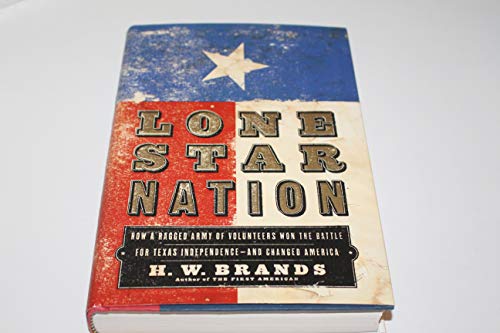
Synopsis
From bestselling historian and long-time Texan H. W. Brands, a richly textured history of one of the most fascinating and colorful eras in U.S. history--the Texas Revolution and the forging of a new America.
"For better or for worse, Texas was very much like America. The people ruled, and little could stop them. If they ignored national boundaries, if they trampled the rights of indigenous peoples and of imported bondsmen, if they waged war for motives that started from base self-interest, all this came with the territory of democracy, a realm inhabited by ordinarily imperfect men and women. The one saving grace of democracy—the one that made all the difference in the end—was that sooner or later, sometimes after a terrible strife, democracy corrected its worst mistakes."
--from Lone Star Nation
Lone Star Nation is the gripping story of Texas's precarious journey to statehood, from its early colonization in the 1820s to the shocking massacres of Texas loyalists at the Alamo and Goliad by the Mexican army, from its rough-and-tumble years as a land overrun by the Comanches to its day of liberation as an upstart republic. H. W. Brands tells the turbulent story of Texas through the eyes of a colorful cast of characters who have become a permanent fixture in the American landscape: Stephen Austin, the state's reluctant founder; Sam Houston, the alcoholic former governor who came to lead the Texas army in its hour of crisis and glory; William Travis, James Bowie, and David Crockett, the unforgettable heroic defenders of the doomed Alamo; Santa Anna, the Mexican generalissimo and dictator whose ruthless tactics galvanized the colonists against him; and the white-haired President Andrew Jackson whose expansionist aspirations loomed large in the background. Beyond these luminaries, Brands unearths the untold stories of the forgotten Texans--the slaves, women, unknown settlers, and children left out of traditional histories--who played crucial roles in Texas’s birth. By turns bloody and heroic, tragic and triumphant, this riveting history of one of our greatest states reads like the most compelling fiction, and further secures H. W. Brands's position as one of the premier American historians.
"synopsis" may belong to another edition of this title.
About the Author
H. W. BRANDS is Distinguished Professor and holder of the Melbern G. Glasscock Chair in American History at Texas A&M University. A finalist for the Pulitzer Prize, he is the author of T.R. and The First American, the critically acclaimed biographies of Theodore Roosevelt and Benjamin Franklin, and The Age of Gold, the celebrated history of the California Gold Rush. He lives in Austin, Texas.
From the Back Cover
Critical Acclaim for The First American, finalist for the Pulitzer Prize
“Enchanting.”—The New Yorker
“A Franklin to savor.”—James Grant, Wall Street Journal
“In his clear and sprightly biography, H. W. Brands . . . recovers the actual Franklin who lived—before his memory became a bourgeois icon and was later, like all icons, trivialized.”—Alan Taylor, The New Republic
“Benjamin Franklin’s life is one every American should know well, and it has not been told better than by Mr. Brands.”—Bob Trimble, Dallas Morning News
“H. W. Brands is a master storyteller.”—Richard Norton Smith, author of the Pulitzer-Prize finalist Thomas E. Dewey and His Times and Patriarch: George Washington and the New American Nation
Critical Acclaim for the celebrated The Age of Gold
“An engrossing, multifaceted history. . . . Its author, like the miners of the gold rush themselves, leaves no stone unturned.”—Janet Maslin, New York Times
“Dazzling. . . . Even California reviewers have gritted their teeth and handed Brands, an acclaimed popular biographer of Benjamin Franklin, some Texas-size praise.”—Los Angeles Times
“There’s only one thing to say about a book that brings the twin touchstones of T.R.’s vigor and Franklin’s humor to bear on the Golden State, and that’s ‘Eureka!’ ”—San Francisco Chronicle
“A fine, robust telling of one of the greatest adventure stories in history.”—David McCullough, Pulitzer-Prize winning author of John Adams
From the Inside Flap
From bestselling historian and long-time Texan H. W. Brands, a richly textured history of one of the most fascinating and colorful eras in U.S. history--the Texas Revolution and the forging of a new America.
"For better or for worse, Texas was very much like America. The people ruled, and little could stop them. If they ignored national boundaries, if they trampled the rights of indigenous peoples and of imported bondsmen, if they waged war for motives that started from base self-interest, all this came with the territory of democracy, a realm inhabited by ordinarily imperfect men and women. The one saving grace of democracy?the one that made all the difference in the end?was that sooner or later, sometimes after a terrible strife, democracy corrected its worst mistakes."
--from Lone Star Nation
Lone Star Nation is the gripping story of Texas's precarious journey to statehood, from its early colonization in the 1820s to the shocking massacres of Texas loyalists at the Alamo and Goliad by the Mexican army, from its rough-and-tumble years as a land overrun by the Comanches to its day of liberation as an upstart republic. H. W. Brands tells the turbulent story of Texas through the eyes of a colorful cast of characters who have become a permanent fixture in the American landscape: Stephen Austin, the state's reluctant founder; Sam Houston, the alcoholic former governor who came to lead the Texas army in its hour of crisis and glory; William Travis, James Bowie, and David Crockett, the unforgettable heroic defenders of the doomed Alamo; Santa Anna, the Mexican generalissimo and dictator whose ruthless tactics galvanized the colonists against him; and the white-haired President Andrew Jackson whose expansionist aspirations loomed large in the background. Beyond these luminaries, Brands unearths the untold stories of the forgotten Texans--the slaves, women, unknown settlers, and children left out of traditional histories--who played crucial roles in Texas?s birth. By turns bloody and heroic, tragic and triumphant, this riveting history of one of our greatest states reads like the most compelling fiction, and further secures H. W. Brands's position as one of the premier American historians.
Reviews
Nicely told as it is, this story could have been written 50 years ago. What's frustrating in this telling is that none of the advances in perspective that would make the work attractive to a general and mixed audience today are to be found in it. Brands's book is macho, tub-thumping, narrative Texas history at its old-fashioned best. But that's no longer good enough. Published at the same time, William C. Davis's Lone Star Rising has ideas, argument and a point of view. It keeps Mexicans, Mexican-Texans and Anglo-Texans front and center. Brands (The First American, The Age of Gold), on the other hand, lets chronicle substitute for history and breathlessness for style. The tale of the hard-won struggle for Texan independence from Mexico has inherent dramatic power. In addition to Stephen Austin and Sam Houston, other actors, like William Travis, Jim Bowie and Noah Smithwick, some little known, could excite any movie producer. It's hard to think that the story could be better told-but what's lacking is a theme or perspective, some new way, like Davis's, to relate the story. And was "the victory of Texans the victory for America" when the spread of slavery was one of its consequences? This anachronistic work may prove popular in the Lone Star State. Davis's better work, however, is where the larger, more pertinent history lies.
Copyright © Reed Business Information, a division of Reed Elsevier Inc. All rights reserved.
Brands' impressive integrative account of the fabled Texas revolution of the 1830s relates key incidents and displays trenchant psychological insights, engraving both with the fundamental forces involved: the flood of American settlers and the anxiety this created within Texas, newly independent from Mexico. Brands' attention to the latter will be particularly enlightening to his audience, likely accustomed to valorization of the defenders of the Alamo, or of figures such as Stephen Austin and Sam Houston. In giving the Mexican viewpoint an equal hearing, however, Brands is not historically consecrating it; he underscores the political instability of Mexico and the resulting caprices of policy that plausibly stoked American shouts of oppression. However dubious the settlers' grievances struck American leaders, such as John Quincy Adams, who observed their introduction of slavery under the banner of liberty, these perceived slights fired the fighters against Mexican generalissimo Santa Anna. Expect big demand for Brands' excellent, fair-minded chronicle. Gilbert Taylor
Copyright © American Library Association. All rights reserved
Excerpt. © Reprinted by permission. All rights reserved.
Chapter 1
The Promised Land
The land was enough to excite any man's lust, and perhaps emotions more deadly. Geology and climate had shaped the region of Texas between the Gulf of Mexico and the Balcones Escarpment almost as if they had human settlement in mind. Like most of the North American continent, this land formed beneath the sea, from sediment drifting down through tepid waters inhabited by prehistoric crustaceans and bony fish. The bones and shells mixed with mud to form the chalky limestone that would characterize much of Texas when it surfaced. Eventually the sea bottom rose, as it did all across proto-North America, but where in other parts of the continent the rising was rapid and disruptive, producing the jagged highlands of the Rocky Mountains and Sierra Nevada, in Texas it was measured and calm. A handful of minor volcanoes spread lava across the landscape, but for the most part the emergence involved little more than a gentle tilting of the seafloor, with the northwest rising slightly more than the southeast.
The placid nature of this process, and its undramatic outcome, had two important results. First, it left Texas with no dominant river--nothing like the Mississippi or the Ohio or even the Delaware or the Hudson. Instead, Texas had (and has) several more or less equal rivers, all relatively small, running roughly parallel from northwest to southeast. In the age before motorized land travel, rivers were the key to crossing continents; with no large rivers, Texas held the key to nothing besides itself. To find Texas, one had to be looking for it; consequently Texas remained off the beaten track for many decades after neighboring regions were explored and settled.
Second, the gentle gradient and modest flow of the Texas rivers meant that their valleys retained most of what their waters eroded. Unlike such large, powerful rivers as the Missouri, which transports its silt hundreds of miles before depositing it in the delta of the Mississippi, the slow, small rivers of Texas drop their burden along their own banks, in bottomlands of wonderful fertility. In the early nineteenth century, when farming formed the mainstay of the American economy (and the economies of nearly every other country), fertile land was money in the bank; it was the pride of the present and the hope of the future; it was what separated the haves from the have-nots; it was what made democracy possible and America different from Europe. Many immigrants to Texas came from Tennessee, where the stony ridges and thin soil tested the patience of even the Jobs among the plowmen; at first feel of the deep black earth along the Brazos and Colorado and Guadalupe, these liberated toilers fell in love.
****
Love wasn't what drew the Austin family to Texas. Moses Austin and his son Stephen responded to emotions more mercenary. Neither was a husbandman; they came not to plant but to extract. Yet they were happy to exploit the land lust of their contemporaries--indeed, their plans depended on such passion.
In another respect, though, Moses Austin was typical of the Americans who settled Texas in the 1820s and 1830s, even archetypal. Failure in the States drove many to this border province of Mexico, and no one's failure was more spectacular than Moses'.
He was born in Connecticut in 1761, when Texas was part of the Spanish empire and Connecticut part of the British empire. He came of age amid the American Revolution, a conflict that left him an orphan with an inheritance of seventy pounds sterling, which he invested in the dry-goods trade. He practiced briefly in Connecticut before relocating to Philadelphia; the commercial (and recurrently political) capital of the new republic, where he partnered with his elder brother Stephen (for whom Moses' son would be named). But Philadelphia was a tough market to crack, and Stephen a hard man to live with, and Moses soon continued south to Richmond, the new capital of Virginia. The young city showed promise, between its location at the head of navigation on the James River and the construction that must accompany the establishment of a seat of government. Unfortunately, the promise remained unfulfilled during Moses' first years there. "As to business," he lamented in the summer of 1787, "nothing can equal it for badness."
Moses didn't discourage easily, and at twenty-six he was willing to seek new outlets for his ambitions. A principal item of inventory for any eighteenth-century dealer in dry goods was lead. In later generations this humble metal would be superseded for many purposes by substances more durable and less toxic, but in Moses Austin's time (as for the preceding couple of millennia), lead seemed a marvel of nature. It was used in plumbing (the Latin for lead was plumbus), in painting (as an ingredient in various pigments), in printing (type was cast in lead), in hunting and war (for lead bullets and shot), in ceramics (pigments again), in tableware and buttons (as a constituent of pewter), in construction (as roofing material and in windows), and in dozens of other ways. Thomas Jefferson praised lead in his Notes on the State of Virginia and pointed to a large deposit on the upper reaches of the Great Kanawha River near Virginia's border with North Carolina. "The metal is mixed, sometimes with earth, and sometimes with rock, which requires the force of gunpowder to open it," Jefferson observed. But despite the difficulties of extracting the metal, Jefferson suggested that money could be made, and American society benefited by the exploitation of this deposit.
After talking brother Stephen into joining him in the venture, Moses persuaded the Virginia legislature to lease the Kanawha mine to the two of them. In 1789, just as George Washington was taking the oath of office as the first president of the republic established under the new federal constitution, Moses Austin embarked on a career as a frontier industrialist. Whether by design or afterthought, this coincidence became part of Austin's business plan. Explaining how essential lead was to American security and independence, the Austin brothers lobbied the federal government to provide tariff protection for domestic lead against imports. Jefferson, now secretary of state, disapproved of protective tariffs on the principle that they taxed the many to enrich the few, but Treasury Secretary Alexander Hamilton, Jefferson's arch-foe and the apostle of assistance to industry, endorsed the Austins' argument. President Washington sided with Hamilton, and when Congress joined the president and the Treasury secretary, the Austin brothers got the duty they desired.
****
A knack for working the border between the public and private sectors would become an Austin family trademark. For now it gave Moses and Stephen the confidence to invest heavily in their new venture. The brothers borrowed to lure laborers to the mines, including some English experts who commanded premium salaries. They built a town--Austinville--to house the workers and provide the services they required. They aggressively hawked their product line--sheet lead, rolled lead, powdered lead, lead ingots, lead shot--in nearly every state, in the belief that while the American market should be shielded from foreign competition, that market ought to belong to the Austins.
In 1785 Moses wedded Mary Brown of Philadelphia. Two years later Maria, as Moses called her, bore a daughter who lived barely a month. In 1790 the couple had another daughter, who died after a half year. Perhaps they thought Richmond was jinxed, for they moved to Austinville, where in 1793 Maria gave birth to a son, Stephen Fuller Austin. This child encountered the usual infant maladies but clung to life. A sister, Emily, similarly resilient, arrived two years later.
By then the restless Moses was looking farther west. The price of lead rose and fell on rumors of war with Britain or France, which had renewed their ancestral struggle and appeared bent on entangling the United States. The commercial turmoil bankrupted the Austins' customers, leaving the brothers holding worthless notes and having to ask their own creditors for grace. Stephen traveled to England to try to unload the mine, only to be imprisoned for debt.
Moses sought salvation in the opposite direction. In the same passage of his Notes on Virginia that praised the mines of southwestern Virginia, Jefferson had mentioned still richer mines "on the Spanish side of the Mississippi, opposite to Kaskaskia." Moses had felt the influence of the Spanish mines in the competition their lead afforded his own for the growing market of Kentucky and Tennessee. During the late autumn of 1796, as cold weather and snow brought operations at Austinville to their winter's halt, he set out to visit the Spanish mines and see how rich they really were.
The route west was called the Wilderness Road, and though few travelers disputed the first part of that label, many questioned the second. The road--a trail, actually, as often as not--crossed the Cumberland Gap, the natural gateway between the uplands of Virginia, where rivers flow to the east, and the Ohio and Mississippi Valleys, where streams run west and south. White travelers first found the gap in the middle of the eighteenth century; Daniel Boone went through in 1769 and spent the next two years roaming Kentucky. He subsequently returned with his family and other prospective settlers, but the party was ambushed by Indians at the gap and forced to turn back. Yet Boone persisted and subsequently laid the route for Boone's Trace, the path that became the Wilderness Road.
By the time Moses Austin embarked on his journey, Kentucky was a state. During the milder seasons of the year, travel along the road wasn't especially arduous, even if long stretches remained sparsely inhabited. But during the winter, the going was difficult to the point of dangerous. Moses left Austinville in the second week of December, accompanied by Joseph Bell, an employee at the mine. Despite ...
"About this title" may belong to another edition of this title.
Other Popular Editions of the Same Title

Search results for Lone Star Nation: How a Ragged Army of Volunteers Won...

Stock Image
Lone Star Nation How a Ragtag
Seller: World of Books (was SecondSale), Montgomery, IL, U.S.A.
Seller rating 5 out of 5 stars

Condition: Acceptable. Item in acceptable condition! Textbooks may not include supplemental items i.e. CDs, access codes etc. Seller Inventory # 00103178960
Seller Image
Lone Star Nation: How a Ragged Army of Volunteers Won the Battle for Texas Independence - and Changed America
Seller: -OnTimeBooks-, Phoenix, AZ, U.S.A.
Seller rating 5 out of 5 stars
Condition: good. A copy that has been read, remains in good condition. All pages are intact, and the cover is intact. The spine and cover show signs of wear. Pages can include notes and highlighting and show signs of wear, and the copy can include "From the library of" labels or previous owner inscriptions. 100% GUARANTEE! Shipped with delivery confirmation, if you're not satisfied with purchase please return item! Ships via media mail. Seller Inventory # OTV.0385507372.G
Stock Image
Lone Star Nation : How a Ragged Army of Volunteers Won the Battle for Texas Independence - And Changed America
Published by
Doubleday Religious Publishing Group, The, 2004
ISBN 10: 0385507372
ISBN 13: 9780385507370
Used
Hardcover
First Edition
Seller: Better World Books: West, Reno, NV, U.S.A.
Seller rating 5 out of 5 stars
Condition: Very Good. 1st. Pages intact with possible writing/highlighting. Binding strong with minor wear. Dust jackets/supplements may not be included. Stock photo provided. Product includes identifying sticker. Better World Books: Buy Books. Do Good. Seller Inventory # 5739292-6
Stock Image
Lone Star Nation : How a Ragged Army of Volunteers Won the Battle for Texas Independence - And Changed America
Published by
Doubleday Religious Publishing Group, The, 2004
ISBN 10: 0385507372
ISBN 13: 9780385507370
Used
Hardcover
First Edition
Seller: Better World Books: West, Reno, NV, U.S.A.
Seller rating 5 out of 5 stars
Condition: Good. 1st. Former library copy. Pages intact with minimal writing/highlighting. The binding may be loose and creased. Dust jackets/supplements are not included. Includes library markings. Stock photo provided. Product includes identifying sticker. Better World Books: Buy Books. Do Good. Seller Inventory # GRP104760228
Stock Image
Lone Star Nation : How a Ragged Army of Volunteers Won the Battle for Texas Independence - And Changed America
Published by
Doubleday Religious Publishing Group, The, 2004
ISBN 10: 0385507372
ISBN 13: 9780385507370
Used
Hardcover
First Edition
Seller: Better World Books, Mishawaka, IN, U.S.A.
Seller rating 5 out of 5 stars
Condition: Good. 1st. Former library copy. Pages intact with minimal writing/highlighting. The binding may be loose and creased. Dust jackets/supplements are not included. Includes library markings. Stock photo provided. Product includes identifying sticker. Better World Books: Buy Books. Do Good. Seller Inventory # GRP104760228
Stock Image
Lone Star Nation: How a Ragged Army of Volunteers Won the Battle for Texas Independence - and Changed America
Seller: ThriftBooks-Atlanta, AUSTELL, GA, U.S.A.
Seller rating 5 out of 5 stars
Hardcover. Condition: Fair. No Jacket. Readable copy. Pages may have considerable notes/highlighting. ~ ThriftBooks: Read More, Spend Less. Seller Inventory # G0385507372I5N00
Stock Image
Lone Star Nation: How a Ragged Army of Volunteers Won the Battle for Texas Independence - and Changed America
Seller: ThriftBooks-Atlanta, AUSTELL, GA, U.S.A.
Seller rating 5 out of 5 stars
Hardcover. Condition: Good. No Jacket. Former library book; Pages can have notes/highlighting. Spine may show signs of wear. ~ ThriftBooks: Read More, Spend Less. Seller Inventory # G0385507372I3N10
Stock Image
Lone Star Nation: How a Ragged Army of Volunteers Won the Battle for Texas Independence - and Changed America
Seller: Wonder Book, Frederick, MD, U.S.A.
Seller rating 5 out of 5 stars
Condition: Very Good. Very Good condition. Good dust jacket. A copy that may have a few cosmetic defects. May also contain light spine creasing or a few markings such as an owner's name, short gifter's inscription or light stamp. Seller Inventory # M05G-02076
Stock Image
Lone Star Nation: How a Ragged Army of Volunteers Won the Battle for Texas Independence - and Changed America
Seller: Half Price Books Inc., Dallas, TX, U.S.A.
Seller rating 5 out of 5 stars
Hardcover. Condition: Very Good. Connecting readers with great books since 1972! Used books may not include companion materials, and may have some shelf wear or limited writing. We ship orders daily and Customer Service is our top priority! Seller Inventory # S_466279608
Stock Image
Lone Star Nation: How a Ragged Army of Volunteers Won the Battle for Texas Independence - and Changed America
Seller: HPB-Diamond, Dallas, TX, U.S.A.
Seller rating 5 out of 5 stars
Hardcover. Condition: Very Good. Connecting readers with great books since 1972! Used books may not include companion materials, and may have some shelf wear or limited writing. We ship orders daily and Customer Service is our top priority! Seller Inventory # S_461341896