
Items related to Radical Evolution: The Promise and Peril of Enhancing...
Radical Evolution: The Promise and Peril of Enhancing Our Minds, Our Bodies -- and What It Means to Be Human - Hardcover
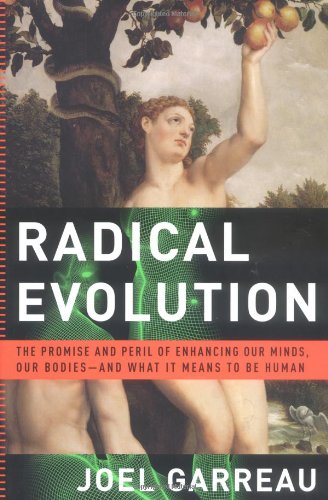
Synopsis
In Radical Evolution, bestselling author Joel Garreau, a reporter and editor for the Washington Post, shows us that we are at an inflection point in history. As you read this, we are engineering the next stage of human evolution. Through advances in genetic, robotic, information and nanotechnologies, we are altering our minds, our memories, our metabolisms, our personalities, our progeny–and perhaps our very souls.
Taking us behind the scenes with today's foremost researchers and pioneers, Garreau reveals that the super powers of our comic-book heroes already exist, or are in development in hospitals, labs, and research facilities around the country -- from the revved up reflexes and speed of Spider-Man and Superman, to the enhanced mental acuity and memory capabilities of an advanced species.
Over the next fifteen years, Garreau makes clear, these enhancements will become part of our everyday lives. Where will they lead us? To heaven–where technology’s promise to make us smarter, vanquish illness and extend our lives is the answer to our prayers? Or will they lead us, as some argue, to hell — where unrestrained technology brings about the ultimate destruction of our entire species? With the help and insights of the gifted thinkers and scientists who are making what has previously been thought of as science fiction a reality, Garreau explores how these developments, in our lifetime, will affect everything from the way we date to the way we work, from how we think and act to how we fall in love. It is a book about what our world is becoming today, not fifty years out. As Garreau cautions, it is only by anticipating the future that we can hope to shape it.
"synopsis" may belong to another edition of this title.
About the Author
JOEL GARREAU is a student of culture, values and change. The author of the bestselling Edge City: Life on the New Frontier and The Nine Nations of North America, he is a reporter and editor at The Washington Post, a member of the scenario-planning organization Global Business Network, and has served as a senior fellow at George Mason University and the University of California at Berkeley. He has appeared on such national media as Good Morning America, Today, The CBS Evening News with Dan Rather, NBC Nightly News, ABC’s World News Tonight, and NPR’s Morning Edition and All Things Considered. He lives in Broad Run, Virginia.
Reviews
Far-fetched as it may sound, the first person who will live to be 1,000 may already walk among us. The first computer that will think like a person may be built before today's kindergarteners graduate from college. By the middle of this century, we may be as blasé about genetically engineered humans as we are today about pierced ears. These sorts of predictions have a habit of sounding silly by the time they're supposed to come true, but there's a certain logic to them. Joel Garreau calls that logic "The Curve."
The Curve is the untamable force of exponential growth that propels technological progress. It's the compound interest on human ingenuity. The fact that computing power has doubled every 18 months, right on schedule, for the last four decades is a manifestation of The Curve. So is the rapid expansion of the Internet and the recent boom in genetic technologies. According to the inexorable logic of The Curve, if you want to get a sense of how radically our world will be transformed over the next century, the best guide will be looking back at how much things have changed, not over the past century, but over the past millennium.
Garreau, a reporter and editor at The Washington Post, has sought out the scientists who are driving The Curve's breakneck acceleration and the major thinkers who are contemplating its implications. His breezy, conversational book, full of mini-profiles and chatty asides, is a guide to the big ideas about the future of our species that are circulating at the beginning of the 21st century.
As he tramps around the country meeting futurists and technophiles, Garreau becomes acquainted with researchers at the Defense Advanced Research Projects Agency (DARPA) who are trying to abolish sleep and invent cyborg soldiers. He meets "transhumanists" for whom genetic enhancement promises a kind of messianic salvation. He also meets naysayers who fear that all this so-called progress is far more likely to lead to auto-annihilation than to techno-bliss. Garreau lays out three alternative futures for our species: a happy ending that he calls the Heaven Scenario, a tragic ending he calls Hell and a middle scenario he calls Prevail, in which humans somehow manage to muddle through the ethical and technological jungle ahead without creating paradise on Earth or blowing ourselves up.
In the Heaven scenario, genetic engineering, robotics and nanotechnology make us happier, smarter, stronger and better-looking. Man and machine gradually meld as we transcend the physical limitations of our bodies and become immortal. Humans evolve into a new species of post-humans as different from us today as we are from chimps. We become like gods.
According to Vernor Vinge, one of several eccentric scientists whom Garreau interviews, The Curve will continue to get steeper and steeper until it eventually goes completely vertical in a rapturous moment he has dubbed "The Singularity." At some point this century, but probably no later than 2030, Vinge believes that humans will build the last machine we'll ever need -- a device so intelligent it will be able to reproduce rapidly and create new machines far smarter than humans could ever imagine. Practically overnight, our social order will rupture, and our world will be transformed. There's no guarantee that will be particularly pleasant.
Many of the thinkers Garreau interviews are less than sanguine about humanity's prospects. Bill Joy, co-founder of Sun Microsystems, warns that technology is empowering individuals to do evil on a scale never before imagined. A single rogue scientist will soon be able to engineer a plague capable of wiping out humankind. Even well-intentioned scientists could accidentally do something catastrophic, such as releasing a swarm of self-replicating nanobots that would suck the planet dry of energy -- turning the world into the "gray goo" of Michael's Crichton's fanciful novel Prey. In such a one-strike-and-you're-out world, it's hard to imagine we'd last very long.
Francis Fukuyama and Bill McKibben's Hell Scenarios are less apocalyptic. They fear that the coming technologies will upend societies and sap life of its meaning, gradually leading us into the dehumanized hell of a Brave New World. They'd like to manage The Curve through government regulation or by taking the Amish approach of forswearing objectionable technologies.
But just as inescapable as The Curve's upward trajectory may be humankind's uncanny knack for rolling with the punches. Garreau's Prevail scenario is "based on a hunch that you can count on humans to throw The Curve a curve." Even if technology seems to be a force out of control, we'll always find some way to direct it toward our desired ends, Garreau suspects. Jaron Lanier, the inventor of virtual reality, envisions a version of the Prevail scenario in which humans use technology to build tighter and tighter interpersonal relations. Our bodies become less important as our social bonds strengthen. The Internet, according to Lanier, is an early step down this path to global interconnectedness.
If these scenarios sound outlandish, that is only because it's hard to look so far into the future without getting whiplash. But Garreau argues that the stakes in thinking all this through are enormous. We "face the biggest change in tens of thousands of years in what it means to be human," he writes. It's an exhilarating adventure our species has embarked upon. It might be a little less terrifying if we knew where we were headed.
Reviewed by Joshua Foer
Copyright 2005, The Washington Post Co. All Rights Reserved.
Washington Post reporter Garreau takes readers on a cross-country trip into the future as he interviews scientists and other thinkers grappling with the implications of our newfound—and, to some, frightening—knowledge of the genome. Highlighting what he calls "the Curve"—the rate of exponential change in technology—Garreau (Edge City: Life on the New Frontier) breaks the central part of his book into four scenarios. In "Heaven," genetic engineering will make us stronger and healthier, help us live longer and metabolize our food more efficiently. "Hell" resembles the island of Dr. Moreau: science runs amok, we cripple the genome of our food supplies, and babies are born with unexpected deformities instead of the improved characteristics promised by gene therapies. The "Prevail" scenario might also be called Muddling Through: even if we make a mistake now and then, we will figure out how to slow potentially harmful changes and speed up potentially beneficial ones. Last, "Transcend" considers that humans might conquer the difficulties that lie ahead and emerge into a new age beyond our wildest dreams. Science buffs fascinated by the leading edges of societal and technological change and readers concerned by the ethical issues that change presents will find much to ponder in Garreau's nonjudgmentallook into our possible futures Agent, John Brockman.(On sale May 17)
What's in store for humanity? It is becoming clear that we will use our growing technological powers to transform not only the world around us but ourselves, too. Many forms of human enhancement are already routine--sports medicine, psychotropic mood drugs, wakefulness and alertness enhancers, cosmetic surgery, drugs for sexual performance. Much more will become possible in coming decades.
Joel Garreau's Radical Evolution joins several recent titles that attempt to make sense of the radical future possibilities for our species. The potential prospects include superintelligent machines, nonaging bodies, direct connections between human brains or between brain and computer, fully realistic virtual reality, and the reanimation of patients in cryonic suspension. As enablers of such miracles, Garreau mentions especially "GRIN technologies"--genetics, robotics, information technology and nanotechnology.
The focus of Garreau's book, however, is not on the nuts and bolts of the technology itself but rather on what it will all mean for us humans. His reporting skills well honed by his work as a journalist and editor at the Washington Post, Garreau is constantly on the lookout for the human story behind the ideas. Biographical sketches of the people he has interviewed for the book get approximately equal airtime with their opinions about human extinction and transcendence. The bulk of one interviewee's beard, the size of another's collection of musical instruments, the length of a third's pants: as Garreau knows all too well, these are the indispensable rivets to hold the attention of the current version of Homo sapiens while we try to ponder whether we will have indefinite life spans or whether the world will end before our children have a chance to grow up.
Garreau organizes his material around several scenarios. Unfortunately, these are not very carefully delineated. It is not clear whether all of them are meant to represent separate possibilities.
In the Curve Scenario, information technology continues to improve exponentially, and this progress bleeds over into adjacent fields such as genetics, robotics and nanotechnology. In the Singularity Scenario, "the Curve of exponentially increasing technological change is unstoppable" and leads, "before 2030, to the creation of greater-than-human intelligence," which proceeds to improve itself "at such a rate as to exceed comprehension." There is a Heaven Scenario, which serves as a rubric for a future in which "almost unimaginably good things ... including the conquering of disease and poverty, but also an increase in beauty, wisdom, love, truth and peace" are happening pretty much on their own accord, without deliberate steering. Garreau associates this view with the distinguished inventor Ray Kurzweil. We are told that one of the early "warning signs" that we are entering the Heaven Scenario is that the phrase "The Singularity" enters common usage.
There is also a Hell Scenario. The chief talking head assigned to this scenario is Bill Joy, who was a co-founder of Sun Microsystems. In April 2000 Joy published a bombshell article in Wired entitled "Why the Future Doesn't Need Us," which described how the author had come to the realization that advances in genetics, nanotechnology and robotics will eventually pose grave threats to human survival. The article argued for the relinquishment of some lines of research in these fields. Since then, we learn, Joy has got divorced, quit Sun, and put the book he was preparing on hold. "Overall his affect was markedly flat," Garreau writes.
One of the early warning signs that we are entering Hell is that "almost unimaginably bad things are happening, destroying large chunks of the human race or the biosphere, at an accelerating pace." Aside from Bill Joy, the chapter on the Hell Scenario features appearances by Francis Fukuyama, Martin Rees, Bill McKibben, Leon Kass and Frankenstein. The common denominator of these fellows is that they have confronted the potential for catastrophic technological downsides. But their worries are not all of the same kind. For example, while Joy focuses on direct threats to human survival (such as bioterrorism), Kass, who is chairman of President Bush's Council on Bioethics, is more concerned about subtle ways in which our quest for technological mastery could undermine the foundations of human dignity. These very different sorts of concerns could have been kept more clearly distinct.
Garreau's last scenario, Prevail, extols the human knack for muddling through--"the ability of ordinary people facing overwhelming odds to rise to the occasion because it is the right thing." The defining characteristic of the Prevail Scenario is that human beings are picking and choosing their futures in an effective manner. The main representative selected for this scenario is Jaron Lanier (the guy with the large collection of musical instruments). Lanier dreams of creating more ways for people to share their thoughts and experiences, and he is fond of pointing out that faster computer hardware does not necessarily lead to equivalent improvements in the usefulness of the software that runs on the computers.
In the final chapter, Garreau asks: "Will we forever keep mum about our obviously intense desire to break the bonds of mortality? Or should we lift the taboo and start dealing with it?" His implied answer is yes. He then asks, "Shall we be bashful about these lines we are crossing because we do not have a way to make them meaningful?" At this point, Garreau has a constructive proposal: let's create some new rituals. Perhaps, he suggests, we should have "a liturgy of life everlasting as a person receives her first cellular age-reversal workup." Why not indeed?
In the meantime, there is still some work left to do in the laboratories. If we develop the cure for aging in a timely fashion, while steering clear of the disasters that Joy and others have foretold, we may one day get to enjoy indefinite life spans with much improved physical and mental capacities--and some cracking new ceremonies, too.
Nick Bostrom is in the faculty of philosophy at the University of Oxford. Many of his papers are available at Nickbostrom.com
We are facing "the biggest change in 50,000 years in what it means to be human," writes Garreau, of the Washington Post, thanks to the swiftly evolving GRIN technologies, that is, genetic, robotic, information, and nano. To get a sense of the possible implications of these paradigm-altering developments, he speaks with scientists who fall roughly into two opposing mind-sets: those who view technology as a stairway to a heaven in which humans perfect the body and greatly extend the mind, and those who see a grimly hellish future in which self-replicating microbes, nanobots, or "enhanced" humans turn viciously against their creators. Clarifying and companionable, Garreau explains astonishing discoveries, ponders just how intimately connected we are to our digital tools, surveys speculative fiction classics, and profiles such visionaries as heaven-inclined Raymond Kurzweil, hell-fearing William Joy, and Jaron Lanier, the virtual-reality guru, who offers a less extreme, more commonsensible vision of the future based on humankind's muddled but powerful instinct to do the right thing. The technoscenarios Garreau explicates are riveting, and of acute importance, as is his reminder that there is much more to life than technology, no matter how amazing it gets. Donna Seaman
Copyright © American Library Association. All rights reserved
Excerpt. © Reprinted by permission. All rights reserved.
Chapter One
Prologue
The Future of Human Nature
Confusion is a word we have invented for an order which is not understood.
–Henry Miller, Tropic of Capricorn
This book can’t begin with the tale of the telekinetic monkey.
That certainly comes as a surprise. After all, how often does someone writing nonfiction get to lead with a monkey who can move objects with her thoughts?
If you lunge at this opportunity, however, the story comes out all wrong. It sounds like science fiction, for one thing, even though the monkey–a cute little critter named Belle–is completely real and scampering at Duke University.
This gulf between what engineers are actually creating today and what ordinary readers might find believable is significant. It is the first challenge to making sense of this world unfolding before us, in which we face the biggest change in tens of thousands of years in what it means to be human.
This book aims at letting a general audience in on the vast changes that right now are reshaping our selves, our children and our relationships. Helping people recognize new patterns in their lives, however, is no small trick, as I’ve discovered over time.
For example, there’s the problem you encounter when asking people what they’d do if offered the chance to live for a very long time–150 years or more. Nine out of 10 boggle at this thought. Many actually recoil. You press on. Engineers are working on ways to allow you to spend all that time with great physical vitality–perhaps even comparable to that of today’s 35-year-olds. How would you react if that opportunity came to market? There’s a question that gets people thinking, but you can tell it is still quite a stretch.
We live in remarkable times. Who could have imagined at the end of the 20th century that a human augmentation substance that does what Viagra does would sponsor the NBC Nightly News?
Discussing this sort of change, however, can be hard. Take the United States Department of Defense program to create the “metabolically dominant soldier.” In one small part of that agenda, researchers hope to allow warriors to run at Olympic sprint speeds for 15 minutes on one breath of air. It might be indisputably true that human bodies process oxygen with great inefficiency, and this may be a solvable problem, and your taxpayer dollars unquestionably are being spent trying to remedy this oversight on the part of evolution. Nonetheless, it takes effort to hold some readers with this report. It just sounds too weird.
One fine spring evening, I found myself at a little table outside a San Francisco laundry, pondering how to bridge this divide between the real and the credible. The laundry, called Star Wash, is on a lovely but quite ordinary street. In the window there is an American flag and a sign that tastefully spells out “God Bless America” in red, white and blue lights. It is run by a woman named Olga, from Guatemala City. I was traveling, interviewing the people who are creating the vastly enhanced human abilities that Radical Evolution discusses, and was waiting for my shirts to be finished.
Most of the prospective readers of this book, it occurred to me, are probably like Olga. They don’t care about gee-whiz technology. Why should they? Neither do I, truth be told.
What they care about is what it means to be human, what it means to have relationships, what it means to live life, to have loves, or to tell lies. If you want to engage such people, you have to tell a story about culture and values–who we are, how we got that way, where we’re headed and what makes us tick. That’s what has always interested me; it’s what my reporting has always been about. The gee-whiz technology is just a window through which to gaze upon human nature.
Four interrelated, intertwining technologies are cranking up to modify human nature. Call them the GRIN technologies–the genetic, robotic, information and nano processes. These four advances are intermingling and feeding on one another, and they are collectively creating a curve of change unlike anything we humans have ever seen.
Already, enhanced people walk among us. You can see it most clearly wherever you find the keenest competition. Sport is a good example. “The current doping agony,” says John Hoberman, a University of Texas authority on performance drugs, “is a kind of very confused referendum on the future of human enhancement.” Extreme pharmacological sport did not begin or end with East Germany. Some athletes today look grotesque. Curt Schilling, the All-Star pitcher, in 2002 talked to Sports Illustrated about the major leagues. “Guys out there look like Mr. Potato Head, with a head and arms and six or seven body parts that just don’t look right.” Competitive bodybuilding is already divided into tested shows (i.e., drug free) versus untested shows (anything goes).That’s merely the beginning. Scientists at the University of Pennsylvania who created genetically modified “mighty mice” have been deluged by calls from athletes and coaches who want to try this technology themselves. These mice are shockingly large and muscular. They are built like steers, with massive haunches and necks wider than their heads. Could such gene doping work in humans–assuming it isn’t already? “Oh yeah, it’s easy,” H. Lee Sweeney, chairman of Penn’s Department of Physiology, told The New York Times. “Anyone who can clone a gene and work with cells could do it. It’s not a mystery....You could change the endurance of the muscle or modulate the speed–all the performance characteristics. All the biology is there. If someone said, ‘Here’s $10 million–I want you to do everything you can think of in terms of sports,’ you could get pretty imaginative.”
Then there’s the military. Remember the comic-book superheroes of the 1930s and 1940s, from Superman to Wonder Woman? Most of their superpowers right now either exist or are in engineering. If you can watch a car chase in Afghanistan with a Predator, you’ve effectively got telescopic vision. If you can figure out what’s inside a cave by peering into the earth with a seismic ground pinger, you’ve got X-ray vision. Want super strength? At the University of California at Berkeley, the U.S. Army has got a functioning prototype exoskeleton suit that allows a soldier to carry 180 pounds as if it were only 4.4 pounds. At Natick Labs in Massachusetts, the U.S. Army imagines that such an exoskeleton suit may ultimately allow soldiers to leap tall buildings with a single bound.
“My thesis is that in just 20 years the boundary between fantasy and reality will be rent asunder,” writes Rodney Brooks, director of the Artificial Intelligence Laboratory at the Massachusetts Institute of Technology. “Just five years from now that boundary will be breached in ways that are as unimaginable to most people today as daily use of the World Wide Web was 10 years ago.”
We are at an inflection point in history.
For all previous millennia, our technologies have been aimed outward, to control our environment. Starting with fire and clothes, we looked for ways to ward off the elements. With the development of agriculture we controlled our food supply. In cities we sought safety. Telephones and airplanes collapsed distance. Antibiotics kept death-dealing microbes at bay.
Now, however, we have started a wholesale process of aiming our technologies inward. Now our technologies have started to merge with our minds, our memories, our metabolisms, our personalities, our progeny and perhaps our souls. Serious people have embarked on changing humans so much that they call it a new kind of engineered evolution– one that we direct for ourselves. “The next frontier,” says Gregory Stock, director of the Program on Medicine, Technology and Society at the UCLA School of Medicine, “is our own selves.”
The people you will meet in Radical Evolution are testing these fundamental hypotheses:
• We are riding a curve of exponential change.
• This change is unprecedented in human history.
• It is transforming no less than human nature.
This isn’t fiction. You can see the outlines of this reality in the headlines now. You’re going to see a lot more of it in just the next few years– certainly within your prospective lifetime. We have been attempting to transcend the limits of human nature for a very long time. We’ve tried Socratic reasoning and Buddhist enlightenment and Christian sanctification and Cartesian logic and the New Soviet Man. Our successes have ranged from mixed to limited, at best. Nonetheless, we are pressing forward, attempting once again to improve not just our world but our very selves. Who knows? Maybe this time we’ll get it right.
In 1913, U.S. government officials prosecuted Lee De Forest for telling investors that his company, RCA, would soon be able to transmit the human voice across the Atlantic Ocean. This claim was so preposterous, prosecutors asserted, that he was obviously swindling potential investors. He was ultimately released, but not before being lectured by the judge to stop making any more fraudulent claims.
With this legal reasoning in mind, flash forward a decade and a half from today. Look at the girl who today is your second-grade daughter. Fifteen years from now, she is just home for the holidays. You were so proud of her when she not only put herself through Ohio State but graduated summa cum laude. Now she has taken on her most formidable challenge yet, competing with her gener...
"About this title" may belong to another edition of this title.
Search results for Radical Evolution: The Promise and Peril of Enhancing...

Stock Image
Radical E: null
Published by
Bantam Doubleday Dell Publishing Group Inc, 2005
ISBN 10: 0385509650
ISBN 13: 9780385509657
Used
Hardcover
Seller: World of Books (was SecondSale), Montgomery, IL, U.S.A.
Seller rating 5 out of 5 stars

Hardback. Condition: Good. In Radical Evolution, bestselling author Joel Garreau, a reporter and editor for the Washington Post, shows us that we are at an inflection point in history. As you read this, we are engineering the next stage of human evolution. Through advances in genetic, robotic, information and nanotechnologies, we are altering our minds, our memories, our metabolisms, our personalities, our progeny-and perhaps our very souls. Taking us behind the scenes with today's foremost researchers and pioneers, Garreau reveals that the super powers of our comic-book heroes already exist, or are in development in hospitals, labs, and research facilities around the country -- from the revved up reflexes and speed of Spider-Man and Superman, to the enhanced mental acuity and memory capabilities of an advanced species. Over the next fifteen years, Garreau makes clear, these enhancements will become part of our everyday lives. Where will they lead us? To heaven-where technology's promise to make us smarter, vanquish illness and extend our lives is the answer to our prayers? Or will they lead us, as some argue, to hell -- where unrestrained technology brings about the ultimate destruction of our entire species? With the help and insights of the gifted thinkers and scientists who are making what has previously been thought of as science fiction a reality, Garreau explores how these developments, in our lifetime, will affect everything from the way we date to the way we work, from how we think and act to how we fall in love. It is a book about what our world is becoming today, not fifty years out. As Garreau cautions, it is only by anticipating the future that we can hope to shape it. Seller Inventory # 00101065094
Stock Image
Radical E: null
Published by
Bantam Doubleday Dell Publishing Group Inc, 2005
ISBN 10: 0385509650
ISBN 13: 9780385509657
Used
Hardcover
Seller: World of Books (was SecondSale), Montgomery, IL, U.S.A.
Seller rating 5 out of 5 stars
Hardback. Condition: Very Good. In Radical Evolution, bestselling author Joel Garreau, a reporter and editor for the Washington Post, shows us that we are at an inflection point in history. As you read this, we are engineering the next stage of human evolution. Through advances in genetic, robotic, information and nanotechnologies, we are altering our minds, our memories, our metabolisms, our personalities, our progeny-and perhaps our very souls. Taking us behind the scenes with today's foremost researchers and pioneers, Garreau reveals that the super powers of our comic-book heroes already exist, or are in development in hospitals, labs, and research facilities around the country -- from the revved up reflexes and speed of Spider-Man and Superman, to the enhanced mental acuity and memory capabilities of an advanced species. Over the next fifteen years, Garreau makes clear, these enhancements will become part of our everyday lives. Where will they lead us? To heaven-where technology's promise to make us smarter, vanquish illness and extend our lives is the answer to our prayers? Or will they lead us, as some argue, to hell -- where unrestrained technology brings about the ultimate destruction of our entire species? With the help and insights of the gifted thinkers and scientists who are making what has previously been thought of as science fiction a reality, Garreau explores how these developments, in our lifetime, will affect everything from the way we date to the way we work, from how we think and act to how we fall in love. It is a book about what our world is becoming today, not fifty years out. As Garreau cautions, it is only by anticipating the future that we can hope to shape it. Seller Inventory # 00105762264
Seller Image
Radical Evolution: The Promise and Peril of Enhancing Our Minds, Our Bodies -- and What It Means to Be Human
Seller: Greenworld Books, Arlington, TX, U.S.A.
Seller rating 5 out of 5 stars
Condition: good. Fast Free Shipping â" Good condition. It may show normal signs of use, such as light writing, highlighting, or library markings, but all pages are intact and the book is fully readable. A solid, complete copy that's ready to enjoy. Seller Inventory # GWV.0385509650.G
Stock Image
Radical Evolution: The Promise and Peril of Enhancing Our Minds, Our Bodies -- and What It Means to Be Human
Seller: More Than Words, Waltham, MA, U.S.A.
Seller rating 5 out of 5 stars
Condition: Very Good. . . All orders guaranteed and ship within 24 hours. Before placing your order for please contact us for confirmation on the book's binding. Check out our other listings to add to your order for discounted shipping. Seller Inventory # WAL-L-5c-001908
Stock Image
Radical Evolution: The Promise and Peril of Enhancing Our Minds, Our Bodies -- and What It Means to Be Human
Published by
Doubleday, 2005
ISBN 10: 0385509650
ISBN 13: 9780385509657
Used
Hardcover
First Edition
Seller: The Maryland Book Bank, Baltimore, MD, U.S.A.
Seller rating 5 out of 5 stars
hardcover. Condition: Like New. First Edition. Used - Like New. Seller Inventory # 3-YY-1-0138
Stock Image
Radical Evolution: The Promise and Peril of Enhancing Our Minds, Our Bodies -- and What It Means to Be Human
Published by
Doubleday, 2005
ISBN 10: 0385509650
ISBN 13: 9780385509657
Used
Hardcover
First Edition
Seller: The Maryland Book Bank, Baltimore, MD, U.S.A.
Seller rating 5 out of 5 stars
hardcover. Condition: Very Good. First Edition. Used - Very Good. Seller Inventory # 4-H-9-1265
Stock Image
Radical Evolution: The Promise and Peril of Enhancing Our Minds, Our Bodies -- and What It Means to Be Human
Seller: Wonder Book, Frederick, MD, U.S.A.
Seller rating 5 out of 5 stars
Condition: Very Good. Signed Copy . Very Good dust jacket. Signed/Inscribed by author on title page. Seller Inventory # SB02N-00057
Stock Image
Radical Evolution: The Promise and Peril of Enhancing Our Minds, Our Bodies -- and What It Means to Be Human
Seller: Wonder Book, Frederick, MD, U.S.A.
Seller rating 5 out of 5 stars
Condition: Very Good. Very Good condition. Very Good dust jacket. A copy that may have a few cosmetic defects. May also contain light spine creasing or a few markings such as an owner's name, short gifter's inscription or light stamp. Seller Inventory # M09B-03417
Stock Image
Radical Evolution: The Promise and Peril of Enhancing Our Minds, Our Bodies -- and What It Means to Be Human
Seller: Wonder Book, Frederick, MD, U.S.A.
Seller rating 5 out of 5 stars
Condition: As New. Like New condition. Like New dust jacket. A near perfect copy that may have very minor cosmetic defects. Seller Inventory # D12A-03091
Stock Image
Radical Evolution : The Promise and Peril of Enhancing Our Minds, Our Bodies - and What It Means to Be Human
Published by
Doubleday Religious Publishing Group, The, 2005
ISBN 10: 0385509650
ISBN 13: 9780385509657
Used
Hardcover
Seller: Better World Books, Mishawaka, IN, U.S.A.
Seller rating 5 out of 5 stars
Condition: Good. Pages intact with minimal writing/highlighting. The binding may be loose and creased. Dust jackets/supplements are not included. Stock photo provided. Product includes identifying sticker. Better World Books: Buy Books. Do Good. Seller Inventory # 5416899-6