
Items related to The First Fall Classic: The Red Sox, the Giants and...
The First Fall Classic: The Red Sox, the Giants and the Cast of Players, Pugs and Politicos Who Re-Invented the World Series in 1912 - Hardcover
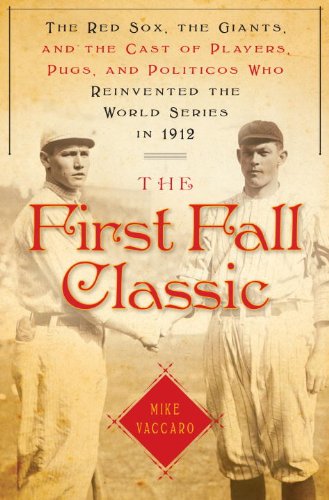
Synopsis
Acclaimed author Mike Vaccaro presents a riveting, must-read account of what remains, nearly a century later, the greatest World Series ever played.
In October of 1912, seven years before gambling nearly destroyed the sport, the world of baseball got lucky. It would get two teams-the Boston Red Sox and the New York Giants, winners of a combined 208 games during the regular season-who may well have been the two finest ball clubs ever assembled to that point. Most importantly, during the course of eight games spanning nine days in that marvelous baseball autumn, they would elevate the World Series from a regional October novelty to a national obsession. The games would fight for space on the front pages of the nation's newspapers, battling both an assassin's bullet and the most sensational trial of the young century, with the Series often carrying the day and earning the “wood.”
In The First Fall Classic, veteran sports journalist and author Mike Vaccaro brings to life a bygone era in cinematic and intimate detail-and gives fans a wonderful page-turner that re-creates the magic and suspense of the world's first great series.
"synopsis" may belong to another edition of this title.
About the Author
MIKE VACCARO is the lead sports columnist for the New York Post and the author of 1941: The Greatest Year in Sports and Emperors and Idiots. He has won more than fifty major journalism awards since 1989 and has been cited for distinguished writing by the Associated Press Sports Editors, the New York State Publishers Association, and the Poynter Institute. A graduate of St. Bonaventure University, he lives in New Jersey.
Reviews
From The Washington Post's Book World/washingtonpost.com Reviewed by Jonathan Yardley The 1912 World Series was not the last won by the Boston Red Sox before they entered their 86-year slough of despondency -- they won again in 1915, 1916 and 1918 -- but it was the most dramatic and the most important. Mike Vaccaro, a sports columnist for the New York Post, does not exaggerate when he says that "the World Series was really born in 1912." What up to then had been a rather casual October encounter between the champions of the established National League and the young American League was transformed, by the 1912 series, into a great American institution, a seven-game competition that commanded the rapt attention of the entire nation. My own attention was first focused on the 1912 series 31/2 decades ago, while I was doing research for a biography of Ring Lardner, the sportswriter who within a few years of that series became one of the most popular and influential American writers of fiction. Lardner, who was 27 years old in 1912, covered the series for the Chicago Examiner, and covered it well. More on that later. For now the focus belongs on Vaccaro, who has written a smart, lively account of the series that goes beyond the games themselves -- though his accounts of all of them are vivid -- to show how what happened during that series reflected what was happening in the nation. The series was played between the New York Giants of the National League and the Red Sox of the American. By any measure they were exceptional teams, winning their leagues handily (the Red Sox finished a full 14 games ahead of the second-place Washington Senators) and having on their rosters five future members of the Hall of Fame: Rube Marquard, Christy Mathewson and John McGraw of the Giants, and Harry Hooper and Tris Speaker of the Red Sox. They played in spanking-new ballparks -- the Polo Grounds in New York, Fenway Park in Boston -- and they had passionate fans, none more so than Boston's Royal Rooters, one of whom was John "Honey Fitz" Fitzgerald, mayor of Boston and future grandfather of John Fitzgerald Kennedy. The October showdown was still a lowercase affair: the "world's series," though Lardner, who poked fun whenever he could, called it the "world's serious." He was only half-kidding. Though in 1912 it had yet to achieve mythical dimensions, the series was indeed taken very seriously by fans all over the country: "No matter where you traveled in the nation -- the only 'world' that mattered to most Americans in 1912, five years before the killing fields of France would permanently expand those boundaries -- you found thousands of people hungry for scores, thirsty for baseball information." The American sporting scene was far different then from what it is now. Even though professional baseball was still in its adolescence, it utterly dominated all other sports; college football was popular but distinctly second-string, pro football barely existed, basketball was only two decades old. Baseball ruled absolutely, and the country followed it with an avidity that didn't really begin to diminish until the rise of pro football in the 1960s. So though plenty of people are excited about the World Series that gets underway this week, the excitement pales beside that which swept through Boston, New York and all points beyond as the world's series opened on Oct. 8, 1912. Newspapers around the country posted huge outdoor scoreboards on which every play -- in the most sophisticated displays -- was posted the instant word was wired in. Thousands gathered in Times and Herald Squares in New York and Scollay Square in Boston and roared their approval or dismay as each new development appeared. There was plenty to roar about. The first game, which the Red Sox won 4-3 behind the gutsy pitching of Smoky Joe Wood, set the pattern: With the exception of Game 7, which the Giants won going away, 11-4, the games were tight and tense, and on-field tensions grew higher day after day. But wait, you're saying: If the Red Sox won the series, how could the Giants have won Game 7? Simple: because Game 2 ended in a 6-6 tie, having been called because of darkness after 11 innings. The 32-year-old Mathewson pitched heroically, but three unearned runs did him in. "Hardest game I've ever played," the great Matty said afterward, while McGraw, his manager, said, "Damnedest one I've ever seen." Newspapers the next day were ecstatic: " 'A CLASSIC!' roared the Los Angeles Times. 'Greatest Ball Game in History!' screamed the Washington Post." The game didn't count, but the three-man National Commission, which then ruled baseball, decided that it most certainly counted toward the four games from which the players would receive their share of the proceeds from ticket sales. This meant that, should the series go the full number of official, complete games, there would be an extra, incomplete game to fatten the pockets of the owners. To help ensure that, the Boston owner, Jimmy McAleer, ordered his manager to hold Smoky Joe back from Game 6 and pitch the journeyman Buck O'Brien, who arrived at Fenway royally hung over and was routed in a 5-2 loss. Students of baseball history will not be surprised that this transparent (and successful) attempt to fix a World Series went essentially unpunished, while the Chicago White Sox players who threw the series seven years later were kicked out of the game and made pariahs for life. McAleer got his way: The series went the full length. But Bostonians had figured out what was going on, and the Fenway that had filled to overflowing was only half-full for the final (and in effect eighth) game on Oct. 16. Too bad for them, for it was a magnificent contest that went right down to the final out, with Matty once again foiled by his teammates' errors, in this case one physical and one mental, enough to bring in two runs in the bottom of the 10th and give the Red Sox a 3-2 victory. Vaccaro has dug up many terrific quotes from the sporting press of the day, but he somehow missed Lardner's dispatch to the Chicago Examiner. I'm going to quote in full its first paragraph, because it captures perfectly the glory and the pathos of that day: "Just after Steve Yerkes had crossed the plate with the run that gave Boston's Red Sox the world's championship in the tenth inning of the deciding game of the greatest series ever played for the big title, while the thousands, made temporarily crazy by a triumph entirely unexpected, yelled, screamed, stamped their feet, smashed hats and hugged one another, there was seen one of the saddest sights in the history of a sport that is a strange and wonderful mixture of joy and gloom. It was the spectacle of a man, old as baseball players are reckoned, walking from the middle of the field to the New York players' bench with bowed head and drooping shoulders, with tears streaming from his eyes, a man on whom his team's fortune had been staked and lost, and a man who would have proved his clear title to the trust reposed in him if his mates had stood by him in the supreme test. The man was Christy Mathewson."
Copyright 2009, The Washington Post. All Rights Reserved.
Vaccaro, sports columnist for the New York Post, recreates the excitement of the 1912 World Series, complete with a hotly contested presidential campaign, an assassination attempt on Roosevelt and a grisly national murder trial. Two superb teams, the Boston Red Sox and New York Giants, reflect the bitter rivalry between the American and National Leagues, with several players destined for the Hall of Fame among them: Christy Mathewson, John McGraw, Tris Speaker and Smokey Joe Wood. Vaccaro tells the reader every riveting detail leading up to the games: death threats, gangster pressure, parents and truant officers seeking young boys with baseball fever. He pulls out all the stops through the series' competitive seven games, with the incredible tie-breaker and its aftermath. Informative yet entertaining, Vaccaro's extraordinary baseball chronicle renders the early days of our national pastime in all its grit and glory. (Oct.)
Copyright © Reed Business Information, a division of Reed Elsevier Inc. All rights reserved.
Excerpt. © Reprinted by permission. All rights reserved.
Chapter One
Spring, Summer, Fall, 1912: A Prelude
New York--The advance fanfare is over. The English language has been plucked of its final consonants, and the last of all figures extant has been twisted out of shape in the maelstrom of a million arguments. And now, at the end of it, there is nothing left. Nothing left but the charge of the Night Brigade against the gates at dawn tomorrow--and after that the first boding hush as Harry Hooper flies out from the Red Sox coop and stands face to face with Mathewson, the veteran, or Tesreau, the debutante . . .
--Grantland Rice, NEW YORK EVENING MAIL,
October 7, 1912
The poor bastards, they never had a chance, they never even saw the damned thing coming. It was a beautiful Friday night, September 27, 1912, a perfect evening to take the sparkling new toy for a spin, and so twenty-nine-year-old Frank O'Neil and twenty-year-old William Popp, neighbors from Manhattan's Upper West Side, had decided to take their freshly souped-up motorcycle for a breezy ride through the streets of Harlem, and they'd mostly been ignoring the posted speed limit of nine miles per hour because, let's face it, who didn't disregard that patently absurd and outdated law; horse-drawn carriages were allowed to zip along at twelve miles an hour, for crying out loud.
So there they were, young, free, blissfully sailing down a hill at the foot of 145th Street and St. Nicholas Avenue, when, quite suddenly, their worlds went dark as the night sky above them. A man named Frank Linke, driving a Model T Speedster and actually obeying the speed limit, hit them flush with the bumper of his brand-new automobile. O'Neil and Popp went flying over the handlebars of their ruined motorcycle, and now both of them were lying on the street, O'Neil bleeding from his mouth thanks to a bruised liver and damaged gallbladder, Popp groaning thanks to a collarbone now rendered a collection of collarbones.
Frank Linke, more horrified than hurt, searched frantically for policemen.
But before he could locate one, he found himself caught in the glare of a set of headlights belonging to a brand-new Cadillac speeding straight for him before screeching to a halt. Out of the car leapt a tall, lanky man wearing a tam-o'-shanter on his head and a brown suit coat over his shoulder, his spit-shined Regal shoes hitting the pavement without missing a stride.
"Put them in my car!" yelled the helpful stranger.
By now, a policeman named Michael Walsh had arrived at the scene, and his first inclination was to shoo the Good Samaritan to the sidewalk . . . except, as the well-dressed visitor's face grew brighter under the glow of the streetlight, Officer Michael Walsh could barely say anything.
"It's . . . it's . . . you," the cop said.
Frank Linke, still trembling, squinted at the stranger and his eyes brightened.
"It is you," he stammered.
"Yes," said Christy Mathewson, the calmest voice of the three, speaking above Popp's groans and the wails of the neighborhood dogs, "it's me. Now, may I suggest loading these unfortunate gentlemen in my car, so we can get them to the hospital?"
Walsh carefully guided Popp to his feet, loaded him in the front seat of Mathewson's car. Walsh, Linke, and Mathewson laid O'Neil, still unconscious, across the back.
"Hey," Linke said, "how'd you guys do today, Matty?"
"We beat the Braves," Mathewson said. "Seven to six."
"Good luck in the series next week," Walsh, the policeman, interjected. "I'm hearing you guys will be heavy underdogs against the Red Sox."
Mathewson smiled.
"We'll see about that," he said. "Now, can you see to it that none of your brethren stop me on the way to the hospital? They have a knack of pulling me over and giving me speeding tickets."
"No worry," he was told. "Just tell them you know Walsh of the One-Five-Two. And I guess if that doesn't work, show them your cargo."
With that, the most famous athlete in the United States of America gunned his gas pedal, sped off into the night for the thirty-block drive toward Washington Heights Hospital. Walsh looked at Linke, still shaken, then peered over at the Speedster, which had a fair-sized dent in it.
"Too bad about your car," the cop said.
"I met Big Six tonight," Frank Linke said. Maybe the dent would bother him in the morning. For now, he probably couldn't see it for the stars in his eyes.
Of course they recognized Christopher Mathewson--known as "Christy" or "Matty" to the common man; known as "Big Six" to teammate and opponent alike, though no one was ever quite sure why; referred to as "The Christian Gentleman" on the editorial pages of the nation's newspapers, which regularly espoused Mathewson as an ideal role model for both pie-eyed youth and weary citizen alike. Of course they knew the man who had won, to that very moment, 328 games, more than any pitcher who ever lived save for the great Cy Young (and even in 1912, Young's record of 511 career victories had been declared all but unapproachable), the man who had gained lasting fame tossing three shutouts at the Philadelphia Athletics in the 1905 World Series, the man who embodied, along with his pugnacious manager John Joseph McGraw, the very spirit of the New York Giants, the flagship team of the National League, the pride of Manhattan, the obsession of composer George M. Cohan and Mayor William Jay Gaynor and ex-heavyweight champion James J. Corbett, to name three prominent acolytes.
This wasn't a malady unique to New York City, of course, for no matter where you traveled in the cities where major-league baseball was played, baseball players were always the most identifiable names and faces, more so than any cop or commissioner, any actor or singer, any pug or politician, any rabbi, priest, or minister. So the denizens of Detroit could spot Ty Cobb or Hughie Jennings from a hundred paces, and the people of Pittsburgh could easily spy Honus Wagner and Claude Hendrix, and the citizens of Chicago were always on the lookout for Joe Tinker and Johnny Evers if they were walking the West Side, home of the National League Cubs, or Ping Bodie and Ed Walsh if they were sauntering along the South Side, ruled by the American League's White Sox.
And in Boston, the self-appointed Hub of the Universe, if you toiled for the Braves at decrepit old South End Grounds or for the Red Sox at gleaming new Fenway Park, you weren't merely a celebrity, you were practically celestial. The Braves had a rough go of things in 1912, losing 101 of the 153 games they played, finishing fifty-two games behind the Giants in the National League, but they did feature a future Hall of Famer in twenty-year-old Rabbit Maranville, they did have a perfectly parochially named pitcher named Herbert "Hub" Perdue (who really didn't need an extra nickname since he'd already been elegantly dubbed "The Gallatin Squash"), and they had the requisite player named "Rube" (no fewer than fourteen men with that less-than-flattering sobriquet were scattered throughout the major leagues in 1912), born Floyd Myron Kroh, who pitched six and a third innings that year, allowed eight hits, six runs, and then quietly faded into retirement before anyone could notice he was gone.
It was the Red Sox, however, who captured the imagination of the faithful in New England and placed a lien on their baseball souls, whose 105 victories shattered the single-season record in the twelve-year history of the American League, who featured an array of stars the locals nicknamed "The Speed Boys" and a rabid following of locals who dubbed themselves the "Royal Rooters"; it is debatable which group would earn more fame across that splendid summer of 1912.
The Speed Boys had Tris Speaker in center field, a twenty-four-year-old Texan who would hit .383 that season and .345 for his career, a number surpassed by only five men in the history of the game. Every fourth day (and sometimes more frequently than that), they sent to the pitcher's mound a twenty-two-year-old native of Kansas City named Joe Wood, universally referred to as "Smoky Joe," who that year would enjoy perhaps the finest season any pitcher ever enjoyed, winning thirty-four games, ten by shutout, striking out 258 in 344 innings, and pitching to a microscopic earned run average of 1.91.
But the Royal Rooters had on their roster a spirited leader named Michael T. McGreevy, the proprietor of a popular tavern named the Third Base Saloon (on whose storefront a sign maker had misfortunately misspelled the surname, adding an extra e before the y, a common indignity suffered by so many sons of the Old Country), which was so named because it was, in the parlance of the favored game discussed within its walls, "the last stop on the way home." Nobody called the affable owner Michael, or Mike, or Mick; he was "Nuf Ced," which was the command with which he ended any beery _argument--baseball, business, politics, money--that filled his lively inn, always punctuated by a tobacco dart sent to a nearby spittoon. Another prominent voice among the Rooters was the foghorn baritone belonging to forty-nine-year-old John Francis Fitzgerald, the fourth of twelve children born to hardworking survivors of the Irish Potato Famine of 1840 who'd emigrated from Counties Limerick and Cavan. Fitzgerald aspired to be a doctor and even spent a year at Harvard Medical School, but when his parents died young he'd been forced to drop out and take a job as a clerk at the Boston Customs House to support his siblings. Soon enough, Fitzgerald immersed himself in the Democratic political machine that ruled the city's North End, he picked up a catchy nickname--"Honey Fitz," a tribute to his boundless blarney--then got himself elected to Congress in 1894. And in 1906, Honey Fitz became the first Irish-American mayor of this city whose sound track was increasingly being brushed by the brogue. Defeated in his first bid at reelection two years later, by 1910 he was restored to office and as the 1912 baseball season dawned the Red Sox had essentially become a central part of hi...
"About this title" may belong to another edition of this title.
Search results for The First Fall Classic: The Red Sox, the Giants and...

Stock Image
The First Fall Classic: The Red Sox, the Giants and the Cast of Players, Pugs and Politicos Who Re-Invented the World Series in 1912
Seller: World of Books (was SecondSale), Montgomery, IL, U.S.A.
Seller rating 5 out of 5 stars

Hardback. Condition: Good. In this wonderful page-turner, veteran sports journalist Mike Vaccaro brings to life a bygone era in cinematic and intimate detail--and re-creates the magic and suspense of the world's first classic series. Despite a major presidential election, the near-assassination of Teddy Roosevelt, and the most sensational trial of the young century, baseball dominated front-page headlines in October 1912. The Boston Red Sox and the New York Giants of that year--two of the finest ball clubs that had ever been assembled--went head-to-head in a thrilling eight-game battle that ultimately elevated the World Series from a regional October novelty to a national obsession. Seller Inventory # 00102344488
Stock Image
The First Fall Classic: The Red Sox, the Giants and the Cast of Players, Pugs and Politicos Who Re-Invented the World Series in 1912
Seller: World of Books (was SecondSale), Montgomery, IL, U.S.A.
Seller rating 5 out of 5 stars
Hardback. Condition: Fair. In this wonderful page-turner, veteran sports journalist Mike Vaccaro brings to life a bygone era in cinematic and intimate detail--and re-creates the magic and suspense of the world's first classic series. Despite a major presidential election, the near-assassination of Teddy Roosevelt, and the most sensational trial of the young century, baseball dominated front-page headlines in October 1912. The Boston Red Sox and the New York Giants of that year--two of the finest ball clubs that had ever been assembled--went head-to-head in a thrilling eight-game battle that ultimately elevated the World Series from a regional October novelty to a national obsession. Seller Inventory # 00097969284
Stock Image
The First Fall Classic: The Red Sox, the Giants and the Cast of Players, Pugs and Politicos Who Re-Invented the World Series in 1912
Published by
Doubleday (edition First Edition), 2009
ISBN 10: 0385526245
ISBN 13: 9780385526241
Used
Hardcover
First Edition
Seller: BooksRun, Philadelphia, PA, U.S.A.
Seller rating 5 out of 5 stars
Hardcover. Condition: Very Good. First Edition. With dust jacket. It's a well-cared-for item that has seen limited use. The item may show minor signs of wear. All the text is legible, with all pages included. It may have slight markings and/or highlighting. Seller Inventory # 0385526245-11-1-29
Stock Image
The First Fall Classic: The Red Sox, the Giants and the Cast of Players, Pugs and Politicos Who Re-Invented the World Series in 1912
Seller: Wonder Book, Frederick, MD, U.S.A.
Seller rating 5 out of 5 stars
Condition: Good. Good condition. Good dust jacket. A copy that has been read but remains intact. May contain markings such as bookplates, stamps, limited notes and highlighting, or a few light stains. Seller Inventory # V11A-05190
Stock Image
The First Fall Classic: The Red Sox, the Giants and the Cast of Players, Pugs and Politicos Who Re-Invented the World Series in 1912
Seller: Wonder Book, Frederick, MD, U.S.A.
Seller rating 5 out of 5 stars
Condition: Very Good. Very Good condition. Very Good dust jacket. A copy that may have a few cosmetic defects. May also contain light spine creasing or a few markings such as an owner's name, short gifter's inscription or light stamp. Seller Inventory # H13M-00231
Stock Image
The First Fall Classic : The Red Sox, the Giants and the Cast of Players, Pugs and Politicos Who Re-Invented the World Series In 1912
Published by
Knopf Doubleday Publishing Group, 2009
ISBN 10: 0385526245
ISBN 13: 9780385526241
Used
Hardcover
Seller: Better World Books, Mishawaka, IN, U.S.A.
Seller rating 5 out of 5 stars
Condition: Very Good. Pages intact with possible writing/highlighting. Binding strong with minor wear. Dust jackets/supplements may not be included. Stock photo provided. Product includes identifying sticker. Better World Books: Buy Books. Do Good. Seller Inventory # 10544174-6
Stock Image
The First Fall Classic: The Red Sox, the Giants and the Cast of Players, Pugs and Politicos Who Re-Invented the World Series in 1912
Seller: Half Price Books Inc., Dallas, TX, U.S.A.
Seller rating 5 out of 5 stars
hardcover. Condition: Very Good. Connecting readers with great books since 1972! Used books may not include companion materials, and may have some shelf wear or limited writing. We ship orders daily and Customer Service is our top priority! Seller Inventory # S_478898394
Stock Image
The First Fall Classic: The Red Sox, the Giants and the Cast of Players, Pugs and Politicos Who Re-Invented the World Series in 1912
Seller: World of Books Inc, Montgomery, IL, U.S.A.
Seller rating 4 out of 5 stars

Hardback. Condition: Fair. In this wonderful page-turner, veteran sports journalist Mike Vaccaro brings to life a bygone era in cinematic and intimate detail--and re-creates the magic and suspense of the world's first classic series. Despite a major presidential election, the near-assassination of Teddy Roosevelt, and the most sensational trial of the young century, baseball dominated front-page headlines in October 1912. The Boston Red Sox and the New York Giants of that year--two of the finest ball clubs that had ever been assembled--went head-to-head in a thrilling eight-game battle that ultimately elevated the World Series from a regional October novelty to a national obsession. Seller Inventory # CIN0385526245A
Stock Image
The First Fall Classic: The Red Sox, the Giants and the Cast of Players, Pugs and Politicos Who Re-Invented the World Series in 1912
Seller: World of Books Inc, Montgomery, IL, U.S.A.
Seller rating 4 out of 5 stars
Hardback. Condition: Good. In this wonderful page-turner, veteran sports journalist Mike Vaccaro brings to life a bygone era in cinematic and intimate detail--and re-creates the magic and suspense of the world's first classic series. Despite a major presidential election, the near-assassination of Teddy Roosevelt, and the most sensational trial of the young century, baseball dominated front-page headlines in October 1912. The Boston Red Sox and the New York Giants of that year--two of the finest ball clubs that had ever been assembled--went head-to-head in a thrilling eight-game battle that ultimately elevated the World Series from a regional October novelty to a national obsession. Seller Inventory # CIN0385526245G
Stock Image
The First Fall Classic: The Red Sox, the Giants and the Cast of Players, Pugs and Politicos Who Re-Invented the World Series in 1912
Published by
Doubleday, 2009
ISBN 10: 0385526245
ISBN 13: 9780385526241
Used
Hardcover
First Edition
Seller: The Maryland Book Bank, Baltimore, MD, U.S.A.
Seller rating 5 out of 5 stars
hardcover. Condition: Very Good. First Edition. Used - Very Good. Seller Inventory # 11-F-4-0167