
Items related to Divided Minds: Intellectuals and the Civil Rights Movement
Synopsis
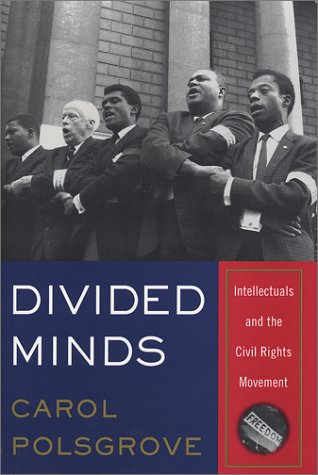
Discusses the civil rights movement through the ambivalent responses of leading writers and scholars to the Supreme Court's call for equality in Brown v. Board of Education.
"synopsis" may belong to another edition of this title.
About the Author
Carol Polsgrove is professor of journalism at Indiana University. She is the author of It Wasn't Pretty, Folks, But Didn't We Have Fun?: Esquire in the Sixties.
Reviews
In the decade after Brown v. Board of Education, "white intellectuals, in the North and the South... having helped for so long to keep Negroes apart and below... were faced with the challenge of racial equality," asserts Polsgrove (It Wasn't Pretty, Folks, but Didn't We Have Fun? Esquire in the Sixties). In this disturbing book, she shows them to have been "fearful, cautious, distracted, or simply indifferent." Based on interviews and archival research, she indicts not only prominent novelists and thinkers, including William Faulkner, Norman Mailer, Hannah Arendt and even the theologian Reinhold Niebuhr ("none better exemplifies the caution that northern white intellectuals... displayed toward desegregation"), but also their editors (who were "more interested in southern whites' responses to the Negro challenge than in what Negroes had to say") and the media, which "at a time when national magazines ought to have been leading the way to change... opened their pages to those who resisted it." Many of the best-known African-American novelists, cowed by "the emotional and political atmosphere of the McCarthy days," fare little better than their white counterparts in Polsgrove's hands. Only a few heroes emerge from her portrait: Lillian Smith, Kenneth Clark, Lawrence Reddick, James Silver, and most importantly, James Baldwin. Polsgrove concludes her accessible and disturbing account with a thought-provoking broadside against contemporary American intellectuals, who she thinks "have abandoned their responsibility even more completely" than those in the 1950s and 1960s and whose "publishing industry has moved farther and farther from any sense of obligation for the social enterprise." (May) Forecast: A wide range of periodicals (and their editors) from major weeklies and monthlies to small journals take a thrashing here. Polsgrove could set off a firestorm if she doesn't get the silent treatment.
Copyright 2001 Cahners Business Information, Inc.
Between 1954, when the Supreme Court declared segregated schools unconstitutional, and the mid-sixties, when Congress passed civil-rights and voting-rights bills, American academics and writers were invited to opine on race relations. In this brisk and understated account, Polsgrove shows that, with a few brave exceptions, whites told blacks to be patient rather than risk white Southerners' violence. Editors were slow to call on black thinkers, and, in the McCarthy era, racists found support for their argument that desegregation was a Communist plot. In 1960, the sit-ins staged by black students interrupted the timid debate, and, soon after, James Baldwin's New Yorker essay "Letter from a Region in My Mind" gave condescending white intellectuals a sense of black anger and suffering.
Copyright © 2005 The New Yorker
Polsgrove explores why American intellectuals, black and white, didn't lend their voices more aggressively to the call for racial justice during the infancy of the civil rights movement, especially in the period after the Supreme Court decision in Brown v. Board of Education (1954) required school desegregation. Celebrated Southern authors William Faulkner and Robert Penn Warren were at best ambivalent about the growing unrest in their region. National magazines ignored pro-integration writers, such as Lillian Smith, in favor of writers and historians who promoted a gradualist approach to ending discrimination. In the North and among black expatriates in Paris, intellectuals were similarly restrained in supporting desegregation. Fear of reprisals from entrenched anticommunist campaigns silenced or dampened many black intellectuals, who had noted the marginalization of the radical W. E. B. Du Bois and the ruined career of Paul Robeson. James Baldwin broke the silence with The Fire Next Time (1963), opening the floodgates of protest and resistance. An absorbing book about a troubled time in U.S. history, whose lessons continue to resonate. Vanessa Bush
Copyright © American Library Association. All rights reserved
"About this title" may belong to another edition of this title.
Search results for Divided Minds: Intellectuals and the Civil Rights Movement

Stock Image
Divided Minds: Intellectuals and the Civil Rights Movement
Published by
W W Norton & Co Inc (edition First Edition), 2001
ISBN 10: 0393020134
ISBN 13: 9780393020137
Used
Hardcover
First Edition
Seller: BooksRun, Philadelphia, PA, U.S.A.
Seller rating 5 out of 5 stars

Hardcover. Condition: Fair. First Edition. The item might be beaten up but readable. May contain markings or highlighting, as well as stains, bent corners, or any other major defect, but the text is not obscured in any way. Seller Inventory # 0393020134-7-1
Stock Image
Divided Minds: Intellectuals and the Civil Rights Movement
Seller: World of Books (was SecondSale), Montgomery, IL, U.S.A.
Seller rating 5 out of 5 stars
Hardback. Condition: Very Good. No movement in the 20th century posed such a stark moral challenge to American intellectuals as that of civil rights. This text tells the history of the civil rights movement, full of stories of unaccountable bravery and inexplicable timidity - often the products of the same divided minds. Seller Inventory # 00101256149
Seller Image
Divided Minds: Intellectuals and the Civil Rights Movement
Seller: Greenworld Books, Arlington, TX, U.S.A.
Seller rating 5 out of 5 stars
Condition: good. Fast Free Shipping â" Good condition. It may show normal signs of use, such as light writing, highlighting, or library markings, but all pages are intact and the book is fully readable. A solid, complete copy that's ready to enjoy. Seller Inventory # GWV.0393020134.G
Stock Image
Divided Minds : Intellectuals and the Civil Rights Movement
Published by
Norton & Company, Incorporated, W. W., 2001
ISBN 10: 0393020134
ISBN 13: 9780393020137
Used
Hardcover
First Edition
Seller: Better World Books, Mishawaka, IN, U.S.A.
Seller rating 5 out of 5 stars
Condition: Good. 1st ed. Pages intact with minimal writing/highlighting. The binding may be loose and creased. Dust jackets/supplements are not included. Stock photo provided. Product includes identifying sticker. Better World Books: Buy Books. Do Good. Seller Inventory # 10329367-6
Stock Image
Divided Minds : Intellectuals and the Civil Rights Movement
Published by
Norton & Company, Incorporated, W. W., 2001
ISBN 10: 0393020134
ISBN 13: 9780393020137
Used
Hardcover
First Edition
Seller: Better World Books, Mishawaka, IN, U.S.A.
Seller rating 5 out of 5 stars
Condition: Very Good. 1st ed. Pages intact with possible writing/highlighting. Binding strong with minor wear. Dust jackets/supplements may not be included. Stock photo provided. Product includes identifying sticker. Better World Books: Buy Books. Do Good. Seller Inventory # GRP71415686
Stock Image
Divided Minds: Intellectuals and the Civil Rights Movement
Seller: HPB-Diamond, Dallas, TX, U.S.A.
Seller rating 5 out of 5 stars
hardcover. Condition: Very Good. Connecting readers with great books since 1972! Used books may not include companion materials, and may have some shelf wear or limited writing. We ship orders daily and Customer Service is our top priority! Seller Inventory # S_458063104
Stock Image
Divided Minds: Intellectuals and the Civil Rights Movement
Seller: World of Books Inc, Montgomery, IL, U.S.A.
Seller rating 4 out of 5 stars

Hardback. Condition: Very Good. No movement in the 20th century posed such a stark moral challenge to American intellectuals as that of civil rights. This text tells the history of the civil rights movement, full of stories of unaccountable bravery and inexplicable timidity - often the products of the same divided minds. Seller Inventory # CIN0393020134VG
Stock Image
Divided Minds: Intellectuals and the Civil Rights Movement
Seller: ThriftBooks-Dallas, Dallas, TX, U.S.A.
Seller rating 5 out of 5 stars
Hardcover. Condition: As New. No Jacket. Pages are clean and are not marred by notes or folds of any kind. ~ ThriftBooks: Read More, Spend Less. Seller Inventory # G0393020134I2N00
Stock Image
Divided Minds: Intellectuals and the Civil Rights Movement
Seller: AwesomeBooks, Wallingford, United Kingdom
Seller rating 5 out of 5 stars
Hardcover. Condition: Very Good. Divided Minds: Intellectuals and the Civil Rights Movement This book is in very good condition and will be shipped within 24 hours of ordering. The cover may have some limited signs of wear but the pages are clean, intact and the spine remains undamaged. This book has clearly been well maintained and looked after thus far. Money back guarantee if you are not satisfied. See all our books here, order more than 1 book and get discounted shipping. . Seller Inventory # 7719-9780393020137
Buy Used
US$ 7.72
US$ 5.45 shipping
Ships from United Kingdom to U.S.A.
Ships from United Kingdom to U.S.A.
Quantity: 1 available
Seller Image
Divided Minds â" Intellectuals and the Civil Rights Movement: Intellectuals and the Civil Rights Movement
Published by
W. W. Norton and Co., 2001
ISBN 10: 0393020134
ISBN 13: 9780393020137
Used
Hardcover
First Edition
Seller: BoundlessBookstore, Wallingford, United Kingdom
Seller rating 5 out of 5 stars
Hardcover. Condition: Good. 1st printing. Boards are clean. Content is clean and bright. Good DJ with some tears. Seller Inventory # 9999-999106985953
Buy Used
US$ 6.82
US$ 9.24 shipping
Ships from United Kingdom to U.S.A.
Ships from United Kingdom to U.S.A.
Quantity: 1 available