
Items related to Extinction: Bad Genes or Bad Luck?
Synopsis
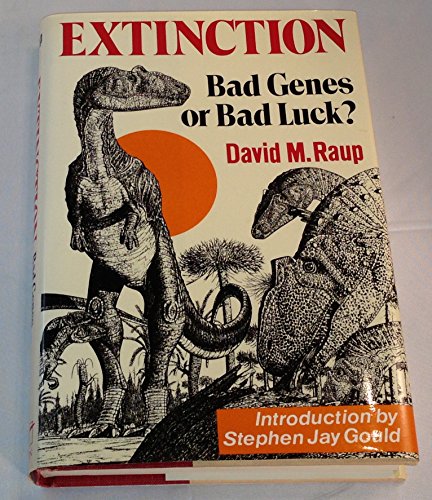
Discusses the causes and mechanisms of extinction, drawing on the fields of paleontology and statistics to chronicle the histories of extinct species
"synopsis" may belong to another edition of this title.
Reviews
Raup takes up a cocktail-party science topic--Why do entire branches of life "suddenly" (in geologic time) disappear?--and gives it weight and validity. Despite the catchy title, Raup's presentation is plenty rigorous, drawing in just enough geology, anthropology, biostatistics and yes, even the Alvarez meteor/earth cataclysm, to send readers looking for additional reading on current evolutionary theory. Fans of Stephen Jay Gould will find a similarly fluent and friendly lecture style here. University of Chicago professor Raup is coauthor of several standard graduate-level texts on paleontology and evolution. Illustrations not seen by PW.
Copyright 1991 Reed Business Information, Inc.
A remarkably candid book on what we know and (mostly) what we don't know about evolution and extinction. Raup, a ``statistical'' paleontologist at the Univ. of Chicago, is best known for his popular exposition of a theory that extinctions come in 25-million- year cycles, an idea that spawned the notion that the sun had a dark companion (``Nemesis'') that periodically triggered cometary showers that wrecked havoc on earth. Maybe not Nemesis, Raup says, but he still holds out for periodicity and mass killing via meteor impact. Before reviewing theories of extinction, Raup provides useful insights and details on evolution and a number of tables illustrating time scales, percentages of organisms dying, etc., as well as a philosophical discussion of the value of extinction. He argues that an extinction-free world might not lead to as much diversity as the world has enjoyed. We can't be sure, but would birds or whales or humans have evolved in the absence of the terrain created after mass killings of other species? Everywhere, he urges caution--the data are not available; people are distressingly anthropomorphic as well as suspicious of unearthly theories of extinction. In a wonderful tour de force, he lays out the arguments and counterarguments for the theory that large impact craters are the cause for mass extinctions. Both sides are convincing. In the end, Raup makes a strong case that extinction is necessary for evolution and largely blind to the fitness of organisms. A first strike, such as human intervention or an epidemic disease, may trigger the beginning of extinction. So may bad genes. But, overall, bad luck is more likely. While the book is important for what it has to say about life on earth, it is also a marvelous exposition of think and double-think in science. -- Copyright ©1991, Kirkus Associates, LP. All rights reserved.
Scientists have directed a good deal of attention to the topic of extinction in recent years. In this book, Raup, a mathematically oriented paleontologist, discusses the role of extinction in evolution, attempting to differentiate the effects of natural selection ("bad genes") and extraterrestrial causes ("bad luck"). It is a nicely done work written for the layperson, much in the vein of his previous book, The Nemesis Affair ( LJ 8/86), which covers some of the same territory and which also favors extraterrestrial causes. This book should serve as a complement to the relatively few other recent works on extinction for the nonspecialist, notably Steven M. Stanley's Extinction (Scientific American Lib., 1987), which offers an alternative viewpoint.
-Joseph Hannibal, Cleveland Museum of Natural History
Copyright 1991 Reed Business Information, Inc.
"About this title" may belong to another edition of this title.
Search results for Extinction: Bad Genes or Bad Luck?

Stock Image
Extinction: Bad Genes or Bad Luck?
Seller: Your Online Bookstore, Houston, TX, U.S.A.
Seller rating 5 out of 5 stars

hardcover. Condition: Fair. Seller Inventory # 0393030083-4-36676760
Stock Image
Extinction: Bad Genes or Bad Luck?
Published by
W W Norton & Co Inc (edition First Edition), 1991
ISBN 10: 0393030083
ISBN 13: 9780393030082
Used
Hardcover
First Edition
Seller: BooksRun, Philadelphia, PA, U.S.A.
Seller rating 5 out of 5 stars
Hardcover. Condition: Fair. First Edition. With dust jacket. The item might be beaten up but readable. May contain markings or highlighting, as well as stains, bent corners, or any other major defect, but the text is not obscured in any way. Seller Inventory # 0393030083-7-1-29
Stock Image
Extinction: Bad Genes or Bad Luck?
Seller: ThriftBooks-Atlanta, AUSTELL, GA, U.S.A.
Seller rating 5 out of 5 stars
Hardcover. Condition: Very Good. No Jacket. Former library book; May have limited writing in cover pages. Pages are unmarked. ~ ThriftBooks: Read More, Spend Less. Seller Inventory # G0393030083I4N10
Stock Image
Extinction: Bad Genes or Bad Luck?
Seller: ThriftBooks-Dallas, Dallas, TX, U.S.A.
Seller rating 5 out of 5 stars
Hardcover. Condition: Very Good. No Jacket. May have limited writing in cover pages. Pages are unmarked. ~ ThriftBooks: Read More, Spend Less. Seller Inventory # G0393030083I4N00
Stock Image
Extinction: Bad Genes or Bad Luck?
Seller: ThriftBooks-Atlanta, AUSTELL, GA, U.S.A.
Seller rating 5 out of 5 stars
Hardcover. Condition: Very Good. No Jacket. May have limited writing in cover pages. Pages are unmarked. ~ ThriftBooks: Read More, Spend Less. Seller Inventory # G0393030083I4N00
Stock Image
Extinction: Bad Genes or Bad Luck?
Seller: Wonder Book, Frederick, MD, U.S.A.
Seller rating 5 out of 5 stars
Condition: Fair. Acceptable condition. Book Acceptable. No dust jacket. Former Library book. A readable, intact copy that may have noticeable tears and wear to the spine. All pages of text are present, but they may include extensive notes and highlighting or be heavily stained. Includes reading copy only books. Seller Inventory # A12A-07191
Stock Image
Extinction: Bad Genes or Bad Luck?
Seller: ThriftBooks-Phoenix, Phoenix, AZ, U.S.A.
Seller rating 5 out of 5 stars
Hardcover. Condition: Very Good. No Jacket. May have limited writing in cover pages. Pages are unmarked. ~ ThriftBooks: Read More, Spend Less. Seller Inventory # G0393030083I4N00
Stock Image
Extinction: Bad Genes or Bad Luck?
Seller: ThriftBooks-Reno, Reno, NV, U.S.A.
Seller rating 5 out of 5 stars
Hardcover. Condition: Very Good. No Jacket. May have limited writing in cover pages. Pages are unmarked. ~ ThriftBooks: Read More, Spend Less. Seller Inventory # G0393030083I4N00
Stock Image
Extinction: Bad Genes or Bad Luck?
Seller: Half Price Books Inc., Dallas, TX, U.S.A.
Seller rating 5 out of 5 stars
hardcover. Condition: Very Good. Connecting readers with great books since 1972! Used books may not include companion materials, and may have some shelf wear or limited writing. We ship orders daily and Customer Service is our top priority! Seller Inventory # S_488786693
Stock Image
Extinction : Bad Genes or Bad Luck?
Published by
Norton & Company, Incorporated, W. W., 1991
ISBN 10: 0393030083
ISBN 13: 9780393030082
Used
Hardcover
First Edition
Seller: Better World Books, Mishawaka, IN, U.S.A.
Seller rating 5 out of 5 stars
Condition: Good. First Edition. Pages intact with minimal writing/highlighting. The binding may be loose and creased. Dust jackets/supplements are not included. Stock photo provided. Product includes identifying sticker. Better World Books: Buy Books. Do Good. Seller Inventory # 16166465-6