Items related to Women's Work: The First 20,000 Years : Women, Cloth,...
Synopsis
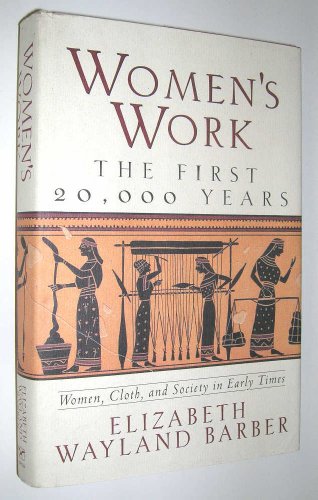
Drawing on the latest archaeological and technological research, this intriguing study of women's history explores the relationship between the development of the fiber arts and women's roles in society.
"synopsis" may belong to another edition of this title.
About the Author
Elizabeth Wayland Barber is the author of Women’s Work and The Mummies of Ürümchi. Professor emerita of archaeology and linguistics at Occidental College, she lives in California.
Excerpt. © Reprinted by permission. All rights reserved.
Among the Batak the act of creation itself is viewed as women's special work, not only in production of babies, which grow where nothing has existed before, but also in creating cloth, which comes into being where nothing has existed before. Cloth and its making are thus taken as analogs for life and birth, in every sense.
"About this title" may belong to another edition of this title.
- PublisherW W Norton & Co Inc
- Publication date1994
- ISBN 10 0393035069
- ISBN 13 9780393035063
- BindingHardcover
- Edition number1
- Number of pages334
- Rating
Buy New
Learn more about this copy
US$ 109.41
Shipping:
US$ 6.95
Within U.S.A.

Top Search Results from the AbeBooks Marketplace
Stock Image
Women's Work: The First 20,000 Years : Women, Cloth, and Society in Early Times
Seller: HPB-Ruby, Dallas, TX, U.S.A.
Seller rating 5 out of 5 stars

Hardcover. Condition: Very Good. Connecting readers with great books since 1972! Used books may not include companion materials, and may have some shelf wear or limited writing. We ship orders daily and Customer Service is our top priority!. Seller Inventory # S_413384742
Quantity: 1 available
Stock Image
Women's Work: The First 20,000 Years : Women, Cloth, and Society in Early Times
Seller: SecondSale, Montgomery, IL, U.S.A.
Seller rating 5 out of 5 stars
Condition: Very Good. Item in very good condition! Textbooks may not include supplemental items i.e. CDs, access codes etc. Seller Inventory # 00073902650
Quantity: 2 available
Stock Image
Women's Work: The First 20,000 Years : Women, Cloth, and Society in Early Times
Seller: SecondSale, Montgomery, IL, U.S.A.
Seller rating 5 out of 5 stars
Condition: Good. Item in very good condition! Textbooks may not include supplemental items i.e. CDs, access codes etc. Seller Inventory # 00074679657
Quantity: 1 available
Stock Image
Women's Work: The First 20,000 Years: Women, Cloth, and Society in Early Times
Seller: ThriftBooks-Dallas, Dallas, TX, U.S.A.
Seller rating 5 out of 5 stars
Hardcover. Condition: Good. No Jacket. Former library book; Missing dust jacket; Pages can have notes/highlighting. Spine may show signs of wear. ~ ThriftBooks: Read More, Spend Less 1.45. Seller Inventory # G0393035069I3N11
Quantity: 1 available
Stock Image
Womens Work: The First 20,000 Years : Women, Cloth, and Society in Early Times
Seller: Goodwill San Antonio, San Antonio, TX, U.S.A.
Seller rating 5 out of 5 stars
Condition: Good. This is a ex library book, stickers and markings accordingly. Good Reading Copy, May have minor shelf wear, Fast Shipping - Safe and Secure in Mailer. Seller Inventory # 4Q2SPP001Q6I
Quantity: 1 available
Stock Image
Women's Work : The First 20,000 Years; Women, Cloth, and Society in Early Times
Published by
W. W. Norton, New York, NY, 1994
ISBN 10: 0393035069
ISBN 13: 9780393035063
Used
Trade Paperback
Seller: Storybook House, Southampton, ON, Canada
Seller rating 4 out of 5 stars

Trade Paperback. Condition: Very Good. Seller Inventory # 038923
Quantity: 1 available
Stock Image
Women's Work: The First 20,000 Years : Women, Cloth, and Society in Early Times
Seller: Book Alley, Pasadena, CA, U.S.A.
Seller rating 4 out of 5 stars
hardcover. Condition: Very Good. Dust Jacket Condition: Very Good. A very good hardcover in a very good dust jacket which has some wear around the edges. Seller Inventory # mon0000694116
Quantity: 1 available
Stock Image
Women's Work : The First 20,000 Years - Women, Cloth and Society in Early Times
Seller: June Samaras, STREETSVILLE, ON, Canada
Seller rating 5 out of 5 stars
Hardcover. Condition: As New. Dust Jacket Condition: Fine. 1st.US Ed. Fascinating account of the contibution of women to early cultures, with archaeological and anthropological evidence for their skills in weaving, spinning and the development of textiles. 334.illus Bibliography. index. Book. Seller Inventory # 039066
Quantity: 1 available
Stock Image
Women's Work: The First 20,000 Years : Women, Cloth, and Society in Early Times
Seller: LibraryMercantile, Humble, TX, U.S.A.
Seller rating 5 out of 5 stars
Condition: very good. Seller Inventory # OldMercantile_0393035069
Quantity: 1 available
Stock Image
Women's Work: The First 20,000 Years : Women, Cloth, and Society in Early Times
Seller: Toscana Books, AUSTIN, TX, U.S.A.
Seller rating 4 out of 5 stars
Hardcover. Condition: very good. Purchase pre-owned books for prompt service and customer satisfaction. Seller Inventory # UnScanned0393035069
Quantity: 1 available