
Items related to Divided We Fall: Gambling With History in the Nineties
Synopsis
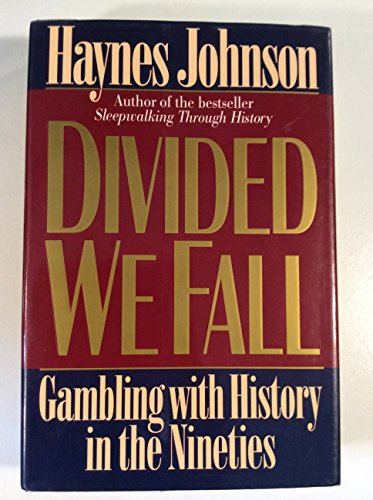
The best-selling author of Sleepwalking Through History draws on interviews with Americans across the country to explore contemporary concerns about such issues as crime, unemployment, education, race relations, values, and more. 50,000 first printing. Tour.
"synopsis" may belong to another edition of this title.
About the Author
Haynes Johnson has taught at Princeton University.
Reviews
Johnson, whose Sleepwalking Through History dealt with America's moral decline in the Reagan era, spent more than a year crisscrossing the country, interviewing people from all walks of life to gauge the current American temperament. Everywhere he went he encountered rising cynicism, alienation from politics and institutions, fear over the economic future, concern with violent crime, volatile ethnic and racial tensions. This sobering report warns that with massive cutbacks in funding for schools, hospitals and social welfare programs, more and more people are falling through a "safety net" rent with gaping holes. Johnson's odyssey culminates in an interview with President Clinton which reads like a canned speech. Calling Clinton's proposed health care plan "the boldest, most visionary domestic initiative since the 1930's," Johnson concludes that Clinton's greatest challenge will be to convince Americans that his programs are worth additional cost and sacrifice. 50,000 first printing; $50,000 ad/promo; author tour.
Copyright 1994 Reed Business Information, Inc.
From Pulitzer Prize-winner Johnson (Sleepwalking through History, 1991): a depressing look at America's disintegrating society and the moribund American dream. Johnson traveled throughout the United States for two years, from Maine to California, talking to ordinary people about the direction of American society. Wherever he went, he found people concerned and angry about the same issues: crime; massive, permanent budget deficits; unemployment and underemployment; the declining schools; and the decaying industrial base. Johnson allows people to tell their truly frightening tales: of college graduates and holders of doctorates unable to find any but unskilled employment; of students who fear random violence in the classroom; of wealthy people living in fortresslike dwellings; of crippling cuts in services such as libraries, schools, and policing; and of cities, filled with economic frustration and racial tension, exploding in riotous rage (most spectacularly, in Los Angeles in 1992). Johnson looks at increasing class polarization, the transformation of American society by huge waves of immigration, the threat of environmental disaster, and the attempts of Americans to restore a sense of purpose and value to their lives. He also examines how unresponsive the American political system is to the nation's many crises and how government is too often hamstrung by marginal groups or special interests. On the other hand, Johnson sees a sense of urgency in the Americans he met. Looking back at other crises Americans overcame, he observes that ``America still possesses enormous resources, backed by an energetic, resourceful people.'' Haynes concludes that Americans can address the challenges facing them, however formidable they may be: he does ``not feel that I have been writing the obituary of the American Dream. I believe I have been writing about an interlude in the reclaiming of that Dream.'' A disturbing snapshot of a nation in crisis, with a critical message: If you love your country, take action. -- Copyright ©1994, Kirkus Associates, LP. All rights reserved.
Johnson, a Pulitzer Prize winner, PBS commentator, and author of the best-selling Sleepwalking Through History ( LJ 2/1/91), follows up with this vision of the problems facing America in the post-Reagan years. Johnson reports from across the country about the concerns of grass-roots Americans and their attitudes about such issues as crime, education, and our economic future. Among the more disturbing trends cited are a tendency toward even more racial and cultural disunity and an obsession with short-term results at the expense of long-range planning. Although his travels took him to only a few select locales, Johnson found some eloquent subjects to interview, including President Clinton. This stark portrayal of the nation makes for a disturbing book but one that should be owned by every library. Previewed in Prepub Alert, LJ 12/93.
- Gary Williams, Southeastern Ohio Regional Lib., Caldwell
Copyright 1994 Reed Business Information, Inc.
When Selma, Alabama, was the focus of the civil-rights movement, Johnson won a Pulitzer Prize for his reports from that city. A 25-year Washington Post veteran, frequent guest commentator on Washington Week in Review, and author of 10 other books, most recently a best-selling overview of the U.S. during the Reagan years, Sleepwalking through History (1991), Johnson has spent much of the past two years in Selma--and dozens of other cities and towns, from Maine to Florida and California to Michigan--probing ordinary Americans' attitudes about the problems and opportunities the U.S. faces as the twentieth century draws to a close. He discusses new economic realities and the devastating effect of years of short-term thinking and decay on America's "fabric"--its services, schools, races, crime, class, culture, migrants, values, politics, leaders, and people--with scores of individuals, from laid-off schoolteachers, welfare moms, farm families, and gang members to bankers and college administrators and, in an August 1993 interview, President Clinton. Finally, Johnson discerns at least some hope that the American people grasp the need for long-term thinking and shared sacrifice, for celebrating our diversity while compromising on our differences--a realization that few politicians and pundits seem capable of understanding. Mary Carroll
"About this title" may belong to another edition of this title.
Search results for Divided We Fall: Gambling With History in the Nineties

Stock Image
Divided We Fall: Gambling With History in the Nineties
Seller: World of Books (was SecondSale), Montgomery, IL, U.S.A.
Seller rating 5 out of 5 stars

Hardback. Condition: Very Good. This text is based on interviews with a wide range of people in American society, from businessmen to illegal immigrants, covering topics such as jobs, crime, race and education. It concludes that many Americans feel disconnected from their government, but are aware of the lack of an easy solution. Seller Inventory # 00098891790
Stock Image
Divided We Fall: Gambling With History in the Nineties
Seller: World of Books (was SecondSale), Montgomery, IL, U.S.A.
Seller rating 5 out of 5 stars
Hardback. Condition: Good. This text is based on interviews with a wide range of people in American society, from businessmen to illegal immigrants, covering topics such as jobs, crime, race and education. It concludes that many Americans feel disconnected from their government, but are aware of the lack of an easy solution. Seller Inventory # 00098828640
Stock Image
Divided We Fall: Gambling With History in the Nineties
Seller: Orion Tech, Kingwood, TX, U.S.A.
Seller rating 5 out of 5 stars
hardcover. Condition: Good. Seller Inventory # 0393036294-3-37919354
Seller Image
Divided We Fall: Gambling With History in the Nineties
Seller: Greenworld Books, Arlington, TX, U.S.A.
Seller rating 5 out of 5 stars
Condition: very_good. Fast Free Shipping â" Very Good condition book with a firm cover and clean pages. Shows normal use and some light wear or limited notes markings. A solid, nice copy to enjoy. Seller Inventory # GWV.0393036294.VG
Stock Image
Divided We Fall: Gambling With History in the Nineties
Seller: BookHolders, Towson, MD, U.S.A.
Seller rating 5 out of 5 stars
Condition: Good. [ No Hassle 30 Day Returns ][ Ships Daily ] [ Underlining/Highlighting: NONE ] [ Writing: NONE ] [ Edition: first ] Publisher: W W Norton & Co Inc Pub Date: 4/1/1994 Binding: Hardcover Pages: 431 first edition. Seller Inventory # 3482905
Stock Image
Divided We Fall: Gambling With History in the Nineties
Published by
W W Norton & Co Inc (edition First Edition), 1994
ISBN 10: 0393036294
ISBN 13: 9780393036299
Used
Hardcover
First Edition
Seller: BooksRun, Philadelphia, PA, U.S.A.
Seller rating 5 out of 5 stars
Hardcover. Condition: Very Good. First Edition. With dust jacket. It's a well-cared-for item that has seen limited use. The item may show minor signs of wear. All the text is legible, with all pages included. It may have slight markings and/or highlighting. Seller Inventory # 0393036294-11-1-29
Stock Image
Divided We Fall: Gambling With History in the Nineties
Seller: ThriftBooks-Atlanta, AUSTELL, GA, U.S.A.
Seller rating 5 out of 5 stars
Hardcover. Condition: As New. No Jacket. Pages are clean and are not marred by notes or folds of any kind. ~ ThriftBooks: Read More, Spend Less. Seller Inventory # G0393036294I2N00
Stock Image
Divided We Fall: Gambling With History in the Nineties
Seller: ThriftBooks-Dallas, Dallas, TX, U.S.A.
Seller rating 5 out of 5 stars
Hardcover. Condition: As New. No Jacket. Pages are clean and are not marred by notes or folds of any kind. ~ ThriftBooks: Read More, Spend Less. Seller Inventory # G0393036294I2N00
Stock Image
Divided We Fall: Gambling With History in the Nineties
Seller: Book Gurus, Tallahassee, FL, U.S.A.
Seller rating 5 out of 5 stars
hardcover. Condition: Fine. Seller Inventory # 01KY3J9GFT5ZGYM
Stock Image
Divided We Fall: Gambling With History in the Nineties
Seller: Wonder Book, Frederick, MD, U.S.A.
Seller rating 5 out of 5 stars
Condition: Very Good. Very Good condition. Good dust jacket. A copy that may have a few cosmetic defects. May also contain light spine creasing or a few markings such as an owner's name, short gifter's inscription or light stamp. Seller Inventory # Y12A-05280