
Items related to In Search of the Racial Frontier: African Americans...
Synopsis
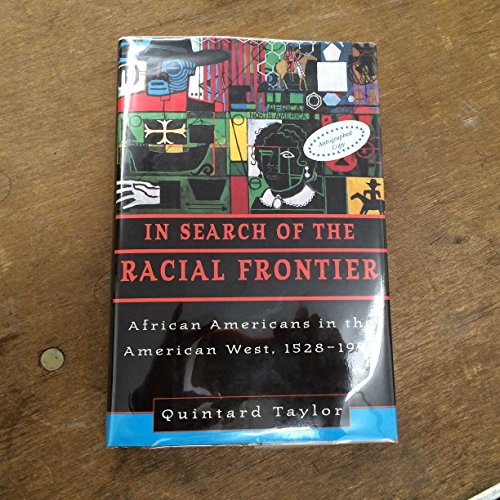
A pioneering illustrated history of the role of African Americans in the development of the American West ranges from the arrival of Spanish-speaking blacks in Texas in 1528, to the growth of the West's black population after World War II.
"synopsis" may belong to another edition of this title.
About the Author
Quintard Taylor is a professor of history at the University of Oregon. He lives in Eugene, Oregon.
Reviews
In an absorbing chronicle more remarkable for its wealth of interesting facts and figures than for any overarching historical thesis, Taylor, a University of Oregon history professor, ably documents the history of African Americans in the American West. Taylor begins in the early 16th century, when the first Spanish-speaking black slaves of the conquistadors arrived in Texas and New Mexico, and carries his study through the civil rights era to the present. Dispelling the lingering stereotype of rugged, solitary black cowboys, Taylor shows that black Westerners were predominantly urban workers?waiters cooks, doctors, lawyers, restaurant and barbershop owners, schoolteachers, newspaper editors?who built community institutions (fraternal organizations, women's clubs) while striving to integrate themselves into the larger society. Among the many facts that will surprise readers is this: of the original 46 settlers who founded Los Angeles in 1781, 26 were black or biracial. Marshaling a wealth of primary source material, Taylor documents black Westerners' participation in all aspects of life in the American West and, in the process, reclaims an important dimension of African American history. Photos, maps.
Copyright 1998 Reed Business Information, Inc.
This important new work is the first substantial study of African Americans in the American West. Taylor (The Forging of a Black Community: Seattle's Central District from 1870 Through the Civil Rights Era, Univ. of Washington, 1994) covers the key individuals and events from the arrival of the first blacks with the Spanish in 1528 through the Civil Rights era of the 1960s. He also examines the similarities and differences between black culture in the West and in the rest of the country. Especially revealing is Taylor's analysis of urban life, which adds new perspectives to the stereotypes of African American Westerners as solitary figures. This extensively researched, well-written book builds on pioneering work found in Kenneth W. Porter's The Negro on the American Frontier (1971), W. Sherman Savage's Blacks in the West (1976), and William Loren Katz's The Black West (1987. 3d ed.). A required purchase for all libraries.?Stephen L. Hupp, Univ. of Pittsburgh at Johnston, Pa.
Copyright 1998 Reed Business Information, Inc.
A general account of the black American component of the history of the states from Kansas, Oklahoma, and Texas westward. Like the larger history of the U.S., that of the West divides into pre-and post-1865, and Taylor, a university history professor, renders a detailed picture of the pre^-Civil War situation of western blacks, 95 percent of whom were enslaved in Texas. (Taylor lays out tables of population statistics throughout this work.) Numbers aside, the text enlivens with stories of those who led forth black settlers after the war; Kansas, with its abolitionist tradition, was most attractive, whereas darkness was again descending in Texas as a "one-sided race war" restored white supremacy. Taylor gives a nod to the latest stars in black history, the buffalo soldiers, featured recently in an eponymous movie, and then resumes his thread with the discrimination problems blacks encountered in western cities, especially as their urban population increased after World War II. Expert orientation for students wishing to journey further into this large subject. Gilbert Taylor
"About this title" may belong to another edition of this title.
Search results for In Search of the Racial Frontier: African Americans...

Stock Image
In Search of the Racial Frontier: African Americans in the American West, 1528-1990
Seller: Your Online Bookstore, Houston, TX, U.S.A.
Seller rating 5 out of 5 stars

Hardcover. Condition: Good. Seller Inventory # 0393041050-3-26927838
Stock Image
IN SEARCH OF RACIAL FRONTIER CL
Seller: World of Books (was SecondSale), Montgomery, IL, U.S.A.
Seller rating 5 out of 5 stars
Hardback. Condition: Good. The American West is mistakenly known as a region with few African Americans and virtually no black history. This book challenges that view in a complex chronicle that begins in 1528 with the Spanish-speaking blacks. In 1848 the first English speaking blacks arrived - as slaves - creating a nucleus of post-American Civil War communities. Thousands of African-Americans thereafter migrated to the high plains while others drove cattle up the Chisholm trail or served on remote army outposts. The book moves on to examine the first black church in 1872, the West's black civil rights movement which began during the Civil War and 20th-century changes such as migration after World War II, the civil rights movement during the 1960s and the interest in multiculturalism. Seller Inventory # 00102489651
Stock Image
In Search of the Racial Frontier: African Americans in the American West, 1528-1990
Seller: ThriftBooks-Atlanta, AUSTELL, GA, U.S.A.
Seller rating 5 out of 5 stars
Hardcover. Condition: Good. No Jacket. Former library book; Missing dust jacket; Pages can have notes/highlighting. Spine may show signs of wear. ~ ThriftBooks: Read More, Spend Less. Seller Inventory # G0393041050I3N11
Stock Image
In Search of the Racial Frontier: African Americans in the American West, 1528-1990
Seller: ThriftBooks-Atlanta, AUSTELL, GA, U.S.A.
Seller rating 5 out of 5 stars
Hardcover. Condition: Very Good. No Jacket. Former library book; May have limited writing in cover pages. Pages are unmarked. ~ ThriftBooks: Read More, Spend Less. Seller Inventory # G0393041050I4N10
Stock Image
In Search of the Racial Frontier: African Americans in the American West, 1528-1990
Seller: ThriftBooks-Dallas, Dallas, TX, U.S.A.
Seller rating 5 out of 5 stars
Hardcover. Condition: Very Good. No Jacket. May have limited writing in cover pages. Pages are unmarked. ~ ThriftBooks: Read More, Spend Less. Seller Inventory # G0393041050I4N00
Stock Image
In Search of the Racial Frontier: African Americans in the American West, 1528-1990
Seller: ThriftBooks-Dallas, Dallas, TX, U.S.A.
Seller rating 5 out of 5 stars
Hardcover. Condition: Very Good. No Jacket. Former library book; May have limited writing in cover pages. Pages are unmarked. ~ ThriftBooks: Read More, Spend Less. Seller Inventory # G0393041050I4N10
Stock Image
In Search of the Racial Frontier: African Americans in the American West, 1528-1990
Published by
W W Norton & Co Inc (edition 1), 1998
ISBN 10: 0393041050
ISBN 13: 9780393041057
Used
Hardcover
Seller: BooksRun, Philadelphia, PA, U.S.A.
Seller rating 5 out of 5 stars
Hardcover. Condition: Very Good. 1. With dust jacket. It's a well-cared-for item that has seen limited use. The item may show minor signs of wear. All the text is legible, with all pages included. It may have slight markings and/or highlighting. Seller Inventory # 0393041050-11-1-29
Stock Image
IN SEARCH OF RACIAL FRONTIER CL
Seller: World of Books Inc, Montgomery, IL, U.S.A.
Seller rating 4 out of 5 stars

Hardback. Condition: Good. The American West is mistakenly known as a region with few African Americans and virtually no black history. This book challenges that view in a complex chronicle that begins in 1528 with the Spanish-speaking blacks. In 1848 the first English speaking blacks arrived - as slaves - creating a nucleus of post-American Civil War communities. Thousands of African-Americans thereafter migrated to the high plains while others drove cattle up the Chisholm trail or served on remote army outposts. The book moves on to examine the first black church in 1872, the West's black civil rights movement which began during the Civil War and 20th-century changes such as migration after World War II, the civil rights movement during the 1960s and the interest in multiculturalism. Seller Inventory # CIN0393041050G
Stock Image
In Search of the Racial Frontier : African Americans in the American West, 1528-1990
Published by
Norton & Company, Incorporated, W. W., 1998
ISBN 10: 0393041050
ISBN 13: 9780393041057
Used
Hardcover
Seller: Better World Books, Mishawaka, IN, U.S.A.
Seller rating 5 out of 5 stars
Condition: Good. 1 Edition. Former library copy. Pages intact with minimal writing/highlighting. The binding may be loose and creased. Dust jackets/supplements are not included. Includes library markings. Stock photo provided. Product includes identifying sticker. Better World Books: Buy Books. Do Good. Seller Inventory # 495218-6
Stock Image
In Search of the Racial Frontier : African Americans in the American West, 1528-1990
Published by
Norton & Company, Incorporated, W. W., 1998
ISBN 10: 0393041050
ISBN 13: 9780393041057
Used
Hardcover
Seller: Better World Books: West, Reno, NV, U.S.A.
Seller rating 5 out of 5 stars
Condition: Good. 1 Edition. Former library copy. Pages intact with minimal writing/highlighting. The binding may be loose and creased. Dust jackets/supplements are not included. Includes library markings. Stock photo provided. Product includes identifying sticker. Better World Books: Buy Books. Do Good. Seller Inventory # 495218-6