
Items related to Global Capitalism: Its Fall and Rise in the Twentieth...
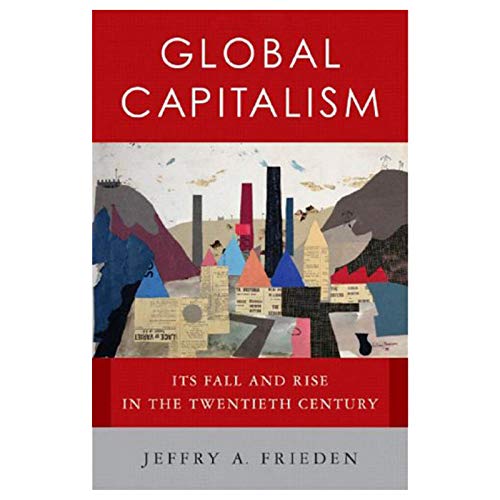
Synopsis
"Magisterial history...one of the most comprehensive histories of modern capitalism yet written."--New York Times Book Review
In 1900 international trade reached unprecedented levels and the world's economies were more open to one another than ever before. Then as now, many people considered globalization to be inevitable and irreversible. Yet the entire edifice collapsed in a few months in 1914.Globalization is a choice, not a fact. It is a result of policy decisions and the politics that shape them. Jeffry A. Frieden's insightful history explores the golden age of globalization during the early years of the century, its swift collapse in the crises of 1914-45, the divisions of the Cold War world, and the turn again toward global integration at the end of the century. His history is full of character and event, as entertaining as it is enlightening."synopsis" may belong to another edition of this title.
About the Author
Jeffry Frieden is Professor of International and Public Affairs and Political Science at Columbia University and Professor of Government emeritus at Harvard University. He specializes in the politics of international economic relations. Frieden is the author of Global Capitalism: Its Fall and Rise in the Twentieth Century (2007; second updated edition 2020); of Currency Politics: The Political Economy of Exchange Rate Policy (2015); and the co-author (with Menzie Chinn) of Lost Decades: The Making of America's Debt Crisis and the Long Recovery (2012). Frieden is also the author of Debt, Development, and Democracy: Modern Political Economy and Latin America, 1965–1985 (1992), of Banking on the World: The Politics of American International Finance (1987), and the co-author or co-editor of over a dozen other books on related topics. His articles on the politics of international economic issues have appeared in a wide variety of scholarly and general-interest publications.
Reviews
Frieden, an academic, traces the history of globalization from the late 1800s to the present, telling us, "Global economy and culture form a nearly seamless web in which the national boundaries are increasingly irrelevant to trade, investment, finance and other economic activity." Globalization is a choice formed by politics and policy decisions. It is now considered the norm, a fact of life that will continue. However, the author points out that this was also true from the end of the 1800s to 1914 and the start of World War I. The foundations of preexisting global economic order disintegrated, reemerging in the 1970s but not thriving until the 1990s. International integration usually expands economic opportunities and benefits society, but global capitalism, which does not address those ill-treated by world markets (e.g., the unemployed, the poor, children and the elderly), has driven societies toward conflict and class warfare. This is an excellent, readable history of globalization with important lessons for our society today. Mary Whaley
Copyright © American Library Association. All rights reserved
"About this title" may belong to another edition of this title.
Search results for Global Capitalism: Its Fall and Rise in the Twentieth...

Stock Image
Global Capitalism: Its Fall and Rise in the Twentieth Century
Seller: ThriftBooks-Reno, Reno, NV, U.S.A.
Seller rating 5 out of 5 stars

Hardcover. Condition: Good. No Jacket. Former library book; Pages can have notes/highlighting. Spine may show signs of wear. ~ ThriftBooks: Read More, Spend Less. Seller Inventory # G0393058085I3N10
Stock Image
Global Capitalism: Its Fall and Rise in the Twentieth Century
Seller: ThriftBooks-Reno, Reno, NV, U.S.A.
Seller rating 5 out of 5 stars
Hardcover. Condition: Good. No Jacket. Missing dust jacket; Pages can have notes/highlighting. Spine may show signs of wear. ~ ThriftBooks: Read More, Spend Less. Seller Inventory # G0393058085I3N01
Stock Image
Global Capitalism: Its Fall and Rise in the Twentieth Century
Seller: ThriftBooks-Reno, Reno, NV, U.S.A.
Seller rating 5 out of 5 stars
Hardcover. Condition: Very Good. No Jacket. Missing dust jacket; May have limited writing in cover pages. Pages are unmarked. ~ ThriftBooks: Read More, Spend Less. Seller Inventory # G0393058085I4N01
Stock Image
Global Capitalism: Its Fall and Rise in the Twentieth Century
Seller: ThriftBooks-Phoenix, Phoenix, AZ, U.S.A.
Seller rating 5 out of 5 stars
Hardcover. Condition: Good. No Jacket. Missing dust jacket; Pages can have notes/highlighting. Spine may show signs of wear. ~ ThriftBooks: Read More, Spend Less. Seller Inventory # G0393058085I3N01
Stock Image
Global Capitalism: Its Fall and Rise in the Twentieth Century
Seller: ThriftBooks-Phoenix, Phoenix, AZ, U.S.A.
Seller rating 5 out of 5 stars
Hardcover. Condition: Fair. No Jacket. Readable copy. Pages may have considerable notes/highlighting. ~ ThriftBooks: Read More, Spend Less. Seller Inventory # G0393058085I5N00
Stock Image
Global Capitalism: Its Fall and Rise in the Twentieth Century
Seller: ThriftBooks-Atlanta, AUSTELL, GA, U.S.A.
Seller rating 5 out of 5 stars
Hardcover. Condition: Good. No Jacket. Missing dust jacket; Pages can have notes/highlighting. Spine may show signs of wear. ~ ThriftBooks: Read More, Spend Less. Seller Inventory # G0393058085I3N01
Stock Image
Global Capitalism: Its Fall and Rise in the Twentieth Century
Seller: ThriftBooks-Dallas, Dallas, TX, U.S.A.
Seller rating 5 out of 5 stars
Hardcover. Condition: Good. No Jacket. Pages can have notes/highlighting. Spine may show signs of wear. ~ ThriftBooks: Read More, Spend Less. Seller Inventory # G0393058085I3N00
Stock Image
Global Capitalism: Its Fall and Rise in the Twentieth Century
Seller: ThriftBooks-Atlanta, AUSTELL, GA, U.S.A.
Seller rating 5 out of 5 stars
Hardcover. Condition: Good. No Jacket. Pages can have notes/highlighting. Spine may show signs of wear. ~ ThriftBooks: Read More, Spend Less. Seller Inventory # G0393058085I3N00
Stock Image
Global Capitalism: Its Fall and Rise in the Twentieth Century
Seller: ThriftBooks-Dallas, Dallas, TX, U.S.A.
Seller rating 5 out of 5 stars
Hardcover. Condition: Fair. No Jacket. Readable copy. Pages may have considerable notes/highlighting. ~ ThriftBooks: Read More, Spend Less. Seller Inventory # G0393058085I5N00
Stock Image
Global Capitalism: Its Fall and Rise in the Twentieth Century
Seller: ThriftBooks-Atlanta, AUSTELL, GA, U.S.A.
Seller rating 5 out of 5 stars
Hardcover. Condition: Very Good. No Jacket. Former library book; May have limited writing in cover pages. Pages are unmarked. ~ ThriftBooks: Read More, Spend Less. Seller Inventory # G0393058085I4N10