
Items related to In Search of Memory: The Emergence of a New Science...
Synopsis
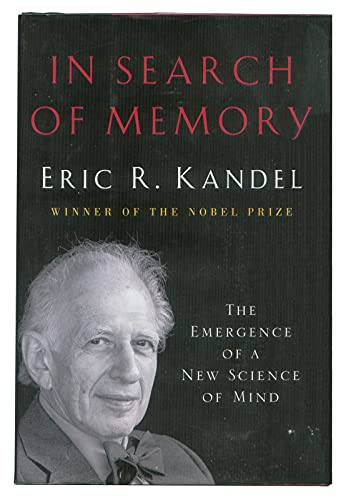
Nobelist Eric Kandel's account of how his personal quest to understand memory intersected with the emergence of a new science.
In Search of Memory relates the astonishing story of how four different and distinct disciplines—behaviorist psychology, cognitive psychology, neuroscience, and molecular biology—converged into a powerful new science of mind. Through its profound insights into thought, perception, action, recollection, and mental illness, this new science is revolutionizing our understanding of learning and memory while simultaneously showing great promise for more effective healing.
The narrative follows Eric R. Kandel through the last five decades, focusing on Vienna, where he became fascinated with memory. With intrepid scientific ardor, Kandel was captivated first by history and psychoanalysis, then by neurobiology, and finally by the biological processes of memory. His resulting, multifaceted perspective was the foundation for his path-breaking research that will continue to dominate modern thought—not only in science but in culture at large. 50 illustrations.
"synopsis" may belong to another edition of this title.
About the Author
Eric R. Kandel, M.D., is University Professor at Columbia University and a senior investigator at the Howard Hughes Medical Institute. Kandel received the Nobel Prize in 2000. He lives in New York City.
Reviews
When, as a medical student in the 1950s, Kandel said he wanted to locate the ego and id in the brain, his mentor told him he was overreaching, that the brain had to be studied "cell by cell." After his initial dismay, Kandel took on the challenge and in 2000 was awarded a Nobel Prize for his groundbreaking research showing how memory is encoded in the brain's neuronal circuits. Kandel's journey into the brain spans five decades, beginning in the era of early research into the role of electrical currents flowing through neurons and ending in the age of genetic engineering. It took him from early studies of reflexes in the lowly squid to the founding of a bioengineering firm whose work could some day develop treatments for Alzheimer's and on to a rudimentary understanding of the cellular mechanisms underlying mental illness. Kandel's life also took him on another journey: from Vienna, which his Jewish family fled after the Anschluss, to New York City and, decades later, on visits back to Vienna, where he boldly confronted Austria's unwillingness to look at its collusion in the Final Solution. For anyone considering a career in science, the early part of this intellectual autobiography presents a fascinating portrait of a scientist's formation: learning to trust his instincts on what research to pursue and how to pose a researchable question and formulate an experiment. Much of the science discussion is too dense for the average reader. But for anyone interested in the relationship between the mind and the brain, this is an important account of a creative and highly fruitful career. 50 b&w illus. (Mar.)
Copyright © Reed Business Information, a division of Reed Elsevier Inc. All rights reserved.
Kandel, who received the Nobel Prize in 2000, traces advances in understanding learning and memory. His own groundbreaking findings showed that learning produces changes in behavior by modifying the strength of connections between nerve cells. He conveys his immense grasp of the science beautifully, but it is his personal recollections that make the book especially compelling. He begins with his searing childhood memories of the German annexation of Austria and his family’s escape to the U.S. when he was nine. And he ends with a conference he organized in Vienna to examine the strange reluctance of Austria (unlike Germany) to acknowledge its role in the Holocaust. One comes away in awe of the scientific advances—and of a life well and fully lived.
Editors of Scientific American
*Starred Review* While most memoirs merely give the reader the contents of memory, this remarkable account by a pioneering neurobiologist actually opens up the cellular and biochemical structure of memory and details the epoch-making science that has uncovered that structure. Through the doors of his own memory, Kandel revisits the Vienna of his childhood, a city recalled with appreciation for its intellectual and artistic life and with antipathy for the anti-Semitism that swept through the region in the thirties, forcing the Kandel family to flee to New York. Kandel carried a career-shaping interest in Freud with him to Brooklyn, but he soon realized that the biology of the brain could explain more about mental processes than could Freud's theorizing. Kandel recounts his own revolutionary research in establishing the molecular chemistry of short-term memory and the cellular dynamics of long-term memory, highlighting particularly the potential of his findings for the treatment of Alzheimer's and other mental disorders. But even as he outlines the biomechanics of memory, Kandel shares his personal reminiscences of the years during which he unraveled those mysteries--a daughter's whimsical fascination with laboratory snails, for instance, and his wife's difficult search for a gown for the Nobel Prize ceremony recognizing his breakthroughs. In a provocative conclusion, Kandel contemplates the broad cultural meaning of memory as he chronicles his visit to a twenty-first-century Vienna still determined to forget its complicity in Nazi atrocities. An autobiography of exceptional substance. Bryce Christensen
Copyright © American Library Association. All rights reserved
"About this title" may belong to another edition of this title.
Search results for In Search of Memory: The Emergence of a New Science...

Seller Image
In Search of Memory: The Emergence of a New Science of Mind
Seller: Zoom Books Company, Lynden, WA, U.S.A.
Seller rating 5 out of 5 stars

Condition: very_good. Book is in very good condition and may include minimal underlining highlighting. The book can also include "From the library of" labels. May not contain miscellaneous items toys, dvds, etc. . We offer 100% money back guarantee and 24 7 customer service. Seller Inventory # ZBV.0393058638.VG
Stock Image
In Search of Memory: The Emergence of a New Science of Mind
Seller: World of Books (was SecondSale), Montgomery, IL, U.S.A.
Seller rating 5 out of 5 stars
Hardback. Condition: Fair. Gives Eric Kandel's account of how his personal quest to understand memory intersected with the emergence of a new science. This book relates the story of how four distinct disciplines - behaviourist psychology, cognitive psychology, neuroscience and molecular biology - converged into a powerful new science of mind. Seller Inventory # 00108008050
Stock Image
In Search of Memory: The Emergence of a New Science of Mind
Seller: World of Books (was SecondSale), Montgomery, IL, U.S.A.
Seller rating 5 out of 5 stars
Hardback. Condition: Good. Gives Eric Kandel's account of how his personal quest to understand memory intersected with the emergence of a new science. This book relates the story of how four distinct disciplines - behaviourist psychology, cognitive psychology, neuroscience and molecular biology - converged into a powerful new science of mind. Seller Inventory # 00108596099
Seller Image
In Search of Memory: The Emergence of a New Science of Mind
Seller: Aspen Book Co., Denver, CO, U.S.A.
Seller rating 5 out of 5 stars
Condition: acceptable. It's been through some chapters of life! Expect visible wearâ"creases, notes, highlights, maybe even a splash of water here and there. Perfect for readers who love a book with history. Seller Inventory # PKV.0393058638.A
Seller Image
In Search of Memory: The Emergence of a New Science of Mind
Seller: Zoom Books East, Glendale Heights, IL, U.S.A.
Seller rating 5 out of 5 stars
Condition: good. Book is in good condition and may include underlining highlighting and minimal wear. The book can also include "From the library of" labels. May not contain miscellaneous items toys, dvds, etc. . We offer 100% money back guarantee and 24 7 customer service. Seller Inventory # ZEV.0393058638.G
Seller Image
In Search of Memory: The Emergence of a New Science of Mind
Seller: Greenworld Books, Arlington, TX, U.S.A.
Seller rating 5 out of 5 stars
Condition: very_good. Fast Free Shipping â" Very Good condition book with a firm cover and clean pages. Shows normal use and some light wear or limited notes markings. A solid, nice copy to enjoy. Seller Inventory # GWV.0393058638.VG
Seller Image
In Search of Memory: The Emergence of a New Science of Mind
Seller: Vive Liber Books, Somers, CT, U.S.A.
Seller rating 5 out of 5 stars
Condition: good. Good condition USED book. Pages are clean with normal wear. May have limited markings inside from previous owner. Seller Inventory # VLM.11LV
Stock Image
In Search of Memory : The Emergence of a New Science of Mind
Published by
Norton & Company, Incorporated, W. W., 2006
ISBN 10: 0393058638
ISBN 13: 9780393058635
Used
Hardcover
First Edition
Seller: Better World Books: West, Reno, NV, U.S.A.
Seller rating 5 out of 5 stars
Condition: Good. 1st Edition. Pages intact with minimal writing/highlighting. The binding may be loose and creased. Dust jackets/supplements are not included. Stock photo provided. Product includes identifying sticker. Better World Books: Buy Books. Do Good. Seller Inventory # GRP102626131
Stock Image
In Search of Memory : The Emergence of a New Science of Mind
Published by
Norton & Company, Incorporated, W. W., 2006
ISBN 10: 0393058638
ISBN 13: 9780393058635
Used
Hardcover
First Edition
Seller: Better World Books, Mishawaka, IN, U.S.A.
Seller rating 5 out of 5 stars
Condition: Good. 1st Edition. Former library copy. Pages intact with minimal writing/highlighting. The binding may be loose and creased. Dust jackets/supplements are not included. Includes library markings. Stock photo provided. Product includes identifying sticker. Better World Books: Buy Books. Do Good. Seller Inventory # GRP18414317
Stock Image
In Search of Memory: The Emergence of a New Science of Mind
Seller: ThriftBooks-Phoenix, Phoenix, AZ, U.S.A.
Seller rating 5 out of 5 stars
Hardcover. Condition: Very Good. No Jacket. May have limited writing in cover pages. Pages are unmarked. ~ ThriftBooks: Read More, Spend Less. Seller Inventory # G0393058638I4N00