
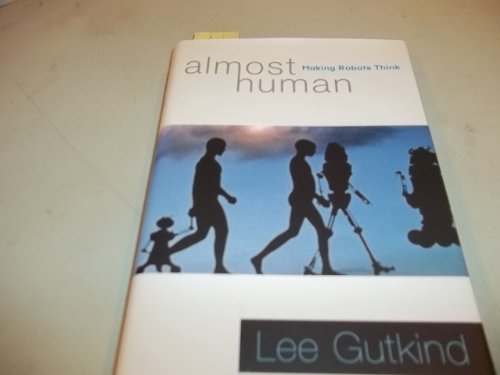
Items related to Almost Human: Making Robots Think
Synopsis
A remarkable, intense portrait of the robotic subculture and the challenging quest for robot autonomy.
The high bay at the Robotics Institute at Carnegie Mellon University is alive and hyper night and day with the likes of Hyperion, which traversed the Antarctic, and Zoe, the world’s first robot scientist, now back home. Robot Segways learn to play soccer, while other robots go on treasure hunts or are destined for hospitals and museums. Dozens of cavorting mechanical creatures, along with tangles of wire, tools, and computer innards are scattered haphazardly. All of these zipping and zooming gizmos are controlled by disheveled young men sitting on the floor, folding chairs, or tool cases, or huddled over laptops squinting into displays with manic intensity. Award-winning author Lee Gutkind immersed himself in this frenzied subculture, following these young roboticists and their bold conceptual machines from Pittsburgh to NASA and to the most barren and arid desert on earth. He makes intelligible their discoveries and stumbling points in this lively behind-the-scenes work."synopsis" may belong to another edition of this title.
About the Author
Lee Gutkind is the founder and editor of the literary journal Creative Nonfiction and a pioneer in the field of narrative nonfiction. Gutkind is also the editor of In Fact and Becoming a Doctor, the author of Almost Human, and has written books about baseball, health care, travel, and technology. A Distinguished Writer in Residence at Arizona State University, he lives in Pittsburgh, Pennsylvania, and Tempe, Arizona.
Reviews
Gutkind (In Fact) spent six years as a self-described "fly on the wall" at Carnegie Mellon's Robotics Institute, watching a group of scientists—mostly grad students—try to develop human movement and decision-making capabilities. The machines he encountered came in a variety of shapes and sizes, from dog-shaped toys programmed to play soccer to a Hummer equipped with sensors that enable it to drive itself. As that Hummer indicates, the institute's research isn't confined to the lab: Gutkind follows his roboticists to abandoned mine shafts and the northern edges of Chile, where they use the world's driest desert to test machines developed to find signs of life on the surface of Mars. Gutkind's reporting captures the individual quirks of the scientists—like one researcher who only shaves on Sundays to save time during the week for his research—but his low-key tone can mute the excitement of their successes, especially given the fail-fix-try-again nature of most of their projects. Yet even though his story lacks the drive of books like Soul of a New Machine or Hackers, it gives a solid sense of what's going on in the field. 15 illus. (Mar.)
Copyright © Reed Business Information, a division of Reed Elsevier Inc. All rights reserved.
Creative nonfiction guru and seasoned immersion journalist Gutkind observes that just as computers changed the world in the 1990s, robots will "transform technology" in the future. To find out who is behind the growing robotic surge, Gutkind spent six years observing life at Carnegie Mellon's Robotics Institute, a "hypertechnological pressure cooker," where work is frenzied, frustrating, "inspiring, compelling," and addictive. Gutkind presents vivid profiles of roboticists, including graduate students, the "strong and vital force" behind the group's innovations. Audacious pranksters, shy geeks, and wry wits, they fall into rivalrous groups, the engineers versus the "code monkeys." Scenes at the institute alternate with entertaining reports on RoboCup competitions (soccer is an excellent mode for robot testing) and dramatic accounts of an ambitious project in Chile's Atacama Desert, a stand-in for Mars. Creating autonomous robots is a daunting task that arouses renewed appreciation for the fact that "a human being is the most sophisticated system in the universe." Gutkind's incisive and provocative dispatches from the robotic front will help prepare us for the next machine wave. Donna Seaman
Copyright © American Library Association. All rights reserved
"About this title" may belong to another edition of this title.
Search results for Almost Human: Making Robots Think

Seller Image
Almost Human: Making Robots Think
Published by
W. W. Norton & Company, USA, 2006
ISBN 10: 0393058670
ISBN 13: 9780393058673
Used
Hardcover
First Edition
Seller: RT Books, Wexford, PA, U.S.A.
Seller rating 5 out of 5 stars

Hardcover. Condition: Near Fine. Dust Jacket Condition: Near Fine. 1st Edition. PUBLISHER: W. W. Norton & Company DATE/EDITION: 2006, stated First Edition, first printing (1-10) BINDING: Hardbound, 284 pages. DUST JACKET: Priced 25.95 on the front flap. Nera fine condition, very clean and bright with no rips. BOOK CONDITION: Near fine, sharp corners and bright lettering, very clean inside and out, tight binding. Seller Inventory # 008558
Stock Image
Almost Human: Making Robots Think
Seller: HPB-Ruby, Dallas, TX, U.S.A.
Seller rating 5 out of 5 stars
hardcover. Condition: Very Good. Connecting readers with great books since 1972! Used books may not include companion materials, and may have some shelf wear or limited writing. We ship orders daily and Customer Service is our top priority! Seller Inventory # S_477847890
Stock Image
Almost Human: Making Robots Think
Seller: Half Price Books Inc., Dallas, TX, U.S.A.
Seller rating 5 out of 5 stars
hardcover. Condition: Very Good. Connecting readers with great books since 1972! Used books may not include companion materials, and may have some shelf wear or limited writing. We ship orders daily and Customer Service is our top priority! Seller Inventory # S_474075266
Stock Image
Almost Human: Making Robots Think [SIGNED COPY, FIRST PRINTING]
Published by
W. W. Norton & Company, New York, 2007
ISBN 10: 0393058670
ISBN 13: 9780393058673
Used
Hardcover
First Edition
Signed
Seller: MostlySignedBooks, Kensington, CA, U.S.A.
Seller rating 5 out of 5 stars
Hardcover. Condition: Fine. Dust Jacket Condition: Fine. 1st Edition. Fine in fine dust jacket. SIGNED by author on half-title page (signature only). 1st edition, 1st printing, complete number line. As new. Glued binding. Paper over boards. With dust jacket. 284 p. Contains: Illustrations. Audience: General/trade. By the author of 'Truckin' with Sam' and 'The Veterinarian's Touch: Profiles of Life Among the Animals'. Rare signed. Where possible, all books come with dust jacket in a protective mylar sleeve, sealed in a ziplock bag, wrapped in bubble wrap, shipped in a box. Signed by Author(s). Seller Inventory # Alibris.0005536
Stock Image
Almsot Human : Making Robots Think
Published by
W. W. Norton and Company, New York, 2006
ISBN 10: 0393058670
ISBN 13: 9780393058673
Used
Hardcover
Signed
Seller: JB Books, Garrison, ND, U.S.A.
Seller rating 5 out of 5 stars
Hardcover. Condition: Fine. Dust Jacket Condition: Near Fine. First Edition (stated). SIGNED BY AUTHOR. FIRST PRINTING of the First Edition (stated). A close look at the latest research and advances in robotics technology, particiularly the efffort to bring machines to 'think' in a human-like manner in order to ultimately replace them in many areas. Has much interesting information on the subculture of scientists and engineers who work in this field - their interests, backgrounds, goals, and passions. Hardcover with dust jacket, illustrated, notes, 284pp. A very nice copy, the jacket neatly encased in an acid-free archival protector. Very rare in this original printing and as signed by author. Size: 8vo - over 7¾" - 9¾" tall. Signed by Author(s). Book. Seller Inventory # 00015970
Stock Image
almost human; Making Robots Think
Published by
W. W. Norton & Company, New York, 2006
ISBN 10: 0393058670
ISBN 13: 9780393058673
Used
Hardcover
First Edition
Seller: Ground Zero Books, Ltd., Silver Spring, MD, U.S.A.
Seller rating 5 out of 5 stars
Hardcover. Condition: Very good. Dust Jacket Condition: Very good. C. E. Mitchell (Author photograph) (illustrator). xiii, [1], 284, [6] pages. Illustrations. A close look at the latest research and advances in robotics technology, particularly the effort to bring machines to 'think' in a human-like manner in order to ultimately replace them in many areas. Has much interesting information on the subculture of scientists and engineers who work in this field - their interests, backgrounds, goals, and passions. Lee Gutkind is an American writer, speaker, and founder of the literary journal called Creative Nonfiction. Gutkind has written or edited more than 30 books, covering a wide range of subjects from motorcycle subculture to child and adolescent mental illness and organ transplantation. Currently he is Distinguished Writer in Residence at the Consortium for Science Policy and Outcomes and Professor at the School of Life Sciences at Arizona State University. In 1973, he published his first book, Bike Fever: On Motorcycle Culture. He then joined the University of Pittsburgh's Department of English faculty, where he became the first tenured professor at the university without an advanced degree. Gutkind spent six years as a "fly on the wall" researcher at the Robotics Institute at Carnegie-Mellon University in Pittsburgh. He observed scientists and students working to design, build, and test robots so advanced that they will one day be able to work alongside or, in some cases, even replace humans. Almost Human is an intense portrait of the robotic subculture and the quest for robot autonomy. In May 2007 Gutkind appeared as a guest author on The Daily Show with Jon Stewart to talk about robots, the future, and his book. Robotics is an interdisciplinary branch of Electronics & Communication, computer science and engineering. Robotics involves the design, construction, operation, and use of robots. The goal of robotics is to design machines that can help and assist humans. Robotics integrates fields of mechanical engineering, electrical engineering, information engineering, mechatronics engineering, electronics, biomedical engineering, computer engineering, control systems engineering, software engineering, mathematics, etc. This is a remarkable, intense portrait of the robotic subculture and the challenging quest for robot autonomy. The high bay at the Robotics Institute at Carnegie Mellon University is alive and hyper night and day with the likes of Hyperion, which traversed the Antarctic, and Zoe, the world's first robot scientist, now back home. Robot Segways learn to play soccer, while other robots go on treasure hunts or are destined for hospitals and museums. Dozens of cavorting mechanical creatures, along with tangles of wire, tools, and computer innards are scattered haphazardly. All of these zipping and zooming gizmos are controlled by disheveled young men sitting on the floor, folding chairs, or tool cases, or huddled over laptops squinting into displays with manic intensity. Award-winning author Lee Gutkind immersed himself in this frenzied subculture, following these young roboticists and their bold conceptual machines from Pittsburgh to NASA and to the most barren and arid desert on earth. He makes intelligible their discoveries and stumbling points in this lively behind-the-scenes work. First Edition [Stated], First Printing [Stated]. Seller Inventory # 86566