
Items related to Colliding Worlds: How Cutting-Edge Science Is Redefining...
Synopsis
A dazzling look at the artists working on the frontiers of science.
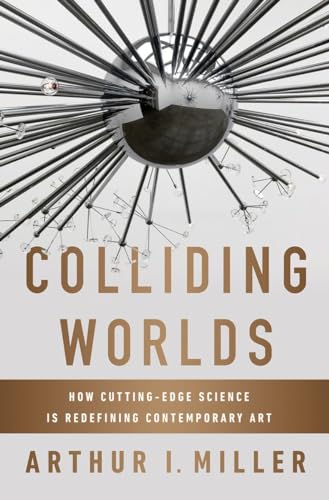
In recent decades, an exciting new art movement has emerged in which artists utilize and illuminate the latest advances in science. Some of their provocative creations―a live rabbit implanted with the fluorescent gene of a jellyfish, a gigantic glass-and-chrome sculpture of the Big Bang (pictured on the cover)―can be seen in traditional art museums and magazines, while others are being made by leading designers at Pixar, Google’s Creative Lab, and the MIT Media Lab. In Colliding Worlds, Arthur I. Miller takes readers on a wild journey to explore this new frontier.Miller, the author of Einstein, Picasso and other celebrated books on science and creativity, traces the movement from its seeds a century ago―when Einstein’s theory of relativity helped shape the thinking of the Cubists―to its flowering today. Through interviews with innovative thinkers and artists across disciplines, Miller shows with verve and clarity how discoveries in biotechnology, cosmology, quantum physics, and beyond are animating the work of designers like Neri Oxman, musicians like David Toop, and the artists-in-residence at CERN’s Large Hadron Collider.
From NanoArt to Big Data, Miller reveals the extraordinary possibilities when art and science collide.
70 illustrations, 8 pages of color"synopsis" may belong to another edition of this title.
About the Author
Arthur I. Miller is a professor emeritus at University College London. He has published many critically acclaimed books, including Einstein, Picasso; Empire of the Stars; and 137. He lives in London.
Reviews
Science historian Miller coins the term artsci to describe the growing realm of creativity that merges art, science, and technology. Beginning his exploration in the early twentieth-century artistic engagements with X-rays and radio waves, Miller goes on to map a wide-ranging contemporary field of practice that encompasses computer-based art, robotics, data visualization, and biotechnology. This well-illustrated and accessible text is refreshingly short on academic theory, instead surveying the vast landscape of artsci through profiles of individual artists, projects, and institutions. Tracing collaborations at the CERN Supercollider, Pixar Studios, and the MIT Media Lab, Miller finds particular inspiration in artworks that go beyond the illustration of scientific principles and actually contribute to real-world scientific advances. Miller’s anecdotes of bioluminescent brains, emotive interfaces, and climate-change mappings trace an exciting new avant-garde of creative research with the potential to realign aesthetics toward an appreciation of information. The author’s comprehensive text not only codifies an important contemporary cultural movement, it also marks the rise of an interdisciplinary “third culture” that fuses the disciplines of art and science. --Lindsay Bosch
"About this title" may belong to another edition of this title.
Search results for Colliding Worlds: How Cutting-Edge Science Is Redefining...

Stock Image
Colliding Worlds: How Cutting-Edge Science Is Redefining Contemporary Art
Seller: World of Books (was SecondSale), Montgomery, IL, U.S.A.
Seller rating 5 out of 5 stars

Hardback. Condition: Good. A dazzling look at the artists working on the frontiers of science. Seller Inventory # 00095468149
Seller Image
Colliding Worlds: How Cutting-Edge Science Is Redefining Contemporary Art
Seller: Bay State Book Company, North Smithfield, RI, U.S.A.
Seller rating 5 out of 5 stars
Condition: good. The book is in good condition with all pages and cover intact, including the dust jacket if originally issued. The spine may show light wear. Pages may contain some notes or highlighting, and there might be a "From the library of" label. Boxed set packaging, shrink wrap, or included media like CDs may be missing. Seller Inventory # BSM.1DWTV
Stock Image
Colliding Worlds : How Cutting-Edge Science Is Redefining Contemporary Art
Published by
Norton & Company, Incorporated, W. W., 2014
ISBN 10: 0393083365
ISBN 13: 9780393083361
Used
Hardcover
First Edition
Seller: Better World Books, Mishawaka, IN, U.S.A.
Seller rating 5 out of 5 stars
Condition: Very Good. 1st Edition. Former library copy. Pages intact with possible writing/highlighting. Binding strong with minor wear. Dust jackets/supplements may not be included. Includes library markings. Stock photo provided. Product includes identifying sticker. Better World Books: Buy Books. Do Good. Seller Inventory # GRP81804266
Stock Image
Colliding Worlds: How Cutting-Edge Science Is Redefining Contemporary Art
Seller: Open Books, Chicago, IL, U.S.A.
Seller rating 5 out of 5 stars
Hardcover. Condition: Very Good. Open Books is a nonprofit social venture that provides literacy experiences for thousands of readers each year through inspiring programs and creative capitalization of books. Seller Inventory # mon0000817680
Stock Image
Colliding Worlds: How Cutting-Edge Science Is Redefining Contemporary Art
Seller: ThriftBooks-Dallas, Dallas, TX, U.S.A.
Seller rating 5 out of 5 stars
Hardcover. Condition: Very Good. No Jacket. May have limited writing in cover pages. Pages are unmarked. ~ ThriftBooks: Read More, Spend Less. Seller Inventory # G0393083365I4N00
Stock Image
Colliding Worlds: How Cutting-Edge Science Is Redefining Contemporary Art
Seller: World of Books Inc, Montgomery, IL, U.S.A.
Seller rating 4 out of 5 stars

Hardback. Condition: Good. A dazzling look at the artists working on the frontiers of science. Seller Inventory # CIN0393083365G
Stock Image
Colliding Worlds: How Cutting-Edge Science Is Redefining Contemporary Art
Seller: St Vincent de Paul of Lane County, Eugene, OR, U.S.A.
Seller rating 5 out of 5 stars
Condition: Acceptable. ATTN: EX-LIBRARY COPY>>> Former Library book. hardcover 100% of proceeds go to charity! Acceptable reading copy with obvious signs of use, wear, and/or cosmetic issues. Item is complete and remains readable despite notable condition issues. Seller Inventory # A-07-4306
Stock Image
Colliding Worlds: How Cutting-Edge Science Is Redefining Contemporary Art
Seller: HPB-Red, Dallas, TX, U.S.A.
Seller rating 5 out of 5 stars
hardcover. Condition: Good. Connecting readers with great books since 1972! Used textbooks may not include companion materials such as access codes, etc. May have some wear or writing/highlighting. We ship orders daily and Customer Service is our top priority! Seller Inventory # S_426697735
Stock Image
Colliding Worlds: How Cutting-Edge Science Is Redefining Contemporary Art
Seller: Amazing Books Pittsburgh, Pittsburgh, PA, U.S.A.
Seller rating 5 out of 5 stars
hardcover. Condition: Good. Sturdy hardcover, clean dj, minor damage to top right of hardcover, no markings within. CC. Seller Inventory # Sq29594
Stock Image
Colliding Worlds: How Cutting-Edge Science Is Redefining Contemporary Art
Seller: HPB-Ruby, Dallas, TX, U.S.A.
Seller rating 5 out of 5 stars
Hardcover. Condition: Very Good. Connecting readers with great books since 1972! Used books may not include companion materials, and may have some shelf wear or limited writing. We ship orders daily and Customer Service is our top priority! Seller Inventory # S_484143656