
Items related to State of the World 2010: Transforming Cultures: From...
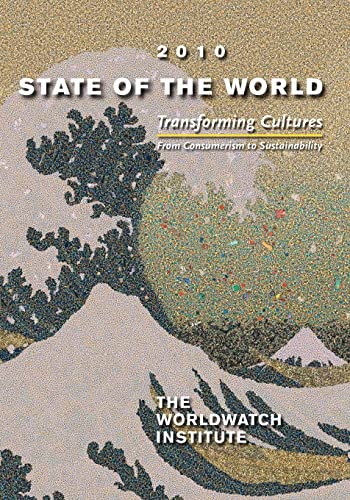
State of the World 2010: Transforming Cultures: From Consumerism to Sustainability (State of the World (Paperback)) - Softcover
Synopsis
The premier environmental nonprofit shows the ways to transform our consumer culture into a culture centered on sustainability.
For society to thrive long into the future, we must move beyond our unsustainable consumer culture to one that respects environmental realities. In State of the World 2010, the Worldwatch Institute’s award-winning research team reveals not only how human societies can make this shift but also how people around the world have already started to nurture a new culture of sustainability. Chapters present innovative solutions to global environmental problems, focusing on institutions that are the principal engineers of culture, such as governments, the media, and religious organizations. Written in clear, concise language, with easy-to-read charts and tables, State of the World presents a view of our changing world that we, and our leaders, cannot afford to ignore."synopsis" may belong to another edition of this title.
About the Author
The Worldwatch Institute is a Washington, DC-based nonprofit research and publishing organization dedicated to fostering the evolution of an environmentally sustainable society.
Reviews
In this year's volume, the D.C.-based Worldwatch Institute think-tank considers, in several dozen pieces, how "cultures of consumption" can be transformed into "cultures of sustainability." Many ideas take inspiration from diverse traditions: religions can be called upon to embrace their own deepest values and renounce materialism, while establishing new holidays, rituals and taboos incorporating strategies for sustainability (Earth Day, "Green funerals," new days of fasting, etc.); practices honoring elders as transmitters of ancient wisdom can be spread beyond regions where they still thrive (Africa, India, etc.); thousand-year-old Asian farming methods can be revived. Ideas for restructuring education include replacing the "Three Rs" with the "Seven Rs" ("reduce, reuse, recycle, respect, reflect, repair, and responsibility") and emphasizing "environmental education" in higher learning. The largest-scale changes include shifting societal goals from "maximizing growth of the market economy to maximizing sustainable human well being"; ensuring that the burden of reduced production falls on the wealthiest, not the poorest; and building sustainable cities like Vauban, a 5,000-household German community that uses 100 percent renewable energy. Though many solutions in this visionary volume require a pie-in-the-sky "whole Earth community" legal system prioritizing "the right to life" over "the right to conduct business," it should give leaders and laypeople much to consider.
Copyright © Reed Business Information, a division of Reed Elsevier Inc. All rights reserved.
"About this title" may belong to another edition of this title.
Search results for State of the World 2010: Transforming Cultures: From...

Stock Image
State of the World 2010: Transforming Cultures: From Consumerism to Sustainability (State of the World (Paperback))
Published by
W. W. Norton & Company (edition 2010 ed.), 2010
ISBN 10: 039333726X
ISBN 13: 9780393337266
Used
Paperback
Seller: BooksRun, Philadelphia, PA, U.S.A.
Seller rating 5 out of 5 stars

Paperback. Condition: Fair. 2010 ed. The item might be beaten up but readable. May contain markings or highlighting, as well as stains, bent corners, or any other major defect, but the text is not obscured in any way. Seller Inventory # 039333726X-7-1-13
Seller Image
State of the World 2010: Transforming Cultures: From Consumerism to Sustainability (State of the World (Paperback))
Seller: ZBK Books, Carlstadt, NJ, U.S.A.
Seller rating 5 out of 5 stars
Condition: good. Fast & Free Shipping â" Good condition. It may show normal signs of use, such as light writing, highlighting, or library markings, but all pages are intact and the book is fully readable. A solid, complete copy that's ready to enjoy. Seller Inventory # ZWV.039333726X.G
Seller Image
State of the World 2010: Transforming Cultures: From Consumerism to Sustainability (State of the World (Paperback))
Seller: Greenworld Books, Arlington, TX, U.S.A.
Seller rating 5 out of 5 stars
Condition: like_new. Fast Free Shipping â" Excellent condition book with clean cover and pages. Barely handled, with minimal wear. An outstanding copy, close to enjoy! Seller Inventory # GWV.039333726X.LN
Stock Image
State of the World 2010: Transforming Cultures: From Consumerism to Sustainability (State of the World (Paperback))
Seller: World of Books (was SecondSale), Montgomery, IL, U.S.A.
Seller rating 5 out of 5 stars
Condition: Good. Good condition ex-library book with usual library markings and stickers. Seller Inventory # 00104620057
Stock Image
State of the World: Transforming Cultures: From Consumerism to Sustainability: A Worldwatch Institute Report on Progress Toward a Sustaina
Seller: ThriftBooks-Atlanta, AUSTELL, GA, U.S.A.
Seller rating 5 out of 5 stars
Paperback. Condition: Good. No Jacket. Pages can have notes/highlighting. Spine may show signs of wear. ~ ThriftBooks: Read More, Spend Less. Seller Inventory # G039333726XI3N00
Stock Image
State of the World: Transforming Cultures: From Consumerism to Sustainability: A Worldwatch Institute Report on Progress Toward a Sustaina
Seller: ThriftBooks-Dallas, Dallas, TX, U.S.A.
Seller rating 5 out of 5 stars
Paperback. Condition: Good. No Jacket. Pages can have notes/highlighting. Spine may show signs of wear. ~ ThriftBooks: Read More, Spend Less. Seller Inventory # G039333726XI3N00
Stock Image
State of the World 2010 : Transforming Cultures - From Consumerism to Sustainability
Published by
Norton & Company, Incorporated, W. W., 2010
ISBN 10: 039333726X
ISBN 13: 9780393337266
Used
Softcover
Seller: Better World Books, Mishawaka, IN, U.S.A.
Seller rating 5 out of 5 stars
Condition: Good. Former library copy. Pages intact with minimal writing/highlighting. The binding may be loose and creased. Dust jackets/supplements are not included. Includes library markings. Stock photo provided. Product includes identifying sticker. Better World Books: Buy Books. Do Good. Seller Inventory # 5564351-6
Stock Image
State of the World 2010 : Transforming Cultures - From Consumerism to Sustainability
Published by
Norton & Company, Incorporated, W. W., 2010
ISBN 10: 039333726X
ISBN 13: 9780393337266
Used
Softcover
Seller: Better World Books, Mishawaka, IN, U.S.A.
Seller rating 5 out of 5 stars
Condition: Very Good. Former library copy. Pages intact with possible writing/highlighting. Binding strong with minor wear. Dust jackets/supplements may not be included. Includes library markings. Stock photo provided. Product includes identifying sticker. Better World Books: Buy Books. Do Good. Seller Inventory # 2309094-20
Stock Image
State of the World 2010: Transforming Cultures: From Consumerism to Sustainability (State of the World)
Seller: Book Alley, Pasadena, CA, U.S.A.
Seller rating 4 out of 5 stars

Paperback. Condition: Very Good. Seller Inventory # mon0000687518
Stock Image
State of the World 2010: Transforming Cultures: From Consumerism to Sustainability (State of the World)
Published by
W. W. Norton & Company January 2010, 2010
ISBN 10: 039333726X
ISBN 13: 9780393337266
Used
Paper Back
Seller: Dunaway Books, St. Louis, MO, U.S.A.
Seller rating 4 out of 5 stars
Paper Back. Condition: Good. Seller Inventory # 139339