
Items related to Tell Me Why: A Beatles Commentary
Synopsis
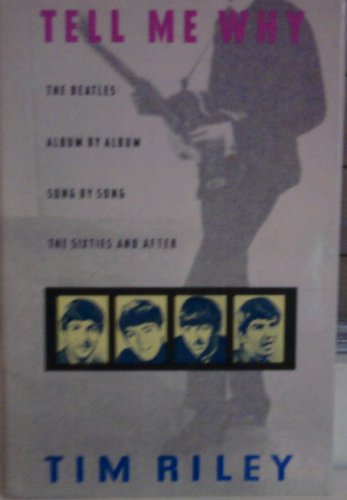
Perhaps the first serious analysis of the Beatles' work and its impact on popular music, Tell Me Why is meticulous in its purpose and long overdue....Of the hundreds of books written about [the Beatles] none bring the musical knowledge and the familiarity with the period that Riley offers here."
-- Cleveland Plain Dealer
Album by album, song by song, Tim Riley gives us a new, deeper understanding of the Beatles. Outdistancing the countless tell-all biographies that have been written, Riley's study of the Beatles' music is as rigorous as it is soulful. He explores the entire Beatles catalogue, making clear that the legendary four were not simply teen idols -- that they were, in fact, brilliant musical innovators who created timeless songs and virtually invented the album-as-art.
From the Trade Paperback edition.
"synopsis" may belong to another edition of this title.
From the Inside Flap
first serious analysis of the Beatles' work and its impact on popular music, Tell Me Why is meticulous in its purpose and long overdue....Of the hundreds of books written about [the Beatles] none bring the musical knowledge and the familiarity with the period that Riley offers here."<br><br>-- Cleveland Plain Dealer<br><br>Album by album, song by song, Tim Riley gives us a new, deeper understanding of the Beatles. Outdistancing the countless tell-all biographies that have been written, Riley's study of the Beatles' music is as rigorous as it is soulful. He explores the entire Beatles catalogue, making clear that the legendary four were not simply teen idols -- that they were, in fact, brilliant musical innovators who created timeless songs and virtually invented the album-as-art.<br><br><br><i>From the Trade Paperback edition.</i>
Reviews
Song by song, record by record, an American music critic discusses the Beatles albums from Please Please Me (1962) to Abbey Road (1969), recounts the circumstances that led to the composition of each song and analyzes the means by which it achieves its individual character. A final chapter, "The Dream Is Over," surveys and sums up the subsequent solo albums. Riley shows that Paul McCartney rarely personalized his songs the way John Lennon did; he had a keener commercial instinct and satisfied pop expectations, while Lennon challenged his audience with lofty ideas like the illusory nature of reality and acute anxiety. Once they became solo artists, their best albums epitomized their strengths as they delineated what a remarkable match of sensibilities the two of them had been. An essential work for all interested parties.
Copyright 1988 Reed Business Information, Inc.
"About this title" may belong to another edition of this title.
Search results for Tell Me Why: A Beatles Commentary

Stock Image
Tell Me Why: A Beatles Commentary
Seller: BooksRun, Philadelphia, PA, U.S.A.
Seller rating 5 out of 5 stars

Hardcover. Condition: Very Good. 1. With dust jacket. It's a well-cared-for item that has seen limited use. The item may show minor signs of wear. All the text is legible, with all pages included. It may have slight markings and/or highlighting. Seller Inventory # 0394550617-11-1-29
Stock Image
Tell Me Why : A Beatles Commentary
Published by
Knopf Doubleday Publishing Group, 1988
ISBN 10: 0394550617
ISBN 13: 9780394550619
Used
Hardcover
First Edition
Seller: Better World Books, Mishawaka, IN, U.S.A.
Seller rating 5 out of 5 stars
Condition: Good. 1st Edition. Former library copy. Pages intact with minimal writing/highlighting. The binding may be loose and creased. Dust jackets/supplements are not included. Includes library markings. Stock photo provided. Product includes identifying sticker. Better World Books: Buy Books. Do Good. Seller Inventory # 3246000-6
Stock Image
Tell Me Why: A Beatles Commentary
Seller: Wonder Book, Frederick, MD, U.S.A.
Seller rating 5 out of 5 stars
Condition: Good. Good condition. Good dust jacket. A copy that has been read but remains intact. May contain markings such as bookplates, stamps, limited notes and highlighting, or a few light stains. Seller Inventory # E02O-01731
Stock Image
Tell Me Why: A Beatles Commentary
Seller: Hawking Books, Edgewood, TX, U.S.A.
Seller rating 4 out of 5 stars

Condition: Acceptable. **Has staining** Meets the acceptable condition guidelines. Has wear. Five star seller - Buy with confidence! Seller Inventory # X0394550617X4
Stock Image
Tell Me Why: A Beatles Commentary
Seller: ThriftBooks-Dallas, Dallas, TX, U.S.A.
Seller rating 5 out of 5 stars
Hardcover. Condition: Good. No Jacket. Former library book; Pages can have notes/highlighting. Spine may show signs of wear. ~ ThriftBooks: Read More, Spend Less. Seller Inventory # G0394550617I3N10
Stock Image
Tell Me Why: A Beatles Commentary
Seller: ThriftBooks-Dallas, Dallas, TX, U.S.A.
Seller rating 5 out of 5 stars
Hardcover. Condition: Good. No Jacket. Pages can have notes/highlighting. Spine may show signs of wear. ~ ThriftBooks: Read More, Spend Less. Seller Inventory # G0394550617I3N00
Stock Image
Tell Me Why: A Beatles Commentary
Seller: ThriftBooks-Atlanta, AUSTELL, GA, U.S.A.
Seller rating 5 out of 5 stars
Hardcover. Condition: Good. No Jacket. Pages can have notes/highlighting. Spine may show signs of wear. ~ ThriftBooks: Read More, Spend Less. Seller Inventory # G0394550617I3N00
Stock Image
Tell Me Why: A Beatles Commentary
Seller: ThriftBooks-Dallas, Dallas, TX, U.S.A.
Seller rating 5 out of 5 stars
Hardcover. Condition: Good. No Jacket. Missing dust jacket; Pages can have notes/highlighting. Spine may show signs of wear. ~ ThriftBooks: Read More, Spend Less. Seller Inventory # G0394550617I3N01
Stock Image
Tell Me Why: A Beatles Commentary
Seller: Read&Dream, SAINT LOUIS, MO, U.S.A.
Seller rating 4 out of 5 stars
Condition: Good. Seller Inventory # 1.6M_MG_H000657Y
Stock Image
Tell Me Why: A Beatles Commentary
Seller: HPB-Ruby, Dallas, TX, U.S.A.
Seller rating 5 out of 5 stars
hardcover. Condition: Very Good. Connecting readers with great books since 1972! Used books may not include companion materials, and may have some shelf wear or limited writing. We ship orders daily and Customer Service is our top priority! Seller Inventory # S_485558627