
Items related to A Field Guide to the Stars and Planets
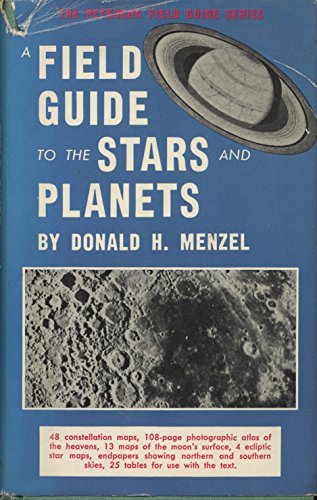
Synopsis
This best-selling field guide has been completely revised and updated to include the latest information from leading astronomical sources. All the time-sensitive material is new and valid through 2017: solar eclipses, phases of the moon, positions of the planets, and more. Twenty-four Monthly Sky Maps, all newly revised and in color, show exactly what you'll see when facing north or south in the night sky. Atlas Charts, also revised and in color, cover the entire sky, including close-ups of areas of special interest such as the Pleiades and the Orion Nebula. The hundreds of thousands of devoted users of the previous editions of this guide have been eagerly awaiting this new volume so they can continue to enjoy their hobby in the coming decades.
"synopsis" may belong to another edition of this title.
About the Author
Roger Tory Peterson, one of the world's greatest naturalists, received every major award for ornithology, natural science, and conservation, as well as numerous honorary degrees, medals, and citations, including the Presidential Medal of Freedom. The Peterson Identification System has been called the greatest invention since binoculars, and the Peterson Field Guides® are credited with helping to set the stage for the environmental movement.
Excerpt. © Reprinted by permission. All rights reserved.
The moon is often the most prominent object in the nighttime sky. The moon is somewhat more than one-quarter the diameter of the earth. This makes it the largest substantial satellite (moon) in the solar system in comparison to its parent planet. (Three moons of Jupiter and one each of Neptune and Saturn are physically larger than our moon; Pluto’s small moon Charon is nearly half Pluto’s size.) The moon orbits the earth every 271?3 days with respect to the stars. But during that time, the earth and moon have moved as a system about 1?12 of the way in their yearly orbit around the sun. So if the moon at a certain point in its orbit is directly between the earth and the sun, 271?3 days later it has not quite returned to that point directly between the earth and the sun. The moon must orbit the earth a bit farther to get back to the same place with respect to the line between the earth and the sun. The moon reaches this point in a couple of days, making the synodic period of the moon equal to 291?2 days. (The synodic period is the interval between two successive conjunctions coming to the same celestial longitude of two celestial bodies, in this case conjunctions of the moon and sun as observed from the earth.) It is the synodic months that are taken into account in lunar calendars.
"About this title" may belong to another edition of this title.
Search results for A Field Guide to the Stars and Planets

Stock Image
A field guide to the stars and planets,: Including the moon, satellites, comets, and other features of the universe, (The Peterson field guide series)
Seller: HPB-Ruby, Dallas, TX, U.S.A.
Seller rating 5 out of 5 stars

hardcover. Condition: Very Good. Connecting readers with great books since 1972! Used books may not include companion materials, and may have some shelf wear or limited writing. We ship orders daily and Customer Service is our top priority! Seller Inventory # S_449556232
Stock Image
A field guide to the stars and planets,: Including the moon, satellites, comets, and other features of the universe, (The Peterson field guide series)
Seller: Half Price Books Inc., Dallas, TX, U.S.A.
Seller rating 5 out of 5 stars
hardcover. Condition: Very Good. Connecting readers with great books since 1972! Used books may not include companion materials, and may have some shelf wear or limited writing. We ship orders daily and Customer Service is our top priority! Seller Inventory # S_471395248
Stock Image
Field Guide to the Stars and Planets
Published by
Houghton Mifflin Harcourt Publishing Company, 1975
ISBN 10: 0395079985
ISBN 13: 9780395079980
Used
Softcover
Seller: Better World Books, Mishawaka, IN, U.S.A.
Seller rating 5 out of 5 stars
Condition: Good. Pages intact with minimal writing/highlighting. The binding may be loose and creased. Dust jackets/supplements are not included. Stock photo provided. Product includes identifying sticker. Better World Books: Buy Books. Do Good. Seller Inventory # 39472780-6
Stock Image
A field guide to the stars and planets,: Including the moon, satellites, comets, and other features of the universe, (The Peterson field guide series)
Seller: Once Upon A Time Books, Siloam Springs, AR, U.S.A.
Seller rating 4 out of 5 stars

Hardcover. Condition: Acceptable. This is a used book. It may contain highlighting/underlining and/or the book may show heavier signs of wear . It may also be ex-library or without dustjacket. This is a used book. It may contain highlighting/underlining and/or the book may show heavier signs of wear . It may also be ex-library or without dustjacket. Seller Inventory # mon0001345466
Stock Image
A field guide to the stars and planets,: Including the moon, satellites, comets, and other features of the universe, (The Peterson field guide series)
Seller: HPB-Emerald, Dallas, TX, U.S.A.
Seller rating 5 out of 5 stars
Hardcover. Condition: Very Good. Connecting readers with great books since 1972! Used books may not include companion materials, and may have some shelf wear or limited writing. We ship orders daily and Customer Service is our top priority! Seller Inventory # S_487465040
Stock Image
A field guide to the stars and planets,: Including the moon, satellites, comets, and other features of the universe, (The Peterson field guide series)
Seller: ThriftBooks-Atlanta, AUSTELL, GA, U.S.A.
Seller rating 5 out of 5 stars
Hardcover. Condition: Good. No Jacket. Pages can have notes/highlighting. Spine may show signs of wear. ~ ThriftBooks: Read More, Spend Less. Seller Inventory # G0395079985I3N00
Stock Image
A Field Guide to the Stars and Planets
Seller: Bank of Books, Ventura, CA, U.S.A.
Seller rating 4 out of 5 stars
paperback. Condition: Good. Dust Jacket Condition: Includes dust jacket. Minor stains and chipping on dust jacket. Pages are clean. Book shows common (average) signs of wear and use. Binding is still tight. Covers are intact but may be repaired. We have 75,000 books to choose from -- Ship within 24 hours -- Satisfaction Guaranteed! Seller Inventory # mon0000933377
Stock Image
FG to Stars
Seller: Books End Bookshop, Syracuse, NY, U.S.A.
Seller rating 4 out of 5 stars
Hardcover. Condition: Very Good. Dust Jacket Condition: Fair. Heavy wear, wrinkles and chips with tears on DJ fmc2%262D. Seller Inventory # 1049731
Stock Image
A field guide to the stars and planets: including the moon, satellites, comets, and other features of the universe
Published by
Houghton Mifflin Company, Boston, MA, 1964
ISBN 10: 0395079985
ISBN 13: 9780395079980
Used
Hardcover
First Edition
Seller: Prairie Creek Books LLC., Torrington, WY, U.S.A.
Seller rating 4 out of 5 stars
Hardcover. Condition: Very Good. Dust Jacket Condition: Good. 1st Edition. VG/good, used, 7th printing, green cloth binding with black text on spine and upper, star map end papers, v-xiv, 397pp. Interior clean, no marks, binding tight. Shelf rubbing to dj, corners worn, paper chipped at head of spine, tiny tear to tail of spine. DJ is price-clipped One of the Peterson field guide series. Seller Inventory # 030697
Stock Image
A Field Guide to the Stars and Planets: The Peterson Field Guide Series
Published by
Houghton Mifflin Company, 1964
ISBN 10: 0395079985
ISBN 13: 9780395079980
Used
Hardcover
First Edition
Seller: 2nd Act Books, Charlottesville, VA, U.S.A.
Seller rating 5 out of 5 stars
Hardcover. Condition: Used - good. Dust Jacket Condition: Poor. First Edition. Jacket in poor condition, physical book and boards in excellent condition. Jacket has been mylar wrapped to prevent further damage. Seller Inventory # 73058