
Items related to Twilight Comes Twice: A Beautiful Free-Verse Picture...
Twilight Comes Twice: A Beautiful Free-Verse Picture Book Revealing the Magic of Everyday Moments for Kids (Ages 4-7) - Hardcover
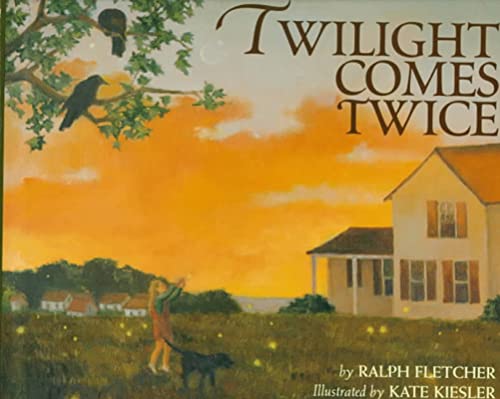
Synopsis
Free-verse text describes the transition from day to night and from night to day, revealing the magic in these everyday moments.
"synopsis" may belong to another edition of this title.
About the Authors
Ralph Fletcher is the author of many well-received books for children, including the novels Fig Pudding and Flying Solo, and the picture books Twilight Comes Twice, Grandpa Never Lies, and Circus Surprise. He lives with his family in New Hampshire. Visit him online at ralphfletcher.com.
Born in New Hampshire and raised in Vermont, Kate Kiesler began painting at an early age. She graduated from the Rhode Island School of Design and now paints and illustrates full-time. Kate paints with oils, and her rich style has been highly praised. Kate Kiesler has illustrated numerous picture books, including The Great Frog Race and Other Poems. She lives in Frisco, Colorado.
Reviews
PreSchool-Grade 2. In spare, poetic prose, Fletcher describes the twilight of mornings and evenings, those two brief times of day that often seem to have magical qualities. He personifies dawn and dusk and uses images and metaphors to evoke their special qualities and events. The full- and double-paged oil paintings depict a suburban community. A young girl and her dog wander through the scenes, adding interest even though they are never mentioned in the text. Various shades of green, orange, and brown are used effectively to show how the colors of things are transformed by twilight. The personification of dawn and dusk seems strained, and the metaphors are sometimes more distracting than illuminating, e.g., dusk "pours/the syrup of darkness/into the forest" and "hisses on the sprinklers." The pictures speak more clearly than the words. Charlotte Zolotow's When the Wind Stops (HarperCollins, 1995) and Jonathan London's I See the Moon and the Moon Sees Me (Viking, 1996) successfully use art and text to convey a sense of the wonder of the natural world.?Virginia Golodetz, St. Michael's College, Winooski, VT
Copyright 1997 Reed Business Information, Inc.
A quietly alluring mood piece that focuses on the twilight times when ``night and day stand whispering secrets before they go their separate ways'' at dawn and dusk. Fletcher (Ordinary Things, p. 460, etc.) finds impressionistic images--``Dusk pours the syrup of darkness into the forest'' and ``dawn erases the stars from the blackboard of night''--that Kiesler makes concrete, by including in her lush, light-drenched paintings a girl and a dog who witness the topical observations of the text. The exploration of how these transitory periods affect the lives of people--from children playing in the park to fishermen casting out in the fading light, from commuters to the girl's family, setting the breakfast table--is achieved through an inclusive sensory range, from dusk's fireflies that swim through air to write ``bright messages in secret code,'' to dawn's smell of doughnuts outside the bakery. Words and art coalesce into an invitation to readers to move beyond the page and into their own explorations of twilight. (Picture book. 4-8) -- Copyright ©1997, Kirkus Associates, LP. All rights reserved.
"About this title" may belong to another edition of this title.
Search results for Twilight Comes Twice: A Beautiful Free-Verse Picture...

Stock Image
Twilight Comes Twice
Seller: World of Books (was SecondSale), Montgomery, IL, U.S.A.
Seller rating 5 out of 5 stars

Hardback. Condition: Good. Kiesler, Kate (illustrator). Free-verse text describes the transition from day to night and from night to day, revealing the magic in these everyday moments. Seller Inventory # 00065327211
Stock Image
Twilight Comes Twice
Seller: World of Books (was SecondSale), Montgomery, IL, U.S.A.
Seller rating 5 out of 5 stars
Hardback. Condition: Very Good. Kiesler, Kate (illustrator). Free-verse text describes the transition from day to night and from night to day, revealing the magic in these everyday moments. Seller Inventory # 00104858137
Stock Image
Twilight Comes Twice: A Beautiful Free-Verse Picture Book Revealing the Magic of Everyday Moments for Kids (Ages 4-7)
Seller: Orion Tech, Kingwood, TX, U.S.A.
Seller rating 5 out of 5 stars
hardcover. Condition: Very Good. Kiesler, Kate (illustrator). Seller Inventory # 0395848261-2-37140340
Stock Image
Twilight Comes Twice: A Beautiful Free-Verse Picture Book Revealing the Magic of Everyday Moments for Kids (Ages 4-7)
Seller: Your Online Bookstore, Houston, TX, U.S.A.
Seller rating 5 out of 5 stars
hardcover. Condition: Very Good. Kiesler, Kate (illustrator). Seller Inventory # 0395848261-2-37317880
Stock Image
Twilight Comes Twice: A Beautiful Free-Verse Picture Book Revealing the Magic of Everyday Moments for Kids (Ages 4-7)
Seller: Gulf Coast Books, Cypress, TX, U.S.A.
Seller rating 5 out of 5 stars
hardcover. Condition: Very Good. Kiesler, Kate (illustrator). Seller Inventory # 0395848261-2-37103310
Seller Image
Twilight Comes Twice: A Beautiful Free-Verse Picture Book Revealing the Magic of Everyday Moments for Kids (Ages 4-7)
Seller: Used Book Company, Egg Harbor Township, NJ, U.S.A.
Seller rating 5 out of 5 stars
Condition: Very Good. Kiesler, Kate (illustrator). Former library copy. Shows minimal signs of wear and previous use. Can include notes/highlighting. A portion of your purchase benefits nonprofits! - Note: Edition & format may differ from what is shown in stock photo & item details. May not include supplementary material such as toys, access code, dvds, etc. Seller Inventory # UBCV.0395848261.VG
Seller Image
Twilight Comes Twice: A Beautiful Free-Verse Picture Book Revealing the Magic of Everyday Moments for Kids (Ages 4-7)
Seller: 3Brothers Bookstore, Egg harbor township, NJ, U.S.A.
Seller rating 5 out of 5 stars
Condition: very_good. Kiesler, Kate (illustrator). Cover may have light wear, pages in very good condition and binding is sturdy; may have other light shelf wear or creases. May have notes or highlighting. Seller Inventory # EVV.0395848261.VG
Seller Image
Twilight Comes Twice: A Beautiful Free-Verse Picture Book Revealing the Magic of Everyday Moments for Kids (Ages 4-7)
Seller: Reliant Bookstore, El Dorado, KS, U.S.A.
Seller rating 5 out of 5 stars
Condition: like_new. Kiesler, Kate (illustrator). This book is in like new condition. Cover image on the book may vary from photo. Ships out quickly in a secure plastic mailer. Seller Inventory # RDV.0395848261.LN
Seller Image
Twilight Comes Twice: A Beautiful Free-Verse Picture Book Revealing the Magic of Everyday Moments for Kids (Ages 4-7)
Seller: Reliant Bookstore, El Dorado, KS, U.S.A.
Seller rating 5 out of 5 stars
Condition: good. Kiesler, Kate (illustrator). This book is in good condition with very minimal damage. This is an ex-library book with stickers and markings. Pages may have minimal notes or highlighting. Cover image on the book may vary from photo. Ships out quickly in a secure plastic mailer. Seller Inventory # RDV.0395848261.G
Seller Image
Twilight Comes Twice: A Beautiful Free-Verse Picture Book Revealing the Magic of Everyday Moments for Kids (Ages 4-7)
Seller: Reliant Bookstore, El Dorado, KS, U.S.A.
Seller rating 5 out of 5 stars
Condition: very_good. Kiesler, Kate (illustrator). This book is in excellent condition. There may be minimal writing on the inside cover or cover page. Cover image on the book may vary from photo. Ships out quickly in a secure plastic mailer. Seller Inventory # RDV.0395848261.VG